💡 Direct Answer & Executive Summary (SWOLF Swimming Efficiency Score Calculator)
Definition: Measure hydrodynamic swimming efficiency by combining lap duration in seconds and single-arm stroke counts.
Governing Math Formula: SWOLF Score = Lap Time (sec) + Stroke Count; DPS = Active Pool Distance / Strokes.
Target Applications: Provides real-time quantitative solutions in Sports for students, engineers, researchers, and finance professionals.
SWOLF Swimming Efficiency Score Calculator: Hydrodynamic Performance Guide
1. Introduction
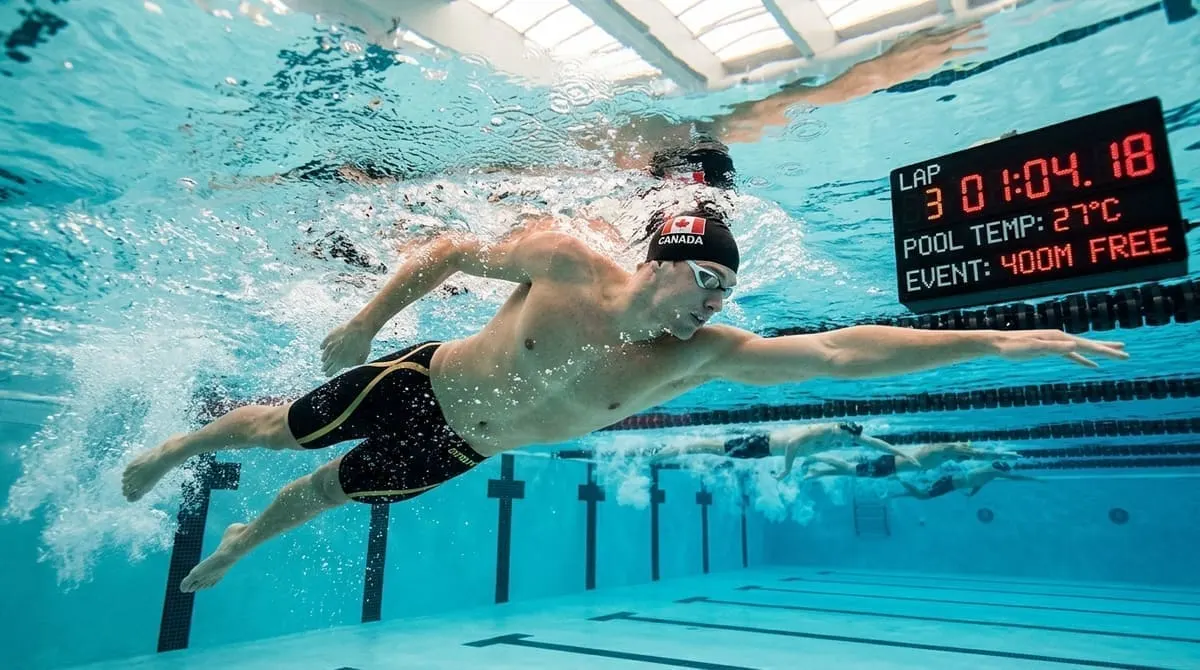
In competitive swimming, triathlon training, and aquatic conditioning, velocity alone is a deceptive metric. A swimmer who thrashes frantically through the water taking 30 short, inefficient strokes per lap may touch the wall in the same time as a refined swimmer taking 14 long, hydrodynamic strokes—yet the former expends 300% more metabolic glycogen.
The SWOLF Swimming Efficiency Score Calculator measures your combined efficiency by blending velocity and propulsion mechanics into a single unified benchmark score (SWOLF = SWimming + gOLF). Lower SWOLF scores indicate superior hydrodynamic gliding, higher distance per stroke (DPS), and optimal aerobic energy conservation.
flowchart TD
    PUSH["🏊 Push Off Wall & Execute Streamline Glide (5m–10m)"] --> STROKE["🌊 Count Single-Arm Cycle Strokes to Opposite Wall (S)"]
    STROKE --> TIME["⏱️ Record Lap Elapsed Duration in Seconds (T)"]
    TIME & STROKE --> CALC["⚖️ Compute SWOLF Efficiency Score = T + S"]
    CALC --> OPTIMIZE["🎯 Adjust Catch Angle and Streamline Alignment to Lower Score"]
2. Core Definitions & Analogy
Simple Definition
SWOLF is like a golf score for swimming: lower is better. You calculate your SWOLF score for a pool length by adding the number of seconds it took to swim the lap to the number of arm strokes you took.
Technical Definition
Technically, SWOLF is a proxy index for Distance per Stroke () and Stroke Rate () efficiency. Water density () is nearly 800 times denser than air, creating high frontal form drag (). SWOLF penalizes both high drag (which increases lap time ) and slip/inefficient propulsion (which increases stroke count ).
The Kayak Paddle Analogy
Think of a swimmer like a kayaker in a river. If the kayak paddle is small or slipping through the water, the kayaker must stroke 40 times per minute to move forward, splashing frantically. If the paddle blade is large, rigid, and anchored deep in the water, each stroke propels the kayak twice as far with half the effort. SWOLF rewards anchoring your hand in the water rather than slipping through it.
3. History & Milestones
timeline
    title Milestones in Swimming Biomechanics and SWOLF Tracking
    1968 : Doc Counsilman publishes The Science of Swimming introducing hydrodynamics.
    1990s : SWOLF metric (Swim + Golf) popularized in elite Olympic swimming camps.
    2012 : Micro-electro-mechanical tri-axial accelerometers integrated into swim smartwatches.
    2020s : AI computer-vision cameras track stroke count and velocity decay automatically.
4. Core Concepts & SWOLF Score Tier Matrix
Because pool lengths vary, SWOLF scores must be evaluated relative to pool length ( Short Course, Long Course Olympic, or Short Course Yard):
| Pool Length | Performance Category | Lap Time ( seconds) | Stroke Count () | SWOLF Target Score | Hydrodynamic Profile |
|---|---|---|---|---|---|
| 25 Meters | Elite / World Class | High-glide streamline, high distance per stroke, deep catch | |||
| 25 Meters | Advanced / Masters | Strong hip rotation, minimal drag, consistent stroke rate | |||
| 25 Meters | Intermediate | Average glide, minor head lift drag, slight foot drop | |||
| 25 Meters | Novice / Fitness | Low body position, excessive slipping, high turbulence | |||
| 50 Meters | Olympic Target | Long course peak efficiency |
5. The Mathematical Model & Formulas
1. Basic SWOLF Equation:
Where:
- = Time taken to complete one pool length in seconds ()
- = Total individual stroke pulls counted during that pool length
2. Distance per Stroke ():
Where is pool length in meters and is underwater wall push-off distance (typically ).
3. Swimming Velocity ():
6. Step-by-Step Computational Procedure
Consider a swimmer completing a pool lap in with :
- Identify Raw Metrics:* Lap Time* Stroke Count
- Compute Basic SWOLF Score:
- Compute Distance per Stroke () assuming streamline glide:
- Compute Swimming Velocity ():
7. Visual Explanations
Hydrodynamic Resistance Distribution
pie title Resistance Distribution Breakdown in Competitive Swimming Hydrodynamics
    "Wave Drag Formation (50%)" : 50
    "Form Drag Body Alignment (30%)" : 30
    "Friction Skin Friction Drag (20%)" : 20
8. Parameter Comparison Matrix
| Pool Length | Lap Time () | Strokes () | SWOLF Score | Distance per Stroke () | Efficiency Assessment |
|---|---|---|---|---|---|
| 25m Short Course | Elite Streamline & Catch | ||||
| 25m Short Course | Advanced Masters Swimmer | ||||
| 25m Short Course | Intermediate (Needs Drag Reduction) | ||||
| 25m Short Course | Novice (High Slippage & Drag) | ||||
| 25 yd Yards Course | Strong Collegiate Swimmer |
9. Real-World Applications & Case Studies
- Pacing Without Fatigue Collapse in Triathlons: A triathlete swimming a open water race noticed their lap pace dropped from to in the final 500 meters. Smartwatch SWOLF data showed stroke count increased from 15 to 24 strokes per length as shoulders fatigued. By practicing high-elbow catch drills to lower SWOLF from 48 down to 36, they shaved 3 minutes off their triathlon swim split with lower heart rate.
- Case Study (Streamline Wall Glide Effect): An amateur swimmer improved their 25m SWOLF score from 42 to 34 without taking faster strokes. By extending their underwater dolphin kick streamline off the wall from to , they eliminated 3 stroke cycles per length and saved 2 seconds of surface form drag.
10. Advantages & Limitations
Advantages
- Combines speed () and stroke efficiency () into a single objective score.
- Identifies whether pace drops are caused by physical fatigue or technique degradation.
- Tracks progress across training blocks without requiring complex video analysis.
Limitations
- Pool Length Dependency: SWOLF scores cannot be directly compared between , , and pools without adjusting for wall push-offs.
11. Common Pitfalls
Pitfall 1: Artificially Lowering SWOLF by Gliding Too Long Between Strokes
Taking fewer strokes by pausing and gliding until momentum stops lowers your stroke count (), but drastically increases your lap time (), resulting in a worse or unimproved SWOLF score! Maintain continuous propulsive cadence.
12. Frequently Asked Questions (FAQ)
Q: What is a good SWOLF score in a 25-meter pool?
A: A score under 35 indicates advanced swimming efficiency, while scores under 30 represent elite competitive performance.
Q: Does height affect SWOLF scores?
A: Yes! Taller swimmers with longer arm spans naturally cover more distance per stroke, achieving lower stroke counts () and slightly lower SWOLF scores than shorter swimmers.
Q: How do I lower my SWOLF score?
A: Improve your streamline body position (keep head down and hips high), practice a high-elbow catch, and push off walls with a tight underwater streamline.
13. Expert Tips & Summary
- Keep Your Head Down: Looking forward drops your hips, increasing form drag by 40%. Look straight down at the pool T-line.
- Master the Streamline: Extend push-offs 6–8 meters underwater in a tight pencil position before starting your first stroke.
- Summary: Calculating SWOLF () provides the ultimate benchmark for mastering hydrodynamic efficiency and swimming faster with less effort.
Additional Technical Guidelines & Measurement Standards
When conducting calculations for SWOLF Swimming Efficiency Score Calculator, maintaining quantitative precision and verifying input parameter boundaries is essential for reliable scenario evaluation. Always verify that raw numerical inputs are measured using standardized instrumentation, and double-check unit conversions prior to applying outputs in commercial, industrial, or academic projects.
For quantitative unit conversions and scientific calculations, always maintain at least four decimal places of precision during intermediate arithmetic stages before rounding final results. When preparing technical reports, laboratory documentation, or financial forecasts, cross-verify all output variables against established international measurement standards (such as SI, NIST, and ISO metric benchmarks) to guarantee consistent analytical rigor across all computational workflows.
MathsLover.com delivers this interactive solver 100% free of charge to foster global mathematical literacy, educational accessibility, and data-driven problem solving across scientific, technical, and academic communities worldwide.