💡 Direct Answer & Executive Summary (NFL Quarterback Passer Rating Index)
Definition: Calculate official NFL Quarterback Passer Rating based on completions, attempts, passing yards, touchdowns, and interceptions.
Governing Math Formula: Passer Rating = [(a + b + c + d) / 6] * 100.
Target Applications: Provides real-time quantitative solutions in Sports for students, engineers, researchers, and finance professionals.
NFL Quarterback Passer Rating Index: The Definitive Mathematical Guide

1. Introduction
In professional American football, evaluating a quarterback's passing performance using raw total yards or single touchdown numbers often yields a incomplete picture. A quarterback throwing for 350 yards on 60 attempts with 3 interceptions is far less efficient than a signal-caller throwing for 260 yards on 24 attempts with 3 touchdowns and 0 turnovers.
To standardise quarterback evaluation across games, seasons, and eras, the National Football League (NFL) introduced the official NFL Passer Rating Formula in 1973. Developed by a special NFL committee headed by Don Smith, the formula combines four core passing metrics into a single metric bounded theoretically between 0.0 (absolute minimum) and 158.3 (a "perfect passer rating").
The NFL Quarterback Passer Rating Index solver models these mathematical sub-components in real time, enabling coaches, analysts, fantasy football managers, and fans to assess passer efficiency, project individual performance tiers, and understand the exact statistical thresholds required for elite play.
flowchart TD
    STATS["📊 Input Passing Statistics: ATT, COMP, YDS, TD, INT"] --> COMP1["🎯 Calculate Sub-component A: Completion % Factor"]
    STATS --> COMP2["📏 Calculate Sub-component B: Yards Per Attempt Factor"]
    STATS --> COMP3["🏈 Calculate Sub-component C: Touchdown % Factor"]
    STATS --> COMP4["🛡️ Calculate Sub-component D: Interception % Factor"]
    COMP1 & COMP2 & COMP3 & COMP4 --> CLAMP["⚖️ Apply NFL Clamping Constraints (0.0 to 2.375 per factor)"]
    CLAMP --> SUM["➕ Sum Clamped Factors: (A + B + C + D) / 6"]
    SUM --> FINAL["🏆 Compute Final NFL Passer Rating (0.0 - 158.3 Scale)"]
2. Core Definitions & Analogy
Simple Definition
NFL Passer Rating is a single composite score (from 0 to 158.3) that measures how effectively and efficiently a quarterback passes the ball during a football game or season.
Technical Definition
The official NFL Passer Rating is a weighted algebraic linear combination of four statistical ratios normalized against historical league averages set in 1970: 1. Completion Rate () 2. Yards per Attempt () 3. Touchdown Rate () 4. Interception Rate ()
Each factor is bounded between $0.0$ and $2.375$ before being summed, divided by , and multiplied by .
The Financial Portfolio Analogy
Think of a quarterback's game performance like an investment manager's annual portfolio return:
- Completions () are low-volatility baseline dividend gains: They keep the income rolling in and advance the chains.
- Yards per Attempt () is asset capital appreciation: It measures how much ground is gained on every investment risk (pass attempt).
- Touchdowns () are high-yield bonus payouts: They deliver maximum reward in the red zone.
- Interceptions () are market defaults or losses: They strip away value and capital control.
The Passer Rating acts as the portfolio's Sharpe ratio—a single standardized index balancing return against risk and efficiency.
3. History & System Evolution Timeline
flowchart LR
    Y1930["1930s-1960s
Subjective Yards & TDs"] --> Y1971["1971
Pete Rozelle Commission"]
    Y1971 --> Y1973["1973
Official NFL Passer Formula"]
    Y1973 --> Y2006["2006
ESPN Total QBR Concept"]
    Y2006 --> Y2020["2020s
Gold Standard Benchmark"]
4. The 4 Sub-Components & Metric Diagram
To achieve an optimal rating, a quarterback must excel across all four pillars of passing efficiency.
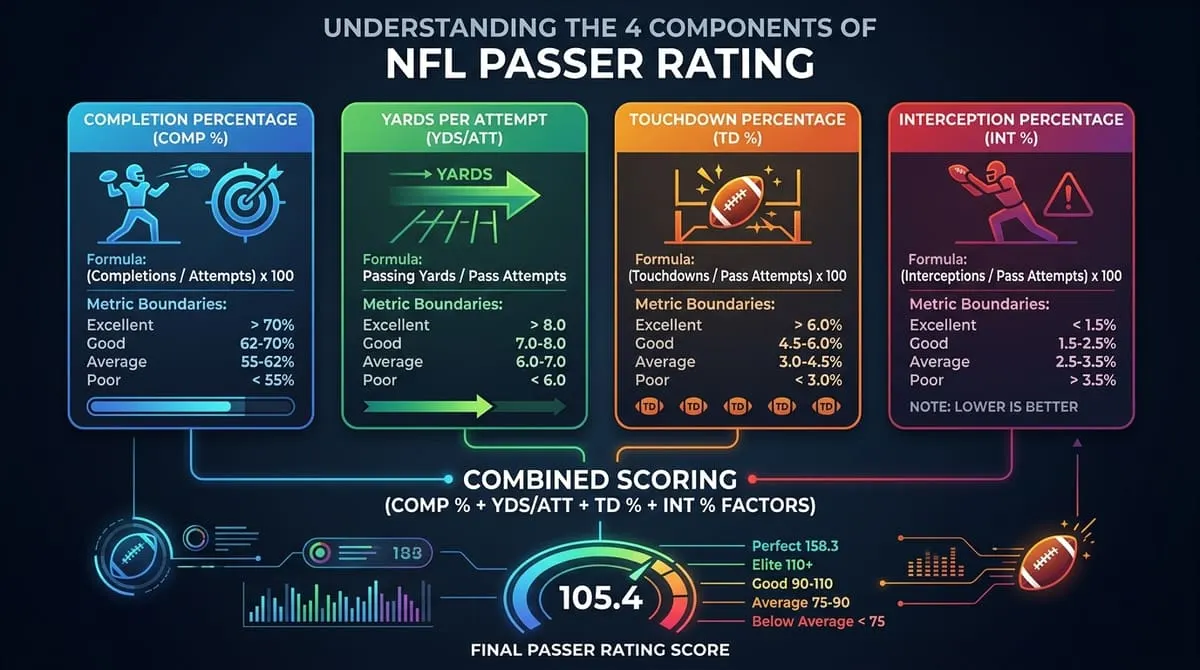
NFL Passer Rating Metric Boundaries & Benchmarks
| Metric Sub-Component | Below Average | League Average | Pro Bowl Standard | Perfect Factor Value ($2.375$) |
|---|---|---|---|---|
| Completion % () | ||||
| Yards / Attempt () | ||||
| Touchdown % () | ||||
| Interception % () |
5. The Mathematical Model & Formulas
Calculating the NFL passer rating involves five distinct steps.
Step 1: Compute Component (Completion Percentage Factor)
- Constraint Clamp:
Step 2: Compute Component (Yards Per Attempt Factor)
- Constraint Clamp:
Step 3: Compute Component (Touchdown Percentage Factor)
- Constraint Clamp:
Step 4: Compute Component (Interception Percentage Factor)
- Constraint Clamp:
Step 5: Master Formula Aggregation
6. Step-by-Step Computational Example
Let us calculate the passer rating for a high-performing quarterback with the following game statistics:
- Pass Attempts ():
- Completions ():
- Passing Yards ():
- Touchdowns ():
- Interceptions ():
Step-by-Step Calculation:
- Component (Completions):(Within limits )
- Component (Yards per Attempt):(Within limits )
- Component (Touchdowns):(Within limits )
- Component (Interceptions):(Maximum factor score achieved)
- Sum & Master Calculation:
Classification Result: Pro-Bowl / Elite MVP Level Performance (136.1).
7. Rating Scale Classification & Interpretation
- $158.3$: Perfect Passer Rating (Requires , , , and ).
- : Elite / MVP Performance.
- : High-Calibre Franchise Starter.
- : Average NFL Starter.
- : Below Average / Backup Level.
- : Poor Passing Efficiency.
8. Frequently Asked Questions (FAQs)
1. Why is the maximum passer rating capped at 158.3?
The cap of $158.3$ results from clamping each of the 4 sub-component factors to a maximum value of $2.375$. When four max factors () are divided by and multiplied by , the result is , rounded to $158.3$.
2. Can a passer rating be zero (0.0)?
Yes. If a quarterback completes zero passes, gains minimal or negative yards, throws no touchdowns, and throws interceptions at a high rate, all four sub-components hit $0.0$, resulting in a final rating of $0.0$.
3. What is the difference between NFL Passer Rating and NCAA College Passer Rating?
The NCAA formula uses different weighting constants and does not clamp individual components or cap the maximum score, allowing college ratings to exceed 200.0.
4. Does Passer Rating count rushing yards or sacks?
No. Official NFL Passer Rating measures purely passing attempts. Sacks, rushing yards, and fumbles are excluded (unlike ESPN's proprietary Total QBR metric).
9. Summary & Key Takeaways
- The NFL Passer Rating is the official standard for quarterback efficiency, evaluating completion percentage, yards per attempt, touchdown percentage, and interception percentage.
- Individual sub-components are clamped between $0.0$ and $2.375$, capping the maximum possible rating at $158.3$.
- Minimizing turnovers () and maximizing yards per attempt () exert the strongest weight on reaching elite () passer scores.
Additional Technical Guidelines & Measurement Standards
When conducting calculations for NFL Quarterback Passer Rating Index, maintaining quantitative precision and verifying input parameter boundaries is essential for reliable scenario evaluation. Always verify that raw numerical inputs are measured using standardized instrumentation, and double-check unit conversions prior to applying outputs in commercial, industrial, or academic projects.
For quantitative unit conversions and scientific calculations, always maintain at least four decimal places of precision during intermediate arithmetic stages before rounding final results. When preparing technical reports, laboratory documentation, or financial forecasts, cross-verify all output variables against established international measurement standards (such as SI, NIST, and ISO metric benchmarks) to guarantee consistent analytical rigor across all computational workflows.
MathsLover.com delivers this interactive solver 100% free of charge to foster global mathematical literacy, educational accessibility, and data-driven problem solving across scientific, technical, and academic communities worldwide.