💡 Direct Answer & Executive Summary (Functional Threshold Power (FTP) Estimator)
Definition: Estimate 1-hour Functional Threshold Power (FTP) from a 20-minute maximum test effort and calculate training intensity zones.
Governing Math Formula: FTP = 20-Minute Max Power * 0.95.
Target Applications: Provides real-time quantitative solutions in Sports for students, engineers, researchers, and finance professionals.
Functional Threshold Power (FTP) Estimator: The Complete Cycling Science Guide
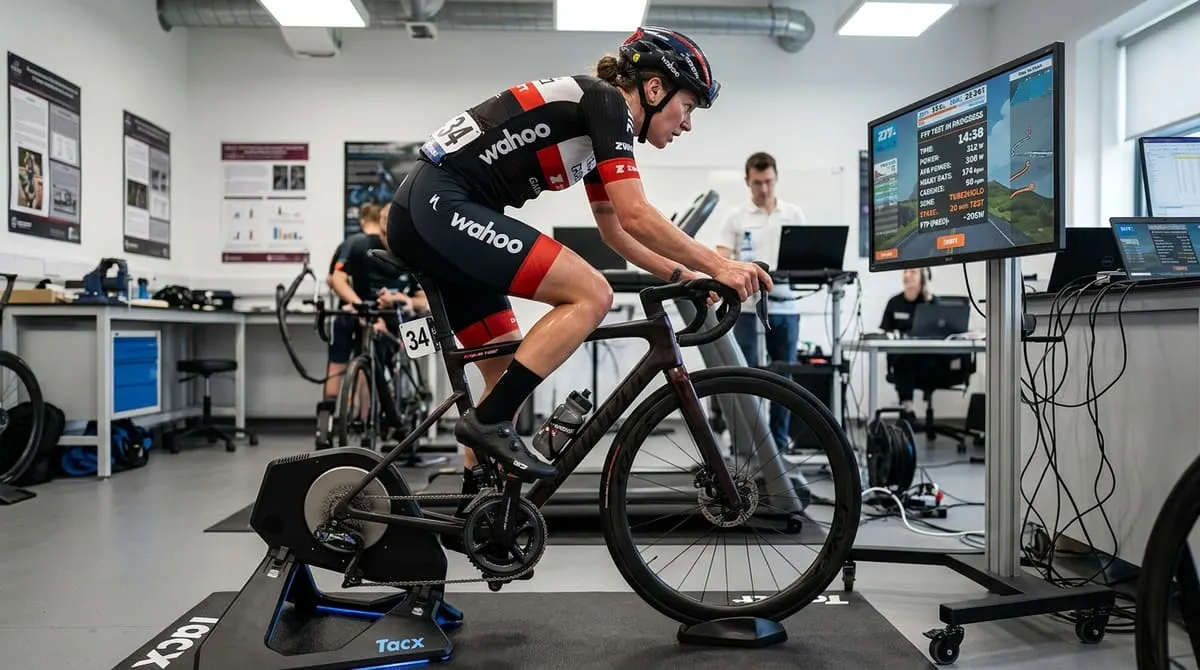
1. Introduction
In modern road cycling, triathlon, and indoor power-meter training (such as Zwift, TrainerRoad, and Wahoo SYSTM), Functional Threshold Power (FTP) is universally recognized as the single most essential metric for structuring training, pacing long distance events, and quantifying endurance fitness improvements.
FTP represents the highest mechanical power output (measured in Watts) that a cyclist can sustain in a quasi-steady state for approximately 60 minutes without experiencing catastrophic neuromuscular exhaustion or overwhelming metabolic acidosis.
While a true 60-minute all-out time trial is mentally and physically brutal to execute regularly, exercise physiologist Dr. Andrew Coggan established the gold-standard field test protocol: performing a max-effort 20-minute power test and applying a 95% correction multiplier ($0.95$).
The Functional Threshold Power (FTP) Estimator automates this evaluation, calculating your 1-hour FTP baseline, power-to-weight ratio (), multi-tier performance categorization, and full 7-zone Coggan power training targets.
flowchart TD
    TEST["🚴 Perform 20-Minute Max Effort Test on Power Meter / Smart Trainer"] --> P20["⚡ Measure Average 20-Minute Power Output (Watts)"]
    P20 --> SCALE["🧮 Apply 95% Anaerobic Work Capacity Correction Factor (P20 x 0.95)"]
    SCALE --> FTP["📊 Calculate 1-Hour Functional Threshold Power (FTP)"]
    FTP --> WKG["⚖️ Compute Power-to-Weight Ratio: FTP (Watts) / Rider Mass (kg)"]
    WKG --> ZONES["🎯 Map Coggan 7-Zone Power Training Targets"]
2. Core Definitions & Analogy
Simple Definition
FTP (Functional Threshold Power) is the maximum wattage you can push on your pedals for an hour non-stop. It is your cycling "cruise control ceiling."
Technical Definition
FTP marks the maximal lactate steady state (MLSS)—the highest exercise intensity at which blood lactate clearance matches blood lactate production rate. Beyond FTP, hydrogen ions () and lactate accumulate exponentially, forcing muscular fatigue and rapid power decline within minutes.
The Hourglass & Water Basin Analogy
Imagine a large water basin with a drainage pipe at the bottom:
- Water flowing into the basin represents metabolic lactate production: The harder you pedal, the faster the faucet opens.
- The drainage pipe represents your liver and muscular lactate clearance system: It drains lactate out of your bloodstream at a steady rate.
- FTP is the exact faucet flow rate where water level stays completely still: You are producing lactate at the exact maximum rate that your body can clear it.
- Pedaling above FTP opens the faucet too wide: Water overflows the basin rapidly, forcing you to stop or slow down dramatically.
3. History & Physiological Milestones
flowchart LR
    Y1980["1980s
First Mobile SRM Power Meters"] --> Y2000["2000s
Hunter Allen & Andrew Coggan Book"]
    Y2000 --> Y2006["2006
20-Min Test & 95% Multiplier Standard"]
    Y2006 --> Y2015["2015+
Smart Trainers & Indoor Virtual Riding"]
    Y2015 --> Y2020["2020s
Ramp Tests & AI Power Profiling"]
Dr. Andrew Coggan and Hunter Allen introduced the standardized -minute testing protocol in their seminal book "Training and Racing with a Power Meter". They demonstrated that an athlete's 20-minute maximal power output overestimates 60-minute threshold power by approximately 5%, due to anaerobic energy storage contribution during the shorter test.
4. Coggan 7-Zone Power Architecture
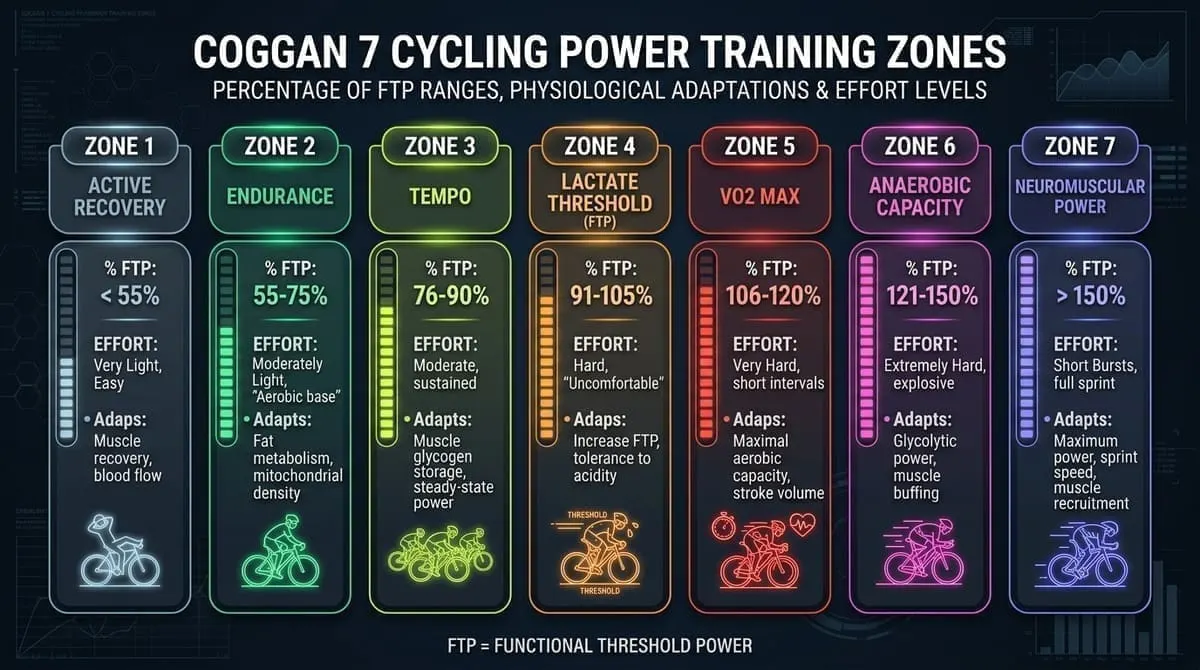
Coggan 7 Cycling Power Training Zones
| Zone ID | Zone Name | % of FTP Threshold | Primary Physiological Adaptation | Effort Perception (RPE 1–10) |
|---|---|---|---|---|
| Zone 1 | Active Recovery | Muscle recovery, blood circulation | (Very Easy) | |
| Zone 2 | Endurance (Base) | Mitochondrial density, fat oxidation | (Comfortable, conversational) | |
| Zone 3 | Tempo | Glycogen storage capacity, steady pace | (Moderate effort) | |
| Zone 4 | Lactate Threshold | FTP increase, lactate clearance | (Hard, "uncomfortable") | |
| Zone 5 | Maximal aerobic capacity, stroke volume | (Very hard, 3–8 min intervals) | ||
| Zone 6 | Anaerobic Capacity | Glycolytic power, muscle buffering | (Severe, 30s–2 min bursts) | |
| Zone 7 | Neuromuscular Power | Maximum sprint velocity, fast-twitch recruitment | All-Out Maximal Sprint () |
5. The Mathematical Model & Formulas
1. Primary FTP Calculation Formula:
Where:
- = Average mechanical power output (Watts) recorded during a 20-minute all-out test effort.
- $0.95$ = Anaerobic work capacity adjustment coefficient (95%).
2. Power-to-Weight Ratio ():
3. Coggan Zone Range Calculation:
6. Step-by-Step Computational Example
Let us work through a complete FTP calculation for a cyclist:
Rider Profile:
- Rider Body Weight (): ()
- 20-Minute Test Average Power ():
Step-by-Step Calculation:
- Step 1: Compute 1-Hour Estimated FTP
- Step 2: Calculate Relative Power-to-Weight Ratio ()
- Step 3: Derive Individual Training Power Zones* Zone 1 (Active Recovery, ):* Zone 2 (Endurance Base, ):* Zone 3 (Tempo, ):* Zone 4 (Lactate Threshold, ):* Zone 5 (, ):* Zone 6 (Anaerobic Capacity, ):
- Step 4: Rider Category ClassificationAt , this cyclist ranks in the Category 3 / Advanced Competitive Amateur division ().
7. Performance Category Benchmark Standards ()
- WorldTour Professional Elite: (Male) / (Female)
- Category 1 / Semi-Pro:
- Category 3 / Advanced Amateur:
- Category 5 / Club Rider:
- Recreational / Beginner:
8. Frequently Asked Questions (FAQs)
1. Why do we multiply the 20-minute test power by 0.95?
A 20-minute effort relies partially on non-oxidative anaerobic energy reserves (ATP-CP and anaerobic glycolysis). Multiplying by $0.95$ subtracts this short-term anaerobic contribution to accurately estimate purely sustainable 1-hour aerobic threshold power.
2. What is the difference between an FTP test and a Ramp test?
A 20-minute test measures sustained pace pacing, whereas a Ramp test increases resistance by 15–20 Watts every minute until muscular failure, taking 75% of the peak 1-minute power as estimated FTP.
3. How often should I test my FTP?
Test every 6 to 8 weeks at the end of a dedicated training block (such as base or build phases) to adjust your power training target zones.
4. Is FTP more important than absolute total Watts?
On flat terrain, total absolute Watts determine speed against aerodynamic drag. However, on steep hill climbs, relative power-to-weight ratio () is the primary predictor of climbing performance.
9. Summary & Key Takeaways
- FTP is the maximum power in Watts you can sustain for 1 hour without overwhelming lactate accumulation.
- The standard 20-minute power test calculates FTP using the formula .
- Dividing FTP by body mass () allows accurate performance comparison across light and heavy riders.
- Training within the 7 Coggan power zones ensures targeted physiological adaptations from Zone 2 endurance base to Zone 4 threshold development.
Additional Technical Guidelines & Measurement Standards
When conducting calculations for Functional Threshold Power (FTP) Estimator, maintaining quantitative precision and verifying input parameter boundaries is essential for reliable scenario evaluation. Always verify that raw numerical inputs are measured using standardized instrumentation, and double-check unit conversions prior to applying outputs in commercial, industrial, or academic projects.
For quantitative unit conversions and scientific calculations, always maintain at least four decimal places of precision during intermediate arithmetic stages before rounding final results. When preparing technical reports, laboratory documentation, or financial forecasts, cross-verify all output variables against established international measurement standards (such as SI, NIST, and ISO metric benchmarks) to guarantee consistent analytical rigor across all computational workflows.
MathsLover.com delivers this interactive solver 100% free of charge to foster global mathematical literacy, educational accessibility, and data-driven problem solving across scientific, technical, and academic communities worldwide.