💡 Direct Answer & Executive Summary (Calories Burned Cycling & Biking Calculator)
Definition: Calculate total caloric expenditure (kcal) during cycling rides based on rider weight, duration, and speed intensity MET ratings.
Governing Math Formula: Calories (kcal) = Duration (hours) * MET * Body Weight (kg).
Target Applications: Provides real-time quantitative solutions in Sports for students, engineers, researchers, and finance professionals.
Calories Burned Cycling & Biking Calculator: The Complete Metabolic Guide
1. Introduction
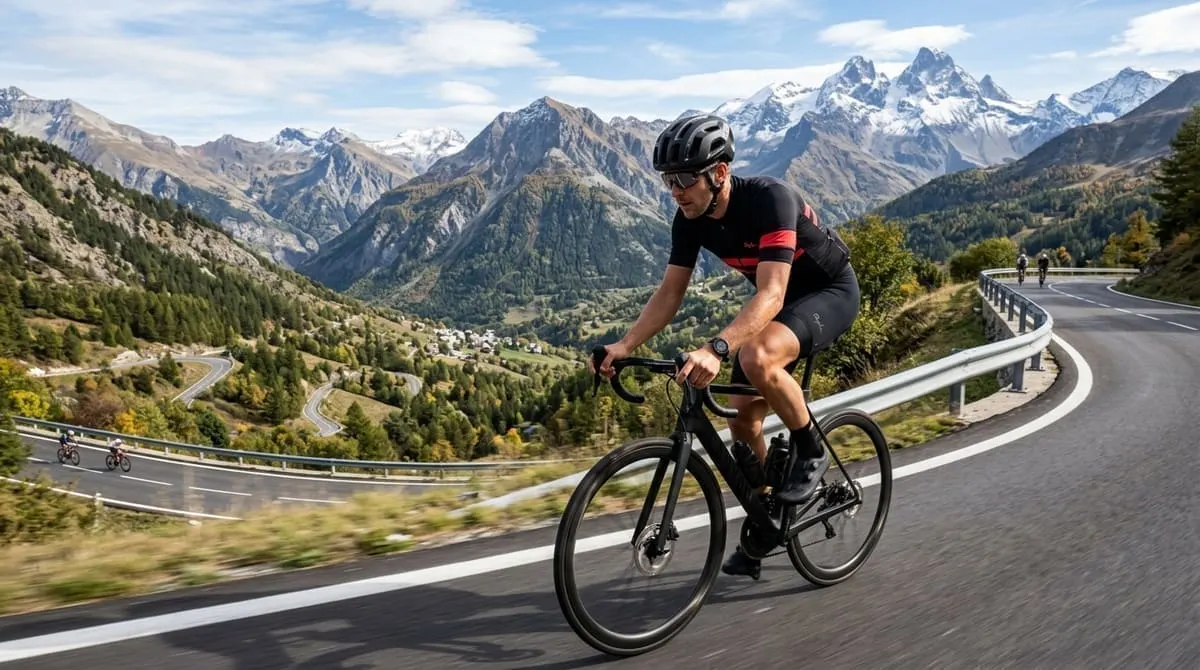
Cycling—whether outdoor road biking, mountain biking, indoor smart-trainer riding, or casual urban commuting—is one of the most effective aerobic exercises for burning calories, improving cardiovascular health, and managing body weight.
However, calculating exact caloric expenditure () during a ride can be challenging. A light leisure ride at burns significantly fewer calories per minute than climbing an 8% alpine incline or racing at . Energy expenditure depends directly on rider body mass, ride duration, and exercise intensity measured in METs (Metabolic Equivalent of Task) or direct mechanical power output in Watts.
The Calories Burned Cycling & Biking Calculator provides precise mathematical estimates of total energy expenditure, burning rate per minute, and equivalent food reward benchmarks based on standardized Compendium of Physical Activities MET ratings and mechanical efficiency formulas.
flowchart TD
    INPUTS["🚴 Input Rider Mass (kg/lbs), Duration (Mins), Speed / MET Level"] --> MET["⚡ Lookup MET Rating: 4.0 (Leisure) to 15.0 (Race Pace)"]
    MET --> FORMULA["🧮 Apply MET Equation: kcal = Hours x MET x Body Weight (kg)"]
    FORMULA --> WATTS["⚙️ Compute Mechanical Power Equivalent (Kilojoules & Watts)"]
    WATTS --> OUTPUTS["📊 Output Total Calories (kcal), Burn Rate (kcal/min), MET Intensity"]
2. Core Definitions & Analogy
Simple Definition
This calculator measures how many calories (kcal) your body burns while riding a bicycle based on how heavy you are, how long you ride, and how fast you pedal.
Technical Definition
Caloric expenditure during cycling is calculated using the Metabolic Equivalent of Task () rating system standardized by the Compendium of Physical Activities. One is defined as the resting metabolic rate of oxygen consumption (, or ). Cycling MET ratings range from (leisurely ) to (racing ). Alternatively, when mechanical power is measured by a power meter in Watts, gross energy expenditure () is derived assuming a human metabolic efficiency ($\eta$) of approximately .
The Furnace Fuel Consumption Analogy
Think of your body like an industrial wood-burning furnace:
- Your body mass is the size of the furnace room: A larger furnace (80 kg rider) requires more baseline wood (calories) to keep warm than a small stove (50 kg rider).
- Speed and incline act as the air blower setting: Riding at a leisurely 10 mph opens the vent slightly, consuming wood slowly. Switching to a fast 20 mph pace turns on high-pressure blowers, consuming logs (calories) at a blistering rate.
- The MET score is the furnace's heat output rating: It tells you how many times more fuel is being burned per minute compared to when the furnace is idling at rest.
3. History & Research Milestones
flowchart LR
    Y1950["1950s
First Douglas Bag Gas Analysis"] --> Y1993["1993
Ainsworth publishes 1st Physical Activity Compendium"]
    Y1993 --> Y2011["2011
Updated Compendium Cycling MET Standards"]
    2011 --> Y2020["2020s
Power-Meter & Smartwatch Real-Time Calorie Sync"]
Dr. Barbara Ainsworth's Compendium of Physical Activities (first published in 1993 and updated in 2011) established standardized MET values for dozens of cycling modalities—from stationary cycling to mountain biking and competitive road racing.
4. MET Intensity Ratings & Speed Comparison
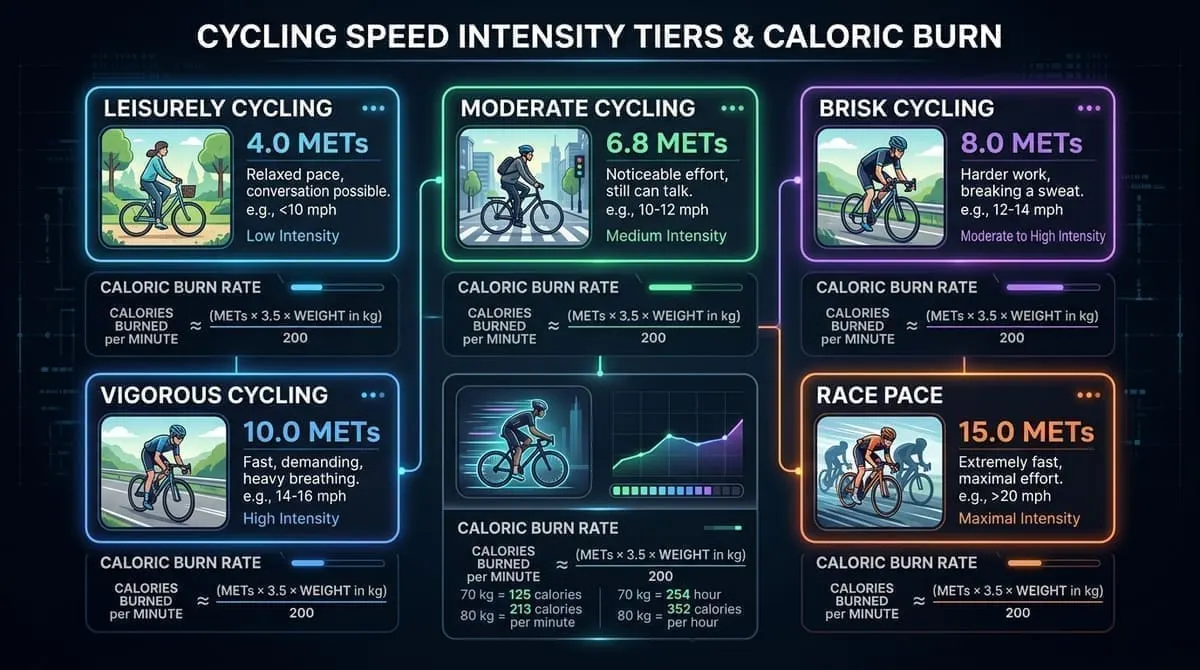
Standard Cycling Intensity & MET Reference Matrix
| Riding Speed & Modality | MET Rating | Caloric Burn Rate ( Rider) | Caloric Burn Rate ( Rider) | Effort Perception (RPE 1-10) |
|---|---|---|---|---|
| Leisurely / Casual () | () | () | (Very Light) | |
| Moderate Pace () | () | () | (Moderate) | |
| Brisk Pace () | () | () | (Brisk Effort) | |
| Vigorous Effort () | () | () | (Vigorous Work) | |
| Very Fast Effort () | () | () | (Very Hard) | |
| Race Pace Effort () | () | () | (All-Out Race Pace) |
5. The Mathematical Model & Formulas
1. Primary MET Calorie Equation:
Where:
- = Metabolic Equivalent of Task rating for the selected riding intensity.
- = Rider body mass in kilograms ().
2. Caloric Burn Rate per Minute:
3. Mechanical Power (Watts) Energy Formula (Power Meter Method):
(Assuming human gross mechanical efficiency , of mechanical bike work requires approximately of gross metabolic energy expenditure).
6. Step-by-Step Computational Example
Let us work through a sample calculation step-by-step:
Rider Profile:
- Body Mass (): ()
- Ride Duration (): ()
- Target Speed & Intensity: Brisk Pace (), corresponding to .
Step-by-Step Calculation:
- Step 1: Convert Duration to Hours
- Step 2: Apply the MET Calorie Formula
- Step 3: Calculate Caloric Burn Rate per Minute
- Step 4: Mechanical Work EquivalentA expenditure during a 1-hour ride corresponds to maintaining an average mechanical power output of approximately on the pedals.
7. Factors Influencing Cycling Caloric Burn
- Aerodynamic Drag: Air resistance increases quadratically with speed. Biking at requires nearly 8 times more aerodynamic power than biking at .
- Hill Incline Grade: Climbing against gravity multiplies mechanical work exponentially, increasing MET expenditure.
- Rider Body Weight: Heavier riders burn more calories moving their own body mass over distance.
- Drafting in a Group: Riding behind another cyclist reduces air drag by up to , reducing caloric burn at identical speeds.
8. Frequently Asked Questions (FAQs)
1. Are cycling calorie estimates accurate on smartwatches?
GPS smartwatches using wrist heart-rate sensors typically estimate calories within accuracy. Pairing a direct pedal or crank power meter provides the gold standard accuracy within .
2. Does indoor stationary cycling burn the same calories as outdoor road cycling?
Yes, if pedaling at the same mechanical power output or heart rate intensity. However, outdoor riding involves headwinds and terrain changes, whereas indoor riding lacks natural cooling wind.
3. How many calories do I need to burn to lose 1 pound of fat?
Burning approximately 3,500 calories creates a energy deficit equivalent to 1 pound () of body fat. A 70 kg rider cycling 6 hours at moderate intensity () burns ~2,850 kcal.
4. Why does riding faster burn exponentially more calories?
Aerodynamic drag force equation () dictates that power required to overcome air resistance scales with the cube of velocity (). Doubling speed requires 8 times the aerodynamic power.
9. Summary & Key Takeaways
- Cycling caloric expenditure is calculated using the formula .
- Riding intensity ranges from () to ( race pace).
- Because aerodynamic drag increases exponentially with speed, riding faster dramatically raises calorie burn rates per minute.
Additional Technical Guidelines & Measurement Standards
When conducting calculations for Calories Burned Cycling & Biking Calculator, maintaining quantitative precision and verifying input parameter boundaries is essential for reliable scenario evaluation. Always verify that raw numerical inputs are measured using standardized instrumentation, and double-check unit conversions prior to applying outputs in commercial, industrial, or academic projects.
For quantitative unit conversions and scientific calculations, always maintain at least four decimal places of precision during intermediate arithmetic stages before rounding final results. When preparing technical reports, laboratory documentation, or financial forecasts, cross-verify all output variables against established international measurement standards (such as SI, NIST, and ISO metric benchmarks) to guarantee consistent analytical rigor across all computational workflows.
MathsLover.com delivers this interactive solver 100% free of charge to foster global mathematical literacy, educational accessibility, and data-driven problem solving across scientific, technical, and academic communities worldwide.