💡 Direct Answer & Executive Summary (Velocity, Distance & Time Solver)
Definition: Compute values for Velocity, Distance & Time Solver in standard SI units physics.
Governing Math Formula: Physical equation system model for Velocity, Distance & Time Solver.
Target Applications: Provides real-time quantitative solutions in Physics & Engineering for students, engineers, researchers, and finance professionals.
Velocity, Distance & Time ()
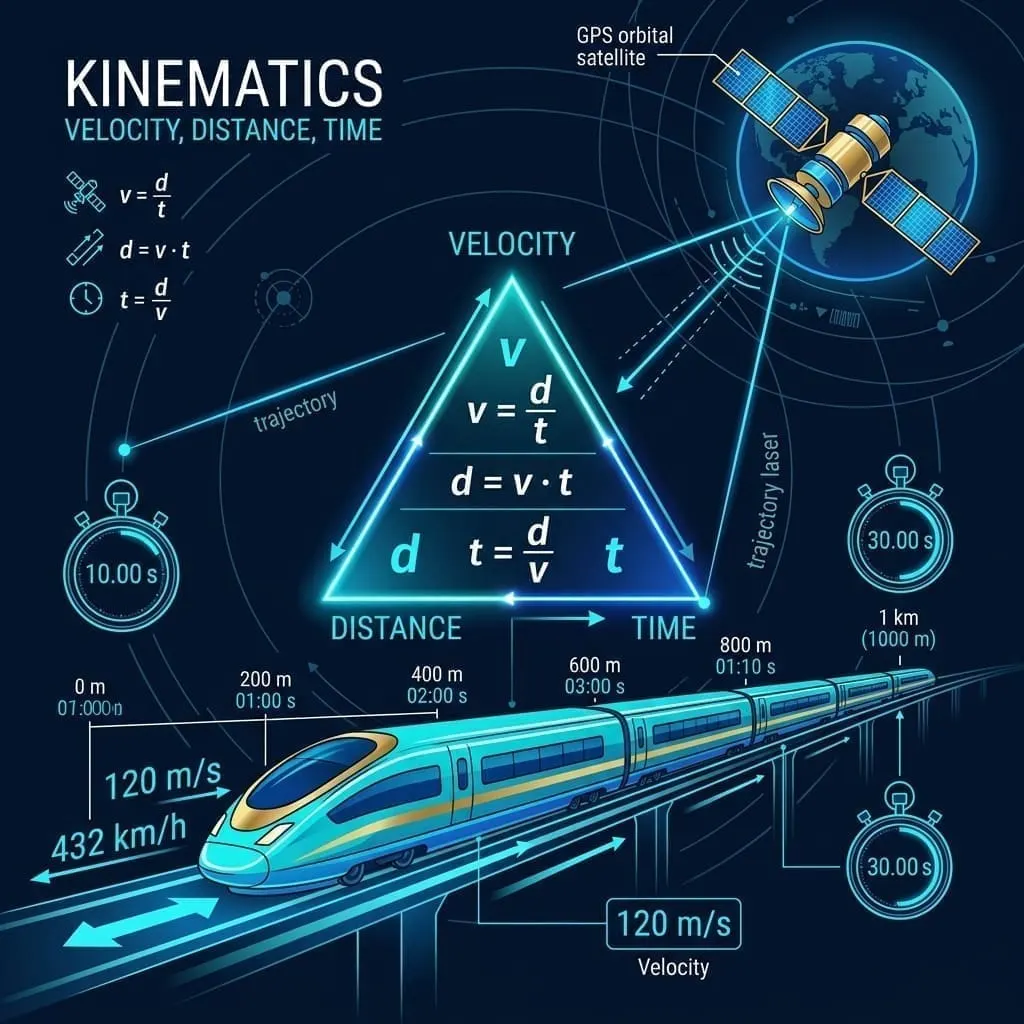
1. Introduction
From the millimeter-per-second crawl of tectonic continental drift to the orbital velocity of the International Space Station, the relentless flow of physical reality is defined by matter traversing space across time.
At the foundational origin of all classical mechanics, navigation, astronomy, robotics, ballistics, and aerospace engineering lies the fundamental kinematic relationship linking Displacement/Distance (), Time Elapsed (), and Velocity/Speed ().
graph LR
    D["📏 Distance / Displacement (d)
Traversed Length in Meters (m)"] --> DIV["➗ Divided By"]
    T["⏱️ Time Duration (t)
Elapsed Seconds (s)"] --> DIV
    DIV --> V["🚀 Velocity / Speed (v)
Rate of Motion: v = d / t (m/s)"]
    V --> CONV["🔄 Unit Normalization
km/h, mph, knots, ft/s"]
Mastering velocity, distance, and time calculations allows engineers, navigators, athletes, and students to:
- Program autonomous drone and self-driving vehicle pathfinding algorithms with real-time waypoint arrival estimation.
- Calculate flight plans, fuel consumption rates, and wind-drift crab angles in commercial aviation.
- Analyze sports performance, sprint biomechanics, and vehicular braking stopping distances.
- Coordinate Global Positioning System (GPS) satellite trilateration using the constant speed of light ().
- Model orbital mechanics, interplanetary transit burn times, and space probe flyby trajectories.
2. Definitions & Analogies
2.1 The Simple Definition
In simple everyday terms:
- Distance () is "how far you traveled" along a path.
- Time () is "how long it took" to complete that journey.
- Speed () is "how fast you moved" on average ().
- If you travel in , your average speed is . If you know your speed and travel time, you can find how far you'll go (); if you know the distance and speed, you can predict your arrival time ().
2.2 The Formal Technical Definition
Scalar vs. Vector Distinctions
In physics and vector calculus, motion is rigorously separated into scalar and vector counterparts:
graph TD
    subgraph Scalar_Domain ["🟢 Scalar Quantities (Magnitude Only)"]
        Distance["Distance (d / s)
Total length of path traveled (always ≥ 0)"]
        Speed["Speed (v or s)
Rate of distance coverage: s = d / t"]
    end

    subgraph Vector_Domain ["🔵 Vector Quantities (Magnitude + Direction)"]
        Displacement["Displacement (Δr or s⃗)
Shortest straight-line vector from origin to finish"]
        Velocity["Velocity (v⃗)
Time-rate of displacement change: v⃗ = d(r⃗)/dt"]
    end

    Distance -.->|"Magnitude of Path"| Speed
Displacement -.->|"Vector Derivative"| Velocity- Distance () vs. Displacement ():- Distance (): A scalar quantity measuring the cumulative length of the total physical path traversed.- Displacement (): A vector pointing directly from the initial starting point to the final ending point : .
- Average Speed () vs. Average Velocity ():- Average Speed: (Scalar, ).- Average Velocity: (Vector, ).
- Instantaneous Velocity ():The first time-derivative of the position vector as elapsed time approaches zero ():
2.3 The Odometer vs. Compass Heading Analogy
To visualize the distinction intuitively, consider a car driving on a circular racetrack:
- The Odometer (Scalar Distance & Speed): When the car completes one full lap in , the odometer increases by . The average speed is ().
- The GPS Displacement & Velocity (Vector): Because the car returned to the exact starting line, its net displacement is . Therefore, its average velocity over the lap is identically ! While instantaneous velocity pointed tangent to the curve at every second, the net directional transport over the full cycle was zero.
3. History & Milestones in Kinematics
timeline
    title Milestones in Kinematics & Motion Measurement
    350 BCE : Aristotle attempts qualitative physics of motion (erroneous drag models)
    1350s : Merton College Calculators derive the Mean Speed Theorem (Oxford)
    1638 : Galileo Galilei publishes 'Two New Sciences' establishing modern kinematics
    1687 : Sir Isaac Newton invents calculus to define instantaneous velocity (v = dr/dt)
    1879 : Speed of Light measured precisely by Albert Michelson using rotating mirrors
1905 : Albert Einstein unifies spacetime with the invariant speed limit of light (c)- Merton College & The Mean Speed Theorem (14th Century): Oxford scholars William Heytesbury and Richard Swineshead proved mathematically that a body undergoing uniform acceleration covers the exact same distance as a body moving at constant speed equal to the arithmetic average of initial and final velocities ().
- Galileo Galilei's Scientific Revolution (1638): In Discourses and Mathematical Demonstrations Relating to Two New Sciences, Galileo rejected Aristotelian philosophy, using water clocks and inclined planes to prove that distance covered under constant gravitational acceleration scales with the square of time ().
- Newton & Leibniz Calculus (1687): Sir Isaac Newton and Gottfried Wilhelm Leibniz independently developed differential calculus, rigorously establishing velocity as the tangent slope of the position-time curve () and acceleration as the curvature derivative ().
- Einstein's Special Relativity (1905): Einstein proved that classical velocity addition () breaks down near relativistic speeds, establishing the speed of light in vacuum () as the ultimate cosmic speed barrier.
4. Core Concepts & Parameters Explained
4.1 Distance & Displacement ( or $\Delta x$)
- Definition: The spatial interval traversed by a body.
- SI Unit: Meter ().
- Common Units & Conversions:----
4.2 Elapsed Time Duration ( or $\Delta t$)
- Definition: The temporal duration between initial and final event timestamps ().
- SI Unit: Second ().
- Conversions:---
4.3 Velocity & Speed ()
- Definition: The rate of change of position with respect to time.
- SI Unit: Meters per second ().
- Master Speed Conversion Factors:
| Unit Name | Symbol | Equivalent in | Equivalent in | Equivalent in |
|---|---|---|---|---|
| Meters per Second (SI Base) | $1.0000$ | $3.6000$ | $2.2369$ | |
| Kilometers per Hour | $0.2778$ | $1.0000$ | $0.6214$ | |
| Miles per Hour (Imperial) | $0.4470$ | $1.6093$ | $1.0000$ | |
| Knots (Nautical) | $0.5144$ | $1.8520$ | $1.1508$ | |
| Feet per Second | $0.3048$ | $1.0973$ | $0.6818$ | |
| Mach 1 (at sea level, ) | $340.3$ | $1,225.0$ | $761.2$ | |
| Speed of Light () | $299,792,458$ |
5. The Kinematic Formula Triangle & Matrix
graph TD
    subgraph Triangle ["🔺 Kinematic Formula Triangle"]
        D["Distance (d)"]
        V["Velocity (v)"]
        T["Time (t)"]
        D --- V
        D --- T
        V --- T
    end
5.1 Master Equation Formulations
| Desired Variable | Primary Formula | Given Imperial Units | Given SI Units |
|---|---|---|---|
| Velocity / Speed () | |||
| Distance Traversed () | |||
| Duration Elapsed () |
5.2 The Harmonic Mean for Multi-Leg Journey Speeds
A notorious trap in physics is calculating average speed when traveling the same distance at two different speeds:
If you drive to a destination at and return along the exact same route at , your average speed is NOT ! Because you spend more time driving at the slower speed, the true average speed is the Harmonic Mean:
6. Step-by-Step Computational Procedure
Follow this systematic 4-step engineering protocol to solve kinematics problems:
flowchart TD
    S1["Step 1: Identify Known & Target Variables
(Classify Distance d, Time t, Velocity v, or Heading Vector)"] --> S2["Step 2: Normalize Units to Consistent System
(Convert hours -> seconds, km -> m, mph -> m/s)"]
    S2 --> S3["Step 3: Select Governing Formula
(Apply v = d/t, d = v·t, or t = d/v)"]
    S3 --> S4["Step 4: Compute Output & Verify Physical Reality
(Check speed limits, unit prefixes, and dimensional consistency)"]
7. Practical Real-World Calculation Examples
Example 1: Commercial Transcontinental Jet Flight
- Scenario: A Boeing 787 Dreamliner flies non-stop from Los Angeles to New York () with an elapsed gate-to-gate flight time of .
- Average Speed Calculation:
Example 2: Olympic 100-Meter Sprint World Record
- Scenario: Usain Bolt set the 100-meter world record in Berlin (2009) with a time of .
- Average Velocity:
- Peak Instantaneous Velocity: During the 60m–80m split, Bolt covered in , reaching a peak velocity of:
Example 3: Space Station Orbital Velocity & Period
- Scenario: The International Space Station (ISS) orbits at an average altitude of above Earth (). Orbit radius . Circular orbit distance . Orbital speed is .
- Time Duration to Complete One Full Orbit ():
Example 4: Fiber Optic Internet Signal Latency
- Scenario: A financial trading firm sends a transaction packet between Chicago and London () via undersea transatlantic fiber optic cable. The speed of light in silica glass optical fiber is .
- One-Way Transit Latency ():
Example 5: High-Speed Maglev Train Trip Planning
- Scenario: A maglev bullet train cruises at constant speed . Determine the distance covered in .
- Distance Calculation:
8. Real-World Engineering Case Studies
Case Study 1: GPS Satellite Trilateration & Relativity Time Corrections
- System Background: The Global Positioning System (GPS) consists of 31 satellites orbiting at altitude at velocities of . Each satellite broadcasts atomic clock radio signals at the speed of light ().
- Kinematic Trilateration Principle: A GPS smartphone measures the exact microsecond arrival time difference ($\Delta t$) of radio signals from 4 satellites:
- Relativistic Velocity & Gravitational Offset:- Special Relativity (Speed): Because satellites move at , time dilation causes onboard atomic clocks to tick slower by .- General Relativity (Gravity): Because satellites are high above Earth's gravity well, clocks tick faster by .- Net Offset: Clocks run fast by .
- Impact of Ignoring Time Precision: If uncorrected, a timing drift of () would cause location errors to accumulate at:Engineers pre-program satellite clocks to tick at instead of , ensuring pinpoint navigation accuracy within centimeters worldwide.
Case Study 2: Aviation Wind Triangles & Groundspeed Navigation
- Flight Scenario: An aircraft flies on a true heading of Due East () at a True Airspeed () of over a route distance of . It encounters a direct crosswind of from Due South ().
- Vector Velocity Analysis:
graph LR
      A["✈️ True Airspeed Vector: 450 kn East"] --> RES["🧭 Resultant Ground Track"]
W["💨 Wind Vector: 50 kn North"] --> RES- Calculations:- Resultant Groundspeed:
- Wind Drift Angle (Crab Angle):
- Trip Duration:
- Flight Management Outcome: The autopilot crabs the nose into the wind, maintaining the desired ground track across waypoints without drift.
9. Common Mistakes & How to Avoid Them
Mistake 1: Arithmetic Averaging of Multi-Leg Speeds
Assuming that averaging and over equal distances gives . Always compute total distance divided by total elapsed time () or use the harmonic mean.
Mistake 2: Mixing Minutes and Hours in Conversions
Entering as instead of (). This introduces an instant 13.3% error into every downstream calculation!
Mistake 3: Confusing Speed with Velocity Vectors
Forgetting that velocity requires a directional sign or vector component. A car traveling and a car traveling have identical speeds (), but opposite velocities ( vs. ).
10. Frequently Asked Questions (FAQ)
Q1: What is the fundamental difference between speed and velocity?
A: Speed is a scalar quantity measuring magnitude only (how fast an object covers distance, always non-negative). Velocity is a vector quantity measuring both magnitude and spatial direction (the rate of change of position).
Q2: Why is the speed of light () constant in all reference frames?
A: According to Einstein's Postulates of Special Relativity and Maxwell's Equations, electromagnetic waves propagate at in a vacuum. Regardless of how fast an observer is moving, light always measures exactly , causing time and space to dilate instead.
Q3: What is instantaneous velocity vs. average velocity?
A: Average velocity is total displacement divided by total time () over a finite interval. Instantaneous velocity is the precise velocity at an infinitesimal instant in time, calculated as the mathematical derivative or read directly on a vehicle's speedometer.
Q4: How do you convert to instantly in your head?
A: Multiply the value by $3.6$ (or multiply by and divide by ). For example: . To convert back to , divide by $3.6$.
Q5: Can an object have zero average velocity but non-zero average speed?
A: Yes! Any object that departs a location and returns to the exact same starting point (like running a lap around a track, or a round-trip road trip) has a net displacement of zero (), meaning average velocity is strictly , even if its average speed was .
Q6: What is Mach number in aerodynamics?
A: Mach number () is the ratio of an object's flow velocity () to the local speed of sound () in the surrounding fluid medium: . At sea level standard temperature (), Mach 1 is approximately .
Q7: What is escape velocity from Earth?
A: Escape velocity is the minimum speed required for an unpropelled ballistic projectile to overcome Earth's gravitational pull without further thrust: .
Q8: What is terminal velocity?
A: Terminal velocity is the steady maximum speed achieved by a falling object when the upward aerodynamic drag force () equals the downward gravitational force (). For a belly-to-earth human skydiver, terminal velocity is approximately .
11. Expert Tips & Best Practices
- Convert All Inputs to SI Base Units First: Always standardize distances to meters () and times to seconds () before evaluating formulas to avoid unit cancellation errors.
- Use Decimal Hours for Trip Planning: When converting minutes to hours, divide minutes by 60: .
- Always Check Vector Components in 2D Motion: When analyzing crosswinds, boat river crossings, or orbital trajectories, decompose velocities into independent and orthogonal components () before adding.
12. Summary & Key Takeaways
- Fundamental Formula Triangle: , , and .
- Scalar vs. Vector: Speed is scalar (magnitude only); velocity is vector (speed plus directional heading).
- Unit Scaling: .
- Multi-Leg Caution: Average speed over multiple equal distance legs must be calculated via total distance over total time, not the arithmetic mean.
- Foundation of Modern Technology: Direct kinematic equations govern everything from GPS satellite timing synchronization and aerospace flight plans to automotive autonomous navigation.
Additional Technical Guidelines & Measurement Standards
When conducting calculations for Velocity, Distance & Time Solver, maintaining quantitative precision and verifying input parameter boundaries is essential for reliable scenario evaluation. Always verify that raw numerical inputs are measured using standardized instrumentation, and double-check unit conversions prior to applying outputs in commercial, industrial, or academic projects.
For quantitative unit conversions and scientific calculations, always maintain at least four decimal places of precision during intermediate arithmetic stages before rounding final results. When preparing technical reports, laboratory documentation, or financial forecasts, cross-verify all output variables against established international measurement standards (such as SI, NIST, and ISO metric benchmarks) to guarantee consistent analytical rigor across all computational workflows.
MathsLover.com delivers this interactive solver 100% free of charge to foster global mathematical literacy, educational accessibility, and data-driven problem solving across scientific, technical, and academic communities worldwide.