💡 Direct Answer & Executive Summary (Newton's Force (F = ma) Calculator)
Definition: Calculate force required to accelerate a given mass at a specific rate.
Governing Math Formula: F = m × a.
Target Applications: Provides real-time quantitative solutions in Physics & Engineering for students, engineers, researchers, and finance professionals.
Newton's Second Law of Motion (): Comprehensive Engineering Guide
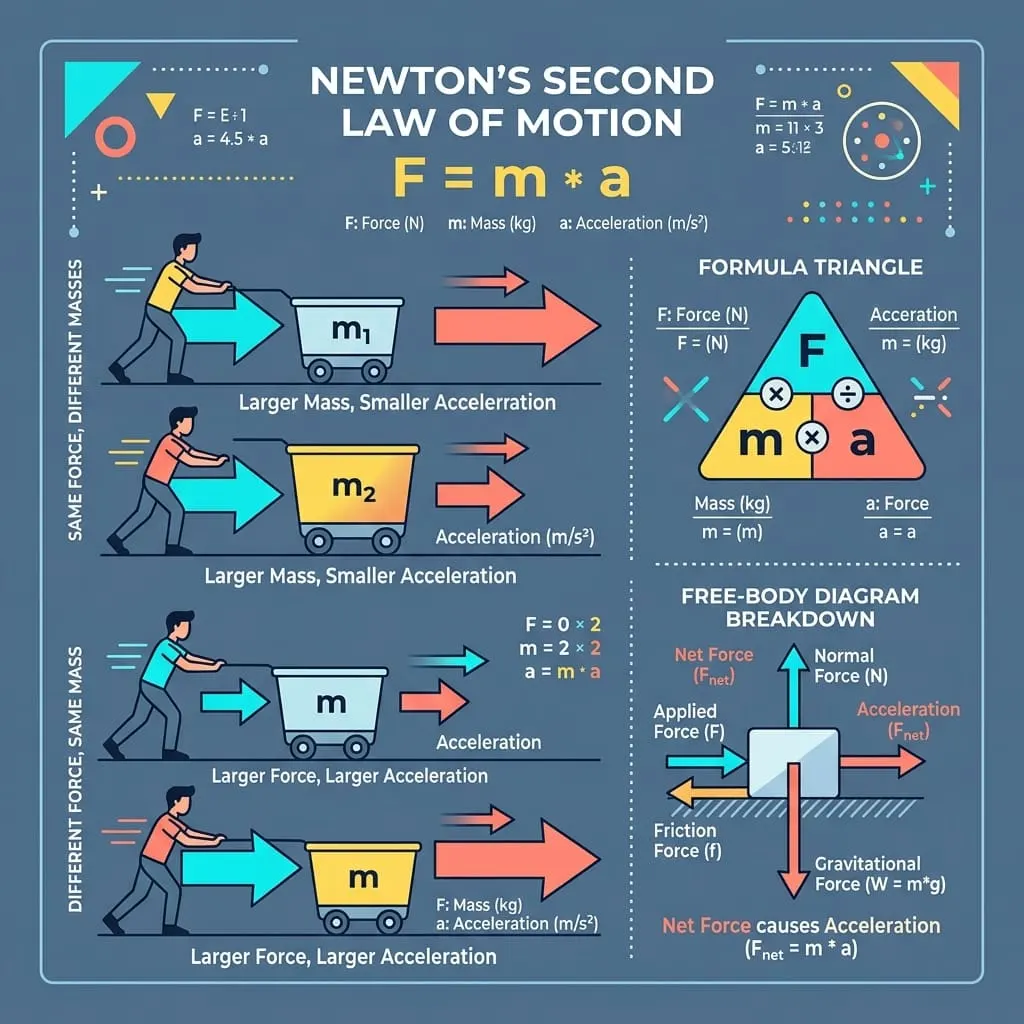
1. Introduction
Why does a loaded freight semi-truck require hundreds of feet more braking distance than a compact motorcycle? Why do astronauts in rocket capsules experience immense forces pressing them into their seats during atmospheric ascent? How do robotic arms on automated automotive assembly lines position heavy steel panels with sub-millimeter precision?
All these phenomena are governed by the most celebrated equation in classical physics: Newton's Second Law of Motion ().
graph LR
    F["💥 Net Force (F_net)
Vector Sum of All Forces (N)"] -->|"Acts Upon"| O["📦 Mass (m)
Inertial Resistance (kg)"]
    O -->|"Produces"| A["🚀 Acceleration (a)
Rate of Velocity Change (m/s²)"]
Formulated by Sir Isaac Newton in his groundbreaking 1687 treatise Philosophiae Naturalis Principia Mathematica, Newton's Second Law establishes the exact mathematical bridge between the forces acting on a body and the resulting kinematic acceleration it experiences.
Mastering enables engineers and scientists to:
- Design structural foundations, bridges, and skyscrapers resistant to wind gusts and seismic earthquake accelerations.
- Calculate propulsion requirements for space launch vehicles, commercial aviation aircraft, and hyperloop pods.
- Optimize mechanical braking, suspension systems, and electronic traction control in automotive engineering.
- Analyze biomechanical impact forces in sports medicine and ballistic defense shielding.
In this guide, we break down every dimension of Newton's Second Law—from differential calculus formulations and free-body diagram (FBD) vector resolution to real-world industrial case studies and worked engineering problems.
2. Definitions & Physical Meaning
2.1 The Simple Definition
In plain terms:
- Force () is a push or pull on an object.
- Mass () is how heavy and stubbornly resistant to motion an object is (inertia).
- Acceleration () is how rapidly the object speeds up, slows down, or changes direction.
If you push twice as hard (), the object speeds up twice as fast (). But if the object is twice as heavy (), pushing with the same force produces only half the acceleration.
2.2 Formal Technical Definition
Formally, Newton's Second Law states:
"The time rate of change of a particle's linear momentum () is directly proportional to the net external force () acting on the particle, and takes place in the exact spatial direction of that net force."
Mathematically expressed in differential form:
For systems with constant inertial mass ():
Where:
- is the net vector sum of all external forces ().
- is the invariant inertial mass of the body ().
- is the resultant acceleration vector ().
2.3 Free-Body Diagram (FBD) Vector Resolution
In real-world engineering, multiple concurrent forces act on an object simultaneously:
graph TD
    subgraph FBD ["📐 Free-Body Diagram (FBD) Vector Balance"]
        Fn["⬆️ Normal Force (F_N = mg cos θ)"]
        Fg["⬇️ Gravitational Weight (W = mg)"]
        Fapp["➡️ Applied Driving Force (F_applied)"]
        Ff["⬅️ Kinetic Friction Force (f_k = μ_k · F_N)"]
        Fn --- Fg
        Fapp --- Ff
    end
By decomposing all coplanar forces along Cartesian orthogonal coordinate axes:
3. Historical Timeline & Evolution
timeline
    title Historical Milestones of Force & Dynamics
    350 BCE : Aristotle claims constant force is required to maintain steady velocity
    1638 : Galileo Galilei discovers the Law of Inertia (Bodies maintain uniform motion)
    1687 : Sir Isaac Newton publishes 'Principia Mathematica' formulating the 3 Laws of Motion
    1736 : Leonhard Euler extends F = ma to rigid bodies and continuum mechanics
    1788 : Joseph-Louis Lagrange formulates Lagrangian Mechanics using Kinetic & Potential Energy
1915 : Albert Einstein publishes General Relativity, reinterpreting gravity as spacetime curvature- Aristotle's Misconception: For over 2,000 years, natural philosophers believed that an applied force was necessary simply to keep an object moving at constant speed. They failed to recognize that friction and air resistance are themselves opposing forces.
- Galileo's Breakthrough: Galileo realized that in the absence of friction, an object in motion continues moving forever without any pushing force.
- Newton's Grand Synthesis (1687): Newton synthesized Galileo's inertia into the First Law, established the quantitative rate equation as the Second Law, and proved mutual reaction pairs in the Third Law ().
4. Fundamental Formulas & Variable Matrix
4.1 Master Formula Matrix
| Desired Unknown | Given & | Given & | Given & | Given Momentum & Time $\Delta t$ | Given Work & Distance |
|---|---|---|---|---|---|
| Force () | — | — | |||
| Acceleration () | — | — | |||
| Mass () | — | — |
4.2 Force Unit Conversions
| Unit | Symbol | Relation to 1 Newton () | Practical Comparison |
|---|---|---|---|
| Newton (SI Base) | Weight of a medium apple () on Earth | ||
| Kilonewton | Structural beam load ratings | ||
| Pound-force (Imperial) | Force exerted by gravity on mass on Earth | ||
| Dyne (CGS System) | Surface tension measurements in chemistry | ||
| Kilopond / kgf | Gravitational force on standard mass |
5. Step-by-Step Problem Solving Protocol
flowchart TD
    S1["Step 1: Sketch & Identify System Boundaries
(Isolate target mass m)"] --> S2["Step 2: Construct Free-Body Diagram (FBD)
(Draw all applied, gravitational, normal, and friction forces)"]
    S2 --> S3["Step 3: Define Cartesian Coordinate System
(Align x-axis along direction of anticipated acceleration)"]
    S3 --> S4["Step 4: Resolve Vectors into Components
(ΣFx = m·ax and ΣFy = m·ay)"]
    S4 --> S5["Step 5: Solve Algebraically & Check Units
(Verify dimensions: N = kg·m/s²)"]
6. Practical Real-World Calculation Examples
Example 1: Accelerating an Electric Vehicle (EV)
- Scenario: A Tesla Model 3 has a curb mass . The electric dual-motor drivetrain accelerates the car from to () in .
- Average Acceleration:
- Required Net Tractive Force:
Example 2: Cable Tension in a High-Rise Passenger Elevator
- Scenario: An elevator cab with passengers has a combined mass . The elevator starts ascending upward from rest with an upward acceleration . Take .
- Free-Body Equation (Vertical -axis):
- Tension in Support Cables:
(Notice the cable must support both gravitational weight plus the dynamic acceleration force ).
Example 3: Braking Force Required to Stop a Freight Train
- Scenario: A freight locomotive pulling railcars has total mass (). It travels at () and must stop over a track distance of .
- Deceleration Needed (Torricelli Equation):
- Net Retarding Brake Force:
Example 4: Rocket Thrust on the Launchpad
- Scenario: A SpaceX Falcon 9 rocket has a liftoff mass of . Its nine Merlin 1D engines generate a total sea-level thrust of .
- Net Upward Force:
- Initial Liftoff Acceleration:
7. Real-World Engineering Case Studies
Case Study 1: Aerospace Ejection Seat Biomechanics
- Engineering Challenge: Military fighter pilots ejecting from crippled jets must clear the aircraft tail fin within , requiring explosive rocket motors under the ejection seat.
- Biomechanical Constraint: The human spinal column will suffer structural compression fractures if sustained axial acceleration exceeds ().
- Calculations:- Pilot + Seat Mass: .- Target Safe Acceleration: .- Required Net Thrust:
- Result: Solid rocket booster propellant grains are precisely contoured to provide a trapezoidal thrust curve peaking at , accelerating the pilot to in while preventing spinal injury.
Case Study 2: Civil Engineering Crane Wind Loading
- Background: A tall tower crane on a skyscraper construction site experiences severe gale wind gusts of ().
- Analysis:- Air density .- Projected surface area of crane jib structure , drag coefficient .- Aerodynamic Drag Force:
- Structural Anchor Verification:- The lateral force at height creates an overturning moment:
- Engineers use this dynamic force to specify 8 high-tensile steel foundation tieback bolts rated for tension each.
8. Variable Mass Systems: When
Variable Mass Systems (Tsiolkovsky Rocket Equation)
When a body ejects or accumulates mass over time (), cannot be used in its simplified form. The full momentum rate equation yields:
Where is the exhaust velocity relative to the rocket, generating the thrust force .
9. Common Mistakes & How to Avoid Them
Mistake 1: Confusing Mass () and Weight ()
Mass (in ) is an intrinsic invariant measure of matter and inertia. Weight (in ) is the gravitational force acting on that mass (). A astronaut has a mass of on Earth, on the Moon, and in deep space, but their weight is on Earth and only on the Moon.
Mistake 2: Forgetting Friction or Opposing Forces in Net Force
Calculating by plugging in only the applied pushing force while ignoring friction or gravity will produce large errors. Always use the NET vector sum .
Mistake 3: Coordinate Sign Inconsistency
If upward or rightward motion is assigned as positive $(+)$, all downward or opposing vectors (gravity, friction) must be entered with negative $(-)$ signs.
10. Frequently Asked Questions (FAQ)
Q1: What is 1 Newton of force in everyday terms?
A: One Newton () is approximately the downward gravitational force exerted on an object with mass (such as an average-sized apple or a small deck of cards resting on your palm).
Q2: Why does an object continue moving if net force is zero ()?
A: By Newton's First Law (Law of Inertia), force is required to change velocity (produce acceleration), not to maintain it. In frictionless deep space, an object moving at continues at indefinitely with zero net force.
Q3: How is Newton's Second Law applied in circular motion?
A: In uniform circular motion at radius and speed , the object accelerates toward the center with centripetal acceleration . The required Centripetal Force is:
Q4: Does work in non-inertial (accelerating) reference frames?
A: In an accelerating reference frame (such as inside a braking bus or rotating carousel), fictitious or pseudo-forces (like centrifugal force and Coriolis force) must be added to make valid:
Q5: What is the difference between static friction and kinetic friction in ?
A: - Static Friction (): Holds an object stationary () until the applied force exceeds the maximum breakaway threshold .
- Kinetic Friction (): Opposes motion once the object is sliding, where .
Q6: Can acceleration be perpendicular to velocity?
A: Yes! When force is applied perpendicular to the velocity vector (such as gravity on a planetary orbit or magnetic force on a moving electron), speed remains constant while direction changes continuously.
Q7: How does Newton's Second Law relate to Hooke's Law for springs?
A: For an oscillating spring-mass system with spring constant , the restoring force is . Combining with Newton's Second Law produces the classic simple harmonic oscillator equation:
Q8: What happens to at quantum scales?
A: At subatomic atomic scales, wave-particle duality dominates. Classical trajectories are replaced by Schrödinger's wave equation (). However, by Ehrenfest's Theorem, the expectation values of quantum operators strictly converge to Newton's Second Law: .
11. Summary & Key Takeaways
- Fundamental Formula: , where is in Newtons (), is in kilograms (), and is in .
- Proportionality: Acceleration is directly proportional to net force () and inversely proportional to mass ($a \propto 1/m$).
- Vector Nature: Force and acceleration are vectors sharing identical spatial direction.
- Dynamic Equilibrium: If net force is zero (), acceleration is zero (), meaning the object remains at rest or moves at constant linear velocity.
Additional Technical Guidelines & Measurement Standards
When conducting calculations for Newton's Force (F = ma) Calculator, maintaining quantitative precision and verifying input parameter boundaries is essential for reliable scenario evaluation. Always verify that raw numerical inputs are measured using standardized instrumentation, and double-check unit conversions prior to applying outputs in commercial, industrial, or academic projects.
For quantitative unit conversions and scientific calculations, always maintain at least four decimal places of precision during intermediate arithmetic stages before rounding final results. When preparing technical reports, laboratory documentation, or financial forecasts, cross-verify all output variables against established international measurement standards (such as SI, NIST, and ISO metric benchmarks) to guarantee consistent analytical rigor across all computational workflows.
MathsLover.com delivers this interactive solver 100% free of charge to foster global mathematical literacy, educational accessibility, and data-driven problem solving across scientific, technical, and academic communities worldwide.