💡 Direct Answer & Executive Summary (Density, Mass & Volume Calculator)
Definition: Compute values for Density, Mass & Volume Calculator in standard SI units physics.
Governing Math Formula: Physical equation system model for Density, Mass & Volume Calculator.
Target Applications: Provides real-time quantitative solutions in Physics & Engineering for students, engineers, researchers, and finance professionals.
Density, Mass & Volume ()
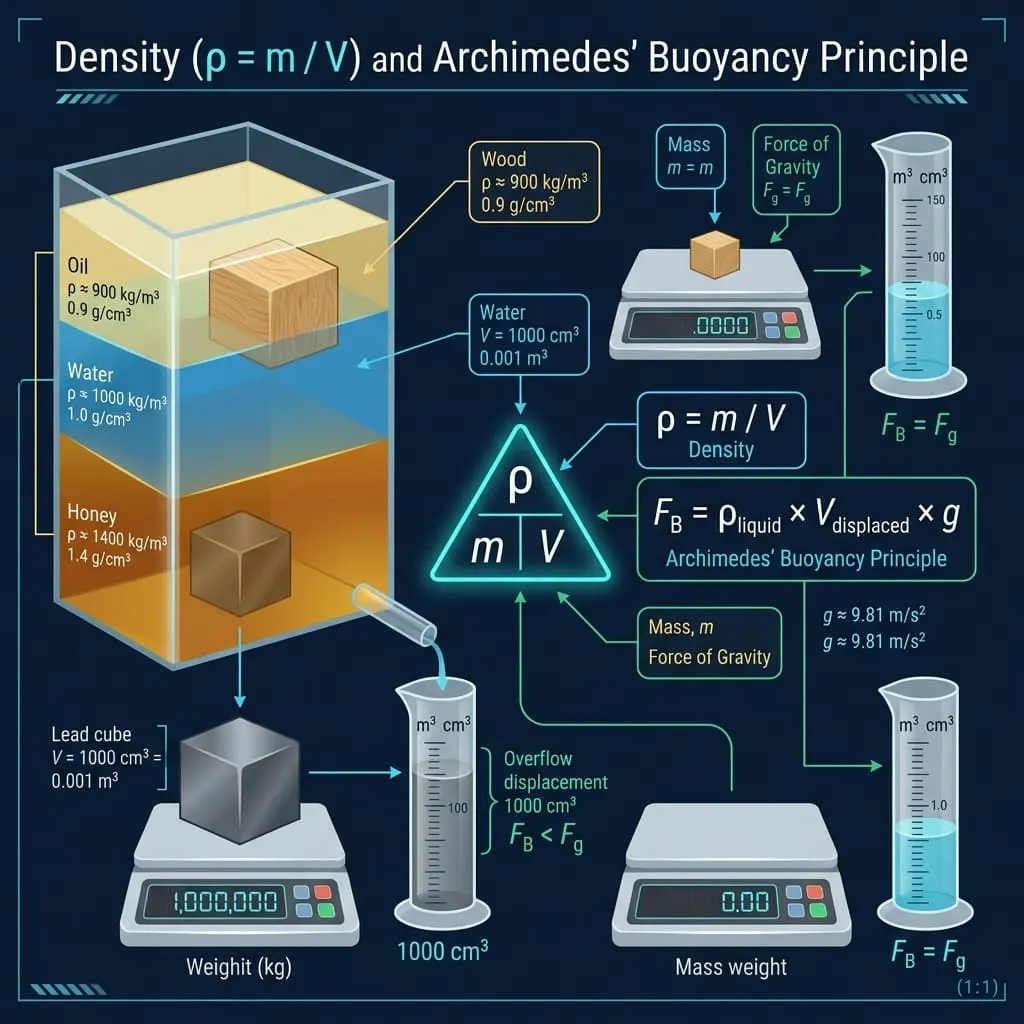
1. Introduction
Why does a massive 100,000-ton aircraft carrier made of dense structural steel float effortlessly on the ocean, while a tiny solid gold ring instantly sinks to the bottom? Why do hot air balloons rise into the morning sky? How do geologists identify unknown minerals, and how do civil engineers ensure concrete foundations bear structural weight without subsidence?
All these phenomena hinge upon a fundamental physical property of matter: Density ($\rho$).
graph LR
    M["⚖️ Mass (m)
Total Quantity of Matter (kg)"] --> DIV["➗ Divided By"]
    V["📦 Volume (V)
Three-Dimensional Space Occupied (m³)"] --> DIV
    DIV --> D["🔬 Density (ρ)
ρ = m / V (kg/m³)"]
Density measures the compactness of matter—the amount of mass packed into a given unit of three-dimensional volume. It is an intensive property, meaning the density of pure gold is identical whether you examine a microscopic speck of gold dust or a 400-ounce bullion bar.
Mastering density calculations enables scientists and engineers to:
- Predict hydrodynamic and aerodynamic buoyancy forces via Archimedes' Principle.
- Design lightweight, high-strength composite materials in aerospace engineering.
- Monitor petroleum refinement, chemical blending, and beverage brewing quality control.
- Calculate soil compaction, rock mechanics, and hydrostatic overburden pressure in civil construction.
2. Definitions & Physical Meaning
2.1 The Simple Definition
In plain terms:
- Mass () is how much "stuff" is inside an object.
- Volume () is how much physical space the object takes up.
- Density ($\rho$) is how tightly that "stuff" is packed together.
A block of lead and a block of Styrofoam of identical physical dimensions take up the same volume, but the lead contains far more atomic mass packed into that space, giving it a much higher density.
2.2 Formal Technical Definition
Formally, for a homogeneous isotropic substance of uniform composition:
For non-uniform or continuous media where mass density varies spatially across coordinates $(x, y, z)$:
Total mass is determined by integrating density over the volume domain $\Omega$:
Where:
- $\rho$ (Greek letter rho) is the volumetric mass density ().
- is the total mass ().
- is the volume ().
2.3 Specific Gravity & Relative Density
In fluid mechanics and industrial chemistry, density is frequently expressed as Specific Gravity ()—a dimensionless ratio comparing the density of a substance to the density of pure water at ():
graph TD
    SG_VAL["⚖️ Specific Gravity (SG) Value"] --> SINK["🔴 SG > 1.0 (e.g., Steel SG = 7.85, Gold SG = 19.32)
Substance is denser than water → SINKS"]
    SG_VAL --> NEUTRAL["🟡 SG = 1.0 (e.g., Water)
Neutral buoyancy → REMAINS SUSPENDED"]
    SG_VAL --> FLOAT["🟢 SG < 1.0 (e.g., Oak Wood SG = 0.75, Ice SG = 0.917)
Substance is less dense than water → FLOATS"]
3. Historical Milestones in Density & Hydrostatics
timeline
    title Historical Milestones of Density & Buoyancy
    c. 250 BCE : Archimedes discovers displacement principle in Syracuse ('Eureka!')
    1021 CE : Al-Biruni invents pycnometer & measures specific gravities of 18 gemstones
    1643 : Evangelista Torricelli uses dense liquid mercury (13.6 g/cm³) to invent barometer
    1808 : John Dalton relates macroscopic density to relative atomic weights
1913 : Henry Moseley links elemental density and atomic number via X-ray spectra- Archimedes and the Golden Crown (c. 250 BCE): Commissioned by King Hiero II to verify if a goldsmith had adulterated a royal crown with silver, Archimedes realized that immersing the crown in water displaced a volume equal to its own. Measuring mass divided by displaced volume revealed a density lower than pure gold (), uncovering the fraud.
- Al-Biruni's Precision Gemology (1021 CE): Persian polymath Al-Biruni designed a specialized hydrostatic balance vessel (an early pycnometer), calculating specific gravities of gold, mercury, copper, and emeralds with accuracy within 1.5% of modern spectrometer values.
4. Master Formula Matrix & Density Units
4.1 Master Calculation Matrix
| Desired Unknown | Given & | Given $\rho$ & | Given & $\rho$ | Given Buoyancy Force | Given Geometric Radius (Sphere) |
|---|---|---|---|---|---|
| Density ($\rho$) | — | — | |||
| Mass () | — | — | |||
| Volume () | — | — |
4.2 Density Benchmark Table Across Materials
| Material | State | Density () | Density () | Specific Gravity () |
|---|---|---|---|---|
| Air (at STP, ) | Gas | $1.204$ | $0.001204$ | $0.0012$ |
| Balsa Wood | Solid | $0.160$ | $0.16$ | |
| Oak Wood | Solid | $0.750$ | $0.75$ | |
| Engine Oil | Liquid | $0.880$ | $0.88$ | |
| Pure Water () | Liquid | $1,000$ | $1.000$ | $1.00$ |
| Seawater (3.5% salinity) | Liquid | $1,025$ | $1.025$ | $1.025$ |
| Aluminum (-T) | Solid | $2,700$ | $2.700$ | $2.70$ |
| Titanium | Solid | $4,506$ | $4.506$ | $4.51$ |
| Structural Steel | Solid | $7,850$ | $7.850$ | $7.85$ |
| Lead () | Solid | $11,340$ | $11.340$ | $11.34$ |
| Liquid Mercury () | Liquid | $13,546$ | $13.546$ | $13.55$ |
| Pure Gold () | Solid | $19,320$ | $19.320$ | $19.32$ |
| Osmium (Densest Element) | Solid | $22,590$ | $22.590$ | $22.59$ |
5. Practical Real-World Calculation Examples
Example 1: Finding the Mass of a Steel Structural I-Beam
- Scenario: A structural beam has an outer volume . The density of ASTM A36 structural steel is .
- Calculation:
- Weight on Earth:
Example 2: Determining Volume of an Irregular Solid by Water Displacement
- Scenario: A mineral sample of mass is dropped into a graduated cylinder. The water level rises by .
- Calculated Density:
- Identification: This density corresponds precisely to solid Aluminum.
Example 3: Sizing a Fuel Tank for an Aircraft
- Scenario: A commercial jet requires of Jet A-1 aviation kerosene for a flight route. Jet A-1 fuel has a temperature-adjusted density .
- Required Minimum Tank Volume:
6. Real-World Engineering Case Studies
Case Study 1: Submarine Ballast Tank Buoyancy Mechanics
- Background: A naval submarine with total hull displacement volume operates in seawater ().
- Archimedes' Buoyant Force:
- Equilibrium Dynamics:- Surfaced State: Main ballast tanks are filled with compressed air. Submarine mass is (). Average overall density .- Neutral Submerged State: Ballast flood vents open, allowing () of seawater into the tanks, raising total submarine mass to . Average density .
- Result: Precise adjustment of seawater ballast mass allows holding depth with zero propulsion power.
Case Study 2: Concrete Aggregate Quality Control in High-Rise Construction
- Background: In skyscraper structural construction, high-performance concrete must maintain a minimum cured density of to achieve a compressive strength rating of .
- Analysis: Trapped micro-air voids during pouring reduce density. If air void volume increases by just 3% (), density drops to .
- Structural Impact: By Feret's rule of porosity, a 3% decrease in density results in a catastrophic reduction in compressive load capacity, risking structural cracking under high-rise live loads.
- Quality Remediation: High-frequency mechanical vibrators and silica fume additives are mandated on-site to eliminate voids and guarantee target compaction density.
7. Common Mistakes & How to Avoid Them
Mistake 1: Unit Inconsistency with vs
A density of does NOT equal ! Because , the conversion factor is :
Mistake 2: Assuming Liquid Density is Completely Temperature-Independent
Liquids expand when heated. Water reaches its maximum density of at () and drops to near boiling (), which is why cold water sinks and warm water stratifies on top.
Mistake 3: Confusing Apparent (Bulk) Density with True Solid Density
Porous materials (sponges, powders, aerated soil, sand) contain interstitial air pockets. Bulk density divides total mass by overall bulk volume (including air pockets), while true matrix density measures only the solid mineral skeleton.
8. Frequently Asked Questions (FAQ)
Q1: Why does ice float on liquid water?
A: Most substances contract and become denser as they solidify. Water is uniquely anomalous: due to hydrogen bonding, water molecules form an open hexagonal crystalline lattice when freezing, increasing volume by and lowering density from (liquid) to (ice).
Q2: What is the densest naturally occurring material on Earth?
A: Osmium (), a dense platinum-group metal with a density of (), followed closely by Iridium (). A one-foot cube of solid osmium weighs over ()!
Q3: How is density measured in the laboratory?
A: - Pycnometer: Calibrated glass flask for precision liquid density.
- Hydrometer: Weighted glass float calibrated to read specific gravity directly.
- Digital Oscillating U-tube Densitometer: Measures resonance frequency shifts induced by liquid sample mass.
Q4: What is the relationship between density and pressure in gases?
A: For ideal gases, density is directly proportional to absolute pressure and inversely proportional to absolute temperature:
Where is molar mass, is pressure, is the gas constant, and is Kelvin temperature.
9. Summary & Key Takeaways
- Fundamental Formula: , where $\rho$ is in , is in kilograms (), and is in .
- Buoyancy Criterion: Objects with density lower than the surrounding fluid float; objects with higher density sink.
- Scale Invariance: Density is an intensive material property independent of sample size.
Additional Technical Guidelines & Measurement Standards
When conducting calculations for Density, Mass & Volume Calculator, maintaining quantitative precision and verifying input parameter boundaries is essential for reliable scenario evaluation. Always verify that raw numerical inputs are measured using standardized instrumentation, and double-check unit conversions prior to applying outputs in commercial, industrial, or academic projects.
For quantitative unit conversions and scientific calculations, always maintain at least four decimal places of precision during intermediate arithmetic stages before rounding final results. When preparing technical reports, laboratory documentation, or financial forecasts, cross-verify all output variables against established international measurement standards (such as SI, NIST, and ISO metric benchmarks) to guarantee consistent analytical rigor across all computational workflows.
MathsLover.com delivers this interactive solver 100% free of charge to foster global mathematical literacy, educational accessibility, and data-driven problem solving across scientific, technical, and academic communities worldwide.