💡 Direct Answer & Executive Summary (Coulomb's Law Electrostatic Force Solver)
Definition: Compute values for Coulomb's Law Electrostatic Force Solver in standard SI units physics.
Governing Math Formula: Physical equation system model for Coulomb's Law Electrostatic Force Solver.
Target Applications: Provides real-time quantitative solutions in Physics & Engineering for students, engineers, researchers, and finance professionals.
Coulomb's Law Electrostatic Force Solver ()
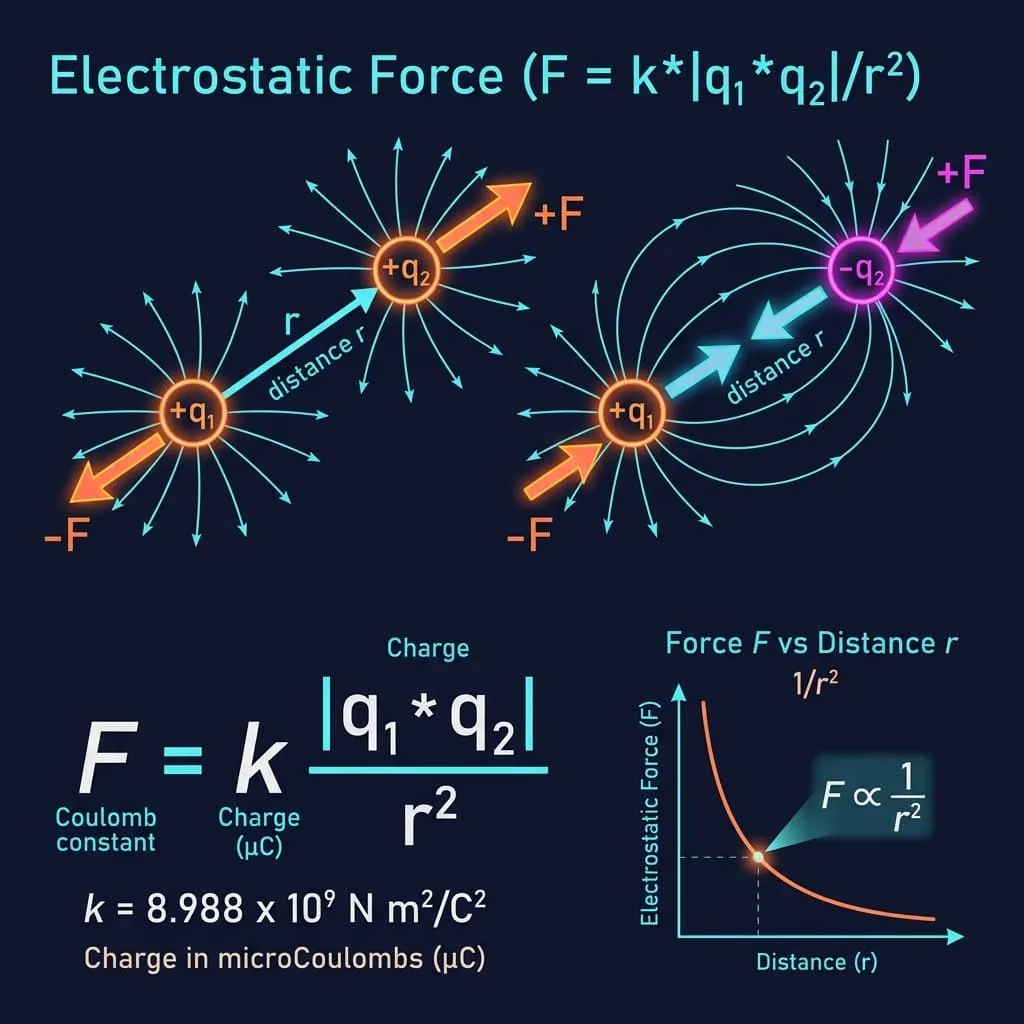
1. Introduction
Why does a rubbed plastic balloon stick stubbornly to a painted wall? Why do the negatively charged electrons in an atom orbit tightly around the positively charged atomic nucleus instead of drifting away into deep space? Why is the electrostatic repulsion between two single protons stronger than their mutual gravitational attraction?
At the foundational bedrock of all atomic physics, chemistry, semiconductor electronics, materials science, and molecular biology lies a single, supreme governing relationship: Coulomb's Law.
Formulated in 1785 by French military engineer and physicist Charles-Augustin de Coulomb, Coulomb's Law describes the quantitative electrostatic force of attraction or repulsion between two stationary, electrically charged point particles.
graph LR
    Q1["⚡ Charge 1 (q₁)
in Coulombs (C)"] --> MULT["✖️ Product: |q₁ · q₂|"]
    Q2["⚡ Charge 2 (q₂)
in Coulombs (C)"] --> MULT
    MULT --> COUL["✖️ Coulomb Constant (k_e)
k_e = 8.98755 × 10⁹ N·m²/C²"]
    R["📏 Separation Distance (r)
Inverse Square: 1 / r²"] --> DIV["➗ Divided By r²"]
    COUL --> DIV
    DIV --> F["💥 Electrostatic Force (F)
F = k_e · |q₁ · q₂| / r² (Newtons)"]
Mastering Coulomb's Law and electrostatics allows physicists and engineers to:
- Model atomic structure, ionic chemical bonding lattice energies, and crystal cohesion (Madelung constant).
- Calculate electric field distributions () and electrostatic potentials () around complex electrode configurations.
- Design electrostatic precipitators (ESP) that filter microscopic fly-ash and soot out of industrial factory smokestacks.
- Engineer semiconductor gate dielectric thicknesses to prevent electrostatic quantum tunneling and dielectric breakdown.
- Optimize electrostatic spray painting, xerographic laser printing toner deposition, and ink-jet droplet deflection.
2. Definitions & Analogies
2.1 The Simple Definition
In simple everyday terms:
- Like charges repel: Two positive charges ($++$) push away from each other; two negative charges ($--$) push away from each other.
- Opposite charges attract: A positive charge and a negative charge ($+-$) pull toward each other.
- The magnitude of the force () depends directly on how big the charges are ().
- The Inverse Square Law: If you double the separation distance between two charges (), the electrostatic force drops to one-fourth (); if you triple the distance (), the force collapses to one-ninth ()!
2.2 The Formal Technical Definition
Scalar Magnitude Equation
For two stationary point charges ( and ) separated by distance () in a vacuum:
Where:
- is the magnitude of the electrostatic force in Newtons ().
- are the quantities of electric charge in Coulombs ().
- is the straight-line center-to-center separation distance in meters ().
- is Coulomb's Constant in vacuum:
- is the Vacuum Permittivity Constant ().
Vector Form of Coulomb's Law
To capture spatial direction, the vector force exerted by charge on charge located at displacement vector :
Where is the unit vector directed from toward .
- If (same sign): points along (Repulsion).
- If (opposite signs): points along (Attraction).
- By Newton's Third Law: .
2.3 Coulomb's Law vs. Newton's Law of Universal Gravitation
Coulomb's Law shares the exact same inverse-square mathematical architecture as Newton's Law of Universal Gravitation, but with three profound physical differences:
graph TD
    subgraph Gravitation ["🌍 Newton's Gravitation"]
        G_Form["F_g = G · (m₁ · m₂) / r²"]
        G_Prop["• Property: Mass (m)
• Sign: ALWAYS Attractive (Positive mass only)
• Coupling Strength: Extremely Weak (G = 6.67 × 10⁻¹¹ N·m²/kg²)
• Dominates: Astronomical scale (Planets, Stars, Galaxies)"]
        G_Form --> G_Prop
    end
    subgraph Electrostatics ["⚡ Coulomb's Electrostatics"]
        E_Form["F_e = k_e · |q₁ · q₂| / r²"]
        E_Prop["• Property: Charge (q)
• Sign: Attractive (+-) OR Repulsive (++, --)
• Coupling Strength: Colossally Strong (k_e = 8.99 × 10⁹ N·m²/C²)
• Dominates: Atomic, Chemical & Biological scale"]
        E_Form --> E_Prop
end- The Staggering Ratio of Electrostatic to Gravitational Force:Comparing the electrostatic repulsion and gravitational attraction between two protons (, ):
Electrostatic force is stronger than gravity! The only reason gravity rules the solar system is that macroscopic celestial bodies contain almost perfectly equal numbers of protons and electrons, cancelling net electrostatic charges to zero.
3. History & Milestones in Electrostatics
timeline
    title Milestones in Electrostatics & Electric Force
    600 BCE : Thales of Miletus discovers static amber triboelectric attraction
    1600 : William Gilbert publishes 'De Magnete', coining the term 'Electricus'
    1733 : Charles François de Cisternay du Fay discovers two types of electricity (Vitreous & Resinous)
    1750 : Benjamin Franklin proposes single-fluid theory and positive (+) / negative (-) terminology
    1785 : Charles-Augustin de Coulomb invents the Torsion Balance and proves the Inverse-Square Law
1839 : Michael Faraday establishes the Electric Field concept (E-field lines)- Early Antiquity: Ancient Greeks discovered that rubbing fossilized tree resin (amber, Greek ēlektron) with animal fur gave it the mysterious ability to attract dry feathers and straw.
- Franklin's Sign Conventions (1750): American polymath Benjamin Franklin proposed that electric charge was an invisible fluid, defining objects with an excess as Positive (+) and a deficit as Negative (-).
- Coulomb's Torsion Balance Breakthrough (1785): French physicist Charles-Augustin de Coulomb engineered an ultra-sensitive torsion balance consisting of a silk fiber suspending an insulating needle with gilded elderberry pith spheres. By measuring the minute angular twist of the fiber under electrostatic deflection, Coulomb verified the inverse-square law with remarkable precision ().
4. Core Concepts & Parameters Explained
4.1 Electric Charge () & Elementary Charge ()
- Definition: The intrinsic physical property of subatomic matter that experiences a force when placed in an electromagnetic field.
- SI Unit: Coulomb ().
- Quantization of Charge (): Electric charge is not continuous; it exists in discrete integer packets of the Elementary Charge Constant:- Proton: .- Electron: .- .
4.2 Separation Distance () & The Inverse Square Law
- Definition: The straight-line radial distance between the centers of two spherically symmetric or point charges.
- SI Unit: Meter ().
- The Falloff: Because electrostatic field flux spreads uniformly over the surface of an expanding sphere (), field intensity and mutual force decay quadratically with distance.
4.3 Dielectric Medium Permittivity ()
When charges are immersed in a material dielectric medium (such as water, oil, or biological cytoplasm), the surrounding polar molecules align to screen the charges, weakening the net electrostatic force by the Relative Permittivity (Dielectric Constant, $\kappa$ or ):
| Surrounding Medium | Relative Permittivity ( or $\kappa$) | Electrostatic Force Attenuation Factor () |
|---|---|---|
| Vacuum | $1.00000$ | (Maximum Force) |
| Dry Air (STP) | $1.00059$ | (Effectively Vacuum) |
| Petroleum Oil / Transformer Oil | (56% force reduction) | |
| Silicon () | $11.7$ | (91.5% force reduction) |
| Pure Water () | $80.1$ | (98.75% force reduction!) |
Why does table salt () dissolve so effortlessly in water? In air, sodium () and chloride () ions attract each other with ferocious electrostatic force. When dropped into water (), water's high permittivity slashes the attractive Coulomb force by , allowing ambient thermal kinetic motion to tear the crystal lattice apart into hydrated ions!
4.4 The Principle of Electrostatic Superposition
When a system contains multiple discrete charges, the net electrostatic force acting on any single charge is the exact vector sum of the individual Coulomb forces exerted by every other charge independently:
5. Master Formula Matrix & Step-by-Step Problem Solver
| Unknown Variable | Primary Formula | Formula Given Force () | ||
|---|---|---|---|---|
| Electrostatic Force () | $F = k_e \frac{\ | q_1 \cdot q_2\ | }{r^2}$ | — |
| Separation Distance () | $r = \sqrt{\frac{k_e \ | q_1 \cdot q_2\ | }{F}}$ | — |
| Charge Magnitude () | $q_1 = \frac{F \cdot r^2}{k_e \ | q_2\ | }$ | — |
| Electric Field Intensity () | $E_1 = \frac{F}{q_2} = k_e \frac{\ | q_1\ | }{r^2}$ | |
| Electrostatic Potential Energy () |
6. Step-by-Step Computational Procedure
flowchart TD
    S1["Step 1: Identify Charges & Separation Distance
(Extract q₁ and q₂ in Coulombs, Distance r in meters)"] --> S2["Step 2: Convert Micro/Nano-Coulombs to SI Units
(μC -> 10⁻⁶ C | nC -> 10⁻⁹ C | pC -> 10⁻¹² C | cm -> 10⁻² m)"]
    S2 --> S3["Step 3: Evaluate Relative Permittivity (ε_r)
(Use k_e = 8.988 × 10⁹ for vacuum/air, or divide by ε_r for liquids)"]
    S3 --> S4["Step 4: Compute Force Magnitude (F = k_e · |q₁q₂| / r²)
(Multiply charges, divide by r², and apply Coulomb constant)"]
    S4 --> S5["Step 5: Determine Vector Direction
(Like signs -> Repulsive vector | Opposite signs -> Attractive vector)"]
7. Practical Real-World Calculation Examples
Example 1: Force Between Two Micro-Coulomb Charges
- Scenario: Two small electrostatic point charges and are placed in air separated by .
- Calculation:(Because both charges are positive, the force is Repulsive, pushing them apart with ).
Example 2: Attractive Force in a Hydrogen Atom
- Scenario: In the Bohr model of the ground-state Hydrogen atom, a single proton () attracts an orbiting electron () at the Bohr radius ().
- Step 1: Calculate Force Magnitude:
- Step 2: Calculate Resulting Electron Acceleration ():
Example 3: Finding Distance from Known Electrostatic Repulsion
- Scenario: Two identical positive charges of repel each other with a measured force of . Find their separation distance ().
- Calculation:
Example 4: The Colossal Force of 1 Full Coulomb of Charge
- Scenario: Imagine you could place of positive charge on one hilltop and on another hilltop away.
- Calculated Repulsive Force:(Equivalent to the gravitational weight of approximately ! This demonstrates why of unneutralized static charge is almost never encountered in daily life).
Example 5: Dielectric Screening in Biological Salt Water
- Scenario: A sodium ion (, ) and chloride ion (, ) are separated by in pure water ().
- Calculated Screened Force:
8. Real-World Engineering Case Studies
Case Study 1: Industrial Smokestack Electrostatic Precipitators (ESP)
- Environmental Problem: Coal power stations and cement manufacturing kilns generate billions of cubic meters of exhaust gas contaminated with toxic sub-micron particulate soot, silica, and heavy metal ash. Mechanical fabric filters clog rapidly under high flue gas temperatures ().
- Electrostatic Solution Mechanics:- High-voltage negative discharge corona wires (energized at ) ionize ambient flue gas into an electron avalanche.- Passing dust particles collide with free electrons, acquiring a strong negative surface charge ().- Positively grounded collecting metal plates spaced apart create an intense transverse electric field .
graph LR
    subgraph ESP_System ["🏭 Electrostatic Precipitator Flow"]
        FlueGas["Raw Toxic Flue Gas
(Neutral Soot & Ash Particles)"] --> CORONA["⚡ High-Voltage Corona Wire (-60 kV)
(Charges particles to -q via electron impact)"]
        CORONA --> PLATES["🧲 Grounded Collector Plates (+)
(Coulomb Force F = q·E drags particles to walls)"]
        PLATES --> CLEAN["🌿 99.8% Clean Purified Exhaust
(Rappers vibrate plates to drop ash into hoppers)"]
end- Coulomb Drift Force:
- Performance Result: This steady Coulomb force pulls dust particles laterally out of the moving gas stream onto the collection plates, achieving 99.8% particulate capture efficiency with virtually zero airflow restriction.
Case Study 2: Xerographic Laser Printing & Photoreceptor Drum Deposition
- Technology Workflow: Modern laser printers and office photocopiers use electrostatics to transfer microscopic dry polymer toner powder () onto paper at 60 pages per minute.
- Coulomb Force Engineering:1. A rotating aluminum drum coated with photoconductive selenium is charged uniformly to .2. A laser diode writes the image, discharging illuminated areas to (creating an electrostatic latent image).3. Triboelectrically charged toner particles () are repelled by dark areas () and Coulomb-attracted onto the laser-exposed areas ().4. Paper receives a strong positive back-charge (), exerting a powerful Coulomb pull that rips toner off the drum onto the sheet before hot fuser rollers melt it into the fibers.
9. Common Mistakes & How to Avoid Them
Mistake 1: Forgetting the Inverse Square () Factor
Calculating instead of . Omitting the square causes the force calculation to be off by orders of magnitude whenever distance is not exactly .
Mistake 2: Entering MicroCoulombs () as Base Coulombs
Substituting directly as instead of . This inflates the calculated force by a factor of one trillion ()! Always convert and .
Mistake 3: Confusing Scalar Magnitude with Vector Direction
Entering negative charge signs into scalar magnitude calculations. Always take absolute values to find the force magnitude, and determine attractive vs. repulsive direction visually based on like vs. opposite signs.
10. Frequently Asked Questions (FAQ)
Q1: What is Coulomb's Constant () and how is it related to the speed of light?
A: Coulomb's constant is . Through Maxwell's electromagnetic equations, vacuum permittivity (), magnetic permeability (), and the speed of light () are unified by:
Q2: Does Coulomb's Law hold inside the atomic nucleus?
A: Yes, electrostatic repulsion between positive protons still obeys Coulomb's Law inside the nucleus. However, at femtometer distances (), the Strong Nuclear Force is roughly stronger than electrostatic repulsion, binding protons and neutrons together into stable nuclei.
Q3: What is the difference between an Electric Field () and Electrostatic Force ()?
A: - Electric Field (): The property of a source charge that alters the space around it (, measured in or ).
- Electrostatic Force (): The actual physical force experienced when a second test charge () is placed into that existing field: .
Q4: Can two neutral objects attract each other via electrostatic forces?
A: Yes! Through Electrostatic Polarization / Van der Waals Induction. When a charged object approaches a neutral insulator (like a charged comb near neutral bits of paper), the electric field shifts electrons within the neutral atoms, inducing a dipole where the near side is attracted more strongly than the far side is repelled, producing net attraction.
Q5: Why is the electrostatic force between macro objects usually zero?
A: Because matter is composed of equal numbers of positive protons and negative electrons (). Even a deviation of 0.0001% in human body charge balance would produce repulsive forces strong enough to blow a person apart!
Q6: What is Gauss's Law and how does it relate to Coulomb's Law?
A: Gauss's Law () is the integral form of Maxwell's First Equation. Applying Gauss's Law to a spherical Gaussian surface around a point charge mathematically derives Coulomb's Law directly.
Q7: What happens to Coulomb force in a conductor vs. an insulator?
A: In an ideal electrical conductor, free conduction electrons move instantly to cancel internal electric fields, shielding internal charges so that (Faraday Cage effect). In insulators (dielectrics), bound charges cannot flow freely, merely polarizing to partially reduce the field by .
Q8: What is the point-charge limitation of Coulomb's Law?
A: Coulomb's Law strictly applies to charges whose physical dimensions are negligibly small compared to the distance separating them. For extended charged conductors (like large plates or cylinders), the charge redistributes dynamically, requiring surface integration or Gauss's Law.
11. Expert Tips & Best Practices
- Always Convert Charges to Base Coulombs: Convert microCoulombs () and nanoCoulombs () before multiplying.
- Use for Fast Mental Estimates: For rapid back-of-the-envelope calculations, rounding to gives accuracy within 0.14%.
- Account for the Dielectric Medium in Solution Chemistry: When analyzing biochemical reactions (like DNA hybridization or enzyme active sites in water), always divide vacuum Coulomb forces by water's relative permittivity ().
12. Summary & Key Takeaways
- Fundamental Coulomb Formula: (Force in Newtons ).
- Charge Polarity Rule: Like charges repel ($++$ or $--$); opposite charges attract ($+-$).
- Inverse-Square Decay: Force drops quadratically with distance ().
- Colossal Microscopic Dominance: stronger than gravity between subatomic particles, governing chemical bonding, molecular biology, and all material rigidity.
- Industrial & Technological Vitality: Essential for laser printing xerography, industrial smokestack pollution scrubbers (ESP), semiconductor gate physics, and high-voltage insulation engineering.
Additional Technical Guidelines & Measurement Standards
When conducting calculations for Coulomb's Law Electrostatic Force Solver, maintaining quantitative precision and verifying input parameter boundaries is essential for reliable scenario evaluation. Always verify that raw numerical inputs are measured using standardized instrumentation, and double-check unit conversions prior to applying outputs in commercial, industrial, or academic projects.
For quantitative unit conversions and scientific calculations, always maintain at least four decimal places of precision during intermediate arithmetic stages before rounding final results. When preparing technical reports, laboratory documentation, or financial forecasts, cross-verify all output variables against established international measurement standards (such as SI, NIST, and ISO metric benchmarks) to guarantee consistent analytical rigor across all computational workflows.
MathsLover.com delivers this interactive solver 100% free of charge to foster global mathematical literacy, educational accessibility, and data-driven problem solving across scientific, technical, and academic communities worldwide.