💡 Direct Answer & Executive Summary (Acceleration Velocity Rate Solver)
Definition: Compute values for Acceleration Velocity Rate Solver in standard SI units physics.
Governing Math Formula: Physical equation system model for Acceleration Velocity Rate Solver.
Target Applications: Provides real-time quantitative solutions in Physics & Engineering for students, engineers, researchers, and finance professionals.
Acceleration & Velocity Rate Solver ()
1. Introduction
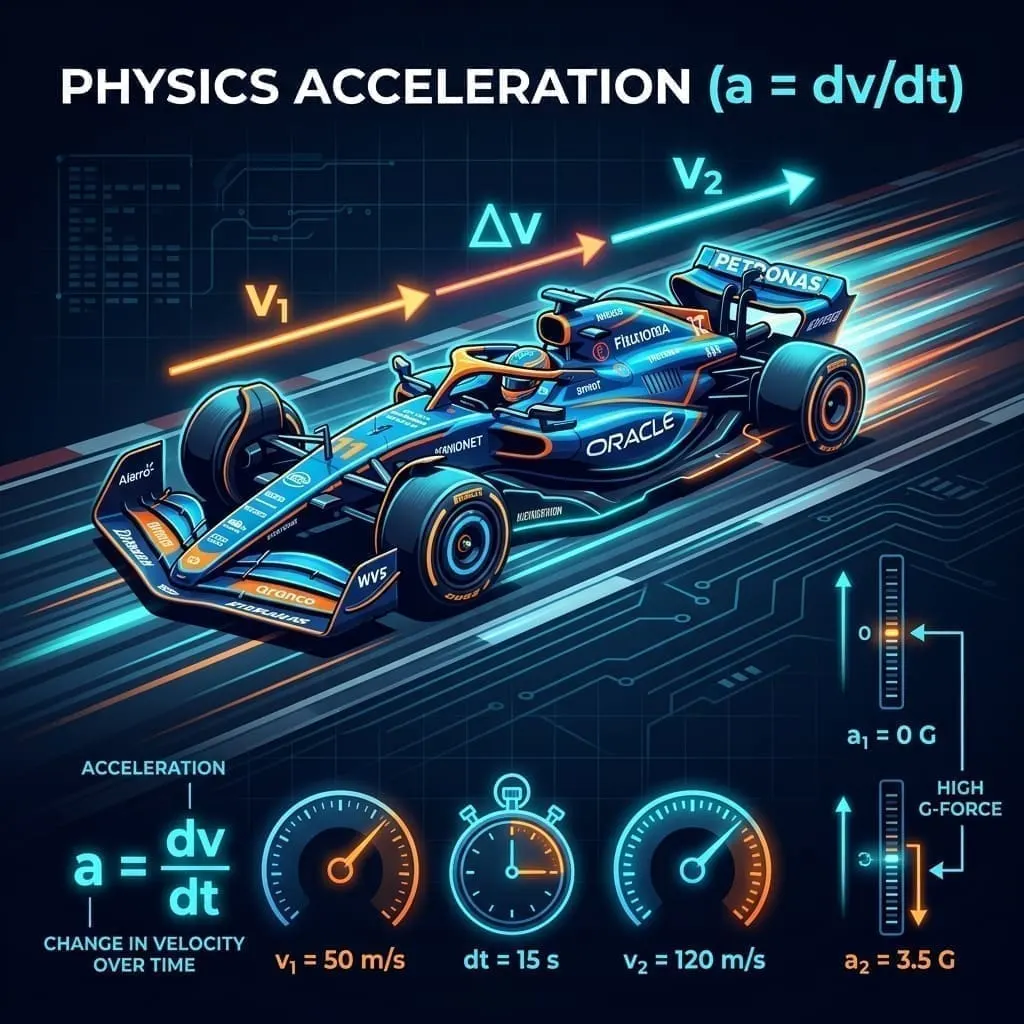
When a space shuttle launches off the pad pressing astronauts firmly into their seats, when a Formula 1 race car slams on carbon-ceramic brakes decelerating into a tight hairpin turn at , or when a roller coaster violently whips riders around a 360-degree loop, the human body does not feel speed itself—it feels Acceleration.
In classical kinematics and Newtonian dynamics, Acceleration () is defined as the time-rate of change of velocity. Because velocity is a vector possessing both magnitude (speed) and spatial direction, an object accelerates whenever it speeds up, slows down (deceleration/braking), or changes its direction of travel (centripetal acceleration).
graph LR
    DV["⚡ Velocity Change (Δv)
v_final - v_initial (m/s)"] --> DIV["➗ Divided By"]
    DT["⏱️ Time Elapsed (Δt)
Duration in Seconds (s)"] --> DIV
    DIV --> A["🚀 Acceleration (a)
a = Δv / Δt (m/s²)"]
    A --> G["🌍 G-Force Equivalent
G = a / 9.80665 m/s²"]
    A --> F["💥 Newton's 2nd Law Force
F_net = m · a (Newtons)"]
Mastering acceleration calculations allows engineers, biomechanists, aviators, and physicists to:
- Design active traction control, anti-lock braking systems (ABS), and airbag crash deployment algorithms in modern automobiles.
- Calculate structural load limits and pilot physiological G-tolerance envelopes in fighter aircraft and spacecraft launch vehicles.
- Analyze elevator and high-speed rail passenger ride comfort profiles, minimizing sudden changes in acceleration (known as Jerk).
- Model ballistic projectile trajectories, missile guidance intercept vectors, and orbital planetary transfer burns.
- Optimize athletic sprinting mechanics, sprint start block explosiveness, and deceleration injury prevention.
2. Definitions & Analogies
2.1 The Simple Definition
In simple everyday terms:
- Velocity tells you how fast and in what direction you are moving right now.
- Acceleration tells you how quickly your velocity is changing each second.
- If your car accelerates at , it means that for every second you press the gas pedal, your speed increases by an additional ().
- If you hit the brakes and your speed drops by each second, your acceleration is (often referred to as deceleration or negative acceleration).
2.2 The Formal Technical Definition
Average Acceleration ()
The ratio of the net change in the velocity vector () to the total elapsed time interval ($\Delta t$):
- SI Base Unit: Meters per second squared () .
- Dimensional Formula: .
Instantaneous Acceleration ()
The instantaneous rate of change of velocity as the elapsed time approaches zero, defined as the first time-derivative of velocity and the second time-derivative of position:
Centripetal (Radial) Acceleration ()
When an object travels along a curved circular path of radius () at constant speed (), the continuous change in directional heading produces an inward radial acceleration toward the center of curvature:
Where is the angular velocity in radians per second ().
2.3 The Airplane Cabin vs. Elevator Drop Analogy
To understand why human senses detect only acceleration and never velocity, consider two everyday scenarios:
graph TD
    subgraph Jet_Cruising ["✈️ Boeing 777 Cruising at 900 km/h"]
        V_High["Velocity = 250 m/s (900 km/h)"]
        A_Zero["Acceleration: a = 0 m/s²"]
        Feel_Zero["Human Body Feels: ZERO Force
(Coffee rests perfectly still on tray table)"]
        V_High --> A_Zero --> Feel_Zero
    end
    subgraph SportsCar_Launch ["🏎️ Supercar Launching from 0 to 100 km/h"]
        V_Low["Velocity = 0 to 28 m/s"]
        A_High["Acceleration: a = 11.2 m/s² (1.14 G)"]
        Feel_Force["Human Body Feels: Heavy Compression
(Head pushed back forcefully into headrest)"]
        V_Low --> A_High --> Feel_Force
end- Cruising at : Even though you are hurtling through the sky faster than a pistol bullet, you can pour a hot cup of coffee smoothly without spilling a single drop because your acceleration is exactly zero ().
- Stepping on the Gas: Even at a modest speed of only , a violent burst of acceleration immediately generates inertial reaction forces () pushing your body deep into the seat padding.
3. History & Milestones in Kinematic Acceleration
timeline
    title Milestones in Acceleration & Dynamics
    1590s : Galileo Galilei measures falling body acceleration on inclined planes
    1687 : Sir Isaac Newton publishes 'Principia', defining F = ma and gravity
    1851 : Jean-Bernard-Léon Foucault proves Earth's rotational acceleration with pendulum
    1915 : Albert Einstein formulates the Equivalence Principle in General Relativity
    1947 : Chuck Yeager breaks the sound barrier in Bell X-1 undergoing rocket acceleration
1954 : John Stapp survives 46.2 Gs on rocket sled to establish human biophysical limits- Galileo Galilei (1590–1638): Prior to Galileo, Aristotelian scholars believed heavy objects fall faster than light ones. Galileo conducted pioneering experiments rolling bronze balls down inclined wooden ramps, using water clocks to prove that falling bodies gain equal increments of velocity in equal time intervals—discovering uniform acceleration () independent of mass.
- Newton's Second Law (, 1687): Sir Isaac Newton unified kinematics with dynamic cause, establishing that acceleration is directly proportional to the net external unbalanced force () and inversely proportional to inertial mass ().
- Einstein's Equivalence Principle (1915): Albert Einstein realized that an observer in a closed elevator cannot distinguish between the upward acceleration of a rocket at and the static downward pull of Earth's gravity, making the concept of G-Force the cornerstone of General Relativity.
- Col. John Stapp's Rocket Sled Experiments (1954): US Air Force physician Dr. John Stapp strapped himself into the Sonic Wind No. 1 rocket sled, accelerating to and decelerating to a dead stop in , subjecting his body to () to prove human survival thresholds for aerospace ejection seat designs.
4. Core Concepts & Parameters Explained
4.1 Velocity Change ()
- Definition: The algebraic difference between the final velocity () and the initial velocity ().
- SI Unit: Meters per second ().
- Sign Conventions:- (): Positive acceleration (speeding up in the forward direction).- (): Negative acceleration (slowing down / braking).
4.2 Elapsed Duration ()
- Definition: The time window over which the velocity change occurs.
- SI Unit: Second ().
- Physical Role: The shorter the duration for a given change in velocity, the greater the resulting acceleration and impact force ().
4.3 Standard G-Force Acceleration ()
- Definition: The ratio of an experienced acceleration () to standard Earth gravitational acceleration ():
- Real-World G-Force Benchmark Spectrum:
| Real-World Scenario | Acceleration ( in ) | Sustained G-Force () | Physical / Physiological Effect |
|---|---|---|---|
| Normal Standing on Earth | Baseline human homeostatic comfort | ||
| High-Speed Passenger Elevator | Mild floating/heavy sensation in stomach | ||
| Commercial Airliner Takeoff Roll | Gentle backward press into cabin seat | ||
| Tesla Model S Plaid (0-60 mph) | Extreme chest compression, rapid blood shift | ||
| Space Shuttle Launch Ascent | Labored breathing, limbs feel heavier | ||
| Formula 1 High-Speed Cornering | Extreme neck muscle strain, vision tunneling | ||
| Untrained Human G-LOC (Blackout) | Blood drains from retinas/brain Loss of consciousness | ||
| Fighter Jet Pilot in Anti-G Suit | Maximum safe sustained military limit | ||
| Sprint Sprinting Start (Blocks) | Explosive muscular horizontal propulsion | ||
| Severe Automotive Crash Impact | Airbag deployment zone; risk of internal organ trauma | ||
| Baseball Bat Striking Ball | Extreme structural material shock loading |
4.4 Jerk: The Derivative of Acceleration ()
In mechanical engineering and elevator design, the rate of change of acceleration with respect to time is known as Jerk ():
High jerk values (sudden snapping changes in acceleration) cause severe whiplash, passenger nausea, and structural fatigue. Modern high-speed elevators use S-curve motion profiling to keep jerk below for silky smooth transit.
5. Master Kinematic Equations of Constant Acceleration
When acceleration () is constant, motion across displacement ($\Delta x$), initial velocity (), final velocity (), and time () obeys the famous Four Big Kinematic Equations:
| Equation Number | Kinematic Equation | Missing / Independent Variable |
|---|---|---|
| 1 | Displacement ($\Delta x$) | |
| 2 | Final Velocity () | |
| 3 | Time Elapsed () | |
| 4 | Acceleration () |
6. Step-by-Step Computational Procedure
flowchart TD
    S1["Step 1: Identify Initial (v_i) & Final (v_f) Velocities
(Extract starting and ending speed parameters)"] --> S2["Step 2: Normalize Units to SI Standards
(Convert km/h or mph to m/s: km/h ÷ 3.6 | mph × 0.44704)"]
    S2 --> S3["Step 3: Calculate Net Velocity Change (Δv = v_f - v_i)
(Determine magnitude and direction of velocity shift)"]
    S3 --> S4["Step 4: Compute Acceleration (a = Δv / Δt)
(Divide by elapsed duration in seconds to yield m/s²)"]
    S4 --> S5["Step 5: Determine Equivalent G-Force & Force Load
(Calculate G = a / 9.80665 and Net Force F = m · a)"]
7. Practical Real-World Calculation Examples
Example 1: Formula 1 Race Car 0-to-200 km/h Launch
- Scenario: A modern Formula 1 car launches from a standstill () reaching in .
- Step 1: Convert Velocity to SI:
- Step 2: Calculate Average Acceleration:
- Step 3: Calculate G-Force:
Example 2: Emergency Vehicle Braking Deceleration & Stopping Distance
- Scenario: A passenger sedan traveling at () performs an emergency ABS stop, coming to a dead stop () in .
- Deceleration Rate:
- Stopping Distance ($\Delta x$):
Example 3: Fighter Jet Aircraft Carrier Catapult Launch
- Scenario: An F/A-18 Super Hornet is accelerated by a steam/EMALS carrier catapult from rest () to takeoff flight speed () along a catapult stroke track of length .
- Step 1: Calculate Acceleration via Kinematic Equation 3:
- Step 2: Sustained Pilot G-Force & Launch Duration:
Example 4: Free-Fall Gravitational Acceleration on Mars
- Scenario: A robotic lander releases a sensor probe from rest on Mars (). How fast is the probe falling after ?
- Final Velocity Calculation:
Example 5: High-Speed Bullet Centripetal Acceleration in Rifled Barrel
- Scenario: A high-velocity rifle bullet spins at () with a bullet radius of .
- Centripetal Acceleration at Bullet Outer Surface:
8. Real-World Engineering Case Studies
Case Study 1: Automotive Crash Pulse Profiling & Airbag Deployment
- Engineering Challenge: In a head-on collision at (), the front chassis crumple zone crushes over . Microcontroller crash sensors must differentiate between a hard pothole impact and a genuine chassis-crushing collision in under to trigger pyrotechnic airbag inflators.
- Kinematic Crash Pulse Analysis:- Average Crash Deceleration Rate:
- Crash Impact Duration:
- Sensor Algorithm Logic: MEMS accelerometers measure the integral of deceleration over time (). When the algorithm detects a sustained deceleration exceeding for over , the airbag inflator squib is energized at , fully inflating the bag by before the occupant's chest strikes the steering column.
Case Study 2: Spacecraft Rocket Staging & Max-Q Acceleration
- Mission Background: A Falcon 9 orbital rocket launches with a liftoff mass of , powered by 9 Merlin 1D engines producing total thrust .
- Dynamic Analysis:- At Liftoff (): Net vertical force .
- Near Main Engine Cut-Off (MECO, ): The rocket has consumed over 90% of its liquid propellant, reducing vehicle mass to only .- Engine Throttling to Prevent Structural Failure:If the engines remained at full thrust:
To prevent payload damage and satellite fairing structural crush, the flight computer throttles down center engines, capping maximum acceleration at strictly ().
9. Common Mistakes & How to Avoid Them
Mistake 1: Confusing High Speed with High Acceleration
An object moving at has zero acceleration if its speed and heading remain constant. Conversely, a stationary car beginning to move () can have a high initial acceleration. Speed is state; acceleration is change.
Mistake 2: Mixing km/h and m/s in $\Delta v$
Calculating acceleration as . This error produces an answer too high! You must convert to first, yielding the true acceleration .
Mistake 3: Forgetting That Turning Is Acceleration
Driving around a roundabout at a perfectly steady is still acceleration! Because your velocity vector direction is rotating continuously, you experience centripetal acceleration () pointing toward the center of the circle.
10. Frequently Asked Questions (FAQ)
Q1: What is the difference between speed, velocity, and acceleration?
A: - Speed is a scalar quantity measuring how fast an object moves ().
- Velocity is a vector specifying speed plus directional heading ().
- Acceleration is the time rate of change of velocity ().
Q2: What is the unit and why is seconds squared?
A: Acceleration measures how many meters per second () of speed an object gains or loses for every second () that passes: . An acceleration of means your speed increases by every single second.
Q3: What is deceleration?
A: Deceleration is a non-technical term for negative acceleration where the acceleration vector opposes the direction of motion, causing the object's scalar speed to decrease.
Q4: What is G-LOC in aviation?
A: G-LOC stands for G-induced Loss of Consciousness. When a fighter pilot pulls steep upward turns (), blood is forced downward away from the brain into the lower limbs. At to , oxygen starvation causes retinal gray-out, tunnel vision, and sudden blackout unless counteracted by pneumatic anti-G suits and the AGSM (Anti-G Straining Maneuver).
Q5: Can an object have zero velocity but non-zero acceleration?
A: Yes! When you throw a ball straight up into the air, at the absolute apex of its flight its velocity is momentarily zero (), but its acceleration is still continuously downward. If acceleration were zero at the top, the ball would freeze in mid-air and never fall down!
Q6: What is the difference between positive and negative Gs?
A: - Positive G (): Pushes you down into your seat, forcing blood toward your feet.
- Negative G (): Lifts you out of your seat, forcing blood upward toward your head (causing "red-out" and high stroke risk). Humans can only tolerate to of negative G-force.
Q7: What is the fastest acceleration ever achieved by a human?
A: Col. John Stapp survived peak deceleration of () on a rocket sled in 1954. IndyCar driver Kenny Bräck survived an instantaneous crash peak of for a fraction of a millisecond during a 2003 collision at Texas Motor Speedway.
Q8: What is tangential vs. centripetal acceleration?
A: In circular or curved motion:
- Tangential Acceleration (): Changes the scalar speed along the curve.
- Centripetal Acceleration (): Changes the direction of travel toward the center of curvature.
- Total Acceleration Vector: .
11. Expert Tips & Best Practices
- Always Convert Speed to Before Calculating: Multiply by $0.44704$, or divide by $3.6$ before substituting values into kinematic formulas.
- Use G-Force for Intuitive Communication: Communicating acceleration as is instantly understandable to pilots, drivers, and the public, whereas feels abstract.
- Check Your Signs Carefully: If initial velocity is and the car is braking, acceleration must be entered as a negative quantity ($-a$) to prevent equations from predicting that the car is speeding up.
12. Summary & Key Takeaways
- Fundamental Formula: (measured in ).
- Vector Nature: Acceleration occurs when speeding up, slowing down, or changing directional heading.
- G-Force Coupling: , representing equivalent Earth gravitational multiples.
- Newton's 2nd Law Link: Net external force directly dictates acceleration: .
- Crucial Real-World Applications: Vital for autonomous vehicle safety engineering, aerospace launch trajectory optimization, elevator ride comfort design, and sports biomechanics.
Additional Technical Guidelines & Measurement Standards
When conducting calculations for Acceleration Velocity Rate Solver, maintaining quantitative precision and verifying input parameter boundaries is essential for reliable scenario evaluation. Always verify that raw numerical inputs are measured using standardized instrumentation, and double-check unit conversions prior to applying outputs in commercial, industrial, or academic projects.
For quantitative unit conversions and scientific calculations, always maintain at least four decimal places of precision during intermediate arithmetic stages before rounding final results. When preparing technical reports, laboratory documentation, or financial forecasts, cross-verify all output variables against established international measurement standards (such as SI, NIST, and ISO metric benchmarks) to guarantee consistent analytical rigor across all computational workflows.
MathsLover.com delivers this interactive solver 100% free of charge to foster global mathematical literacy, educational accessibility, and data-driven problem solving across scientific, technical, and academic communities worldwide.