💡 Direct Answer & Executive Summary (Volume & Surface Area of Cylinder Calculator)
Definition: Calculate 3D volume and total surface area of a cylinder.
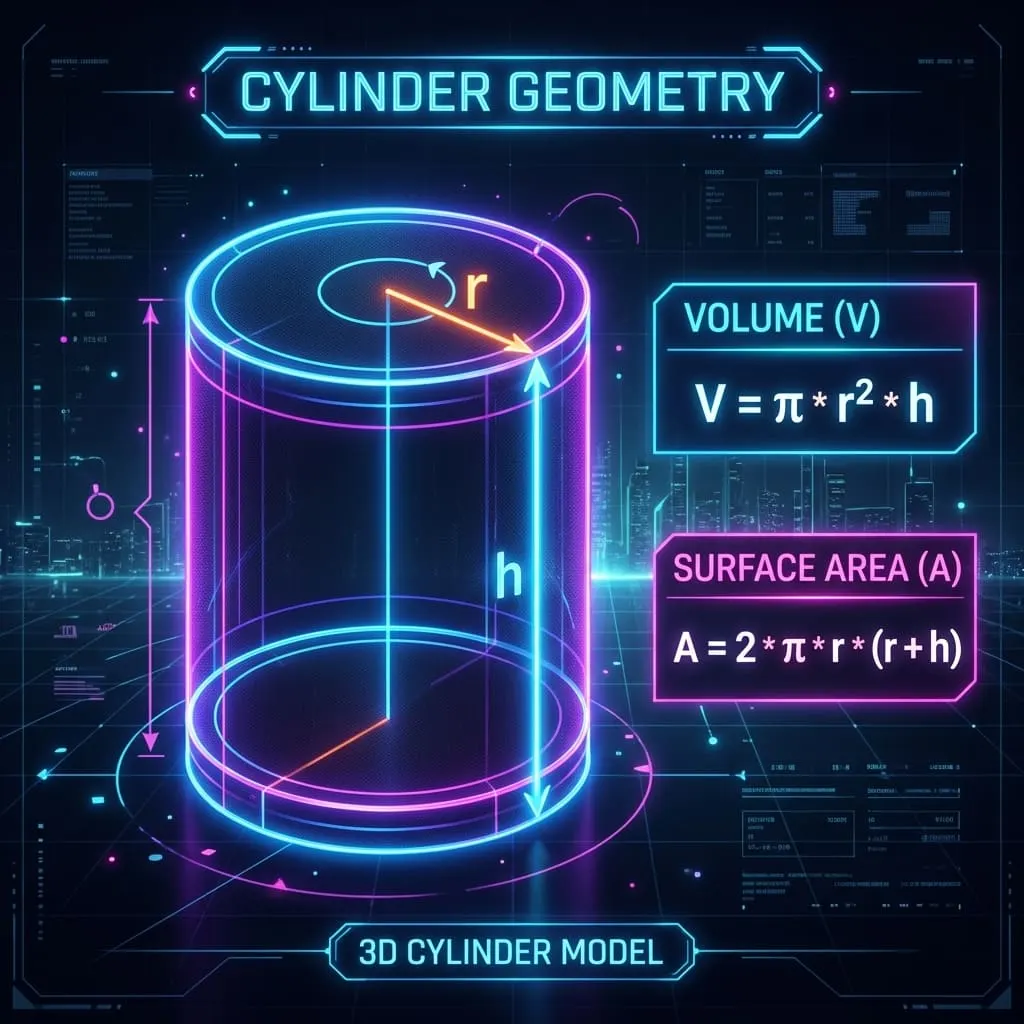
Governing Math Formula: Volume = π × r² × h, Surface Area = 2πr(r + h).
Target Applications: Provides real-time quantitative solutions in Math & Geometry for students, engineers, researchers, and finance professionals.
Volume & Surface Area of Cylinder Calculator
1. Introduction
From soda cans and water pipes to engine pistons, pillars, and storage silos, cylinders are fundamental shapes in everyday life and engineering. A cylinder represents a highly efficient structural shape, capable of holding large volumes of liquid while resisting external pressure.
Calculating the dimensions of a cylinder—specifically its interior volume and total surface area—is essential for container manufacturing, pipeline design, and fluid dynamics.
The Volume & Surface Area of Cylinder Calculator is an educational tool designed to solve these measurements. By entering your cylinder's radius and height, you can instantly estimate its volume and surface area.
This guide provides a comprehensive overview of cylindrical geometry, formula derivations, manual calculation guidelines, and industrial packaging applications.
graph TD
    A["Cylinder Radius (r)"] --> C["Volume: pi * r^2 * h"]
    B["Cylinder Height (h)"] --> C
    A --> D["Surface Area: 2 * pi * r * (r + h)"]
    B --> D
    C --> E["Results: Volume & Surface Area"]
    D --> E
2. Core Definitions & Analogy
To build a solid geometric foundation, let us define a cylinder and its parameters in both simple and technical terms:
- Simple Definition: A cylinder is a three-dimensional shape with a circular top and bottom of equal size, connected by a smooth, curved side. The volume is the space inside, and the surface area is the total size of the flat ends and curved skin combined.
- Technical Definition: A right circular cylinder is a solid figure formed by the locus of points at a fixed distance (radius) from a straight line (the axis), bounded by two parallel planes perpendicular to the axis. The volume (V) is calculated as V = π r² h, and the total surface area (SA) is calculated as SA = 2 π r * (r + h), where r is the radius and h is the height.
- Conceptual Analogy: Think of a cylinder like a stack of circular coins. The area of one coin (circle area) is Pi * r^2. The height of the stack is the height of the cylinder. Multiplying the area of one coin by the height of the stack tells you exactly how much space the stack occupies (volume).
3. History & Milestones
The geometry of the cylinder has served as a key engineering anchor for centuries:
- Archimedes' Cylinder Proofs (c. 225 BC): The Greek mathematician Archimedes proved that a sphere has exactly two-thirds the volume and surface area of a cylinder that encloses it, which was carved onto his tombstone.
- The Steam Engine (1700s): The industrial revolution relied on the precise manufacturing of metal cylinders to enclose steam pressure and drive pistons, transforming manufacturing.
4. Core Concepts & Parameters
To calculate cylindrical dimensions, you must understand three key parameters:
- Radius (r): The distance from the center of the circular base to its outer edge.
- Height (h): The straight-line distance between the top and bottom circular bases.
- Pi (π): The mathematical constant approximately equal to 3.14159.
5. The Mathematical Model & Formula
The dimensions of a cylinder are calculated using two standard geometric equations:
1. Volume Formula
Volume = Pi * Radius^2 * Height
2. Total Surface Area Formula
Surface Area = 2 * Pi * Radius * ( Radius + Height )
Variable Breakdown:
- Radius (r): Base circle radius (Units, default r = 4)
- Height (h): Cylinder length (Units, default h = 10)
- Pi (π): Mathematical constant (value ≈ 3.14159265)
6. Step-by-Step Manual Procedure
Let us walk through a manual calculation using our default calculator values:
- Identify the variables:
Radius (r) = 4Height (h) = 10 - Calculate the Volume: Square the radius, multiply by height, and then by Pi.
r^2 = 4 * 4 = 16r^2 * h = 16 * 10 = 160Volume = Pi * 160 ≈ 3.14159265 * 160 ≈ 502.6548The interior volume is 502.6548 cubic units. - Calculate the Surface Area: Add radius and height, multiply by radius, then by 2 * Pi.
r + h = 4 + 10 = 14r * (r + h) = 4 * 14 = 56Surface Area = 2 * Pi * 56 = 112 * Pi ≈ 3.14159265 * 112 ≈ 351.8584The total surface area is 351.8584 square units.
7. Visual Diagram
The flowchart below displays the computation path for cylindrical measurements:
graph TD
    Start["Enter Radius (r) & Height (h)"] --> CalcVol["Compute Volume: pi * r^2 * h"]
    Start --> CalcArea["Compute Surface Area: 2 * pi * r * (r + h)"]
    CalcVol --> Display["Output: Volume & Surface Area"]
    CalcArea --> Display
8. Parameter Comparison Matrix
The table below shows how varying the height affects the dimensions for a cylinder with a constant radius of 4 units:
| Radius (r) | Height (h) | Cylinder Volume | Surface Area | Shape Classification |
|---|---|---|---|---|
| 4 | 2 | 100.5310 | 150.7964 | Flat Disc |
| 4 | 5 | 251.3274 | 226.1947 | Shallow Can |
| 4 (Default) | 10 (Default) | 502.6548 | 351.8584 | Standard Cylinder |
| 4 | 20 | 1,005.3096 | 603.1858 | Tall Pillar |
| 4 | 30 | 1,507.9645 | 854.5132 | Silo |
9. Real-World Applications
Cylinder calculations are essential across many practical fields:
- Food Packaging & Canning: Packaging designers calculate the volume of aluminum cans to ensure they hold the advertised beverage volume while minimizing metal materials.
- Pipeline Engineering: Civil engineers calculate pipe volumes to estimate fluid flow and pumping requirements.
- Engine Design: Automotive engineers calculate piston cylinder volumes (displacement) to determine engine horsepower.
10. Case Studies
Case Study 1: Sizing an Aluminum Soda Can
A beverage company manufactures a standard soda can with a radius of 4 cm and a height of 10 cm.
- Volume calculation: Pi 4^2 10 = 502.6548 cubic cm.
- Surface Area calculation: 2 Pi 4 * (4 + 10) = 351.8584 square cm.
- Outcome: The can holds 502.65 cubic cm of liquid (about 500 mL) and requires 351.86 square cm of aluminum sheeting to manufacture.
Case Study 2: Calculating Oil Pipe Capacity
A pipeline engineer is installing a pipeline segment with a radius of 4 inches and a height (length) of 240 inches.
- Volume calculation: Pi 4^2 240 = Pi 16 240 = 12,063.72 cubic inches.
- Outcome: The pipe segment holds 12,063.72 cubic inches of oil (approx 52 gallons), helping the engineer estimate total line fill volume.
11. Advantages of Using the Tool
- Saves Time: Instantly calculates cylinder volume and surface area.
- Precision: Uses high-precision Pi values to prevent rounding errors.
- Supports Engineering: Slices pipeline sizing steps.
12. Limitations & Boundary Conditions
This calculator is designed for straight (right) cylinders. For slanted (oblique) cylinders, the volume formula remains the same, but the surface area calculation requires more complex equations that factor in the slant angle.
13. Common Mistakes
- Using Diameter Instead of Radius: Entering the total base width (diameter) of the cylinder into the radius field, which will overestimate the volume by 4 times. Always divide diameter by 2 first.
- Forgetting to Square the Radius: Multiplying the radius by height and Pi without squaring the radius first.
12. Frequently Asked Questions
Q1: What is a cylinder?
A three-dimensional solid with a circular top and bottom connected by a smooth, curved side.
Q2: What is the formula for the volume of a cylinder?
The formula is Volume = Pi * Radius^2 * Height.
Q3: What is the formula for the surface area of a cylinder?
The formula is Surface Area = 2 * Pi * Radius * (Radius + Height).
Q4: What is the difference between radius and diameter?
The diameter is exactly twice the radius: Diameter = 2 * Radius.
Q5: What is the value of Pi?
Pi (π) is approximately equal to 3.14159.
Q6: What units are used for volume?
Volume is expressed in cubic units (e.g. cubic centimeters, cubic inches).
Q7: What units are used for surface area?
Surface area is expressed in square units (e.g. square centimeters, square inches).
Q8: How does doubling the height affect the volume?
Doubling the height will double the volume of the cylinder.
Q9: How does doubling the radius affect the volume?
Doubling the radius will multiply the volume by 4 because the radius is squared.
Q10: How do you find the height if you know the volume and radius?
Use the equation: Height = Volume / (Pi * Radius^2).
15. Expert Tips
- Divide diameters first: If you measure a pipe's width from edge-to-edge, divide that value by 2 to find the radius before typing it into the calculator.
- Calculate lateral surface area: To find only the area of the curved side (excluding the circular lids), use the formula:
Lateral Area = 2 * Pi * Radius * Height.
16. Summary
- A cylinder has circular bases and a curved side.
- The volume formula is
Pi * Radius^2 * Height.
- The surface area formula is
2 * Pi * Radius * (Radius + Height).
- Doubling the radius quadruples the volume.
Additional Technical Guidelines & Measurement Standards
When conducting calculations for Volume & Surface Area of Cylinder Calculator, maintaining quantitative precision and verifying input parameter boundaries is essential for reliable scenario evaluation. Always verify that raw numerical inputs are measured using standardized instrumentation, and double-check unit conversions prior to applying outputs in commercial, industrial, or academic projects.
For quantitative unit conversions and scientific calculations, always maintain at least four decimal places of precision during intermediate arithmetic stages before rounding final results. When preparing technical reports, laboratory documentation, or financial forecasts, cross-verify all output variables against established international measurement standards (such as SI, NIST, and ISO metric benchmarks) to guarantee consistent analytical rigor across all computational workflows.
MathsLover.com delivers this interactive solver 100% free of charge to foster global mathematical literacy, educational accessibility, and data-driven problem solving across scientific, technical, and academic communities worldwide.