💡 Direct Answer & Executive Summary (Complex Number Polar Form Converter)
Definition: Convert a complex number z = x + yi to its polar form.
Governing Math Formula: r = √(x² + y²), θ = atan2(y, x).
Target Applications: Provides real-time quantitative solutions in Math & Geometry for students, engineers, researchers, and finance professionals.
Complex Number Polar Form Converter
1. Introduction
In mathematics and electrical engineering, numbers are not limited to the standard one-dimensional number line. To solve equations involving square roots of negative numbers, mathematicians developed complex numbers, which consist of a real part and an imaginary part (e.g. 3 + 4i).
Complex numbers are typically represented in rectangular coordinates (x + yi) on a two-dimensional grid called the complex plane. However, when performing multiplication, division, or analyzing electrical circuits, representing complex numbers in polar coordinates (using modulus and argument) is much more efficient.
The Complex Number Polar Form Converter is an educational tool designed to solve this conversion. By entering your real and imaginary parts, you can instantly estimate the modulus and argument in degrees.
This guide provides a comprehensive overview of complex number theory, modulus and argument formulas, manual calculation guidelines, and electrical engineering applications.
graph TD
    A["Real Part (x)"] --> C["Calculate Modulus: r = sqrt(x^2 + y^2)"]
    B["Imaginary Part (y)"] --> C
    A --> D["Calculate Argument: theta = atan2(y, x)"]
    B --> D
    C --> E["Results: Modulus (r) & Argument (theta)"]
    D --> E
2. Core Definitions & Analogy
To build a solid algebraic foundation, let us define complex numbers and polar form in both simple and technical terms:
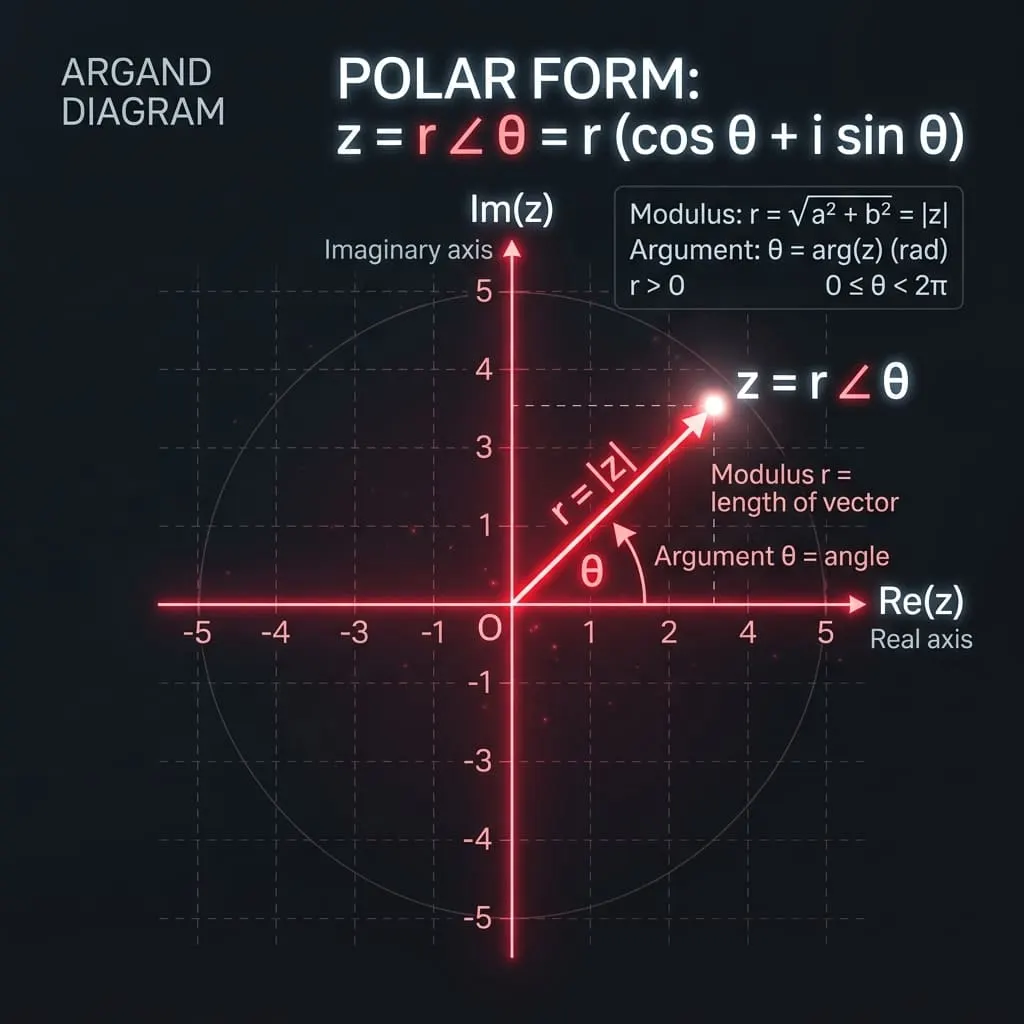
- Simple Definition: A complex number represents a point on a grid. Rectangular form shows how to reach the point using left/right and up/down steps (x + yi). Polar form shows how to reach the same point by rotating a specific angle and walking straight out from the center (r and theta).
- Technical Definition: A complex number z = x + yi in rectangular coordinates is represented in polar form as z = r (cos(theta) + isin(theta)), often abbreviated as r cis(theta). The modulus (r) is the Euclidean distance from the origin, r = sqrt(x² + y²). The argument (theta) is the angle formed with the positive real axis, resolved as theta = atan2(y, x).
- Conceptual Analogy: Imagine you are navigating a city. Rectangular coordinates are like telling someone to walk 3 blocks East (real part, x) and 4 blocks North (imaginary part, y) to reach a coffee shop. Polar coordinates are like telling them to turn exactly 53.13 degrees North of East (argument, theta) and walk straight for 5 blocks (modulus, r) to reach the same shop. Both instructions land you in the same spot, but the polar instructions are a direct line.
3. History & Milestones
The formalization of complex numbers and their coordinates transformed algebraic analysis:
- Rafael Bombelli & Complex Algebra (1572): The Italian mathematician Rafael Bombelli wrote down rules for multiplying complex numbers, demonstrating that imaginary numbers could be used to solve cubic equations.
- Caspar Wessel & the Complex Plane (1799): Wessel published the first geometric representation of complex numbers as points in a two-dimensional plane, which was later popularized by Carl Friedrich Gauss.
- Leonhard Euler & Polar Notation: Euler published Euler's Formula, \( e^{i\theta} = \cos\theta + i\sin\theta \), linking polar coordinates with exponential functions and transforming calculus.
4. Core Concepts & Parameters
To convert complex numbers, you must understand three key parameters:
- Real Part (x): The horizontal coordinate value on the complex plane.
- Imaginary Part (y): The vertical coordinate value on the complex plane (multiplied by the imaginary unit i, where i^2 = -1).
- Modulus (r): The absolute value or magnitude of the complex number, representing the distance from the origin.
- Argument (theta): The angle of rotation from the positive real axis, typically expressed in degrees or radians.
5. The Mathematical Model & Formula
The conversion from rectangular to polar form is solved using two standard equations:
1. Modulus Formula (Pythagorean Equation)
Modulus r = sqrt( Real^2 + Imaginary^2 )
2. Argument Formula (Trigonometric Angle)
Argument theta = atan2( Imaginary , Real ) * ( 180 / Pi )
Variable Breakdown:
- Real Part (x): Horizontal coordinate (Units, default x = 3)
- Imaginary Part (y): Vertical coordinate (Units, default y = 4)
6. Step-by-Step Manual Procedure
Let us walk through a manual calculation using our default calculator values:
- Identify the variables:
Real part (x) = 3Imaginary part (y) = 4 - Calculate the Modulus (r): Square the parts, add them, and find the square root.
x^2 + y^2 = 3^2 + 4^2 = 9 + 16 = 25Modulus r = sqrt(25) = 5.00The modulus (magnitude) is 5.00 units. - Calculate the Argument (theta): Find the arctangent of y/x, then convert to degrees.
theta = atan2(4, 3) ≈ 0.9273 radiansDegrees = 0.9273 * (180 / Pi) ≈ 53.13 degreesThe argument angle is 53.13 degrees.The polar form of the number is 5 cis 53.13° or **5 e^(i 53.13°)**.
7. Visual Diagram
The flowchart below displays the computation path for polar conversions:
graph TD
    Start["Enter Real (x) & Imaginary (y)"] --> CalcMod["Compute Modulus: r = sqrt(x^2 + y^2)"]
    Start --> CalcArg["Compute Argument: theta = atan2(y, x) * 180/pi"]
    CalcMod --> Display["Output: Modulus (r) & Argument Angle (Degrees)"]
    CalcArg --> Display
8. Parameter Comparison Matrix
The table below shows how varying the coordinates affects the modulus and argument:
| Real Part (x) | Imaginary Part (y) | Modulus (r) | Argument Angle (Degrees) | Quadrant Location |
|---|---|---|---|---|
| 1 | 1 | 1.4142 | 45.00° | Quadrant 1 |
| 3 (Default) | 4 (Default) | 5.0000 | 53.13° | Quadrant 1 (3-4-5 Triangle) |
| -3 | 4 | 5.0000 | 126.87° | Quadrant 2 |
| -3 | -4 | 5.0000 | -126.87° | Quadrant 3 |
| 0 | 5 | 5.0000 | 90.00° | Positive Imaginary Axis |
9. Real-World Applications
Polar conversions are essential across several advanced engineering fields:
- AC Electrical Engineering: Engineers model alternating currents (AC) and voltages as complex numbers, using polar form to analyze impedance, phase shifts, and power factors.
- Signal Processing: Sound and radio wave signals are analyzed in polar coordinates to filter frequencies and compress audio files.
- Control Systems: Aerospace engineers use complex polar plots to design stable autopilot systems for aircraft.
10. Case Studies
Case Study 1: AC Circuit Impedance Analysis
An electrical engineer is designing an AC circuit. The measured resistance is 3 ohms (real part, x), and the inductive reactance is 4 ohms (imaginary part, y), yielding an impedance of 3 + 4i ohms.
- Polar conversion: Modulus r = 5, Argument = 53.13 degrees.
- Outcome: The total circuit impedance is 5 ohms, with a current phase shift of 53.13 degrees, helping the engineer select safety fuses.
Case Study 2: Radio Signal Phase Shift
A communications engineer analyzes a radio signal represented as -3 + 4i.
- Polar conversion: Modulus r = 5, Argument = 126.87 degrees.
- Outcome: The signal has a magnitude of 5 and a phase rotation of 126.87 degrees, allowing the engineer to sync the receivers.
11. Advantages of Using the Tool
- Quadrant Protection: Automatically uses
atan2to prevent angle errors in Quadrants 2, 3, and 4.
- Saves Time: Instantly calculates Pythagoras and trig operations.
- Engineering Ready: Perfect for impedance phase evaluations.
12. Limitations & Boundary Conditions
This calculator handles two-dimensional complex numbers. For three-dimensional vector coordinates, you must use spherical or cylindrical coordinates instead.
13. Common Mistakes
- Using Standard
atanInstead ofatan2: Calculating the angle asatan(y/x), which fails for negative coordinates (reversing Quadrant 2 and 4 angles).
- Confusing Modulus and Real Part: Assuming the modulus is just the real part, ignoring the imaginary component.
12. Frequently Asked Questions
Q1: What is a complex number?
A number consisting of a real part and an imaginary part (x + yi).
Q2: What is the polar form of a complex number?
A representation using modulus and argument angle: r * (cos(theta) + i*sin(theta)).
Q3: What is the modulus (r)?
The magnitude or absolute value of the complex number, representing its distance from the origin.
Q4: What is the argument (theta)?
The angle of rotation from the positive real axis on the complex plane.
Q5: What does the imaginary unit i stand for?
The mathematical unit representing the square root of negative one: i^2 = -1.
Q6: Why is polar form preferred for multiplication?
Because multiplying complex numbers in polar form is simple: multiply the moduli and add the argument angles.
Q7: What is the complex plane?
A two-dimensional grid where the horizontal axis represents real numbers and the vertical axis represents imaginary numbers.
Q8: Does this calculator output in radians?
No, it outputs the argument angle in degrees for easier visualization.
Q9: Does a co-signer help lower the DTI ratio?
This is a mortgage underwriting metric; in complex numbers, focus on polar conversions.
Q10: What does "atan2" mean?
A special two-argument arctangent function that returns the correct angle across all four quadrants.
15. Expert Tips
- AC formulas: When analyzing AC circuits, remember that voltage is the product of current and impedance, which is easiest to calculate by multiplying their polar forms.
- Check the quadrant: Always trace the signs of x and y to verify that your calculated angle matches the correct quadrant in the plane.
16. Summary
- Complex numbers combine real and imaginary parts:
x + yi.
- Modulus (r) is the magnitude:
sqrt(x^2 + y^2).
- Argument is the angle:
atan2(y, x).
- Polar form simplifies multiplication and AC circuit analysis.
Additional Technical Guidelines & Measurement Standards
When conducting calculations for Complex Number Polar Form Converter, maintaining quantitative precision and verifying input parameter boundaries is essential for reliable scenario evaluation. Always verify that raw numerical inputs are measured using standardized instrumentation, and double-check unit conversions prior to applying outputs in commercial, industrial, or academic projects.
For quantitative unit conversions and scientific calculations, always maintain at least four decimal places of precision during intermediate arithmetic stages before rounding final results. When preparing technical reports, laboratory documentation, or financial forecasts, cross-verify all output variables against established international measurement standards (such as SI, NIST, and ISO metric benchmarks) to guarantee consistent analytical rigor across all computational workflows.
MathsLover.com delivers this interactive solver 100% free of charge to foster global mathematical literacy, educational accessibility, and data-driven problem solving across scientific, technical, and academic communities worldwide.