💡 Direct Answer & Executive Summary (Arithmetic Progression (AP) Solver)
Definition: Calculate n-th term and cumulative sum of an Arithmetic Progression series.
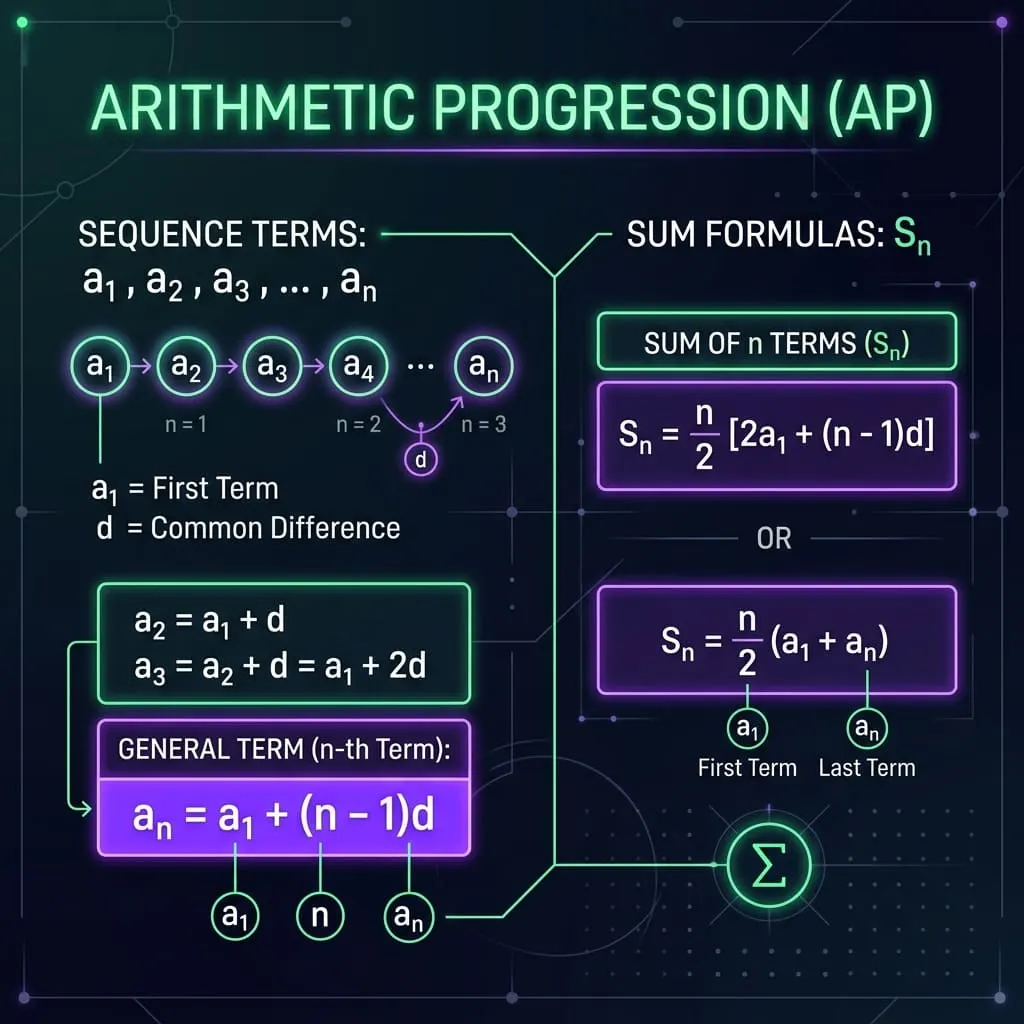
Governing Math Formula: an = a + (n-1)d, Sn = n/2 * (2a + (n-1)d).
Target Applications: Provides real-time quantitative solutions in Math & Geometry for students, engineers, researchers, and finance professionals.
Arithmetic Progression (AP) Solver
1. Introduction
In mathematics, sequences and series help us understand patterns of growth. One of the most fundamental sequences is the arithmetic progression (commonly known as an AP series). In an arithmetic progression, the difference between any two consecutive terms remains constant (e.g. 2, 5, 8, 11...).
Calculating the properties of an arithmetic progression—specifically the value of the n-th term and the cumulative sum of the series—is essential for computing interest schedules, financial projections, and physics equations.
The Arithmetic Progression (AP) Solver is an educational tool designed to analyze these series. By entering your first term, common difference, and number of terms, you can instantly estimate the n-th term and the sum of the series.
This guide provides a comprehensive overview of AP mathematics, sequence formulas, manual calculation guidelines, and financial applications.
graph TD
    A["First Term (a)"] --> D["Calculate n-th Term: a + (n-1) * d"]
    B["Common Difference (d)"] --> D
    C["Number of Terms (n)"] --> D
    A --> E["Calculate Sum: (n/2) * (2*a + (n-1)*d)"]
    B --> E
    C --> E
    D --> F["Results: n-th Term & Sum of Terms"]
    E --> F
2. Core Definitions & Analogy
To build a solid algebraic foundation, let us define arithmetic progressions in both simple and technical terms:
- Simple Definition: An arithmetic progression is a sequence of numbers where each number increases or decreases by the exact same amount to get to the next number.
- Technical Definition: An arithmetic progression (AP) is a sequence of numbers a_1, a_2, a_3... such that the difference a_k - a_(k-1) is a constant d (the common difference). The n-th term (a_n) is expressed as a_n = a + (n - 1) d. The cumulative sum (S_n) of the first n terms is expressed as S_n = (n / 2) [ 2a + (n - 1)d ].
- Conceptual Analogy: Think of an arithmetic progression like climbing a staircase. The first term (a) is the height of the first step. The common difference (d) is the height of each step. The number of terms (n) is the step number you stand on. The n-th term calculates your height at that step, and the sum calculates the total wood used to build the steps from the bottom to where you stand.
3. History & Milestones
The study of arithmetic progression forms the basis of algebraic history:
- Ancient Egyptian Mathematics (c. 1650 BC): The Rhind Papyrus contains problems involving the division of bread and grains in arithmetic progressions, showing early practical use.
- Carl Friedrich Gauss (c. 1787): According to mathematical lore, when Gauss was a child, his teacher asked the class to add all integers from 1 to 100 to keep them busy. Gauss solved it in seconds by identifying the pairing property of AP sums, writing down the answer (5,050) instantly.
4. Core Concepts & Parameters
To evaluate an arithmetic progression, you must understand three key parameters:
- First Term (a): The starting number of the sequence.
- Common Difference (d): The constant value added to each term to get the next term (can be positive or negative).
- Terms (n): The total number of terms in the sequence you want to calculate.
5. The Mathematical Model & Formula
The properties of an arithmetic progression are calculated using two standard algebraic equations:
1. The n-th Term Formula
a_n = a + ( n - 1 ) * d
2. The Sum of Terms Formula
S_n = ( n / 2 ) * ( 2 * a + ( n - 1 ) * d )
Variable Breakdown:
- First Term (a): Starting value (Units, default a = 2)
- Common Difference (d): Step difference (Units, default d = 3)
- Terms (n): Number of steps (Count, default n = 10)
6. Step-by-Step Manual Procedure
Let us walk through a manual calculation using our default calculator values:
- Identify the variables:
First Term (a) = 2Common Difference (d) = 3Terms (n) = 10 - Calculate the n-th Term (a_10):
a_10 = a + (n - 1) * da_10 = 2 + (10 - 1) * 3 = 2 + (9 * 3) = 2 + 27 = 29.00The 10th term in the sequence is 29.00. - Calculate the Sum of Terms (S_10):
S_10 = (n / 2) * (2 * a + (n - 1) * d)S_10 = (10 / 2) * (2 * 2 + (10 - 1) * 3) = 5 * (4 + 9 * 3) = 5 * (4 + 27) = 5 * 31 = 155.00The sum of the first 10 terms is 155.00.
7. Visual Diagram
The flowchart below displays the computation path for AP solvers:
graph TD
    Start["Enter First Term (a), Diff (d), & Terms (n)"] --> CalcTerm["Compute n-th Term: a + (n-1)*d"]
    Start --> CalcSum["Compute Sum: (n/2) * (2*a + (n-1)*d)"]
    CalcTerm --> Display["Output: n-th Term & Sum of Terms"]
    CalcSum --> Display
8. Parameter Comparison Matrix
The table below shows how the common difference affects the n-th term and the sum for a sequence starting at 2 with 10 terms:
| First Term (a) | Difference (d) | Terms (n) | n-th Term | Sum of Terms | Sequence Example |
|---|---|---|---|---|---|
| 2 | 1 | 10 | 11.0000 | 65.0000 | Consecutive integers (2, 3, 4...) |
| 2 | 2 | 10 | 20.0000 | 110.0000 | Even numbers (2, 4, 6...) |
| 2 (Default) | 3 (Default) | 10 (Default) | 29.0000 | 155.0000 | Standard AP (2, 5, 8...) |
| 2 | 5 | 10 | 47.0000 | 245.0000 | High Growth AP (2, 7, 12...) |
| 2 | -1 | 10 | -7.0000 | -25.0000 | Decreasing AP (2, 1, 0...) |
9. Real-World Applications
AP calculations are essential across many practical fields:
- Financial Plan Installments: Loans that increase by a flat fee or savings plans with fixed monthly increases are modeled as AP series.
- Logistical Scheduling: Stadium seating layouts where each row adds a fixed number of seats (e.g. 20 in row 1, 23 in row 2) use AP formulas to calculate total seating capacity.
- Physics Velocity Projections: Objects accelerating under constant gravity increase their velocity in an arithmetic progression.
10. Case Studies
Case Study 1: Sizing Stadium Seating
An arena designer is planning a triangular seating section. The first row has 2 seats, and each subsequent row adds 3 seats. The section has 10 rows.
- n-th Term calculation (Row 10 seats): 2 + (10 - 1) * 3 = 29 seats.
- Sum calculation (Total seats): (10 / 2) (22 + 9*3) = 155 seats.
- Outcome: Row 10 has 29 seats, and the entire section holds 155 seats, helping the designer order the correct number of plastic chairs.
Case Study 2: Calculating Savings Growth
A saver deposits $2 in a jar on day 1. Every day, they increase their deposit by $3 (day 2 is $5, day 3 is $8). They want to check their balance after 10 days.
- Balance calculation: Sum of first 10 terms = 155.
- Outcome: The saver accumulates $155 in 10 days, using calculations to set their savings goals.
11. Advantages of Using the Tool
- Saves Time: Instantly calculates large sequences.
- Dual Outputs: Returns both the n-th term and the cumulative sum.
- Supports Decreasing series: Handles negative difference rates.
12. Limitations & Boundary Conditions
This calculator requires a constant step difference. If your sequence grows by a percentage rate (e.g. doubling every step like 2, 4, 8, 16), you must use a Geometric Progression (GP) calculator instead.
13. Common Mistakes
- Swapping Variables: Putting the common difference in the terms field, which will return incorrect results.
- Off-by-One Errors: Using
ninstead ofn-1in the formulas, which overestimates the terms.
12. Frequently Asked Questions
Q1: What is an arithmetic progression?
A sequence of numbers where the difference between consecutive terms is constant.
Q2: What is the formula for the n-th term of an AP?
The formula is a_n = a + (n - 1) * d.
Q3: What is the formula for the sum of an AP?
The formula is S_n = (n / 2) * (2 * a + (n - 1) * d).
Q4: Can the common difference be negative?
Yes. A negative difference represents a decreasing sequence (e.g. 10, 8, 6...).
Q5: What is the common difference (d)?
The constant value added to each term to get the next term.
Q6: Can the first term be a decimal?
Yes, the solver handles decimal inputs for both the first term and the difference.
Q7: What does "n" stand for?
The total number of terms in the sequence you want to calculate.
Q8: How did Gauss calculate the sum of 1 to 100?
By pairing 1+100=101, 2+99=101, and multiplying 101 by 50 pairs to get 5,050.
Q9: Does a co-signer help lower the DTI ratio?
This is a mortgage underwriting metric; in sequence algebra, focus on arithmetic progression formulas.
Q10: How often do physicists use AP solvers?
Whenever modeling objects moving under constant acceleration.
15. Expert Tips
- Use the pairing shortcut: If you know the first term (a) and the last term (L), you can calculate the sum using:
Sum = (n / 2) * (a + L).
- Verify the sequence: Ensure that the difference between the first three terms is identical before using the AP formulas.
16. Summary
- AP sequences grow or shrink by a constant difference.
- The n-th term formula is
a + (n - 1) * d.
- The sum formula is
(n / 2) * (2 * a + (n - 1) * d).
- AP formulas model constant acceleration and flat savings growth.
Additional Technical Guidelines & Measurement Standards
When conducting calculations for Arithmetic Progression (AP) Solver, maintaining quantitative precision and verifying input parameter boundaries is essential for reliable scenario evaluation. Always verify that raw numerical inputs are measured using standardized instrumentation, and double-check unit conversions prior to applying outputs in commercial, industrial, or academic projects.
For quantitative unit conversions and scientific calculations, always maintain at least four decimal places of precision during intermediate arithmetic stages before rounding final results. When preparing technical reports, laboratory documentation, or financial forecasts, cross-verify all output variables against established international measurement standards (such as SI, NIST, and ISO metric benchmarks) to guarantee consistent analytical rigor across all computational workflows.
MathsLover.com delivers this interactive solver 100% free of charge to foster global mathematical literacy, educational accessibility, and data-driven problem solving across scientific, technical, and academic communities worldwide.