💡 Direct Answer & Executive Summary (Area of Right-Angled Triangle Calculator)
Definition: Compute area, hypotenuse length, and acute angles of a right triangle given legs a and b.
Governing Math Formula: Area = ½ × a × b, Hypotenuse c = √(a² + b²).
Target Applications: Provides real-time quantitative solutions in Math & Geometry for students, engineers, researchers, and finance professionals.
Area of Right-Angled Triangle Calculator
1. Introduction
In geometry and practical trade applications, the right-angled triangle is the most frequently encountered triangle. Defined by having exactly one 90-degree corner, this shape forms the basis of trigonometry, navigation, and structural engineering.
Calculating the dimensions of a right-angled triangle—including its surface area, hypotenuse length, and acute angles—is essential for building roof structures, laying out staircases, and surveying land. Because of the 90-degree angle, the two adjacent sides (legs) serve directly as the base and perpendicular height.
The Area of Right-Angled Triangle Calculator is an educational tool designed to solve these dimensions. By entering the lengths of the two legs, you can instantly estimate the surface area and hypotenuse length.
This guide provides a comprehensive overview of right triangle geometry, the Pythagorean theorem, manual calculation guidelines, and practical construction applications.
graph TD
    A["Leg Length a"] --> C["Area: 0.5 * a * b"]
    B["Leg Length b"] --> C
    A --> D["Hypotenuse: sqrt(a^2 + b^2)"]
    B --> D
    C --> E["Results: Area & Hypotenuse"]
    D --> E
2. Core Definitions & Analogy
To build a solid geometric foundation, let us define a right-angled triangle in both simple and technical terms:
- Simple Definition: A right-angled triangle is a three-sided shape where one corner is a perfect square right angle (90 degrees). The area is calculated by taking half of the product of the two sides that form that 90-degree corner.
- Technical Definition: A right triangle is a triangle in which one angle is a right angle (90 degrees / π/2 radians). The sides adjacent to the right angle are the legs (a, b), and the opposite side is the hypotenuse (c). The area (A) is calculated as A = 0.5 a b, and the hypotenuse (c) is resolved as c = sqrt(a² + b²).
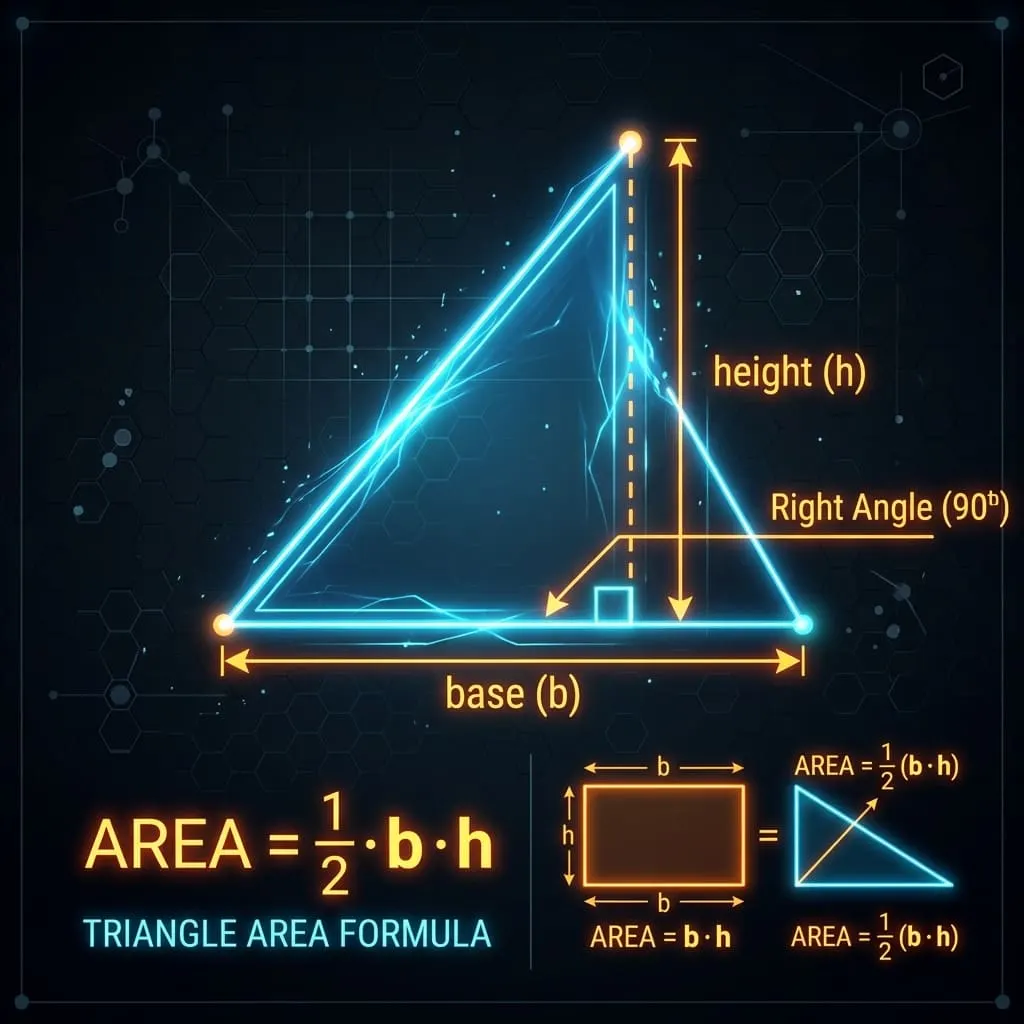
- Conceptual Analogy: Think of a right triangle like a rectangular sandwich cut diagonally in half. The two sides that meet at the square corner represent the length and width of the rectangle. The diagonal cut is the hypotenuse. The surface area of the sandwich half is exactly half of the total rectangular area.
3. History & Milestones
The properties of right-angled triangles form the foundation of historical mathematics:
- Ancient Babylonia (c. 1800 BC): The Plimpton 322 clay tablet displays tables of Pythagorean triples (whole numbers that form right triangles, like 3, 4, 5), showing early knowledge of right triangle geometry.
- The Pythagorean Theorem (c. 500 BC): The Greek philosopher and mathematician Pythagoras popularized the proof that for any right triangle, the square of the hypotenuse equals the sum of the squares of the legs:
a^2 + b^2 = c^2.
4. Core Concepts & Parameters
To calculate right triangle dimensions, you must understand three key parameters:
- Leg a: One of the two sides adjacent to the 90-degree corner (serves as the height).
- Leg b: The other side adjacent to the 90-degree corner (serves as the base).
- Hypotenuse (c): The longest side of the triangle, located opposite the 90-degree corner.
5. The Mathematical Model & Formula
The dimensions of a right triangle are calculated using two standard geometric equations:
1. Area Formula
Area = 0.5 * Leg a * Leg b
2. Hypotenuse Formula (Pythagorean Theorem)
Hypotenuse = sqrt( Leg a^2 + Leg b^2 )
Variable Breakdown:
- Leg a: Height dimension (Units, default a = 3)
- Leg b: Base dimension (Units, default b = 4)
6. Step-by-Step Manual Procedure
Let us walk through a manual calculation using our default calculator values:
- Identify the variables:
Leg a = 3Leg b = 4 - Calculate the Area: Multiply the two legs, then divide by 2.
Area = 0.5 * 3 * 4 = 0.5 * 12 = 6.00The surface area is 6.00 square units. - Calculate the Hypotenuse (c): Square both legs, add them, and find the square root.
a^2 + b^2 = 3^2 + 4^2 = 9 + 16 = 25Hypotenuse (c) = sqrt(25) = 5.00The hypotenuse length is 5.00 units.The side lengths (3, 4, 5) form a classic Pythagorean triple.
7. Visual Diagram
The flowchart below displays the computation path for right triangle dimensions:
graph TD
    Start["Enter Leg a & Leg b"] --> CalcArea["Compute Area: 0.5 * a * b"]
    Start --> CalcHypot["Compute Hypotenuse: sqrt(a^2 + b^2)"]
    CalcArea --> Display["Output: Area & Hypotenuse"]
    CalcHypot --> Display
8. Parameter Comparison Matrix
The table below shows how the leg lengths affect the area and hypotenuse of a right-angled triangle:
| Leg a | Leg b | Triangle Area | Hypotenuse (c) | Perimeter | Classification |
|---|---|---|---|---|---|
| 1 | 1 | 0.5000 | 1.4142 | 3.4142 | Isosceles Right Triangle |
| 3 (Default) | 4 (Default) | 6.0000 | 5.0000 | 12.0000 | Classic 3-4-5 Triple |
| 5 | 12 | 30.0000 | 13.0000 | 30.0000 | 5-12-13 Triple |
| 8 | 15 | 60.0000 | 17.0000 | 40.0000 | 8-15-17 Triple |
| 10 | 10 | 50.0000 | 14.1421 | 34.1421 | Large Isosceles Right |
9. Real-World Applications
Right triangle calculations are essential across many practical fields:
- Carpentry & Framing: Roofers use right triangle calculations to determine the pitch and length of roof rafters.
- Staircase Design: Carpenters calculate the riser (Leg a) and run (Leg b) of steps to determine the stringer length (hypotenuse).
- Navigation & GPS Systems: Navigation systems use triangulation (solving right triangles) to calculate coordinate distances.
10. Case Studies
Case Study 1: Cutting a Staircase Stringer
A carpenter is building a wooden staircase leading to a deck. The deck height is 3 feet (Leg a), and the horizontal distance along the ground is 4 feet (Leg b).
- Hypotenuse calculation: sqrt(3^2 + 4^2) = 5 feet.
- Outcome: The carpenter cuts a wooden stringer exactly 5 feet long, ensuring the staircase fits the deck dimensions perfectly.
Case Study 2: Estimating Roof Rafter Materials
A builder designs a simple roof truss. The roof ridge is 3 meters above the ceiling beam (Leg a), and the horizontal half-span is 4 meters (Leg b).
- Area calculation: 0.5 3 4 = 6 square meters.
- Rafter Length calculation: sqrt(3^2 + 4^2) = 5 meters.
- Outcome: The builder purchases 5-meter rafters, using calculations to check material requirements before starting assembly.
11. Advantages of Using the Tool
- No Height Search Required: The legs serve directly as base and height.
- Saves Time: Instantly calculates both area and hypotenuse.
- High Precision: Solves complex Pythagorean square roots without rounding errors.
12. Limitations & Boundary Conditions
This calculator requires that the angle between the two legs is exactly 90 degrees. If the triangle does not contain a right angle, you must use the standard base and height calculator or Heron's formula calculator instead.
13. Common Mistakes
- Using the Hypotenuse as a Leg: Entering the hypotenuse length into the Leg a or Leg b fields, which will overestimate the area.
- Forgetting to Divide by 2: Multiplying the two legs and forgetting to divide by 2, which will overestimate the triangle's area by double.
12. Frequently Asked Questions
Q1: What is a right-angled triangle?
A triangle that contains exactly one right angle (90 degrees).
Q2: What is the formula for the area of a right triangle?
The formula is Area = 0.5 * Leg a * Leg b.
Q3: What is the Pythagorean theorem?
The formula is a^2 + b^2 = c^2, which states that the sum of the squares of the legs equals the square of the hypotenuse.
Q4: What is the hypotenuse?
The longest side of a right triangle, located opposite the 90-degree corner.
Q5: Can a right triangle have equal legs?
Yes, an isosceles right triangle has two equal legs (e.g. 1, 1, sqrt(2)) and two 45-degree acute angles.
Q6: What is a Pythagorean triple?
A set of three positive integers that fit the Pythagorean theorem, such as (3, 4, 5) or (5, 12, 13).
Q7: What units are used for area?
Area is expressed in square units (e.g. square feet, square meters).
Q8: How do you find the perimeter?
Sum the three sides: Perimeter = Leg a + Leg b + Hypotenuse.
Q9: Does the formula work if I use Leg b as the height?
Yes. Since multiplication is commutative, 0.5 * a * b yields the same result as 0.5 * b * a.
Q10: How do you check if a corner is exactly 90 degrees?
By measuring a 3-4-5 triangle on the corner. If the diagonal measures exactly 5 units, the corner is a perfect right angle.
15. Expert Tips
- Use the 3-4-5 rule: When building fences or decks, measure 3 feet along one side and 4 feet along the other. If the distance between those points is exactly 5 feet, your corner is perfectly square.
- Maintain unit consistency: Ensure both leg measurements are in the same unit (e.g. both in inches or both in centimeters) before calculating.
16. Summary
- Right triangles contain one 90-degree angle.
- The area is
0.5 * Leg a * Leg b.
- The hypotenuse is
sqrt(Leg a^2 + Leg b^2).
- The adjacent legs serve directly as base and height.
Additional Technical Guidelines & Measurement Standards
When conducting calculations for Area of Right-Angled Triangle Calculator, maintaining quantitative precision and verifying input parameter boundaries is essential for reliable scenario evaluation. Always verify that raw numerical inputs are measured using standardized instrumentation, and double-check unit conversions prior to applying outputs in commercial, industrial, or academic projects.
For quantitative unit conversions and scientific calculations, always maintain at least four decimal places of precision during intermediate arithmetic stages before rounding final results. When preparing technical reports, laboratory documentation, or financial forecasts, cross-verify all output variables against established international measurement standards (such as SI, NIST, and ISO metric benchmarks) to guarantee consistent analytical rigor across all computational workflows.
MathsLover.com delivers this interactive solver 100% free of charge to foster global mathematical literacy, educational accessibility, and data-driven problem solving across scientific, technical, and academic communities worldwide.