💡 Direct Answer & Executive Summary (Area of Triangle (Base & Height))
Definition: Calculate surface area of any triangle given its base width and perpendicular height.
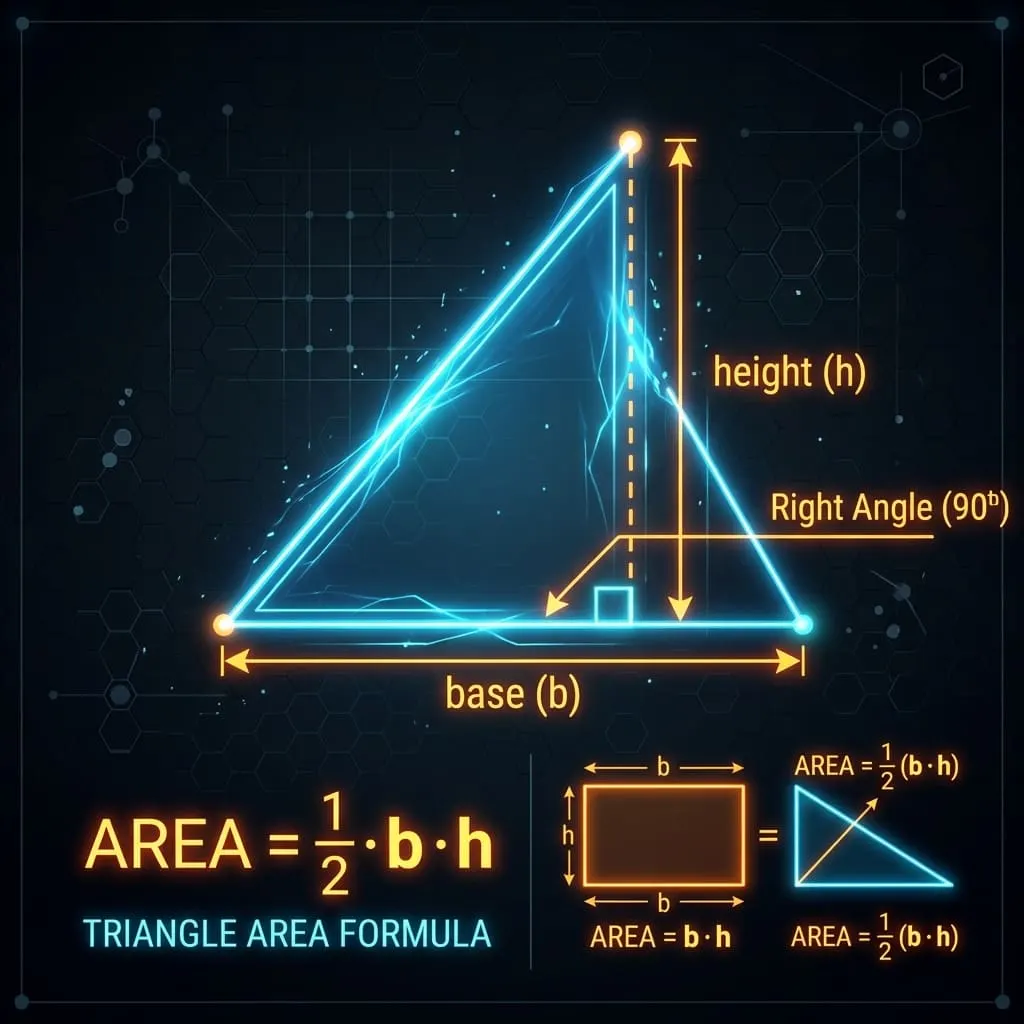
Governing Math Formula: Area = ½ × Base × Height (A = 0.5 × b × h).
Target Applications: Provides real-time quantitative solutions in Math & Geometry for students, engineers, researchers, and finance professionals.
Area of Triangle (Base & Height)
1. Introduction
Triangles are the structural bedrock of geometry and engineering. Because of their structural stability, triangles are used in bridge trusses, roof frames, and architectural structures. Unlike quadrilaterals, triangles cannot deform without changing their side lengths, making them exceptionally strong.
Calculating the size of a triangle is a fundamental requirement in trigonometry, surveying, and design. The most common way to calculate a triangle's surface area is by using its base width and perpendicular height.
The Area of Triangle (Base & Height) Calculator is an educational tool designed to solve this measurement. By entering your triangle's base width and perpendicular height, you can instantly estimate its surface area and equivalent square side.
This guide provides a comprehensive overview of triangular geometry, formula derivations, manual calculation guidelines, and structural applications.
graph TD
    A["Base Width (b)"] --> C["Multiply: 0.5 * b * h"]
    B["Perpendicular Height (h)"] --> C
    C --> D["Result: Triangle Area ($)"]
    D --> E["Square Root of Area"]
    E --> F["Result: Equivalent Square Side"]
2. Core Definitions & Analogy
To build a solid geometric foundation, let us define a triangle and its parameters in both simple and technical terms:
- Simple Definition: A triangle is a three-sided shape. The area is the flat space inside its boundaries, calculated by taking half of the base multiplied by the height.
- Technical Definition: A triangle is a polygon with three vertices and three edges. The area (A) is half the product of any side chosen as the base (b) and the corresponding altitude or perpendicular height (h), expressed as A = 0.5 b h.
- Conceptual Analogy: Imagine a rectangular sandwich. If you cut the sandwich diagonally from one corner to the opposite corner, you get two identical triangles. The length of the sandwich is the base, and the width is the height. The area of one of these triangular sandwich halves is exactly half of the total rectangular area.
3. History & Milestones
The formula for the area of a triangle has been used for thousands of years:
- Rhind Mathematical Papyrus (c. 1650 BC): Ancient Egyptian scribes recorded calculations for the area of triangles to determine taxes on agricultural land along the Nile.
- Euclidean Geometry (c. 300 BC): Euclid proved that any triangle has exactly half the area of a parallelogram with the same base and height, providing the mathematical proof for the formula.
4. Core Concepts & Parameters
To calculate triangular dimensions, you must understand two key parameters:
- Base Width (b): Any chosen side of the triangle, typically the bottom horizontal side.
- Height (h): The perpendicular (90-degree) distance from the chosen base to the opposite corner (vertex). This is not the length of the slanted sides.
5. The Mathematical Model & Formula
The dimensions of a triangle are calculated using two standard geometric equations:
1. Area Formula
Area = 0.5 * Base * Height
2. Equivalent Square Side Formula
Equivalent Square Side = sqrt( Area )
Variable Breakdown:
- Base (b): Length of the bottom horizontal side (Units, default b = 10)
- Height (h): Perpendicular altitude from base to peak (Units, default h = 6)
6. Step-by-Step Manual Procedure
Let us walk through a manual calculation using our default calculator values:
- Identify the variables:
Base Width (b) = 10Height (h) = 6 - Multiply the base by the height:
Base * Height = 10 * 6 = 60 - Divide by 2 to get the area:
Area = 0.5 * 60 = 30.00The surface area is 30.00 square units. - Calculate the Equivalent Square Side: Find the square root of the area.
Equivalent Square Side = sqrt(30) ≈ 5.4772A square with a side length of 5.4772 units will cover the exact same surface area as the triangle.
7. Visual Diagram
The flowchart below displays the computation path for triangle base and height measurements:
graph TD
    Start["Enter Base Width (b) & Height (h)"] --> CalcArea["Compute Area: 0.5 * b * h"]
    CalcArea --> CalcSquare["Compute Square Side: sqrt(Area)"]
    CalcSquare --> Display["Output: Triangle Area & Equivalent Square Side"]
8. Parameter Comparison Matrix
The table below shows how changing the height affects the dimensions of a triangle with a constant base of 10 units:
| Base (b) | Height (h) | Triangle Area | Equivalent Square Side | Shape Category |
|---|---|---|---|---|
| 10 | 2 | 10.0000 | 3.1623 | Flat Triangle |
| 10 | 4 | 20.0000 | 4.4721 | Short Triangle |
| 10 (Default) | 6 (Default) | 30.0000 | 5.4772 | Standard Triangle |
| 10 | 10 | 50.0000 | 7.0711 | Tall Triangle (Height equals base) |
| 10 | 20 | 100.0000 | 10.0000 | Ultra-Tall Triangle |
9. Real-World Applications
Triangle calculations are essential across many practical fields:
- Construction & Carpentry: Roofers calculate the surface area of triangular gables to purchase siding material or shingles.
- Structural Engineering: Bridge designers calculate truss loads, which are modeled as networks of triangles.
- Art & Graphic Design: Digital designers use triangular meshes (polygon models) to render three-dimensional objects in computer graphics.
10. Case Studies
Case Study 1: Shingling a Triangular Gable
A builder wants to install siding on a triangular gable on the side of a house.
- Dimensions: The base of the gable is 10 meters wide, and the height from the base to the roof peak is 6 meters.
- Area calculation: 0.5 10 6 = 30 square meters.
- Outcome: The builder purchases 30 square meters of siding material (plus a buffer) to cover the gable.
Case Study 2: Calculating sail area
A sailboat owner wants to replace their mainsail. The sail is a right triangle.
- Dimensions: The base along the boom is 10 feet, and the height along the mast is 20 feet.
- Area calculation: 0.5 10 20 = 100 square feet.
- Outcome: The sail area is 100 square feet, which helps the owner select the correct sail weight and material.
11. Advantages of Using the Tool
- Saves Time: Instantly calculates triangular areas.
- Supports Material Estimations: Helps size raw materials for triangular frames.
- Equivalency Checker: Easily compares triangular areas to equivalent squares.
12. Limitations & Boundary Conditions
This calculator requires the perpendicular height. If you only know the lengths of the three outer sides, you must use Heron's formula instead.
13. Common Mistakes
- Using Slanted Side Lengths as Height: Measuring along the slanted edge of the triangle to find the height. Always measure the perpendicular distance from the base to the opposite peak.
- Forgetting to Divide by 2: Multiplying base by height and forgetting to divide by 2, which will overestimate the triangle's area by double.
12. Frequently Asked Questions
Q1: What is the formula for the area of a triangle?
The formula is Area = 0.5 * Base * Height.
Q2: What is the height of a triangle?
The perpendicular distance from the chosen base to the opposite corner.
Q3: Can any side of the triangle be the base?
Yes. You can choose any of the three sides as the base, as long as you measure the height perpendicular to that specific side.
Q4: How is a triangle's area related to a rectangle?
A triangle's area is exactly half the area of a rectangle or parallelogram with the same base and height.
Q5: What is the equivalent square side?
The side length of a square that has the exact same surface area as the calculated triangle.
Q6: What units are used for area?
Area is expressed in square units (e.g. square meters, square feet).
Q7: Does the formula work for obtuse triangles?
Yes. The formula works for all triangles, though the perpendicular height may fall outside the base boundary in obtuse triangles.
Q8: What if I only know the side lengths?
Use Heron's formula calculator instead of the base and height formula.
Q9: Does a triangle's shape alter the formula?
No. The formula 0.5 * b * h applies to right, equilateral, isosceles, and scalene triangles.
Q10: How do you double a triangle's area?
By doubling either the base or the height.
15. Expert Tips
- Measure height perpendicularly: When building roof trusses or gables, use a plumb line to verify that your height measurement is perfectly vertical to the base.
- Deconstruct complex shapes: You can calculate the area of complex polygons by dividing them into simpler triangles and summing their areas.
16. Summary
- The area of a triangle is
0.5 * Base * Height.
- Height must be measured perpendicular to the base.
- The equivalent square side is
sqrt(Area).
- The formula applies to all triangle shapes.
Additional Technical Guidelines & Measurement Standards
When conducting calculations for Area of Triangle (Base & Height), maintaining quantitative precision and verifying input parameter boundaries is essential for reliable scenario evaluation. Always verify that raw numerical inputs are measured using standardized instrumentation, and double-check unit conversions prior to applying outputs in commercial, industrial, or academic projects.
For quantitative unit conversions and scientific calculations, always maintain at least four decimal places of precision during intermediate arithmetic stages before rounding final results. When preparing technical reports, laboratory documentation, or financial forecasts, cross-verify all output variables against established international measurement standards (such as SI, NIST, and ISO metric benchmarks) to guarantee consistent analytical rigor across all computational workflows.
MathsLover.com delivers this interactive solver 100% free of charge to foster global mathematical literacy, educational accessibility, and data-driven problem solving across scientific, technical, and academic communities worldwide.