💡 Direct Answer & Executive Summary (Area of Square Calculator)
Definition: Calculate surface area, perimeter length, and diagonal distance of a square from side length.
Governing Math Formula: Area = a², Perimeter = 4a, Diagonal d = a√2.
Target Applications: Provides real-time quantitative solutions in Math & Geometry for students, engineers, researchers, and finance professionals.
Area of Square Calculator
1. Introduction
Geometrical shapes form the building blocks of both physical structures and abstract mathematical reasoning. Among these, the square is one of the most fundamental, recognizable, and widely used polygons in the world. From the tiles on our floors to the architectural layout of city squares, this four-sided figure plays an essential role in daily design, engineering, and spatial optimization.
Understanding how to calculate the area of a square is critical because it tells us the total two-dimensional space enclosed within its boundaries. Whether you are a student learning the basics of geometry, a home designer determining how many carpet tiles to buy, or an urban planner mapping layout zones, mastering square area is a core spatial competency.
In this guide, you will learn the definition of a square, the history behind its study, the mathematical formula for area, step-by-step instructions for manual calculation, and real-world case studies demonstrating its application.
graph TD
    A["Side Length (a)"] --> B["Square Shape"]
    B --> C["Multiply: a * a"]
    C --> D["Result: Area in Square Units"]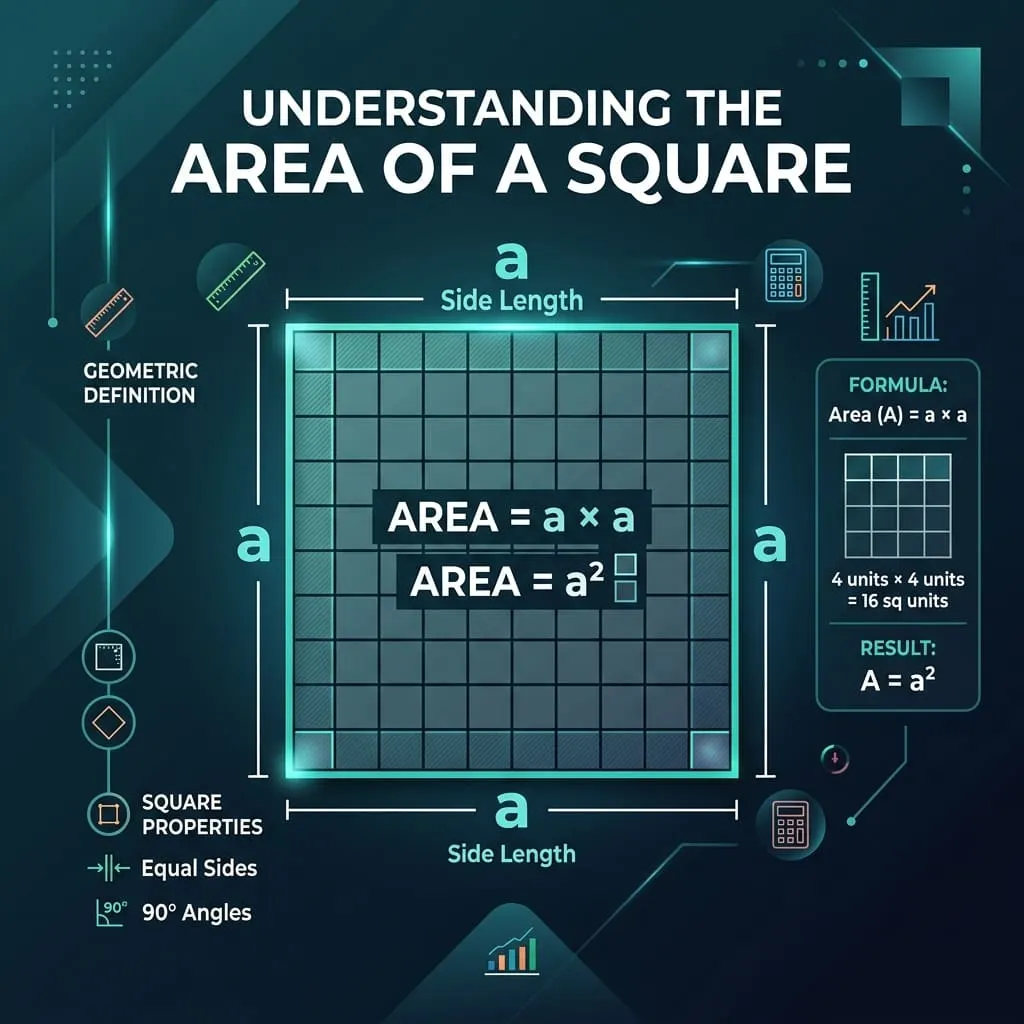
2. Core Definitions & Analogy
To build a strong understanding, let us define the square and its properties in simple and technical terms:
- Simple Definition: A square is a flat, four-sided shape where all four sides are exactly the same length, and all four corners are perfectly square (90-degree right angles).
- Technical Definition: A square is a regular quadrilateral, which means it is a convex polygon with four equal sides and four equal angles of 90 degrees. It is a special type of rectangle (where adjacent sides are equal) and a special type of rhombus (where all angles are right angles).
- Conceptual Analogy: Think of a square like a perfectly folded square napkin. If you fold it so that any side is shorter or longer than the others, or if you pull the corners so they form slanted diamonds, it loses its perfect square shape. Every side and angle must remain completely balanced and symmetrical.
3. History & Milestones
The study of squares and quadratic forms dates back to the dawn of human civilization, when ancient societies needed to partition land, build monuments, and trade goods:
- Ancient Babylonia (c. 1900–1600 BC): Archeological clay tablets show that Babylonian mathematicians understood how to compute the areas of squares and rectangles, using them as basic units for land measurement.
- Ancient Egypt: Egyptian surveyors, known as "rope stretchers," utilized squares and right angles (with 3-4-5 triangles) to rebuild land boundaries along the Nile River after annual floods.
- Pythagoreans (c. 500 BC): The ancient Greeks studied the properties of squares deeply. The diagonal of a square led to the discovery of irrational numbers, specifically the square root of 2, which shocked the Pythagorean school.
- Modern Algebra: The term "squaring" a number (multiplying a number by itself, written as x^2) comes directly from the geometric process of building a physical square with side length x.
4. Core Concepts & Parameters
To compute the parameters of a square, we look at three fundamental metrics derived from the side length:
- Side Length (a): The linear distance of any one of the four identical edges. This is the primary independent variable.
- Perimeter (P): The total distance around the outside of the square. Since there are four equal sides, the perimeter is simply the sum of all sides:
P = 4 * a. - Diagonal (d): The straight-line distance between opposite corners. It bisects the square into two right-angled triangles. By the Pythagorean theorem, the diagonal is:
d = a * sqrt(2).
5. The Mathematical Formula
The mathematical formulas used to solve the square's geometric properties are highly straightforward but mathematically elegant:
Area Formula
Area = a * a
Variable Breakdown:
- Area: The total surface space (measured in square units like cm^2, m^2, or in^2).
- a: The side length (measured in linear units like cm, m, or in).
Why the Formula Works:
Area is a measure of two-dimensional grid space. If you have a square with a side length of 5 centimeters, you can divide it into 5 rows and 5 columns of 1-centimeter grid squares. Counting the total number of blocks yields 5 * 5 = 25 blocks. Therefore, multiplying the side length by itself gives the exact area.
6. Step-by-Step Manual Procedure
Calculating the area of a square manually is simple when following these steps:
- Measure the side length: Identify the length of one side of the square. Let's say it is 8 meters.
- Verify the shape is a square: Double-check that all four sides are equal and all internal angles are 90 degrees.
- Multiply the side by itself: Multiply the side length by itself (square it).
8 * 8 = 64 - Append the correct square units: Ensure the result is written in square units.
Area = 64 square meters (m^2)
7. Visual Diagram
The following flowchart shows the process of calculating a square's parameters:
graph TD
    Start["Get Side Length (a)"] --> Input["Input Value (e.g. 5)"]
    Input --> CalcArea["Compute Area: a * a"]
    Input --> CalcPeri["Compute Perimeter: 4 * a"]
    Input --> CalcDiag["Compute Diagonal: a * sqrt(2)"]
    CalcArea --> Display["Display Results: Area, Perimeter, Diagonal"]
8. Parameter Comparison Matrix
The table below demonstrates how varying the side length impacts the area, perimeter, and diagonal metrics:
| Side Length (a) | Perimeter (4a) | Diagonal Length (a * sqrt(2)) | Total Area (a * a) |
|---|---|---|---|
| 1 unit | 4 units | 1.414 units | 1 square unit |
| 3 units | 12 units | 4.243 units | 9 square units |
| 5 units (Default) | 20 units | 7.071 units | 25 square units |
| 10 units | 40 units | 14.142 units | 100 square units |
| 20 units | 80 units | 28.284 units | 400 square units |
9. Real-World Applications
Calculating the area of a square is highly relevant in daily life and industrial fields:
- Tiling & Flooring: Contractors calculate the floor area of a square room to purchase the correct volume of wood, vinyl, or ceramic tiles.
- Solar Panel Placement: Technicians measure square roof spaces to determine how many square solar panels can be installed.
- Art & Framing: Artists and custom framers compute the area of square canvas boards to price materials.
- Agriculture: Farmers calculate the square area of crop plots to estimate seed density and water requirements.
10. Case Studies
Case Study 1: Living Room Renovation
A homeowner wants to install ceramic tiles in a square living room with a side length of 6 meters. Each tile box covers 3 square meters of floor space.
- Area calculation: 6 * 6 = 36 m^2.
- Material requirement: 36 / 3 = 12 boxes of tiles. By calculating the exact square area, the homeowner purchases the perfect volume of tiles without wasting money on excess stock.
Case Study 2: School Yard Fence
A school wants to secure a square playground with a perimeter fence. The playground side length is 25 meters.
- Perimeter calculation: 4 * 25 = 100 meters of fencing wire.
- Area of playground: 25 * 25 = 625 m^2 of play space for students.
11. Advantages of Using the Tool
- Instant Solutions: Computes Area, Perimeter, and Diagonal concurrently in milliseconds.
- No Manual Errors: Eliminates mistakes in square root evaluations for diagonals.
- Unit Agnostic: Works with any linear units (metric or imperial).
12. Limitations & Boundary Conditions
This calculator handles standard, positive numbers representing physical dimensions. It does not accept negative numbers or zero side lengths, as a physical square must have a positive, real side length to exist in two-dimensional space.
13. Common Mistakes
- Confusing Area and Perimeter: Beginners sometimes add the sides together instead of multiplying them, leading to incorrect area estimates (e.g. for side = 4, area is 16, perimeter is 16, but for side = 5, area is 25 while perimeter is 20).
- Unit Mismatch: Forgetting to square the units in the final answer (e.g. writing "25 cm" instead of "25 cm^2").
12. Frequently Asked Questions
Q1: What is the area of a square?
The area is the total two-dimensional space enclosed within the four equal sides of a square.
Q2: What is the formula for the area of a square?
The formula is Area = a * a, where a is the length of one side.
Q3: How do you find the diagonal of a square?
You multiply the side length by the square root of 2: d = a * sqrt(2).
Q4: If the side of a square is doubled, what happens to its area?
The area is multiplied by four because the area scales quadratically.
Q5: Can you find the area if you only know the diagonal?
Yes. The formula is Area = d * d / 2.
Q6: What is the perimeter of a square?
The perimeter is the total boundary distance around the square: P = 4 * a.
Q7: Are the area and perimeter of a square ever equal?
Yes, for a square with a side length of 4 units, both the area and perimeter equal 16.
Q8: What units are used to measure the area of a square?
Square units are used, such as square centimeters (cm^2), square meters (m^2), or square inches (in^2).
Q9: Why is it called "squaring" a number?
Because raising a number to the power of 2 corresponds geometrically to finding the area of a square with that side length.
Q10: Does a square have equal diagonals?
Yes, the two diagonals of a square are always equal in length and bisect each other at 90-degree right angles.
15. Expert Tips
- Always include waste margins: When purchasing square tiles or drywall sheets, buy 10% extra material to account for cutting wastes at corners.
- Use the diagonal to check squareness: When building furniture or laying out foundations, measure the two diagonals. If they are exactly equal, your structure is perfectly square.
16. Summary
- A square has 4 equal sides and 4 equal 90-degree right angles.
- The area is calculated by multiplying the side length by itself:
Area = a * a.
- The perimeter is the sum of the four outer edges:
P = 4 * a.
- The diagonal length is computed using the formula:
d = a * sqrt(2).
Additional Technical Guidelines & Measurement Standards
When conducting calculations for Area of Square Calculator, maintaining quantitative precision and verifying input parameter boundaries is essential for reliable scenario evaluation. Always verify that raw numerical inputs are measured using standardized instrumentation, and double-check unit conversions prior to applying outputs in commercial, industrial, or academic projects.
For quantitative unit conversions and scientific calculations, always maintain at least four decimal places of precision during intermediate arithmetic stages before rounding final results. When preparing technical reports, laboratory documentation, or financial forecasts, cross-verify all output variables against established international measurement standards (such as SI, NIST, and ISO metric benchmarks) to guarantee consistent analytical rigor across all computational workflows.
MathsLover.com delivers this interactive solver 100% free of charge to foster global mathematical literacy, educational accessibility, and data-driven problem solving across scientific, technical, and academic communities worldwide.