💡 Direct Answer & Executive Summary (Daily Water Intake in Cups Solver)
Definition: Compute values for Daily Water Intake in Cups Solver in standard exercise science.
Governing Math Formula: Biometric calculation formula for Daily Water Intake in Cups Solver.
Target Applications: Provides real-time quantitative solutions in Health & Fitness for students, engineers, researchers, and finance professionals.
Daily Water Intake in Cups Solver - Complete Hydration & Fluid Balance Guide
1. Introduction
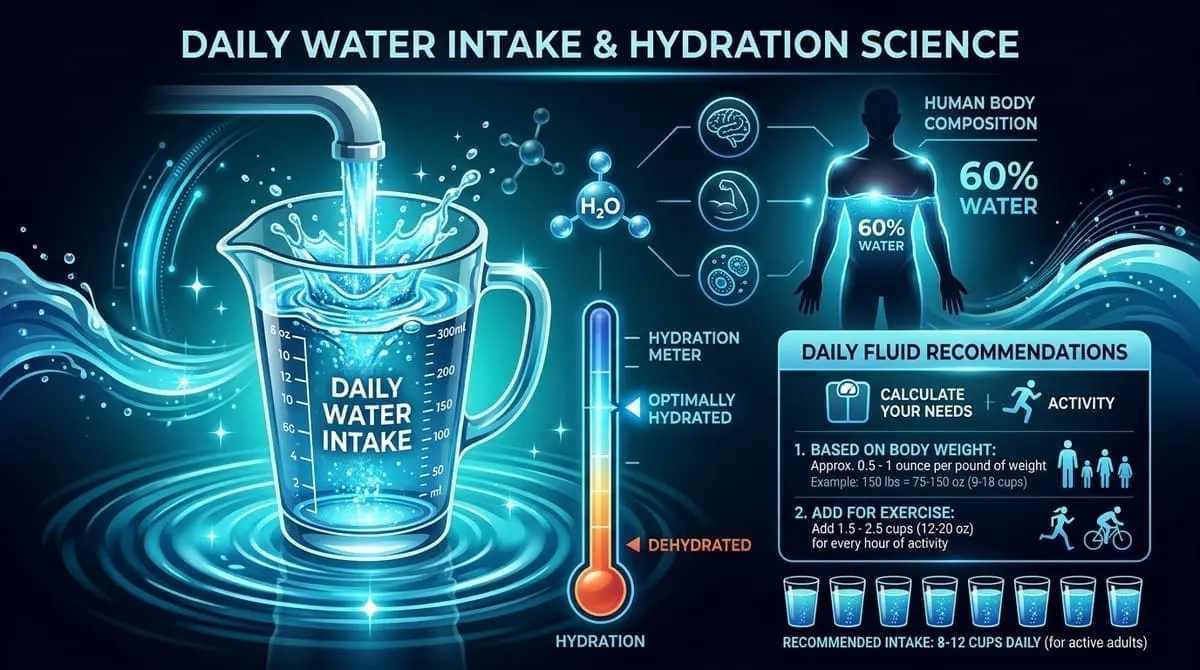
Water is the essential matrix of all biological life. Representing roughly 60% of adult body weight, water serves as the medium for every biochemical reaction, maintains cardiovascular blood volume, lubricates articular cartilage joints, regulates core internal temperature via sweating, and flushes metabolic waste metabolites through renal filtration.
Despite its critical importance, mild chronic dehydration affects an estimated 75% of the population. A fluid loss of just 1% to 2% of body weight degrades cognitive focus, slows athletic reaction times, reduces physical strength output by up to 15%, and elevates cardiovascular strain through increased heart rates.
While old health rules famously suggested drinking "8 glasses a day," hydration science is fundamentally personal. Fluid requirements scale dynamically with total body mass, physical exertion duration, sweat rate, ambient climate humidity, and dietary sodium intake.
The Daily Water Intake in Cups Solver calculates your customized daily hydration target in standard 8 oz measuring cups and milliliters based on your body weight and active exercise hours. This comprehensive guide details fluid compartmentalization, dehydration stages, sweat electrolyte dynamics, and optimal hydration strategies for peak vitality.
2. Core Definitions & Analogy
To understand fluid physiology and daily water needs, let us examine the core concepts:
- Simple Definition: Daily water intake in cups is the recommended number of standard 8-fluid-ounce cups of water you should drink each day to stay fully hydrated.
- Technical Definition: Daily fluid requirement is the volumetric replacement volume needed to achieve euhydration—balancing total daily physiological water outputs (renal urine excretion, gastrointestinal fecal loss, respiratory moisture exhalation, and cutaneous perspiration) with metabolic water synthesis () and dietary water intake.
- The Automotive Radiator & Hydraulic Fluid Analogy: Think of your body as an engine with both a liquid cooling radiator (thermoregulation via perspiration) and hydraulic steering lines (blood plasma and cellular pressure). When water levels drop, the hydraulic pressure declines (low blood volume and lightheadedness) and the engine runs hotter (elevated core body temperature and cardiac drift). Regularly refilling your reservoir in measured cup increments keeps the entire hydraulic and cooling system running at peak performance.
3. The Physiology of Body Fluid Balance
Total body water is distributed across two primary internal fluid compartments:
flowchart TD
    TBW["Total Body Water (~60% of Body Weight)"]
    TBW --> ICF["Intracellular Fluid (ICF): ~67% (Inside billions of living cells)"]
    TBW --> ECF["Extracellular Fluid (ECF): ~33% (Surrounding cells)"]
    ECF --> ISF["Interstitial Fluid: ~75% of ECF (Bathing tissues & lymph)"]
ECF --> PV["Blood Plasma: ~25% of ECF (Vascular circulatory volume)"]- Intracellular Fluid (ICF) [~67%]: Two-thirds of bodily water is locked inside individual cells, rich in potassium () and magnesium () ions, maintaining cellular turgor and enzymatic reactions.
- Extracellular Fluid (ECF) [~33%]: One-third circulates outside cells, partitioned into interstitial fluid and vascular blood plasma, rich in sodium () and chloride () ions.
- Osmotic Regulation: The hypothalamus constantly monitors extracellular osmolality. When water loss elevates plasma sodium concentrations by as little as 1%, osmoreceptors trigger the posterior pituitary gland to release Antidiuretic Hormone (ADH / Vasopressin), signaling kidneys to concentrate urine and inducing conscious thirst.
4. The Mathematical Formulas
The solver calculates daily hydration requirements using weight-based scaling combined with physical activity sweat replacement:
Step 1: Baseline Water Need from Body Weight
A validated clinical baseline is consuming approximately 0.5 to 0.67 fluid ounces per pound of body weight:
Step 2: Additional Fluid for Physical Exercise
For every hour of active work or exercise, add 12 to 16 ounces (1.5 to 2 cups) to replace perspiration and respiratory moisture:
Step 3: Total Daily Cups Calculation
Since 1 standard measuring cup = 8 fluid ounces (236.6 mL):
Metric Equivalent (Liters):
5. Daily Hydration Guidelines by Weight and Activity
The table below outlines recommended daily water intake across body weights and exercise durations:
| Body Weight (lbs / kg) | Sedentary (0 hrs) | Moderate Activity (1 hr) | Heavy Training (2 hrs) | Liters Equivalent |
|---|---|---|---|---|
| 120 lbs (54 kg) | 7.5 Cups (60 oz) | 9.0 Cups (72 oz) | 10.5 Cups (84 oz) | 1.8 – 2.5 L |
| 150 lbs (68 kg) | 9.5 Cups (75 oz) | 11.0 Cups (88 oz) | 12.5 Cups (100 oz) | 2.2 – 3.0 L |
| 180 lbs (82 kg) | 11.5 Cups (90 oz) | 13.0 Cups (104 oz) | 14.5 Cups (116 oz) | 2.7 – 3.5 L |
| 210 lbs (95 kg) | 13.0 Cups (105 oz) | 14.5 Cups (117 oz) | 16.0 Cups (129 oz) | 3.1 – 3.8 L |
| 240 lbs (109 kg) | 15.0 Cups (120 oz) | 16.5 Cups (132 oz) | 18.0 Cups (144 oz) | 3.5 – 4.3 L |
6. Step-by-Step Practical Calculations
Example 1: Active 160-Pound Runner
- Parameters: Body Weight = 160 lbs, Active Workout = 1.5 hours.
- Step 1 (Baseline Needs): .
- Step 2 (Exercise Needs): .
- Step 3 (Total Ounces): .
- Step 4 (Cups Conversion):
- Volume in Liters: .
Example 2: Sedentary 130-Pound Office Professional
- Parameters: Body Weight = 130 lbs, Active Workout = 0 hours.
- Step 1: .
- Step 2: .
- Volume in Liters: .
7. The Urine Color Hydration Scale
A practical clinical indicator of hydration status is urine color:
flowchart LR
    C1["Pale Straw / Light Lemon (Optimal Euhydration)"] --> C2["Medium Yellow (Adequate Hydration)"]
    C2 --> C3["Dark Amber / Honey (Mild Dehydration - Drink 2 Cups Immediately)"]
C3 --> C4["Dark Brownish (Severe Dehydration / Potential Rhabdomyolysis)"]- Optimal (Level 1–2): Pale straw or faint yellow indicates well-balanced electrolyte dilution and healthy kidney filtration.
- Dehydrated (Level 4–6): Dark yellow or amber indicates the kidneys are heavily concentrating waste to preserve vascular volume.
8. Clinical Case Studies
Case Study 1: Resolving Chronic Afternoon Headaches and Fatigue
- Background: Alex, a 28-year-old software engineer (180 lbs, sedentary), suffered from recurring 3:00 PM tension headaches and brain fog. He drank 3 cups of coffee daily and only 2 cups of water (~16 oz).
- Analysis: His calculated baseline requirement was 11.5 cups (90 oz). He was operating at a daily 70+ oz fluid deficit.
- Intervention: Replaced mid-day caffeine with a structured 32 oz refillable water bottle (targeting 3 full bottles spaced across work hours).
- Outcome (2 Weeks): Afternoon headaches vanished completely, subjective energy levels improved, and afternoon cognitive focus increased.
Case Study 2: Preventing Heat Exhaustion in Summer Athletic Training
- Background: Marcus, a 200-pound collegiate football player practicing 2 hours outdoors in 88°F heat.
- Hydration Strategy: Pre-hydrated with 2.5 cups 2 hours before practice, consumed 1 cup with electrolytes every 20 minutes during drills, and rehydrated with 16 oz per pound of scale weight lost post-practice.
- Outcome: Avoided heat cramps and muscle spasms while teammates without structured hydration experienced cramping and heat exhaustion.
9. Common Hydration Mistakes & Hyponatremia Risks
- Waiting Until You Feel Thirsty: Conscious thirst triggers only after you are already 1% to 2% dehydrated. Sip water steadily throughout the day rather than chugging large volumes when parched.
- Ignoring Electrolytes During Prolonged Sweating: Drinking excessive amounts of pure distilled or plain water during 2+ hours of intense sweating without sodium replacement can dilute serum sodium below , causing Exercise-Associated Hyponatremia (EAH). During prolonged workouts, consume electrolyte drinks containing sodium and potassium.
- Counting Alcohol and Sugary Sodas: Alcohol inhibits ADH release, accelerating fluid excretion and worsening net dehydration.
10. Frequently Asked Questions (FAQ)
- Does coffee or tea count toward my daily water intake?Yes. While caffeine has a mild acute diuretic effect in non-habituated individuals, moderate consumption of coffee and tea contributes positively to total daily fluid balance.
- How much water comes from the food I eat?In a balanced diet rich in fruits (watermelon, oranges) and vegetables (cucumbers, lettuce, zucchini), food provides roughly 20% to 25% of your total daily water intake.
- Can you drink too much water?Yes. Healthy kidneys can excrete approximately 0.8 to 1.0 Liters of water per hour. Exceeding this rate for multiple consecutive hours can cause dangerous water intoxication (cellular swelling and hyponatremia).
- What is the best time of day to drink water?Drink 1 to 2 cups upon waking in the morning to rehydrate after 8 hours of respiratory sleep loss, and drink a glass 30 minutes before meals to aid digestive enzymatic secretion.
11. Expert Recommendations & Summary
- Calculate Your Baseline: Use
Body Weight (lbs) × 0.5 / 8to determine your baseline cup target.
- Adjust for Workouts: Add 1.5 to 2 cups of water for every hour of exercise or intense outdoor physical labor.
- Monitor Daily Indicators: Check your morning urine color and aim for a consistent light straw hue throughout the day for optimal energy, metabolic health, and mental focus.
Additional Technical Guidelines & Measurement Standards
When conducting calculations for Daily Water Intake in Cups Solver, maintaining quantitative precision and verifying input parameter boundaries is essential for reliable scenario evaluation. Always verify that raw numerical inputs are measured using standardized instrumentation, and double-check unit conversions prior to applying outputs in commercial, industrial, or academic projects.
For quantitative unit conversions and scientific calculations, always maintain at least four decimal places of precision during intermediate arithmetic stages before rounding final results. When preparing technical reports, laboratory documentation, or financial forecasts, cross-verify all output variables against established international measurement standards (such as SI, NIST, and ISO metric benchmarks) to guarantee consistent analytical rigor across all computational workflows.
MathsLover.com delivers this interactive solver 100% free of charge to foster global mathematical literacy, educational accessibility, and data-driven problem solving across scientific, technical, and academic communities worldwide.