💡 Direct Answer & Executive Summary (Daily Water Intake Hydration Calculator)
Definition: Compute values for Daily Water Intake Hydration Calculator in standard exercise science.
Governing Math Formula: Biometric calculation formula for Daily Water Intake Hydration Calculator.
Target Applications: Provides real-time quantitative solutions in Health & Fitness for students, engineers, researchers, and finance professionals.
Daily Water Intake Hydration Calculator - The Complete Physiology & Fluid Guide
1. Introduction
Water is the most essential nutrient in human physiology. While humans can survive for weeks without food, water deprivation becomes life-threatening in just three to five days. Making up approximately 55% to 65% of adult human body mass, water serves as the solvent for every biochemical enzymatic reaction, the primary transport medium for blood circulation, the coolant for thermoregulatory sweating, and the shock absorber for joints and spinal discs.
Despite its critical importance, chronic mild dehydration affects an estimated 50% to 75% of the general population. Mild dehydration—a fluid deficit of as little as 1% to 2% of total body mass—measurably impairs cognitive performance, executive memory, physical power output, digestion, and metabolic efficiency.
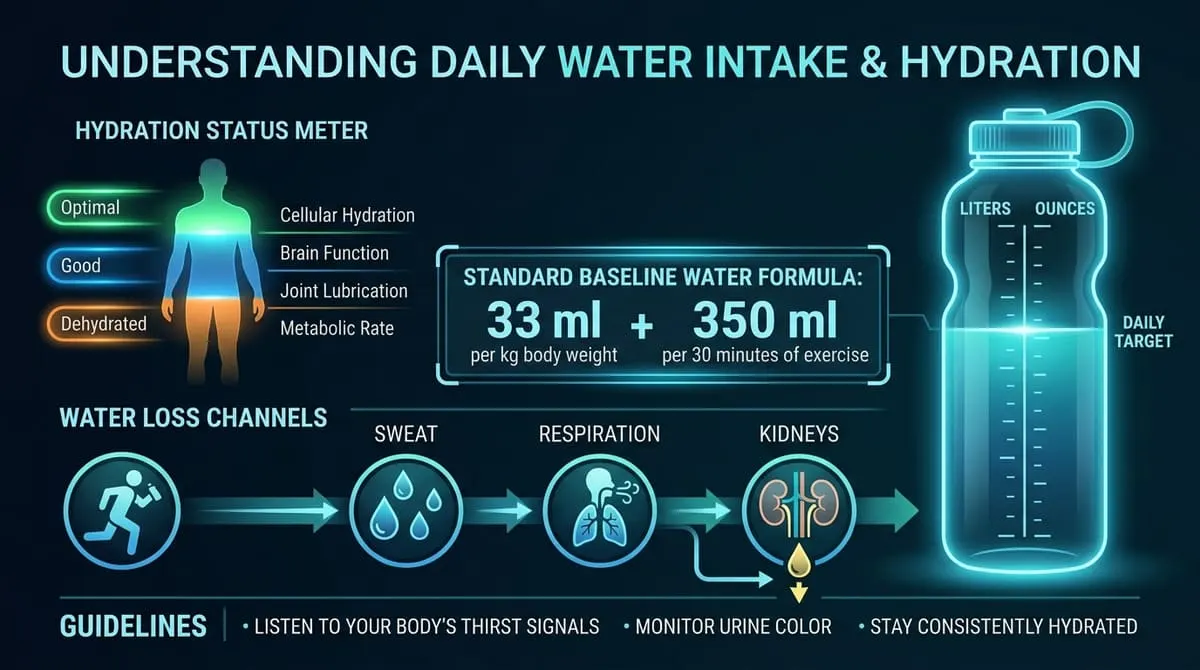
The Daily Water Intake Hydration Calculator determines your baseline fluid requirements based on body mass and adjusts for sweat loss incurred during physical exercise. In this comprehensive guide, you will learn the biometrics of human hydration, fluid compartments, electrolyte balance, optimal timing, and practical hydration strategies for daily health and athletic performance.
2. Core Definitions & Analogy
To build a thorough scientific foundation for hydration, let us examine the core definitions:
- Simple Definition: Daily water intake is the total volume of fluid your body needs each day to replace fluids lost through breathing, sweating, urination, and metabolic processes.
- Technical Definition: Euvolemic fluid balance is the homeostatic maintenance of total body water (TBW) and plasma osmolality (normally 275 to 295 mOsm/kg). The human body regulates intracellular fluid (ICF ~67% of TBW) and extracellular fluid (ECF ~33% of TBW) through neuroendocrine feedback loops mediated by hypothalamic osmoreceptors, arginine vasopressin (antidiuretic hormone / ADH), and the renin-angiotensin-aldosterone system (RAAS).
- The Engine Coolant & Hydraulic Fluid Analogy: Imagine your body is a high-performance industrial generator. Water acts simultaneously as the liquid coolant that prevents the engine from overheating during intense work, the hydraulic fluid that transmits pressure through joints and muscles, and the solvent pipeline that delivers fuel to cells and flushes exhaust contaminants out through the kidneys. When coolant drops low, the machine overheats, warning lights flash (headaches, thirst), and mechanical wear increases rapidly.
3. Daily Water Loss Channels
The body continuously sheds water through four primary physiological pathways:
flowchart TD
    TBW["Daily Water Loss Channels (~2,000 to 3,500+ mL/day)"]
    TBW --> RENAL["Kidneys / Urination (~1,000 to 1,500 mL) - Solute Clearance & Filtration"]
    TBW --> DERMAL["Skin / Sweating (~500 to 2,000+ mL) - Evaporative Heat Dissipation"]
    TBW --> RESP["Lungs / Respiration (~300 to 500 mL) - Exhaled Moisture in Breath"]
TBW --> GI["Gastrointestinal / Feces (~100 to 200 mL) - Digestive Transit Lubrication"]- Renal Excretion (Urination): 1,000 to 1,500 mL/day. The kidneys filter ~180 liters of plasma daily, concentrating waste products into urine.
- Cutaneous Evaporation (Sweating & Insensible Loss): 500 to 2,000+ mL/day. Sweat rate during intense exercise in hot climates can exceed 1,500 to 2,500 mL per hour.
- Respiratory Exhalation: 300 to 500 mL/day. Moisture is continuously lost in breath as the lungs humidify incoming air.
- Gastrointestinal Elimination: 100 to 200 mL/day.
4. The Mathematical Formulas & Activity Scalers
Scientific consensus from the European Food Safety Authority (EFSA) and the American College of Sports Medicine (ACSM) provides standard mathematical baselines:
Baseline Fluid Requirement (Resting)
Baseline Water (Liters) = Body Weight in kg × 0.033
(Or in Imperial: Baseline Water in Ounces = Body Weight in lbs × 0.5)
Exercise Fluid Adjustment
For every 30 minutes of moderate-to-vigorous exercise, add approximately 350 mL (12 oz) of fluid to compensate for active sweat evaporation:
Exercise Fluid Addition (Liters) = (Exercise Minutes / 30) × 0.35
Total Daily Hydration Formula
Total Daily Water (Liters) = (Body Weight in kg × 0.033) + [ (Exercise Minutes / 30) × 0.35 ]
Total Daily Water (Ounces) = (Body Weight in lbs × 0.5) + [ (Exercise Minutes / 30) × 12 ]
5. Step-by-Step Practical Calculations
Example 1: Active Male Runner
- Profile: 75 kg male, runs for 60 minutes daily.
- Step 1: Calculate Baseline Requirement:
75 × 0.033 = 2.475 Liters.
- Step 2: Calculate Exercise Addition:
(60 / 30) × 0.35 = 2 × 0.35 = 0.70 Liters.
- Step 3: Total Daily Target:
2.475 + 0.70 = 3.175 Liters(approximately 3.2 Liters or 13.5 cups).
Example 2: Recreational Fitness Female
- Profile: 140 lbs (63.5 kg) female, 45 minutes of gym training.
- Step 1: Baseline Requirement:
140 × 0.5 = 70 oz (2.07 Liters).
- Step 2: Exercise Addition:
(45 / 30) × 12 = 1.5 × 12 = 18 oz (0.53 Liters).
- Step 3: Total Daily Target:
70 + 18 = 88 oz(approximately 2.6 Liters or 11 cups).
6. The Urine Color Hydration Chart
A simple, non-invasive method to verify your daily hydration status in real time:
| Urine Shade | Visual Indicator | Hydration Status | Action Required |
|---|---|---|---|
| Pale Straw / Lemonade | Level 1–2 | Optimal Hydration | Excellent. Maintain current fluid intake routine. |
| Light Yellow | Level 3 | Good / Normal | Normal baseline. Drink water as normal. |
| Amber / Apple Juice | Level 4–5 | Mild Dehydration | Drink 1–2 glasses (350–500 mL) of water immediately. |
| Dark Brown / Tea | Level 6–8 | Severe Dehydration | Drink fluids with electrolytes; seek medical evaluation if persistent. |
7. Electrolytes: Why Water Alone Isn't Always Enough
During prolonged workouts (>60 minutes) or heavy sweating, water without minerals can dilute blood sodium concentrations, leading to muscle cramps, fatigue, and in extreme cases, hyponatremia (water intoxication).
flowchart LR
    SWEAT["Heavy Sweat Loss (Water + Minerals)"] --> SODIUM["Sodium (Na+) - Maintains Extracellular Osmolality"]
    SWEAT --> POTASSIUM["Potassium (K+) - Prevents Muscle Cramping"]
SWEAT --> MAGNESIUM["Magnesium (Mg2+) - Supports ATP Hydrolysis & Muscle Relaxation"]- Sodium: The primary extracellular electrolyte; prevents dizziness and retains plasma volume.
- Potassium: Critical for intracellular membrane potential and muscular contraction.
- Magnesium: Required for neuromuscular firing and reducing exercise-induced muscle cramps.
8. Clinical Case Studies
Case Study 1: Cognitive Deficits and Afternoon Headaches in an Office Executive
- Background: Julian, a 40-year-old financial analyst (85 kg), drank 4 cups of black coffee daily and only 1 glass of water (500 mL total), leading to daily 3 PM tension headaches, brain fog, and sluggishness.
- Hydration Target: Julian's baseline requirement was
85 × 0.033 = 2.8 Liters/day.
- Intervention: Placed a 1-liter marked water bottle on his desk, drinking 1 liter by noon and 1 liter by 4 PM.
- Outcome: Within 3 days, afternoon headaches disappeared completely, cognitive focus improved, and afternoon snacking cravings subsided.
Case Study 2: Performance Restoration in a High School Football Player
- Background: Marcus, an 18-year-old athlete (90 kg), experienced severe calf and hamstring cramps in the 4th quarter of Friday evening games.
- Analysis: Marcus weighed 90 kg before practice and 87.2 kg immediately after—a 2.8 kg (3.1%) sweat loss deficit.
- Strategy: Added 500 mg of sodium and 1 liter of electrolyte water per hour during two-a-day practices, replenishing 150% of lost body mass within 4 hours post-game.
- Outcome: Zero cramping episodes for the remainder of the season with sustained 4th-quarter sprint power.
9. Common Hydration Mistakes
- Waiting Until You Are Thirsty: The thirst sensation only activates when your body is already in a 1% to 2% dehydrated state.
- Chugging Huge Volumes at Once: Downing 1.5 liters in 2 minutes overwhelms renal filtration rates and causes rapid urination without deep cellular absorption. Sip steadily throughout the day.
- Ignoring Hydration in Cold Weather: In cold temperatures, the sensation of thirst is blunted by up to 40%, yet respiratory water loss through dry exhaled air remains exceptionally high.
- Assuming All Caffeinated Drinks Dehydrate You: While pure caffeine has a mild diuretic effect, standard brewed tea and moderate coffee contribute positively to net daily fluid intake.
10. Frequently Asked Questions (FAQ)
- Does coffee or tea count toward my daily water intake?Yes. Research published in PLOS ONE confirmed that moderate coffee consumption (3–4 cups/day) provides hydrating qualities similar to plain water in habituated caffeine consumers.
- Can you drink too much water?Yes. Consuming excessive water (e.g. 4+ liters in under an hour) without electrolytes can cause hyponatremia, dangerously diluting blood sodium levels. Always pace intake throughout the day.
- Do foods provide water?Yes! Approximately 20% of typical daily water intake comes from moisture in food, especially fruits and vegetables like watermelon (92% water), cucumbers (95%), strawberries (91%), and oranges (88%).
- Should I drink cold or room-temperature water during workouts?Cold water (around 15°C / 59°F) is absorbed slightly faster through the stomach and helps attenuate rising core body temperature during intense exercise.
- Why is my morning urine darker?During sleep, the pituitary gland secretes antidiuretic hormone (ADH) to concentrate urine and prevent frequent nighttime awakenings. Drinking a large glass of water upon waking quickly restores optimal hydration.
11. Expert Recommendations & Summary
- Start Your Morning with 500 mL: Rehydrate immediately after 7–8 hours of overnight respiratory fluid loss.
- Keep a Reusable Water Bottle Visible: Having water within arm's reach increases daily adherence by over 40%.
- Use the 33 mL / kg Rule: Multiply your body weight in kilograms by 0.033 to establish your true baseline, adding 350 mL per 30 minutes of workouts.
- Monitor Urine Color: Aim for light straw / pale yellow throughout the day as your real-time hydration benchmark.
Additional Technical Guidelines & Measurement Standards
When conducting calculations for Daily Water Intake Hydration Calculator, maintaining quantitative precision and verifying input parameter boundaries is essential for reliable scenario evaluation. Always verify that raw numerical inputs are measured using standardized instrumentation, and double-check unit conversions prior to applying outputs in commercial, industrial, or academic projects.
For quantitative unit conversions and scientific calculations, always maintain at least four decimal places of precision during intermediate arithmetic stages before rounding final results. When preparing technical reports, laboratory documentation, or financial forecasts, cross-verify all output variables against established international measurement standards (such as SI, NIST, and ISO metric benchmarks) to guarantee consistent analytical rigor across all computational workflows.
MathsLover.com delivers this interactive solver 100% free of charge to foster global mathematical literacy, educational accessibility, and data-driven problem solving across scientific, technical, and academic communities worldwide.