💡 Direct Answer & Executive Summary (Total Daily Energy Expenditure (TDEE) Calculator)
Definition: Determine total daily calorie burn based on exercise activity level.
Governing Math Formula: TDEE = BMR × Activity Factor.
Target Applications: Provides real-time quantitative solutions in Health & Fitness for students, engineers, researchers, and finance professionals.
Total Daily Energy Expenditure (TDEE) Calculator - The Complete Exercise & Metabolic Guide
1. Introduction
Every action you take—from blinking while reading this sentence, to typing on a keyboard, to lifting heavy weights at the gym, to the involuntary beating of your heart—demands a steady supply of cellular energy. While your Basal Metabolic Rate (BMR) quantifies what your body burns just to survive at rest, your Total Daily Energy Expenditure (TDEE) represents the total sum of all calories your body actually burns across an entire 24-hour day.
TDEE is the master metric of human energy balance. Whether your goal is sustainable fat loss, clean muscle building, athletic peak conditioning, or long-term weight maintenance, every successful dietary protocol begins with an accurate assessment of your daily energy output.
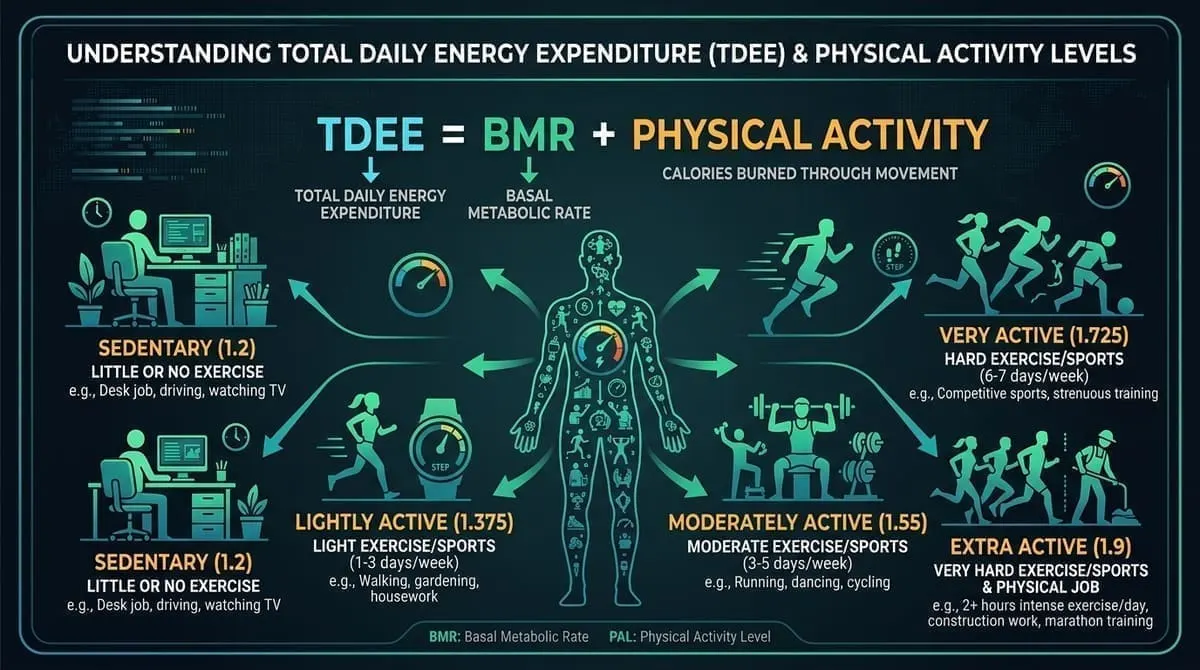
The Total Daily Energy Expenditure (TDEE) Calculator pairs baseline metabolic rates with scientifically validated Physical Activity Level (PAL) multipliers to determine your true daily caloric demands. This guide details the four distinct components of human metabolism, the physiology of physical activity, how to accurately calculate your daily burn, and how to calibrate your nutrition for peak results.
2. Core Definitions & Analogy
To grasp the mechanics of daily energy expenditure, let us define TDEE across three practical lenses:
- Simple Definition: TDEE is the total number of calories your body burns in a single day, including sleep, daily movement, digestion, work, and intentional exercise.
- Technical Definition: Total Daily Energy Expenditure (TDEE) is the aggregate 24-hour rate of biological work performed by the human body, expressed in kilocalories per day (kcal/day). It is the mathematical sum of four distinct metabolic components: Basal Metabolic Rate (BMR), Non-Exercise Activity Thermogenesis (NEAT), Exercise Activity Thermogenesis (EAT), and the Thermic Effect of Food (TEF).
- The Household Utility Budget Analogy: Think of your daily calorie expenditure like your household's daily electricity consumption. Your BMR is the baseline electricity required just to keep the refrigerator humming, security systems armed, and routers powered 24/7. TEF is the electrical surge required whenever you run the microwave or stove to process food. NEAT represents the lights turning on as you walk room to room, and EAT is running heavy industrial appliances like power tools or high-draw laundry machines. TDEE is the final total on your daily electric meter.
3. The Four Pillars of Human Metabolism
Understanding TDEE requires dissecting the four components that constitute 100% of human energy expenditure:
flowchart TD
    TDEE["Total Daily Energy Expenditure (TDEE) - 100%"]
    TDEE --> BMR["Basal Metabolic Rate (BMR) - 60% to 75%"]
    TDEE --> NEAT["Non-Exercise Activity Thermogenesis (NEAT) - 15% to 30%"]
    TDEE --> TEF["Thermic Effect of Food (TEF) - 8% to 10%"]
    TDEE --> EAT["Exercise Activity Thermogenesis (EAT) - 5% to 15%"]
1. Basal Metabolic Rate (BMR): 60% – 75% of Total Burn
BMR represents the energy needed for cellular survival, organ perfusion, respiration, and autonomic nervous function. Even in active athletes, baseline organ maintenance consumes the majority of daily energy.
2. Non-Exercise Activity Thermogenesis (NEAT): 15% – 30% of Total Burn
Coined by endocrinologist Dr. James Levine at the Mayo Clinic, NEAT encompasses all spontaneous physical movement outside of formal workouts: pacing on phone calls, taking stairs, carrying groceries, typing, yard work, and posture adjustments. NEAT is the most variable component of human metabolism between individuals, varying by up to 800 to 1,000 kcal/day between sedentary office workers and highly active individuals.
3. Thermic Effect of Food (TEF): 8% – 10% of Total Burn
Digesting, absorbing, and storing nutrients requires significant metabolic energy. TEF varies drastically depending on the macronutrient composition of meals:
- Protein: 20% – 30% of consumed energy burned in processing.
- Carbohydrates: 5% – 10% of consumed energy burned in processing.
- Dietary Fats: 0% – 3% of consumed energy burned in processing.
4. Exercise Activity Thermogenesis (EAT): 5% – 15% of Total Burn
Deliberate physical training—such as running, resistance training, cycling, or team sports. Surprisingly to many, formal exercise accounts for the smallest fraction of daily energy expenditure for non-professional athletes.
4. The Mathematical Formulas & Activity Multipliers
The calculation of TDEE follows a two-tier mathematical formulation:
Step 1: Compute Baseline BMR (Mifflin-St Jeor)
- Men:
BMR = (10 × Weight in kg) + (6.25 × Height in cm) - (5 × Age in years) + 5
- Women:
BMR = (10 × Weight in kg) + (6.25 × Height in cm) - (5 × Age in years) - 161
Step 2: Apply the Physical Activity Level (PAL) Multiplier
TDEE = BMR × Activity Factor
| Activity Level | PAL Factor | Typical Daily Lifestyle & Routine |
|---|---|---|
| Sedentary | 1.200 | Desk worker, minimal walking (< 4,000 steps/day), no formal exercise. |
| Lightly Active | 1.375 | Light exercise 1–3 days/week, 5,000–7,500 daily steps. |
| Moderately Active | 1.550 | Moderate workout 3–5 days/week, active job or 8,000–10,000 daily steps. |
| Very Active | 1.725 | Hard training 6–7 days/week, athletic job or 12,000+ daily steps. |
| Extra Active / Athlete | 1.900 | Twice-daily intense sports sessions, heavy construction, endurance training. |
5. Step-by-Step Practical Calculations
Example 1: Corporate Analyst (Sedentary Desk Job)
- Profile: 30-year-old male, weight = 80 kg, height = 180 cm.
- BMR Calculation:
10(80) + 6.25(180) - 5(30) + 5 = 800 + 1125 - 150 + 5 = 1780 kcal/day.
- Activity Multiplier: Sedentary (1.200).
- TDEE Calculation:
1780 × 1.200 = 2136 kcal/day.
Example 2: Fitness Coach / Active Instructor
- Profile: 27-year-old female, weight = 62 kg, height = 165 cm.
- BMR Calculation:
10(62) + 6.25(165) - 5(27) - 161 = 620 + 1031.25 - 135 - 161 = 1355.25 kcal/day.
- Activity Multiplier: Very Active (1.725).
- TDEE Calculation:
1355.25 × 1.725 = 2338 kcal/day.
6. How to Set Nutrition Targets Based on TDEE
Once your baseline TDEE is established, you can engineer precise nutritional targets based on your specific body composition objectives:
flowchart TD
    TDEE["Calculated Daily TDEE"]
    TDEE --> Deficit["Fat Loss (Caloric Deficit): TDEE - (300 to 500 kcal)"]
    TDEE --> Maint["Weight Maintenance: TDEE"]
TDEE --> Surplus["Muscle Hypertrophy (Lean Surplus): TDEE + (200 to 350 kcal)"]- Moderate Fat Loss (-15% to -20%): Subtracting 300 to 500 kcal/day produces roughly 0.4 to 0.6 kg (0.8 to 1.3 lbs) of fat loss per week without sacrificing lean tissue.
- Lean Muscle Hypertrophy (+10% to +15%): Adding 200 to 350 kcal/day alongside progressive overload provides the energetic substrate for muscle protein synthesis while keeping fat accumulation minimal.
- Athletic Maintenance: Consuming 100% of TDEE maintains stable body mass and maximizes day-to-day recovery.
7. Clinical Case Studies
Case Study 1: The "Sedentary Exerciser" Misconception
- Background: David, a 34-year-old software engineer (88 kg, 178 cm, BMR = 1820 kcal), worked out for 45 minutes 4 days per week but sat in an office chair for 10 hours daily. He chose the "Very Active" (1.725) setting, giving him a target TDEE of 3,140 kcal.
- Problem: David struggled with unintended weight gain because his 45-minute workout only burned ~300 kcal, while the rest of his day was completely motionless. His true activity level was "Lightly Active" (1.375, ~2500 kcal).
- Adjustment: By recalibrating his multiplier to 1.375 and setting his intake to 2,000 kcal/day (a 500 kcal deficit), David achieved steady 0.5 kg weekly fat loss.
Case Study 2: Preventing Relative Energy Deficiency in Sport (RED-S)
- Background: Sarah, a 22-year-old collegiate rower (68 kg, 175 cm, BMR = 1500 kcal), trained twice daily (rowing and strength). She assumed her TDEE was 2,200 kcal and ate accordingly.
- Symptoms: Chronic fatigue, menstrual irregularities (amenorrhea), and declining bone mineral density.
- Intervention: Clinical assessment revealed her true athlete TDEE was
1500 × 1.9 = 2850 kcal/day. Increasing daily carbohydrate and caloric intake to 2,900 kcal restored energy availability, normalized hormonal cycles, and boosted performance metrics.
8. Common Mistakes When Estimating TDEE
- Overestimating Activity Levels: Selecting "Moderately Active" simply because you lift weights for 45 minutes while sitting for 12 hours. Unless you are on your feet throughout the working day, start with a lower multiplier.
- Relying Solely on Wearable Trackers: Studies demonstrate consumer fitness trackers can overestimate workout caloric expenditure by 25% to 40%.
- Failing to Adjust as Body Mass Decreases: As you lose 5–10 kg, your BMR drops and the energy cost of moving a lighter body decreases. Recalculate your TDEE every 4–6 weeks.
- Ignoring NEAT Fluctuations: When dieting, your body subconsciously conserves energy by reducing spontaneous movement (fidgeting, pacing). Monitoring daily step counts preserves consistent NEAT.
9. Frequently Asked Questions (FAQ)
- How accurate is a calculated TDEE?Standard predictive equations are accurate within ±5% to 10% of laboratory indirect calorimetry for approximately 80% of individuals. Treat your result as a starting baseline, track body weight trends over 3 weeks, and fine-tune your calorie intake.
- Why is my weight not dropping despite eating below my TDEE?Common causes include inaccurate food logging (forgetting cooking oils, sauces, and beverages), water retention from elevated cortisol or muscle soreness, or overestimating your baseline activity multiplier.
- Does muscle mass increase TDEE?Yes. Lean muscle tissue is metabolically active, burning roughly 13 kcal/kg per day at complete rest compared to 4.5 kcal/kg for adipose fat tissue.
- Should I change my calorie intake on rest days vs. training days?Calorie cycling (eating slightly more on heavy training days and less on rest days) is popular, but weekly average energy balance is the primary driver of body composition. Consistency is more important than day-to-day fluctuations.
- How do steps relate to TDEE multipliers?A reliable real-world benchmark:* < 4,000 steps/day: Sedentary (1.200)* 5,000 – 7,500 steps/day: Lightly Active (1.375)* 8,000 – 11,000 steps/day: Moderately Active (1.550)* 12,000+ steps/day: Very Active (1.725)
- What is metabolic adaptation?During sustained calorie restriction, your body decreases thyroid output, resting energy expenditure, and spontaneous movement to conserve energy. This adaptive response is normal and reversible through diet breaks and gradual reverse dieting.
- Does intermittent fasting increase TDEE?No. Multiple controlled metabolic chamber trials show that intermittent fasting and continuous calorie restriction produce identical 24-hour total energy expenditures when total calories and protein are matched.
- How does stress affect TDEE?Chronic psychological stress elevates cortisol levels, which can promote fluid retention and cravings for refined carbohydrates, often causing people to underestimate their actual caloric intake.
10. Expert Tips & Summary
- Pick Conservative Multipliers: When in doubt between two activity brackets, choose the lower one to avoid unintentional over-fueling.
- Track Your Real-World Average: Log daily morning scale weight and 7-day rolling averages to verify your calculated TDEE in real time.
- Prioritize Daily Steps (NEAT): Aiming for 8,000 to 10,000 steps daily is the most reliable, sustainable way to keep your TDEE elevated without excessive fatigue.
- Pair with High Protein: Consume 1.6 to 2.2 grams of protein per kilogram of body weight to maximize TEF and protect lean tissue during caloric deficits.
Additional Technical Guidelines & Measurement Standards
When conducting calculations for Total Daily Energy Expenditure (TDEE) Calculator, maintaining quantitative precision and verifying input parameter boundaries is essential for reliable scenario evaluation. Always verify that raw numerical inputs are measured using standardized instrumentation, and double-check unit conversions prior to applying outputs in commercial, industrial, or academic projects.
For quantitative unit conversions and scientific calculations, always maintain at least four decimal places of precision during intermediate arithmetic stages before rounding final results. When preparing technical reports, laboratory documentation, or financial forecasts, cross-verify all output variables against established international measurement standards (such as SI, NIST, and ISO metric benchmarks) to guarantee consistent analytical rigor across all computational workflows.
MathsLover.com delivers this interactive solver 100% free of charge to foster global mathematical literacy, educational accessibility, and data-driven problem solving across scientific, technical, and academic communities worldwide.