💡 Direct Answer & Executive Summary (Max Heart Rate & Training Zones Solver)
Definition: Compute values for Max Heart Rate & Training Zones Solver in standard exercise science.
Governing Math Formula: Biometric calculation formula for Max Heart Rate & Training Zones Solver.
Target Applications: Provides real-time quantitative solutions in Health & Fitness for students, engineers, researchers, and finance professionals.
Max Heart Rate & Training Zones Solver - Comprehensive Cardiovascular Guide
1. Introduction
Cardiovascular fitness, athletic endurance, and metabolic conditioning all hinge upon one physiological anchor: your Maximum Heart Rate (). Maximum heart rate represents the absolute upper limit of cardiac contractions per minute that your cardiovascular system can sustain during maximal all-out exertion.
Exercising without reference to your heart rate zones frequently leads to two common training failures: 1. The "Black Hole" Effect (Chronic Moderate Intensity): Training too hard during easy base runs, causing chronic fatigue, systemic inflammation, elevated cortisol, and overtraining syndrome. 2. Sub-Threshold Underperformance: Not pushing hard enough during anaerobic intervals to stimulate mitochondrial density, cardiac stroke volume expansion, and breakthroughs.
The Max Heart Rate & Training Zones Solver computes your age-adjusted maximum heart rate, resting pulse baseline, Heart Rate Reserve (HRR), and a tailored 5-tier cardiovascular training zone breakdown. This comprehensive guide details the physiological science behind maximal cardiac output, comparative accuracy of historical formulas, cellular fuel utilization across zones, and evidence-based training periodization.
2. Core Definitions & Analogy
To grasp the mechanics of cardiovascular training zones, let us examine the core concepts:
- Simple Definition: Maximum Heart Rate () is the fastest speed your heart can beat in one minute when working as hard as physiologically possible.
- Technical Definition: is the peak chronotropic capacity of the sinoatrial node under maximal sympathetic neural activation and circulating catecholamine surge during progressive, exhaustive aerobic exercise. Target training zones are calculated as fixed percentages of or scaled relative to Heart Rate Reserve ().
- The Automobile RPM Tachometer Analogy: Think of your heart as a performance automobile engine. Your Maximum Heart Rate is the engine's "Redline" (e.g., 7,000 RPM). Your Resting Heart Rate () is your engine's idle speed at a red light (e.g., 800 RPM). The range between idle and redline is your "Usable Powerband" (Heart Rate Reserve). Training in Zone 1 or 2 is like cruising in high gear on the highway for maximum fuel efficiency, while Zone 5 is running the engine at wide-open throttle near the redline, which consumes fuel rapidly and can only be sustained briefly.
3. History & Milestones of Heart Rate Formulas
Over the past six decades, exercise physiologists and cardiologists have developed various empirical equations to predict without requiring a clinical graded exercise test (GXT):
flowchart TD
    A["1970: Fox & Haskell Formula (220 - Age) - Clinical Estimate from Literature Survey"] --> B["2001: Tanaka et al. Meta-Analysis (208 - 0.7 × Age) - 18,712 Subjects"]
    B --> C["2002: Gellish et al. Longitudinal Study (207 - 0.7 × Age) - Improved Precision in Masters Athletes"]
    C --> D["2007: Gulati et al. Women's Health Study (206 - 0.88 × Age) - Female-Specific Cardiac Modeling"]
    D --> E["Present: Multi-Zone Integration with Heart Rate Reserve & Wearable Optical Sensors"]
While Dr. William Fox and Dr. Samuel Haskell popularized the straightforward 220 - Age formula in 1970 for cardiac rehabilitation screening, modern sports science frequently employs the Tanaka or Gellish equations to minimize statistical regression errors in masters athletes over age 40.
4. The Mathematical Formulas
The solver supports both the classic maximum heart rate models and the Karvonen Heart Rate Reserve (HRR) zone distribution model:
Step 1: Compute Maximum Heart Rate ()
- Fox Formula (Standard Baseline):
- Tanaka Formula (Validated Meta-Analysis):
- Gellish Formula:
Step 2: Compute Heart Rate Reserve (HRR)
Step 3: Compute Training Zones (Karvonen Hybrid Method)
(Alternatively, for basic percentage of : )
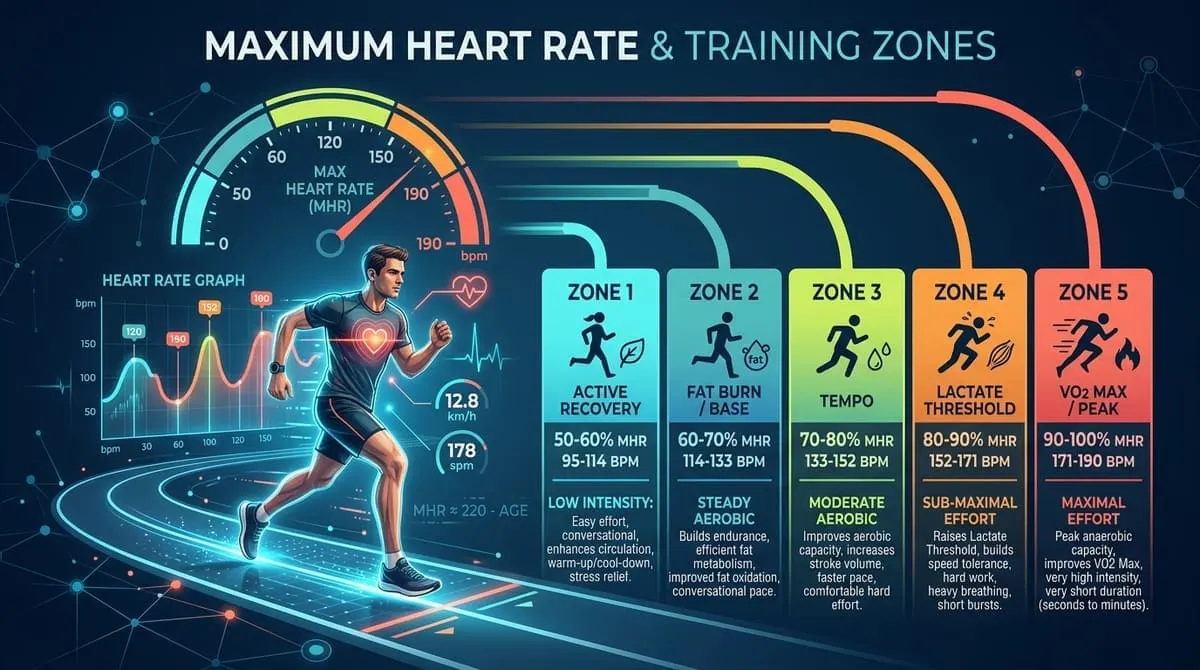
5. The 5-Zone Cardiovascular Training Spectrum
The table below describes the 5 physiological training zones, their metabolic substrate reliance, and target conditioning benefits:
| Training Zone | Intensity (% HRR / % ) | Metabolic Classification | Primary Substrate Fuel | Primary Physiological Benefit |
|---|---|---|---|---|
| Zone 1 | 50% – 60% | Active Recovery | >85% Fatty Acids | Circulatory flushing, parasympathetic stimulation, lactic clearance. |
| Zone 2 | 60% – 70% | Aerobic Base / FatMax | 70% – 85% Lipids, 15% – 30% Glucose | Mitochondrial biogenesis, capillary proliferation, metabolic efficiency. |
| Zone 3 | 70% – 80% | Aerobic Tempo / Steady State | 50% Lipids, 50% Glycogen | Cardiac stroke volume expansion, intermediate muscle fiber recruitment. |
| Zone 4 | 80% – 90% | Anaerobic Lactate Threshold | >80% Blood Glucose & Muscle Glycogen | Upregulation of monocarboxylate transporters (MCT-1/4), high-speed endurance. |
| Zone 5 | 90% – 100% | Neuromuscular / Peak | 100% Rapid Anaerobic Glycolysis + ATP-CP | Peak cardiac output, fast-twitch motor unit recruitment, anaerobic power. |
6. Step-by-Step Practical Calculations
Example 1: 30-Year-Old Active Individual
- Parameters: Age = 30 years, Resting Heart Rate () = 65 bpm.
- Step 1 ( Calculation):
- Step 2 (Heart Rate Reserve):
- Step 3 (Zone 2 Fat-Burn Window: 60% – 70% HRR):* Lower Bound (60%):* Upper Bound (70%):
- Step 4 (Zone 4 Threshold Window: 80% – 90% HRR):* Lower Bound (80%):* Upper Bound (90%):
Example 2: 50-Year-Old Master Runner
- Parameters: Age = 50 years, Resting Heart Rate = 55 bpm.
- Step 1 (Tanaka Formula):
- Step 2 (Heart Rate Reserve):
- Step 3 (Zone 2 Target 60% – 70%):**
- Prescribed Aerobic Base Range: 126 to 138 bpm.
7. Cellular Metabolism & Fuel Selection Dynamics
The relationship between exercise heart rate and energy substrate partitioning is defined by the Crossover Concept (Brooks & Mercier):
flowchart LR
    Z12["Low Intensity (Zone 1 & 2: <70% HRR)"] --> LIP["Primary Fuel: Adipose Free Fatty Acids via Beta-Oxidation"]
    Z34["Moderate-to-High (Zone 3 & 4: 70-90% HRR)"] --> MIX["Substrate Crossover: Shift from Lipid Oxidation to Intramuscular Glycogen"]
Z5["Maximal Intensity (Zone 5: >90% HRR)"] --> GLY["Primary Fuel: Fast Anaerobic Glycolysis & High Lactate Flux"]- Fat Oxidation Efficiency: In Zone 2, your cells utilize abundant oxygen to breakdown fatty acids within mitochondria, yielding 36+ ATP molecules per cycle while generating negligible systemic lactate.
- The Lactate Turnpoint: As heart rate crosses Zone 4, glycolysis accelerates faster than oxidative phosphorylation can clear pyruvate. Hydrogen ions accumulate, intracellular pH drops, and muscle contractions experience fatigue.
8. Clinical Case Studies
Case Study 1: The "Black Hole" Recovery Breakthrough
- Subject: David, a 44-year-old cyclist (, ).
- Problem: David completed all 5 weekly rides at 155–165 bpm (Zone 4 tempo). Despite heavy training, his average speed plateaued and morning resting heart rate climbed to 68 bpm.
- Intervention: Rebalanced his schedule to the Polarized 80/20 Model:* 4 sessions per week locked in Zone 2 ().* 1 session per week of Zone 5 high-intensity intervals ().
- Result (12 Weeks): Morning resting pulse dropped to 52 bpm, power output at 135 bpm increased by 22 watts, and chronic knee tendinitis resolved completely.
Case Study 2: Cardiac Safety in Sedentary Weight Loss
- Subject: Sarah, 36 years old, sedentary desk worker (, ).
- Protocol: Guided walking and light treadmill incline jogging targeted strictly at Zone 2 () 4 days per week for 45 minutes.
- Result (16 Weeks): Lost 7.5 kg of body fat, resting pulse dropped to 68 bpm, and systemic systolic blood pressure decreased by 10 mmHg without any joint strain.
9. Common Training Pitfalls & Environmental Biases
- Cardiac Drift in Hot Environments: When exercising in hot or humid conditions, cutaneous blood flow increases to dissipate thermal heat, decreasing venous return and stroke volume. Consequently, heart rate drifts upward by 10–15 bpm at the exact same running pace. In high heat, slow down your pace to preserve your target cardiovascular zone.
- Wrist-Sensor Cadence Lock: Optical photoplethysmography (PPG) wrist sensors can mistakenly lock onto running stride cadence (e.g., 170 steps/min) instead of actual pulse. For high-precision interval sessions, use an electrocardiographic Bluetooth chest strap.
- Ignoring Sleep Deprivation & Stimulants: Pre-workout supplements, energy drinks, caffeine, and poor sleep artificially inflate resting heart rate by 8–12 bpm, shifting calculated target zones.
10. Frequently Asked Questions (FAQ)
- Why is my maximum heart rate different on a bike versus running?Running involves full weight-bearing musculature (recruiting upper body and postural stabilizing muscles), which generally yields a maximum heart rate 5 to 10 bpm higher than cycling or rowing where body mass is supported.
- Does having a higher maximum heart rate mean I am more fit?No. Maximum heart rate is an innate biological ceiling determined by genetics, heart chamber dimensions, and age—not fitness. Aerobic fitness is reflected by a low Resting Heart Rate, rapid Heart Rate Recovery (HRR) post-exercise, and high power output at Zone 2 heart rates.
- Can cardiovascular exercise exceed my calculated Max HR?Calculated formulas carry a statistical standard deviation of to . If your observed peak heart rate on a sprint hill test consistently reaches 198 bpm when a formula predicts 190 bpm, calibrate your zones using your true measured peak.
- What is Heart Rate Recovery (HRR) and why does it matter?Heart Rate Recovery measures how many beats your heart drops in the first 60 seconds immediately after stopping exercise. A drop of in 1 minute indicates strong parasympathetic nervous system reactivity and excellent cardiovascular health.
11. Expert Recommendations & Summary
- Establish Accurate Morning Baselines: Measure your resting pulse across 3 consecutive days immediately upon waking in bed before reaching for your phone or coffee.
- Adopt Polarized Training: Allocate roughly 75% to 80% of your aerobic volume to Zone 2 base development, dedicating the remaining 20% to structured Zone 4/5 interval training.
- Re-Evaluate Seasonally: As your aerobic conditioning improves, your resting pulse drops and your cardiac stroke volume expands—recalculate your zones every 8 to 12 weeks to keep training intensities optimized.
Additional Technical Guidelines & Measurement Standards
When conducting calculations for Max Heart Rate & Training Zones Solver, maintaining quantitative precision and verifying input parameter boundaries is essential for reliable scenario evaluation. Always verify that raw numerical inputs are measured using standardized instrumentation, and double-check unit conversions prior to applying outputs in commercial, industrial, or academic projects.
For quantitative unit conversions and scientific calculations, always maintain at least four decimal places of precision during intermediate arithmetic stages before rounding final results. When preparing technical reports, laboratory documentation, or financial forecasts, cross-verify all output variables against established international measurement standards (such as SI, NIST, and ISO metric benchmarks) to guarantee consistent analytical rigor across all computational workflows.
MathsLover.com delivers this interactive solver 100% free of charge to foster global mathematical literacy, educational accessibility, and data-driven problem solving across scientific, technical, and academic communities worldwide.