💡 Direct Answer & Executive Summary (Keto Macronutrient Deficit Cutting Calculator)
Definition: Compute values for Keto Macronutrient Deficit Cutting Calculator in standard exercise science.
Governing Math Formula: Biometric calculation formula for Keto Macronutrient Deficit Cutting Calculator.
Target Applications: Provides real-time quantitative solutions in Health & Fitness for students, engineers, researchers, and finance professionals.
Keto Macronutrient Deficit Cutting Calculator - Ketogenic Fat Loss Guide
1. Introduction
For athletes, bodybuilders, and individuals seeking rapid body fat reduction while preserving lean muscle mass, the Ketogenic Diet (Keto) represents one of the most metabolically potent dietary strategies.
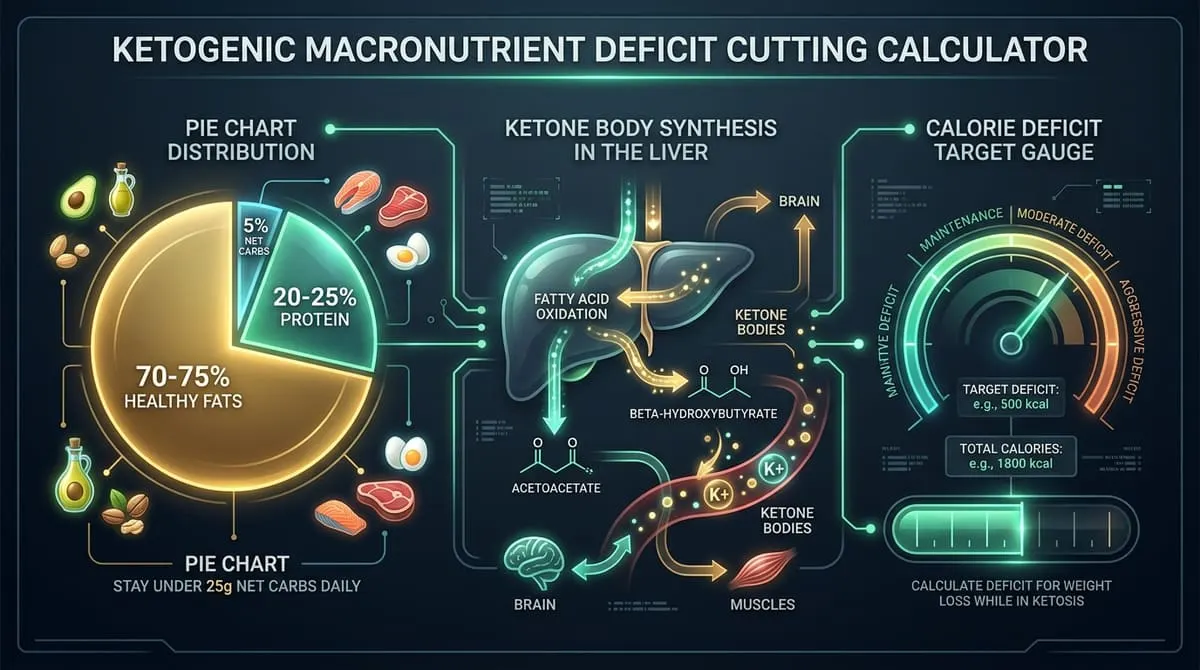
By restricting dietary carbohydrates to fewer than 20 to 50 grams per day (under 5% of total caloric intake), the body rapidly depletes liver glycogen stores. In response, circulating insulin levels plummet, signaling adipose tissue to release free fatty acids into circulation. Within the liver, accelerated hepatic beta-oxidation converts these fatty acids into Ketone Bodies (acetoacetate, beta-hydroxybutyrate, and acetone), shifting cellular metabolism from glucose-dependence to Nutritional Ketosis.
However, being in ketosis alone does not guarantee fat loss. Even on a strict ketogenic diet, the fundamental thermodynamic law of energy balance applies: you must maintain a calorie deficit to mobilize stored body fat.
The Keto Macronutrient Deficit Cutting Calculator calculates your target calorie intake and exact gram-by-gram macronutrient breakdown (Fats, Protein, and Net Carbohydrates) tailored specifically for a ketogenic cutting phase. This comprehensive guide covers ketone biochemistry, calculating net carbs, optimal protein ratios to prevent gluconeogenesis panic, and how to conquer the "keto flu."
2. Core Definitions & Analogy
To understand ketogenic cutting and energy balance, let us examine the core concepts:
- Simple Definition: A keto cut is a high-fat, moderate-protein, very-low-carb diet calculated at a calorie deficit (burning more calories than you eat) to force your body to burn its own stored fat for energy.
- Technical Definition: A hypocaloric ketogenic dietary protocol designed to induce hepatic ketogenesis () while enforcing a negative energy balance (). Macronutrient energy ratios are typically structured at 70%–75% Fats, 20%–25% Protein, and ≤5% Net Carbohydrates.
- The Dual-Fuel Hybrid Vehicle Analogy: Think of your metabolism like a hybrid gasoline/electric vehicle. Glucose (carbohydrates) is regular gasoline from the station (food intake). Stored body fat and ketone bodies represent the high-capacity electric battery pack. As long as you keep refilling the gas tank with carbs, the car runs on gas. When you cut off the gas supply (carb restriction), the engine seamlessly switches over to running on pure battery power (ketosis). Creating a deficit ensures the car draws heavily from its stored internal battery reserves to cover daily mileage.
3. The Biochemistry of Ketosis: How Fat Burns
When carbohydrate intake drops below 25g net carbs per day, the following physiological shifts occur:
flowchart TD
    REST["Carbohydrate Restriction (<25g Net Carbs/day)"] --> GLY["Liver Glycogen Depletion (24 - 48 Hours)"]
    GLY --> INS["Insulin Drops & Glucagon Rises"]
    INS --> HSL["Hormone-Sensitive Lipase (HSL) Mobilizes Adipose Triglycerides"]
    HSL --> FFA["Free Fatty Acids Flood the Liver"]
    FFA --> KET["Hepatic Mitochondrial Ketogenesis: Acetoacetate & Beta-Hydroxybutyrate (BHB)"]
KET --> ENERG["Ketones Cross Blood-Brain Barrier to Fuel Brain, Heart & Skeletal Muscle"]- Circulating Insulin Suppression: Low insulin removes the molecular brake on adipose tissue lipolysis, allowing continuous release of fatty acids into the bloodstream.
- Liver Ketogenesis: Fatty acids entering hepatic mitochondria undergo beta-oxidation into Acetyl-CoA. Excess Acetyl-CoA that exceeds the capacity of the citric acid cycle is converted by HMG-CoA synthase into Acetoacetate, which is reduced into -Hydroxybutyrate (BHB).
- Brain Energy Optimization: BHB easily crosses the blood-brain barrier via monocarboxylate transporters (MCT-1/2), supplying up to 60% to 70% of the brain's total energy demands, eliminating the mental fog and intense sugar crashes typical of high-carb diets.
4. The Mathematical Formulas
Calculating your customized keto cutting macronutrient targets follows four steps:
Step 1: Compute Cutting Calorie Target
Example Deficits: Moderate Cut = 20% deficit; Aggressive Cut = 25% to 30% deficit.
Step 2: Set Net Carbohydrates (Fixed 5% Allocation)
Keep net carbohydrates under 20 to 25 grams per day: (Where )
Step 3: Set Protein Target (20% to 25% Allocation / 1.6 to 2.2 g/kg)
Step 4: Allocate Remaining Calories to Healthy Fats (70% to 75%)
5. Keto Macronutrient Cutting Breakdown Matrix
The table below illustrates sample macro splits for an active individual () across different deficit levels:
| Deficit Level | Daily Calories | Net Carbs (5%) | Protein (25%) | Healthy Fats (70%) | Expected Fat Loss |
|---|---|---|---|---|---|
| Maintenance | 2,200 kcal | 27 g (110 kcal) | 138 g (550 kcal) | 171 g (1,540 kcal) | 0.0 lbs/week |
| Mild Cut (10%) | 1,980 kcal | 25 g (100 kcal) | 124 g (495 kcal) | 154 g (1,385 kcal) | ~0.5 lb/week |
| Moderate Cut (20%) | 1,760 kcal | 22 g (88 kcal) | 110 g (440 kcal) | 137 g (1,232 kcal) | ~1.0 lb/week |
| Aggressive Cut (25%) | 1,650 kcal | 20 g (82 kcal) | 103 g (412 kcal) | 128 g (1,156 kcal) | ~1.5 lbs/week |
| Extreme Cut (30%) | 1,540 kcal | 19 g (77 kcal) | 96 g (385 kcal) | 120 g (1,078 kcal) | ~1.8 lbs/week |
6. Step-by-Step Practical Calculations
Example: Moderate 20% Cut for an 80 kg Athlete
- Parameters: Daily Energy Output () = 2,200 kcal/day, Cut Deficit = 20%.
- Step 1 (Daily Caloric Budget):(Total Daily Deficit = 440 kcal/day)
- Step 2 (Net Carbs: 5%):
- Step 3 (Protein: 25%):
- Step 4 (Fats: 70%):
- Final Macro Prescription: 1,760 kcal | 22g Carbs | 110g Protein | 137g Fat.
7. Overcoming the "Keto Flu": Electrolyte Protocol
During the first 3 to 7 days of carbohydrate restriction, the drop in insulin causes the kidneys to excrete large quantities of sodium and water (natriuresis). This temporary electrolyte depletion causes the "Keto Flu" (headaches, lethargy, muscle cramps, dizziness):
flowchart LR
    INS_DROP["Low Insulin Signaling"] --> RENAL["Kidneys Excrete Sodium (Na+) & Water"]
    RENAL --> FLU["Keto Flu Symptoms (Fatigue, Cramps, Brain Fog)"]
    FLU --> PROTOCOL["Electrolyte Protocol: 4-5g Sodium + 3-4g Potassium + 400mg Magnesium"]
Daily Electrolyte Targets to Prevent Keto Flu:
- Sodium (): 4,000 to 5,000 mg/day (add Himalayan pink salt or sea salt liberally to meals).
- Potassium (): 3,000 to 4,000 mg/day (avocados, leafy spinach, salmon, Lite-Salt).
- Magnesium Glycinate (): 400 mg/day at bedtime to prevent nocturnal calf cramps and support deep sleep.
8. Debunking the Gluconeogenesis Myth
- Myth: "Eating too much protein kicks you out of ketosis because protein turns directly into sugar."
- Scientific Reality: Gluconeogenesis is a demand-driven, not a supply-driven, hepatic process. Consuming adequate protein during a cut (1.6 to 2.2 g/kg) is essential to stimulate muscle protein synthesis and prevent skeletal muscle catabolism. Do not fear dietary protein while cutting on keto.
9. Best Whole-Food Choices for a Keto Cut
- Healthy Fats (70%): Extra virgin olive oil, avocados, avocado oil, grass-fed butter, unrefined coconut oil, macadamia nuts, and egg yolks.
- Quality Protein (25%): Wild-caught salmon, grass-fed ribeye steak, chicken thighs, whole eggs, canned sardines, and turkey.
- Low-Carb Vegetables (5%): Spinach, kale, arugula, asparagus, zucchini, broccoli, cauliflower, and cucumbers.
10. Frequently Asked Questions (FAQ)
- How do I test if I am in nutritional ketosis?Blood ketone meters measuring -hydroxybutyrate are the clinical gold standard (). Breath ketone meters (acetone) and urine test strips provide quick, cost-effective alternatives.
- Why did I lose 5 pounds in the first 4 days of keto?Every gram of stored glycogen in muscles and liver binds approximately 3 to 4 grams of water. Depleting glycogen releases 3 to 6 pounds of bound water weight immediately. True fat loss follows steadily thereafter.
- Can you build muscle on keto?Yes! Resistance training combined with sufficient protein (20%–25% of calories) provides the stimulus and building blocks for muscular hypertrophy.
11. Expert Recommendations & Summary
- Keep Net Carbs Under 25g: Count net carbs () to maintain uninterrupted ketosis.
- Prioritize Electrolytes Daily: Drink salted bone broth or electrolyte water to completely bypass the keto flu.
- Combine with Moderate Deficits: Use a 20% to 25% deficit for sustainable fat mobilization without metabolic fatigue or muscle loss.
Additional Technical Guidelines & Measurement Standards
When conducting calculations for Keto Macronutrient Deficit Cutting Calculator, maintaining quantitative precision and verifying input parameter boundaries is essential for reliable scenario evaluation. Always verify that raw numerical inputs are measured using standardized instrumentation, and double-check unit conversions prior to applying outputs in commercial, industrial, or academic projects.
For quantitative unit conversions and scientific calculations, always maintain at least four decimal places of precision during intermediate arithmetic stages before rounding final results. When preparing technical reports, laboratory documentation, or financial forecasts, cross-verify all output variables against established international measurement standards (such as SI, NIST, and ISO metric benchmarks) to guarantee consistent analytical rigor across all computational workflows.
MathsLover.com delivers this interactive solver 100% free of charge to foster global mathematical literacy, educational accessibility, and data-driven problem solving across scientific, technical, and academic communities worldwide.