💡 Direct Answer & Executive Summary (Lean Body Mass Boer Formula Calculator)
Definition: Compute values for Lean Body Mass Boer Formula Calculator in standard exercise science.
Governing Math Formula: Biometric calculation formula for Lean Body Mass Boer Formula Calculator.
Target Applications: Provides real-time quantitative solutions in Health & Fitness for students, engineers, researchers, and finance professionals.
Lean Body Mass Boer Formula Calculator - Clinical & Anthropometric Guide
1. Introduction
When assessing body composition, total scale weight provides an incomplete picture of physiological health and metabolic status. A 90 kg individual could be a muscular athlete with 10% body fat or an untrained individual with 35% body fat.
To separate metabolically active non-fat tissues from adipose storage, clinicians, sports scientists, and pharmacologists evaluate Lean Body Mass (LBM) (also referred to as Fat-Free Mass).
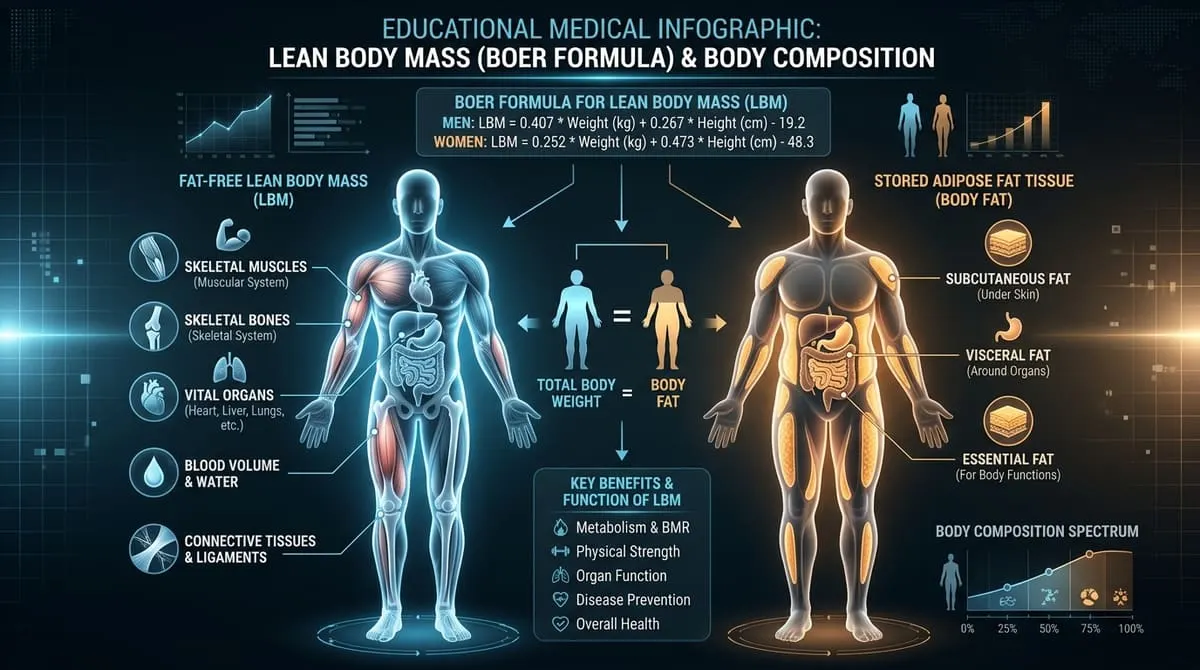
Lean Body Mass encompasses:
- Skeletal muscle tissue
- Internal organs (heart, liver, kidneys, lungs, brain)
- Bone mineral matrix and skeletal framework
- Intracellular and extracellular bodily fluids and blood volume
In clinical pharmacokinetics, critical medications—including chemotherapeutic agents, intravenous anesthetics, antibiotics, and neuromuscular blockers—distribute exclusively into lean tissues. Calculating dosage based on total weight in overweight patients leads to dangerous toxicity.
In 1984, Dr. P. Boer published a sex-stratified anthropometric model in the American Journal of Physiology that accurately estimates Lean Body Mass using only height and body weight: the Boer Formula.
The Lean Body Mass Boer Formula Calculator estimates your physiological lean body mass and fat-free percentage with clinical accuracy. This comprehensive guide covers the physiological foundations of lean mass, mathematical derivations, comparison with James and Hume equations, clinical drug dosing applications, and strategies for maximizing muscular retention.
2. Core Definitions & Analogy
To understand Lean Body Mass and the Boer equation, let us examine the core concepts:
- Simple Definition: Lean Body Mass (LBM) is everything in your body that is not fat—including your muscles, bones, organs, and water.
- Technical Definition: In a two-compartment somatic model, Lean Body Mass () equals Total Body Weight () minus total Adipose Lipid Mass (): . The Boer formula provides an empirical anthropometric regression of derived from height and weight parameters without requiring hydrostatic weighing or dual-energy X-ray absorptiometry (DEXA).
- The Ship Cargo Analogy: Think of the human body as a cargo cargo ship. The ship's steel hull, engines, navigation systems, fuel tanks, and crew represent the Lean Body Mass—the essential operational machinery required for navigation and function. The shipping containers stacked on the deck represent the Adipose Fat Mass—stored energy reserves. When evaluating engine horsepower requirements, fuel consumption, and operational ballast (pharmacological dosing and metabolic rate), naval engineers look at the ship's dry weight and hull specifications, not the excess cargo containers.
3. History & Comparative Equations
In clinical medicine, multiple formulas have been developed to predict Lean Body Mass from stature and weight:
flowchart TD
    A["1976: James Formula - Widely used in early pharmacokinetic models"] --> B["1984: Boer Formula (Am. J. Physiol.) - Corrects overestimation in high BMI individuals"]
    B --> C["1966/1971: Hume & Weyers Formula - Alternative logarithmic and linear derivations"]
    C --> D["Modern ICU & Anesthesia: Boer Formula designated standard for propofol & remifentanil infusion"]
While the earlier James formula (1976) performed well in normal-weight individuals, it produced paradoxical declines in calculated lean mass for severely obese patients. In 1984, Boer developed refined coefficients using tracer-dilution body composition data, creating a stable linear model that remains standard across clinical anesthesia and intensive care worldwide.
4. The Mathematical Formulas
The Boer Formula utilizes height (in centimeters) and total weight (in kilograms) with sex-stratified linear constants:
Boer Formula Equations:
- For Men:
- For Women:
Derived Body Fat Percentage from Boer LBM:
Lean Mass in Pounds (lbs):
5. Lean Body Mass Normative Reference Matrix
The table below outlines expected Lean Body Mass percentages across athletic, fitness, and average populations:
| Classification | Men: LBM (% of Total Weight) | Men: Body Fat % | Women: LBM (% of Total Weight) | Women: Body Fat % |
|---|---|---|---|---|
| Elite / Athletic | 86% – 94% | 6% – 14% | 80% – 86% | 14% – 20% |
| Fitness / Active | 82% – 86% | 14% – 18% | 76% – 80% | 20% – 24% |
| Average / Acceptable | 76% – 82% | 18% – 24% | 69% – 76% | 24% – 31% |
| Elevated Adiposity | < 75% | > 25% | < 68% | > 32% |
6. Step-by-Step Practical Calculations
Example 1: Adult Male
- Parameters: Male, Weight = 80 kg, Height = 180 cm.
- Step 1: Multiply weight by 0.407:
- Step 2: Multiply height by 0.267:
- Step 3: Sum values and subtract constant (19.2):
- Step 4 (Body Fat Estimation):**
- Step 5 (Imperial Conversion):
Example 2: Adult Female
- Parameters: Female, Weight = 65 kg, Height = 168 cm.
- Step 1: Multiply weight by 0.252:
- Step 2: Multiply height by 0.473:
- Step 3: Sum values and subtract constant (48.3):
- Step 4 (Body Fat Estimation):**
- Step 5 (Imperial Conversion):
7. Clinical & Sports Applications
Lean Body Mass calculations play a vital role across multiple medical and athletic domains:
flowchart TD
    LBM["Lean Body Mass (Boer Formula)"]
    LBM --> ANESTH["Clinical Anesthesia: Target-Controlled Infusion (TCI) of Propofol & Remifentanil"]
    LBM --> RENAL["Nephrology: Normalization of Glomerular Filtration Rate (GFR)"]
    LBM --> BMR["Metabolic Science: High-Precision BMR estimation (Katch-McArdle Equation)"]
LBM --> HYP["Hypertrophy & Sports: Tracking pure skeletal muscle gain vs. fat gain"]- Target-Controlled Infusion (TCI) in Anesthesiology: Anesthetic agents such as Propofol and Remifentanil distribute rapidly into vascularized lean tissues. Clinical infusion algorithms (e.g., the Marsh and Schnider pharmacokinetic models) utilize Boer LBM to prevent fatal cardiac depression or delayed emergence from anesthesia in obese surgical patients.
- Katch-McArdle BMR Precision: Standard BMR equations rely on total weight, which can overestimate calories in individuals with high body fat. The Katch-McArdle formula calculates metabolic rate directly from Boer Lean Mass:
- Athletic Strength-to-Weight Ratio: In powerlifting, gymnastics, and sprinting, performance correlates directly with the ratio of Lean Body Mass to Total Body Weight.
8. Clinical Case Studies
Case Study 1: Anesthetic Dosing in Bariatric Surgery
- Patient Profile: 48-year-old male, weight = 135 kg, height = 178 cm, undergoing laparoscopic sleeve gastrectomy.
- Risk: If dosed on total weight (135 kg), anesthetic concentrations would cause profound hypotension and respiratory arrest.
- Boer LBM Calculation:
- Outcome: Anesthesia induction dosed based on 83.3 kg LBM resulted in stable arterial pressure, smooth intraoperative maintenance, and rapid extubation within 8 minutes of surgery completion.
Case Study 2: Tracking Skeletal Muscle Preservation During Contest Prep
- Athlete Profile: 27-year-old natural bodybuilder (Starting: 88 kg, 182 cm, Boer LBM = 69.2 kg).
- Cut Strategy: 16-week calorie deficit of 500 kcal/day paired with 2.2 g/kg protein and heavy resistance training.
- 16-Week Result: Final weight dropped to 77 kg with DEXA-confirmed LBM at 68.8 kg. The athlete preserved 99.4% of baseline lean muscle tissue while dropping from 21.4% to 10.6% body fat.
9. Limitations & Boundary Considerations
- Extremely Muscular Bodybuilders: Because the Boer formula relies on height and weight correlations from the general population, elite athletes carrying extreme skeletal muscle mass beyond natural genetic limits may have higher true LBM than predicted by standard linear equations.
- Severe Edema & Fluid Retention: In patients with congestive heart failure, renal disease, or ascites, retained extracellular fluid is categorized as lean mass, artificially elevating LBM estimates.
- Children & Adolescents: The Boer formula was validated on adult cohorts (); pediatric patients require specialized pediatric growth charts.
10. Frequently Asked Questions (FAQ)
- What is the difference between Lean Body Mass (LBM) and Fat-Free Mass (FFM)?In clinical literature, LBM and FFM are often used interchangeably. Technically, Lean Body Mass includes a small amount of essential cellular lipids found in cell membranes and the central nervous system (~2%–3%), whereas FFM mathematically excludes all lipid molecules.
- Why do men have higher Boer coefficients than women?Men possess higher average bone mineral density, larger thoracic cage structures, and greater natural skeletal muscle distribution due to testosterone, yielding higher baseline lean mass at identical stature.
- Can you increase your Lean Body Mass while in a calorie deficit?Yes, through body recomposition. Resistance training provides the mechanical tension required for muscle protein synthesis, while dietary protein supplies the necessary amino acid substrates.
- How often should I measure Lean Body Mass?Recalculate your Boer LBM every 4 to 8 weeks alongside body circumference measurements and scale weight to verify that weight loss represents fat reduction rather than muscle atrophy.
11. Expert Recommendations & Summary
- Base Nutrition on Lean Mass: Calculate your daily protein intake based on your Lean Body Mass (2.2 to 2.8 g per kg of LBM) during cutting phases to maximize muscle retention.
- Combine with Resistance Training: Perform progressive strength training 3 to 5 days per week to preserve metabolically active muscle tissue.
- Use for Clinical Baseline Modeling: Utilize Boer Lean Mass for high-precision Katch-McArdle metabolic calculations and athletic strength-to-weight ratio tracking.
Additional Technical Guidelines & Measurement Standards
When conducting calculations for Lean Body Mass Boer Formula Calculator, maintaining quantitative precision and verifying input parameter boundaries is essential for reliable scenario evaluation. Always verify that raw numerical inputs are measured using standardized instrumentation, and double-check unit conversions prior to applying outputs in commercial, industrial, or academic projects.
For quantitative unit conversions and scientific calculations, always maintain at least four decimal places of precision during intermediate arithmetic stages before rounding final results. When preparing technical reports, laboratory documentation, or financial forecasts, cross-verify all output variables against established international measurement standards (such as SI, NIST, and ISO metric benchmarks) to guarantee consistent analytical rigor across all computational workflows.
MathsLover.com delivers this interactive solver 100% free of charge to foster global mathematical literacy, educational accessibility, and data-driven problem solving across scientific, technical, and academic communities worldwide.