💡 Direct Answer & Executive Summary (Ideal Body Weight (IBW Devine Formula) Calculator)
Definition: Compute values for Ideal Body Weight (IBW Devine Formula) Calculator in standard exercise science.
Governing Math Formula: Biometric calculation formula for Ideal Body Weight (IBW Devine Formula) Calculator.
Target Applications: Provides real-time quantitative solutions in Health & Fitness for students, engineers, researchers, and finance professionals.
Ideal Body Weight (IBW Devine Formula) Calculator - Clinical & Pharmacological Guide
1. Introduction
Determining an individual's "ideal" body weight has long been a fundamental objective in medicine, clinical dietetics, pharmacology, and anesthesiology. In clinical practice, administering critical medications—such as water-soluble antibiotics, anticoagulants, anesthetics, and chemotherapy agents—based purely on total scale weight can cause severe overdose in patients carrying excess adipose fat tissue.
To standardize safe medication dosing and establish clinical nutritional baselines, Dr. Ben J. Devine published a linear mathematical model in 1974 that remains the global medical benchmark: the Devine Formula for Ideal Body Weight (IBW).
The Ideal Body Weight (IBW Devine Formula) Calculator computes your baseline physiological weight based on height and biological sex according to clinical standards. This comprehensive guide covers the medical origins of the formula, the exact calculations for both metric and imperial measurements, comparison with modern BMI ranges, and its widespread applications in emergency medicine, intensive care, and sports science.
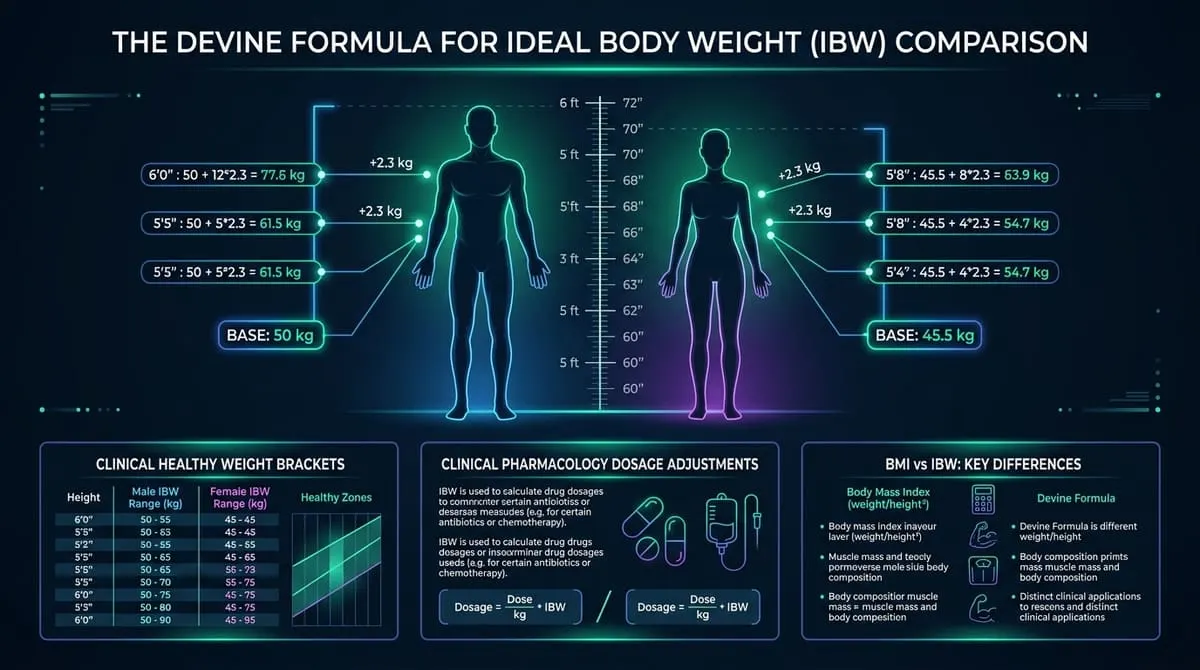
2. Core Definitions & Analogy
To understand how clinical Ideal Body Weight functions, let us define it through three practical angles:
- Simple Definition: Ideal Body Weight (IBW) is a standardized estimate of what a person of a given height and biological sex would weigh with normal body fat levels and typical muscle development.
- Technical Definition: Ideal Body Weight (IBW) is an anthropometrically estimated reference mass representing expected lean-adjusted somatic weight for a given stature. It is calculated via sex-stratified linear height offsets anchored to a baseline stature of 5 feet (60 inches or 152.4 cm). In clinical medicine, it serves as the reference volume of distribution for hydrophilic pharmaceuticals with narrow therapeutic indexes.
- The Architectural Blueprint Analogy: Think of the human body as a building. The height of the building's structural steel foundation determines how many floors can be safely supported under standard engineering codes (IBW). You can decorate the building with extra aesthetic structures or store heavy inventory inside (fat and muscle mass), but structural foundation calculations are anchored to the core architectural height.
3. History of the Devine Formula
In 1974, Dr. Ben J. Devine was investigating dosing protocols for the cardiac medication theophylline and published his findings in the Drug Intelligence & Clinical Pharmacy journal.
flowchart TD
    A["1874: Broca Index (Initial Rule of Thumb: Weight = Height cm - 100)"] --> B["1974: Dr. Ben J. Devine (IBW Formulation for Theophylline Dosing)"]
    B --> C["1983: Robinson Formula & Miller Formula (Empirical Revisions)"]
    C --> D["Present Day: Devine Formula Retains Universal Status in ICU & Pharmacy Dosing"]
While originally developed purely for pharmacological clearance modeling, the Devine formula correlated so strongly with the World Health Organization's normal BMI range (21.5 to 22.5 kg/m²) that it was rapidly adopted as the universal clinical definition of IBW across intensive care units (ICUs), mechanical ventilator setting algorithms, and dietary guidelines worldwide.
4. The Mathematical Formulas
The Devine Formula uses a baseline anchor for individuals measuring 5 feet (60 inches) tall, adding an incremental coefficient for every inch of height above 5 feet:
Imperial Formulas (Height in Inches)
- For Men:
IBW (kg) = 50.0 + 2.3 × (Height in inches - 60)
- For Women:
IBW (kg) = 45.5 + 2.3 × (Height in inches - 60)
Metric Formulas (Height in Centimeters)
Since 1 inch = 2.54 cm, the height in centimeters (H_cm) converts to:
- For Men:
IBW (kg) = 50.0 + 0.9055 × (Height in cm - 152.4)
- For Women:
IBW (kg) = 45.5 + 0.9055 × (Height in cm - 152.4)
Converting IBW to Pounds (lbs)
Multiply the kilogram result by 2.20462:
IBW (lbs) = IBW (kg) × 2.20462
Adjusted Body Weight (ABW) in Clinical Medicine
When a patient's actual body weight exceeds their IBW by more than 20% (e.g. in obesity), clinicians use Adjusted Body Weight for dosing hydrophilic drugs to account for partial drug penetration into adipose tissue:
Adjusted Body Weight = IBW + 0.4 × (Actual Weight - IBW)
5. Devine Formula Reference Table
The table below details standard Ideal Body Weight values across heights for adult men and women:
| Height (ft / in) | Height (cm) | Male IBW (kg / lbs) | Female IBW (kg / lbs) | Equivalent BMI (kg/m²) |
|---|---|---|---|---|
| 5' 0" (60 in) | 152.4 cm | 50.0 kg (110.2 lbs) | 45.5 kg (100.3 lbs) | ~21.5 (Male) / ~19.6 (Female) |
| 5' 2" (62 in) | 157.5 cm | 54.6 kg (120.4 lbs) | 50.1 kg (110.5 lbs) | ~22.0 (Male) / ~20.2 (Female) |
| 5' 4" (64 in) | 162.6 cm | 59.2 kg (130.5 lbs) | 54.7 kg (120.6 lbs) | ~22.4 (Male) / ~20.7 (Female) |
| 5' 6" (66 in) | 167.6 cm | 63.8 kg (140.7 lbs) | 59.3 kg (130.7 lbs) | ~22.7 (Male) / ~21.1 (Female) |
| 5' 8" (68 in) | 172.7 cm | 68.4 kg (150.8 lbs) | 63.9 kg (140.9 lbs) | ~22.9 (Male) / ~21.4 (Female) |
| 5' 10" (70 in) | 177.8 cm | 73.0 kg (160.9 lbs) | 68.5 kg (151.0 lbs) | ~23.1 (Male) / ~21.7 (Female) |
| 6' 0" (72 in) | 182.9 cm | 77.6 kg (171.1 lbs) | 73.1 kg (161.2 lbs) | ~23.2 (Male) / ~21.9 (Female) |
| 6' 2" (74 in) | 188.0 cm | 82.2 kg (181.2 lbs) | 77.7 kg (171.3 lbs) | ~23.3 (Male) / ~22.0 (Female) |
6. Step-by-Step Practical Calculations
Example 1: Adult Male
- Profile: Male, height = 5' 11" (71 inches or 180.34 cm).
- Step 1: Calculate inches above 60 inches:
71 - 60 = 11 inches.
- Step 2: Multiply by the 2.3 kg coefficient:
11 × 2.3 = 25.3 kg.
- Step 3: Add male baseline (50 kg):
50 + 25.3 = 75.3 kg.
- Step 4: Convert to pounds:
75.3 × 2.20462 ≈ 166.0 lbs.
Example 2: Adult Female
- Profile: Female, height = 5' 5" (65 inches or 165.1 cm).
- Step 1: Calculate inches above 60 inches:
65 - 60 = 5 inches.
- Step 2: Multiply by the 2.3 kg coefficient:
5 × 2.3 = 11.5 kg.
- Step 3: Add female baseline (45.5 kg):
45.5 + 11.5 = 57.0 kg.
- Step 4: Convert to pounds:
57.0 × 2.20462 ≈ 125.7 lbs.
7. Major Clinical & Real-World Applications
flowchart TD
    IBW["Ideal Body Weight (Devine Formula)"]
    IBW --> MED["Pharmacology & Drug Dosing: Aminoglycosides, Chemotherapy, Sedatives"]
    IBW --> ICU["ICU Mechanical Ventilation: Tidal Volume Settings (6-8 mL/kg IBW)"]
    IBW --> NUT["Clinical Dietetics: Enteral & Parenteral Nutrition Targets"]
IBW --> FIT["Athletic Target Setting: Aesthetic & Weight-Class Category Baselines"]- ICU Mechanical Ventilation Settings: In Acute Respiratory Distress Syndrome (ARDS), setting ventilator tidal volume based on actual weight in obese patients causes fatal barotrauma (lung overinflation). The ARDSNet clinical protocol mandates setting tidal volumes to strictly 6 to 8 mL/kg of IBW because lung capacity is proportional to height, not adipose tissue.
- Pharmacology & Chemotherapy: Critical antibiotics like Gentamicin, Tobramycin, and Vancomycin distribute primarily into extracellular fluid and lean mass. Dosing according to IBW or Adjusted Body Weight prevents acute kidney toxicity (nephrotoxicity).
- Sports & Combat Weight Classes: IBW provides an objective baseline for combat sports athletes (wrestling, boxing, MMA) to evaluate whether a desired weight class is physiologically attainable without severe dehydration.
8. Clinical Case Studies
Case Study 1: Antibiotic Dosing in an Obese Patient
- Patient Profile: 52-year-old male, height = 5' 9" (175.26 cm), actual weight = 125 kg (BMI = 40.7 kg/m², Class III Obesity).
- Condition: Severe sepsis requiring intravenous Gentamicin (5 mg/kg standard dose).
- Risk of Error: Dosing on actual weight (
125 × 5 = 625 mg) would lead to toxic renal failure.
- Devine IBW Calculation:
IBW = 50 + 2.3(69 - 60) = 70.7 kg.
- Adjusted Weight Calculation:
AdjBW = 70.7 + 0.4(125 - 70.7) = 92.42 kg.
- Safe Dose:
92.42 × 5 ≈ 460 mg. The Devine formula prevented a potentially lethal 165 mg drug overdose.
Case Study 2: Setting Ventilator Tidal Volume in ARDS
- Patient Profile: 40-year-old female, height = 5' 4" (162.6 cm), actual weight = 95 kg.
- Ventilator Protocol: 6 mL/kg lung-protective ventilation.
- Incorrect Target (Actual Weight):
95 × 6 = 570 mL(high risk of ventilator-induced lung injury).
- Devine Target:
IBW = 45.5 + 2.3(64 - 60) = 54.7 kg.
- Correct Tidal Volume:
54.7 × 6 ≈ 330 mL. Patient ventilated safely and recovered without pulmonary barotrauma.
9. Limitations & Differences from BMI
- Fixed Baseline Under 5 Feet: The original formula is anchored at 5'0". For individuals under 5 feet tall, the calculation can understate baseline requirements unless scaled downward proportionally.
- Frame Size & Skeletal Density: Devine does not adjust for broad vs. narrow skeletal wrist girth.
- Muscular Athletes: High-muscle athletes will naturally weigh significantly more than their Devine IBW while maintaining low body fat. For such individuals, body composition and body fat percentage are superior metrics.
10. Frequently Asked Questions (FAQ)
- Is Ideal Body Weight the same as healthy weight on BMI?Yes, Devine IBW lands precisely within the healthy BMI range (typically 21.5 to 23.0 kg/m²), representing the statistical midpoint of optimal health.
- What is the difference between Devine, Robinson, and Miller formulas?The Robinson (1983) and Miller (1983) formulas are minor statistical modifications of Devine. While Robinson yields slightly lower weights for tall men, Devine remains the universal standard in hospitals and medical software.
- If I weigh more than my IBW, am I unhealthy?Not necessarily. IBW does not measure muscle mass. If your excess weight is lean skeletal muscle from exercise, you can be in outstanding cardiovascular and metabolic health.
- Why do men have a higher IBW base than women?Men have higher average bone mineral density, larger thoracic skeletal structures, and greater natural lean mass, resulting in a +4.5 kg base offset at the same height.
11. Expert Recommendations & Summary
- Use IBW for Realistic Goal Setting: Treat Devine IBW as a reliable reference point for general weight management targets.
- Pair with Body Fat Testing: Track body composition alongside IBW to ensure you maintain functional lean muscle tissue while losing fat.
- Consult Healthcare Providers: In clinical contexts, always use IBW and Adjusted Body Weight under professional medical guidance for prescription dosage planning.
Additional Technical Guidelines & Measurement Standards
When conducting calculations for Ideal Body Weight (IBW Devine Formula) Calculator, maintaining quantitative precision and verifying input parameter boundaries is essential for reliable scenario evaluation. Always verify that raw numerical inputs are measured using standardized instrumentation, and double-check unit conversions prior to applying outputs in commercial, industrial, or academic projects.
For quantitative unit conversions and scientific calculations, always maintain at least four decimal places of precision during intermediate arithmetic stages before rounding final results. When preparing technical reports, laboratory documentation, or financial forecasts, cross-verify all output variables against established international measurement standards (such as SI, NIST, and ISO metric benchmarks) to guarantee consistent analytical rigor across all computational workflows.
MathsLover.com delivers this interactive solver 100% free of charge to foster global mathematical literacy, educational accessibility, and data-driven problem solving across scientific, technical, and academic communities worldwide.