💡 Direct Answer & Executive Summary (Calorie Deficit Weight Loss Target Calculator)
Definition: Compute values for Calorie Deficit Weight Loss Target Calculator in standard exercise science.
Governing Math Formula: Biometric calculation formula for Calorie Deficit Weight Loss Target Calculator.
Target Applications: Provides real-time quantitative solutions in Health & Fitness for students, engineers, researchers, and finance professionals.
Calorie Deficit Weight Loss Target Calculator - The Complete Nutritional & Energy Guide
1. Introduction
Weight loss has been surrounded by fads, conflicting diet trends, and commercial hype for decades. Yet, beneath all dietary philosophies—whether low-carb, Mediterranean, plant-based, or intermittent fasting—there is an immutable biological law of thermodynamics: The First Law of Thermodynamics.
To lose body fat, your body must expend more energy than it consumes from food and beverages over time. This negative energy imbalance is known as a Calorie Deficit.
When you maintain a consistent calorie deficit, your body is forced to mobilize stored triglyceride lipids from adipose fat tissue to fuel cellular processes, resulting in sustained fat loss.
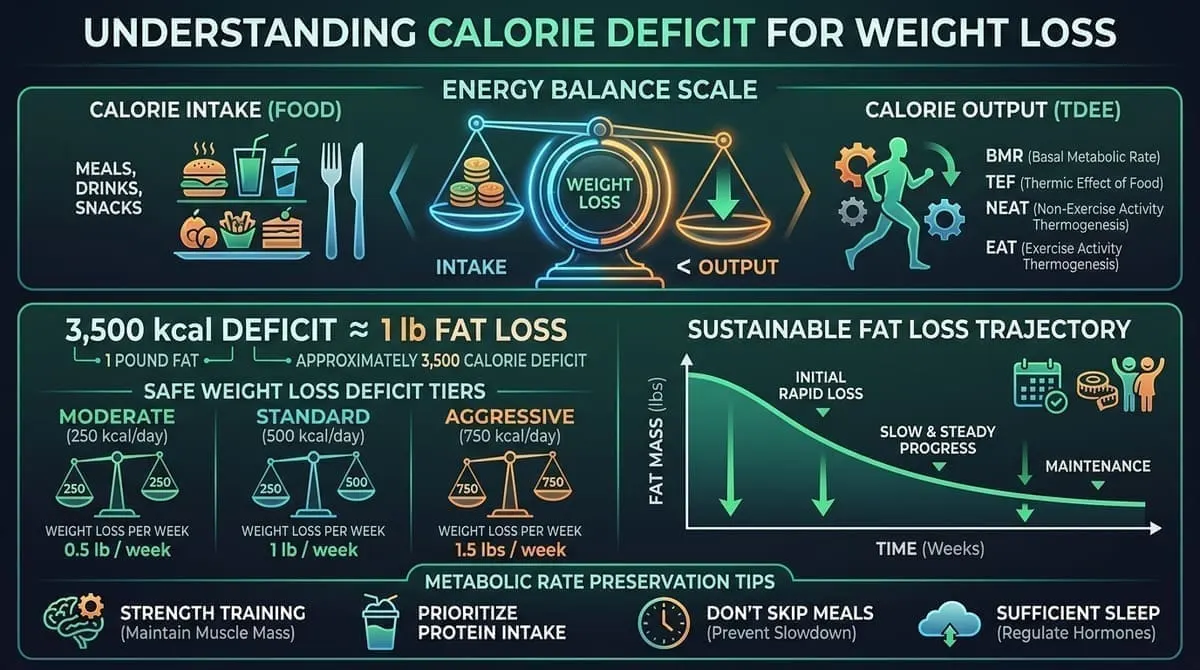
The Calorie Deficit Weight Loss Target Calculator computes your exact daily caloric targets based on your Total Daily Energy Expenditure (TDEE) and chosen rate of fat loss. This comprehensive guide breaks down the science of the 3,500-calorie rule, safe deficit tiers, how to prevent metabolic adaptation, and practical meal strategies for permanent body transformation.
2. Core Definitions & Analogy
To understand energy balance and fat mobilization, let us explore the core definitions:
- Simple Definition: A calorie deficit occurs when you consume fewer calories each day than your body burns through daily living, metabolism, and exercise.
- Technical Definition: A negative energy balance condition where total gross metabolic energy intake is less than total daily energy expenditure. Under this state, the neuroendocrine system downregulates insulin and activates hormone-sensitive lipase (HSL), mobilizing intracellular triglycerides via beta-oxidation to meet cellular ATP requirements.
- The Bank Savings Account Analogy: Think of your body fat as a high-yield emergency savings account, and food calories as your daily paycheck. When your paycheck (intake) is smaller than your daily living expenses (TDEE), you have a financial deficit. To keep the lights on and pay your bills, your bank is forced to withdraw money from your savings account (burning fat). To preserve savings, you must reduce expenses or increase income; to burn fat, you must create a deficit between intake and output.
3. The 3,500-Calorie Rule & The Physics of Fat Loss
In 1958, Dr. Max Wishnofsky established a foundational nutritional metric known as Wishnofsky's Rule:
flowchart LR
    A["1 Pound (453.6 g) Adipose Tissue"] --> B["~87% Pure Triglyceride Lipids (~395 g)"]
    B --> C["~13% Water, Collagen & Connective Protein (~58 g)"]
    C --> D["Total Stored Energy ≈ 3,500 Kilocalories (kcal)"]
Because 1 pound of adipose tissue contains approximately 3,500 kcal of stored chemical energy:
- A 500 kcal/day deficit produces:
500 × 7 = 3,500 kcal/week ≈ 1.0 lb (0.45 kg) fat loss per week.
- A 250 kcal/day deficit produces:
250 × 7 = 1,750 kcal/week ≈ 0.5 lb (0.23 kg) fat loss per week.
- A 750 kcal/day deficit produces:
750 × 7 = 5,250 kcal/week ≈ 1.5 lbs (0.68 kg) fat loss per week.
- A 1,000 kcal/day deficit produces:
1,000 × 7 = 7,000 kcal/week ≈ 2.0 lbs (0.91 kg) fat loss per week.
4. The Mathematical Formulas
Calculating your customized daily calorie deficit target follows this sequence:
Step 1: Determine Daily Maintenance Calories (TDEE)
TDEE = BMR × Physical Activity Factor
Step 2: Calculate Required Daily Calorie Deficit
Daily Deficit (kcal) = Target Weekly Loss (lbs) × 500
(Or for metric targets: Target Weekly Loss (kg) × 1100)
Step 3: Compute Final Daily Calorie Intake Target
Daily Calorie Target = TDEE - Daily Deficit
5. Safe Deficit Tiers & Recommended Loss Rates
Selecting the right deficit level depends on your starting body fat percentage and fitness background:
| Deficit Tier | Daily Deficit | Weekly Fat Loss | Best Suited For | Advantages & Trade-Offs |
|---|---|---|---|---|
| Conservative | 250 – 350 kcal | 0.5 – 0.7 lb / week | Lean individuals (<15% men, <23% women), athletes. | Zero hunger, maximal muscle retention, seamless social life. |
| Moderate (Standard) | 500 – 600 kcal | 1.0 – 1.2 lbs / week | General population, fitness enthusiasts. | The clinical "sweet spot": steady results with high sustainability. |
| Aggressive | 750 – 1,000 kcal | 1.5 – 2.0 lbs / week | Individuals with high starting body fat (BMI > 30). | Rapid visible progress; requires high protein and disciplined sleep. |
| Crash / Extreme | > 1,000 kcal | > 2.5 lbs / week | Generally not medically advised without clinical supervision. | High risk of muscle loss, gallstones, lethargy, and rebound weight gain. |
6. Step-by-Step Practical Calculations
Example 1: Moderate Deficit for an Office Worker
- Profile: 35-year-old male, TDEE = 2,600 kcal/day. Goal: Lose 1.0 lb/week.
- Step 1: Target Deficit:
1.0 × 500 = 500 kcal/day.
- Step 2: Daily Target Intake:
2,600 - 500 = 2,100 kcal/day.
- Weekly Energy Deficit: 3,500 kcal/week.
Example 2: Conservative Deficit for a Fit Individual
- Profile: 29-year-old female, TDEE = 2,050 kcal/day. Goal: Lose 0.5 lb/week while preserving gym strength.
- Step 1: Target Deficit:
0.5 × 500 = 250 kcal/day.
- Step 2: Daily Target Intake:
2,050 - 250 = 1,800 kcal/day.
- Weekly Energy Deficit: 1,750 kcal/week.
7. Macronutrient Distribution During a Deficit
Setting total calories creates fat loss, but setting macronutrients determines what kind of weight you lose:
flowchart TD
    CAL["Daily Calorie Deficit Target"]
    CAL --> PRO["Dietary Protein (1.6 to 2.2 g/kg body weight) - Preserves Muscle Mass & Elevates Satiety"]
    CAL --> FAT["Dietary Fats (20% to 30% total calories) - Supports Hormone & Testosterone Synthesis"]
CAL --> CARB["Carbohydrates (Remaining Calorie Budget) - Fuels Workout Intensity & Glycogen"]- Protein (High Priority): 1.6 to 2.2 g/kg of total body weight (0.8 to 1.0 g/lb). Protein triggers muscle protein synthesis, minimizes lean tissue catabolism during calorie restriction, and boasts the highest Thermic Effect of Food (20–30%).
- Dietary Fats: Keep at 20% to 30% of total calories (at least 0.6 g/kg) to support steroid hormone synthesis (testosterone, estrogen), fat-soluble vitamin absorption (A, D, E, K), and cellular membrane fluidity.
- Complex Carbohydrates: Fill the remaining caloric allocation with fibrous vegetables, legumes, whole grains, and tubers to sustain training performance and digestive health.
8. Clinical Case Studies
Case Study 1: The Weight Loss Plateau & Metabolic Adaptation
- Background: Mark, a 42-year-old male (100 kg, TDEE = 2,800 kcal), ate 1,800 kcal/day (1,000 kcal deficit) for 16 weeks. He lost 12 kg (down to 88 kg), but his weight stalled completely for 4 consecutive weeks.
- Analysis: At 88 kg, his new baseline TDEE dropped naturally to 2,400 kcal due to smaller body mass. Additionally, subconscious NEAT reduction and adaptive thermogenesis accounted for ~200 kcal/day. His actual deficit had shrunk from 1,000 kcal to only 200 kcal/day, which was easily masked by normal water fluctuations.
- Solution: Mark implemented a 2-week Diet Break at maintenance (2,300 kcal/day), restoring thyroid output and NEAT. When he resumed a structured 500 kcal deficit (1,800 kcal/day), consistent fat loss resumed immediately.
Case Study 2: Preserving Lean Muscle in a Female Lifter
- Background: Chloe, a 26-year-old recreational lifter (65 kg, 26% body fat, TDEE = 2,200 kcal), wanted to reach 20% body fat for a summer competition.
- Diet Strategy: Chloe selected a moderate 400 kcal deficit (1,800 kcal/day) paired with high protein (140 g/day, 2.15 g/kg) and maintained her heavy squat/deadlift strength routine.
- 12-Week Result: Chloe lost 4.2 kg of pure fat mass while losing zero skeletal muscle, maintaining full strength and muscular definition.
9. Common Mistakes That Sabotage a Deficit
- Underreporting Caloric Intake: Studies demonstrate that individuals underestimate their daily calorie intake by 30% to 50% on average. Cooking oils (1 tbsp = 120 kcal), salad dressings, liquid beverages, and grazing snacks are the most frequent culprits.
- Slashing Calories Below BMR: Eating drastically below basal needs slows metabolic output, causes hair thinning, triggers sleep disturbances, and inevitably leads to intense rebound bingeing.
- Neglecting Resistance Training: Dieting without lifting weights causes up to 30% to 40% of lost weight to come from muscle tissue rather than fat, resulting in a "skinny-fat" appearance and a lower post-diet metabolic rate.
- Assuming Cardio is Mandatory: Cardiovascular exercise is a helpful tool for health and creating an extra 200–300 kcal buffer, but dietary control is the primary driver of fat loss. You cannot out-train an unchecked diet.
10. Frequently Asked Questions (FAQ)
- What is the minimum calorie intake for health?General clinical safety guidelines recommend that daily intake should not drop below 1,200 kcal/day for women or 1,500 kcal/day for men without direct physician or dietitian supervision.
- Can you build muscle and lose fat at the same time in a deficit?Yes! This phenomenon—known as body recomposition—is common in beginners, individuals returning from a training hiatus, or those with significant body fat, provided they lift weights and consume high dietary protein.
- Why did I gain weight on the scale after starting my workout routine?New resistance training causes micro-tears in muscle fibers, triggering local inflammation and temporary water retention for recovery. True fat loss is occurring beneath the scale fluctuation.
- What is a diet break and when should I take one?A diet break is a planned 1-to-2 week period where you raise calories back to your current maintenance level (TDEE). It alleviates diet fatigue, restores leptin and thyroid hormone levels, and boosts mental adherence without adding body fat.
- Do meal timing and meal frequency matter for a calorie deficit?No. Whether you eat 6 small meals a day or 2 large meals within an intermittent fasting window, total 24-hour calorie intake and protein quantity dictate 95%+ of fat loss outcomes.
11. Expert Recommendations & Summary
- Choose Moderate Deficits: Aim for a 300 to 500 kcal daily deficit (10% to 20% below TDEE) for maximum sustainability and muscle preservation.
- Weigh Foods with a Digital Scale: Use a kitchen scale for peanut butter, oils, grains, and meats for 2 weeks to recalibrate your portion awareness.
- Prioritize Satiety & Volume: Fill meals with high-volume, low-calorie density foods: leafy greens, cruciferous vegetables, lean poultry, fish, berries, and potatoes.
- Focus on Long-Term Consistency: A moderate deficit maintained 90% of the time for 6 months will completely outperform an extreme crash diet that leads to quitting after 3 weeks.
Additional Technical Guidelines & Measurement Standards
When conducting calculations for Calorie Deficit Weight Loss Target Calculator, maintaining quantitative precision and verifying input parameter boundaries is essential for reliable scenario evaluation. Always verify that raw numerical inputs are measured using standardized instrumentation, and double-check unit conversions prior to applying outputs in commercial, industrial, or academic projects.
For quantitative unit conversions and scientific calculations, always maintain at least four decimal places of precision during intermediate arithmetic stages before rounding final results. When preparing technical reports, laboratory documentation, or financial forecasts, cross-verify all output variables against established international measurement standards (such as SI, NIST, and ISO metric benchmarks) to guarantee consistent analytical rigor across all computational workflows.
MathsLover.com delivers this interactive solver 100% free of charge to foster global mathematical literacy, educational accessibility, and data-driven problem solving across scientific, technical, and academic communities worldwide.