💡 Direct Answer & Executive Summary (US Navy Body Fat Percentage Calculator)
Definition: Estimate body fat percentage and lean tissue mass using circumference measurements.
Governing Math Formula: Navy Equation utilizes waist, neck, and height dimensions.
Target Applications: Provides real-time quantitative solutions in Health & Fitness for students, engineers, researchers, and finance professionals.
US Navy Body Fat Percentage Calculator - The Complete Anthropometric Guide
1. Introduction
When assessing personal fitness and chronic health risk, scale weight alone tells only a fraction of the story. A muscular strength athlete and a sedentary individual may weigh the exact same amount at the same height, yet have completely different health profiles and metabolic demands. What truly matters for longevity, physical capability, and metabolic efficiency is body composition—specifically your ratio of fat mass to lean muscle mass.
While clinical methods like Dual-Energy X-ray Absorptiometry (DEXA) or hydrostatic underwater weighing offer high precision, they are expensive and inaccessible for regular monitoring. To solve this problem for military readiness evaluations, the United States Department of Defense developed the US Navy Circumference Method.
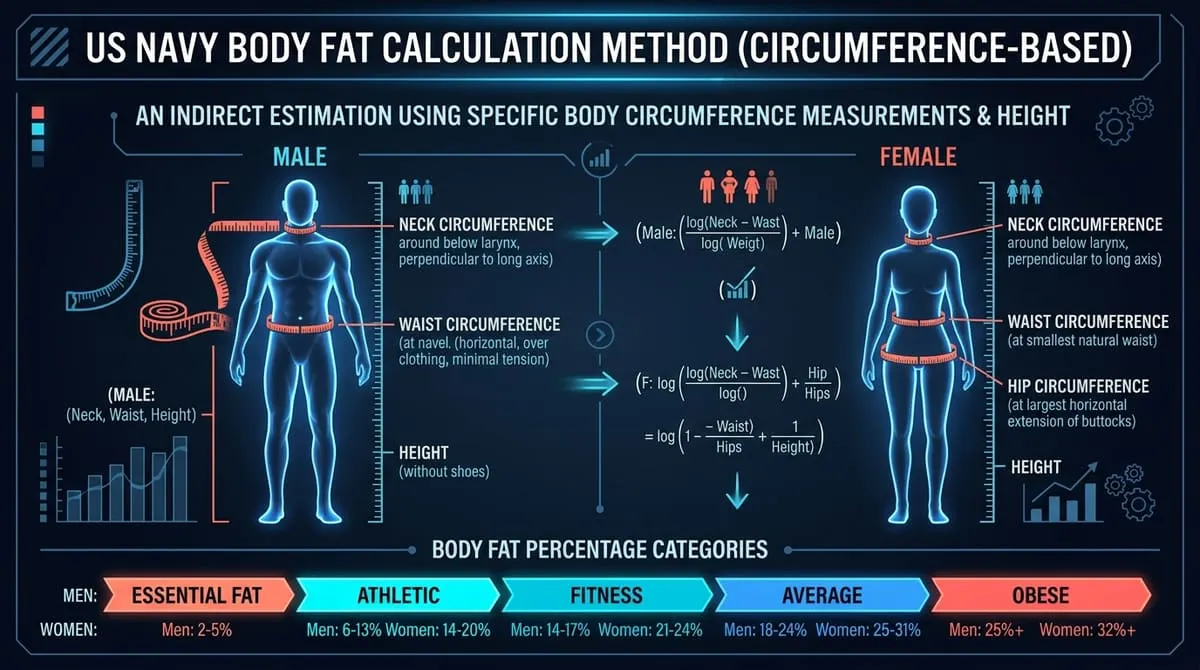
The US Navy Body Fat Percentage Calculator uses standardized body circumference measurements (neck, waist, and hips for women) combined with height to estimate body fat percentage with remarkable accuracy. In this guide, you will learn the mathematical foundation of the Navy formula, standardized measuring techniques, body fat category classifications, and practical strategies to optimize your body composition.
2. Core Definitions & Analogy
To build a thorough understanding of body composition metrics, let us define the key concepts:
- Simple Definition: Body fat percentage is the portion of your total weight that consists of adipose (fat) tissue, compared to everything else (muscles, bones, organs, blood, and water).
- Technical Definition: Body Fat Percentage (%BF) is the total mass of adipose lipid stores divided by total body mass multiplied by 100. The human body is modeled into two primary compartments: Fat Mass (FM), which includes essential physiological lipids and non-essential subcutaneous/visceral adipose storage, and Fat-Free Mass (FFM), which includes skeletal muscle, osseous bone mineral content, visceral organs, and total body water.
- The Shipping Container & Cargo Analogy: Imagine two cargo ships of the exact same physical size and displacement. The first ship is loaded with heavy structural steel and high-efficiency generators (lean functional mass). The second ship is loaded with lightweight packaging foam and excess storage crates (adipose fat tissue). Even if both ships draw the same water level on a scale, their seaworthiness, structural power, and fuel consumption are vastly different.
3. History of the US Navy Circumference Method
In the late 1970s and early 1980s, Dr. J.A. Hodgdon and Dr. M.B. Beckett at the Naval Health Research Center in San Diego, California, conducted extensive multi-variable regression studies on thousands of active-duty Navy personnel.
flowchart TD
    A["Direct Hydrostatic Weighing (Gold Standard Baseline)"] --> B["Multi-Site Anthropometric Regression Analysis"]
    B --> C["Hodgdon & Beckett Navy Standard Formulas (1984)"]
    C --> D["Adopted Across DoD, Military Branches & Global Fitness Protocols"]
Their goal was to create a cost-effective, field-deployable method that correlated closely with laboratory hydrostatic (underwater) weighing without requiring expensive equipment. The resulting logarithmic formulas demonstrated a high correlation coefficient with underwater weighing, making the Navy method the official physical readiness test (PRT) standard across the armed forces.
4. The Mathematical Formulas
The US Navy method utilizes logarithmic equations based on circumferences measured in centimeters or inches:
Male Formula (Metric: cm)
Body Fat % = [ 495 / ( 1.0324 - 0.19077 × log10(Waist - Neck) + 0.15456 × log10(Height) ) ] - 450
Female Formula (Metric: cm)
Body Fat % = [ 495 / ( 1.29579 - 0.35004 × log10(Waist + Hip - Neck) + 0.22100 × log10(Height) ) ] - 450
Male Formula (Imperial: inches)
Body Fat % = 86.010 × log10(Waist - Neck) - 70.041 × log10(Height) + 36.76
Female Formula (Imperial: inches)
Body Fat % = 163.205 × log10(Waist + Hip - Neck) - 97.684 × log10(Height) - 78.387
Why the Formula Works
- Waist minus Neck for Men: Abdominal waist circumference reflects subcutaneous and visceral adipose accumulation, while neck circumference serves as a proxy for muscular frame and skeletal width. Subtracting neck from waist isolates relative abdominal fat storage from structural bone size.
- Waist plus Hip minus Neck for Women: Biological females naturally store higher proportions of essential and subcutaneous fat in the gluteofemoral (hip and thigh) region due to estrogenic receptor distribution. Including hip circumference accounts for female gynoid fat patterns.
5. Standardized Measurement Protocols
Accurate results depend entirely on precise measuring tape placement:
| Measurement Site | Standard Anatomical Technique | Important Precautions |
|---|---|---|
| Height | Standing upright, barefoot, head aligned horizontally. | Measure without shoes or heavy hair accessories. |
| Neck | Tape positioned directly below the larynx (Adam's apple), perpendicular to the long axis of the neck. | Keep shoulders relaxed; avoid flaring neck muscles or constricting tape. |
| Waist (Men) | Horizontally across the abdomen at the level of the navel (umbilicus). | Measure at the end of normal expiration; do not suck in the abdomen. |
| Waist (Women) | Horizontally across the smallest natural waist circumference (typically between lowest rib and iliac crest). | Measure at end of normal expiration. |
| Hips (Women) | Horizontally across the maximal protrusion of the buttocks/gluteal muscles. | Keep feet together; tape must remain perfectly level on all sides. |
6. Body Fat Category Classifications
The American Council on Exercise (ACE) and the World Health Organization categorize body fat percentages into clinical tiers:
| Category Classification | Men (% Body Fat) | Women (% Body Fat) | Physiological Context |
|---|---|---|---|
| Essential Fat | 2% – 5% | 10% – 13% | Minimum lipids needed for nerve myelination, hormone production, and organ cushioning. |
| Athletes | 6% – 13% | 14% – 20% | Elite sport conditioning, visible muscle definition, vascularity. |
| Fitness | 14% – 17% | 21% – 24% | Excellent metabolic health, athletic leanness, sustainable fitness. |
| Average / Acceptable | 18% – 24% | 25% – 31% | Standard general population range, normal cardiovascular risk. |
| Obese | 25%+ | 32%+ | Elevated risk for insulin resistance, type 2 diabetes, and hypertension. |
7. Step-by-Step Practical Calculations
Example 1: Active Male
- Measurements: Height = 178 cm, Waist = 84 cm, Neck = 39 cm.
- Step 1: Calculate Waist - Neck:
84 - 39 = 45 cm.
- Step 2: Compute Log Values:
log10(45) = 1.65321,log10(178) = 2.25042.
- Step 3: Evaluate Density Equation:
Density = 1.0324 - (0.19077 × 1.65321) + (0.15456 × 2.25042) = 1.0324 - 0.31538 + 0.34782 = 1.06484
- Step 4: Calculate Body Fat %:
Body Fat % = (495 / 1.06484) - 450 = 464.86 - 450 = 14.86% ≈ 14.9%
- Classification: "Fitness / Lean" category.
8. Clinical Case Studies
Case Study 1: The BMI vs. Body Fat Discrepancy
- Background: Alex, a 26-year-old collegiate rugby player (182 cm, 96 kg).
- BMI Assessment:
BMI = 96 / (1.82)² = 28.98 kg/m²("Overweight" category).
- Navy Measurements: Neck = 43 cm, Waist = 84 cm.
- Navy Body Fat Result:
Body Fat ≈ 12.8%("Athletic" category).
- Clinical Takeaway: BMI misclassified Alex as borderline obese due to heavy muscle density. The Navy circumference method correctly reflected his lean, athletic composition.
Case Study 2: Tracking Postpartum Body Recomposition
- Background: Elena, a 31-year-old female (165 cm, 68 kg, Neck = 34 cm, Waist = 78 cm, Hips = 102 cm).
- Baseline:
Body Fat ≈ 29.5%.
- 12-Week Intervention: Structured strength training and high-protein nutrition (130 g/day).
- Follow-Up: Scale weight only dropped 2 kg (to 66 kg), but waist decreased to 72 cm and hips to 97 cm.
- New Body Fat:
Body Fat ≈ 24.1%.
- Outcome: Elena lost 4.3 kg of pure fat mass while gaining 2.3 kg of functional lean muscle tissue—a major health transformation that the scale alone failed to capture.
9. Limitations & Practical Considerations
- Hydration & Bloating: Measuring waist circumference after sodium-rich meals or during periods of gastrointestinal water retention can temporarily inflate body fat readings by 1% to 2%. Measure first thing in the morning under fasting conditions.
- Muscle Distribution: Bodybuilders with disproportionately thick necks may receive artificially low body fat estimates.
- Consistency is Key: Use a flexible, non-elastic vinyl tape measure and apply consistent, light tension without depressing soft tissues.
10. Frequently Asked Questions (FAQ)
- How accurate is the US Navy body fat method compared to DEXA?Controlled comparative studies show the US Navy method correlates within ±3% to 4% of DEXA and hydrostatic weighing for the majority of the adult population.
- Why is female body fat percentage higher than male percentage?Women possess biological sex-specific essential fat stores in breast tissue, pelvis, and reproductive anatomy (10–13% essential fat vs. 2–5% for men) necessary for fertility and hormonal homeostasis.
- Can you spot-reduce fat from your waist or hips?No. Targeted fat reduction is biologically impossible. Fat loss occurs systemically when in a sustained caloric deficit, dictated by genetics, sex hormones, and overall energy balance.
- What is a healthy body fat goal for longevity?For men, maintaining 12% to 18% body fat supports optimal testosterone, insulin sensitivity, and cardiovascular health. For women, 20% to 26% supports healthy menstrual cycles, bone density, and metabolic wellness.
- How often should I measure my body fat percentage?Every 2 to 4 weeks. Fat mass changes slowly, and measuring too frequently introduces noise from normal daily fluid fluctuations.
11. Expert Recommendations & Summary
- Standardize Your Testing Routine: Measure once a month on the same day of the week, immediately upon waking after using the restroom.
- Focus on Trends Over Individual Numbers: The direction of your circumference changes over 6 to 12 weeks provides a reliable measure of true body recomposition.
- Combine with Strength Training: Lifting weights preserves lean muscle mass during fat loss, ensuring that lost kilograms come exclusively from adipose stores.
Additional Technical Guidelines & Measurement Standards
When conducting calculations for US Navy Body Fat Percentage Calculator, maintaining quantitative precision and verifying input parameter boundaries is essential for reliable scenario evaluation. Always verify that raw numerical inputs are measured using standardized instrumentation, and double-check unit conversions prior to applying outputs in commercial, industrial, or academic projects.
For quantitative unit conversions and scientific calculations, always maintain at least four decimal places of precision during intermediate arithmetic stages before rounding final results. When preparing technical reports, laboratory documentation, or financial forecasts, cross-verify all output variables against established international measurement standards (such as SI, NIST, and ISO metric benchmarks) to guarantee consistent analytical rigor across all computational workflows.
MathsLover.com delivers this interactive solver 100% free of charge to foster global mathematical literacy, educational accessibility, and data-driven problem solving across scientific, technical, and academic communities worldwide.