💡 Direct Answer & Executive Summary (Body Density to Fat Percentage Siri Calculator)
Definition: Compute values for Body Density to Fat Percentage Siri Calculator in standard exercise science.
Governing Math Formula: Biometric calculation formula for Body Density to Fat Percentage Siri Calculator.
Target Applications: Provides real-time quantitative solutions in Health & Fitness for students, engineers, researchers, and finance professionals.
Body Density to Fat Percentage Siri Calculator - Densitometry Guide
1. Introduction
In human body composition science, body weight and skinfold calipers provide indirect approximations of fatness. To achieve clinical accuracy without invasive tissue biopsies, exercise scientists and physiologists developed densitometric body composition analysis.
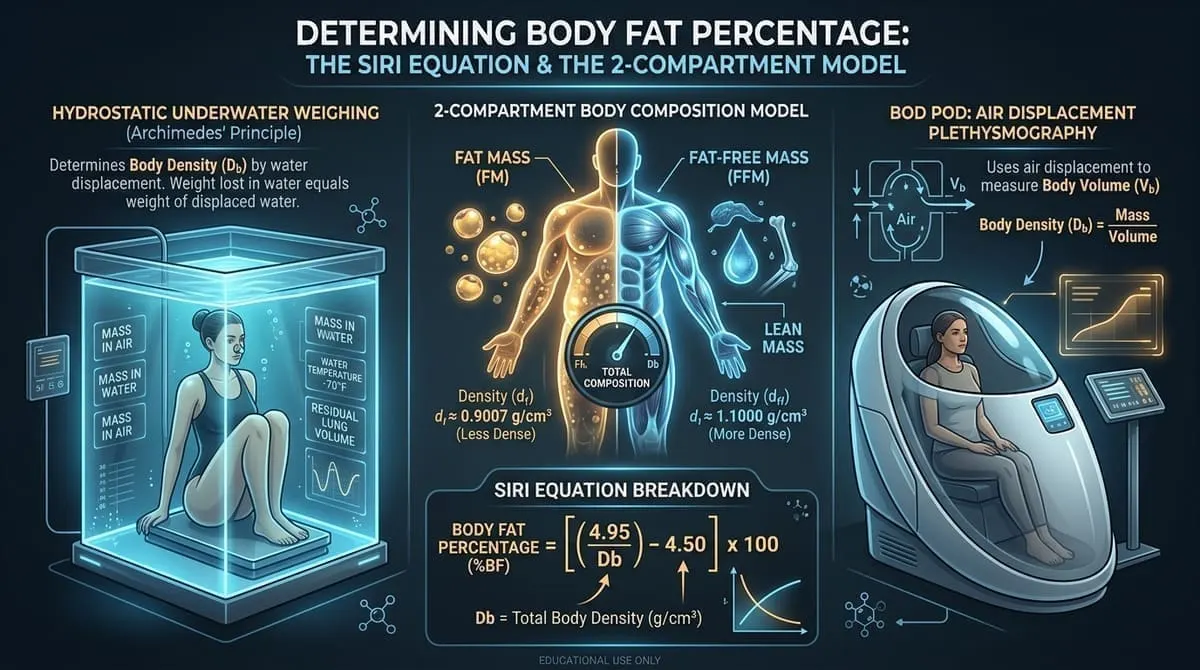
Densitometry relies on physical measurement of Whole-Body Density ()—the ratio of an individual's total body mass to their true anatomical body volume:
Because adipose fat tissue is less dense than water () while fat-free lean tissue (muscle, bone, organs) is denser than water (), a person with higher body fat will displace more volume and exhibit a lower overall whole-body density.
In 1956 and 1961, biophysicist Dr. William E. Siri published a foundational mathematical derivation in Techniques for Measuring Body Composition that converts measured body density directly into body fat percentage: the Siri Equation.
The Body Density to Fat Percentage Siri Calculator converts body density measurements obtained from Hydrostatic Underwater Weighing or Bod Pod Air Displacement Plethysmography into exact body fat percentages and fat-free mass metrics. This comprehensive guide covers Archimedes' principle, Siri vs. Brozek formulas, residual lung volume corrections, and multi-compartment body composition modeling.
2. Core Definitions & Analogy
To understand densitometry and the Siri formula, let us explore the core concepts:
- Simple Definition: The Siri Equation is a mathematical formula that calculates your exact body fat percentage based on how dense your body is.
- Technical Definition: A two-compartment somatic densitometric model that calculates fractional fat mass () by modeling total somatic density () as the harmonic mean of two constant-density compartments: an anhydrous pure chemical triglyceride fat compartment ( at 37°C) and a fat-free lean mass compartment ().
- The Iceberg & Floating Object Analogy: Think of pure body fat like an iceberg or a block of cedar wood, and lean muscle/bone like a dense brick. When placed in water, the wood (fat) floats easily because its density is less than water (), while the brick (lean tissue) sinks immediately. An athlete with dense muscular tissue sinks like an anchor in a swimming pool, showing a high body density (), whereas an individual with high body fat floats easily, showing a lower density ().
3. The 2-Compartment Densitometric Model
The Siri equation is built upon the classic Two-Compartment (2C) Model of human biology:
flowchart TD
    TB["Total Body Mass (100%)"]
    TB --> FM["Fat Mass (FM): Density = 0.9007 g/cm³ (Subcutaneous, Visceral, Intermuscular Adipose)"]
    TB --> FFM["Fat-Free Mass (FFM): Density = 1.1000 g/cm³ (Muscle 1.06, Bone 1.30, Organs 1.05, Water 0.993)"]
Key Assumptions of the Siri 2C Model:
- The density of pure human fat is universally constant at at normal core body temperature (37°C).
- The density of fat-free mass is universally constant at .
- Fat-free mass consists of fixed proportions: 73.8% water, 19.4% protein, and 6.8% bone mineral ash.
4. The Mathematical Derivations & Formulas
The relationship between density and volume fractions begins with:
Substituting and :
Solving for produces the famous Siri Equation (1961):
Alternative Brozek Formula (1963):
Dr. Josef Brozek derived an alternative formulation using slightly different assumptions for essential cellular lipid density (, ):
Hydrostatic Underwater Weighing Density Equation:
Where is mass in air, is submerged mass, is water density at tank temperature, is residual lung volume, and is gastrointestinal gas volume ().
5. Body Density to Fat Percentage Reference Table
The table below maps measured body density to Siri body fat percentage and typical fitness classifications:
| Measured Body Density () | Siri Body Fat % | Brozek Body Fat % | Classification |
|---|---|---|---|
| 1.0900 g/cm³ | 4.1% | 5.1% | Essential Fat / Elite Bodybuilder Stage Lean |
| 1.0800 g/cm³ | 8.3% | 9.0% | Athletic / Lean |
| 1.0700 g/cm³ | 12.6% | 12.9% | Fitness / Standard Athletic Male |
| 1.0600 g/cm³ | 17.0% | 16.9% | Average Healthy Male / Fit Female |
| 1.0500 g/cm³ | 21.4% | 21.0% | Average Female / Moderate Male |
| 1.0400 g/cm³ | 26.0% | 25.2% | Moderate Adiposity Female / Overweight Male |
| 1.0300 g/cm³ | 30.6% | 29.5% | Elevated Body Fat |
| 1.0200 g/cm³ | 35.3% | 33.9% | Clinical Obesity Class I |
| 1.0100 g/cm³ | 40.1% | 38.4% | Clinical Obesity Class II |
6. Step-by-Step Practical Calculations
Example 1: High-Density Athlete
- Parameters: Measured Body Density , Total Weight = 80 kg.
- Step 1: Divide 4.95 by measured density:
- Step 2: Subtract 4.50:
- Step 3: Multiply by 100:
- Step 4 (Fat Mass & Lean Mass):**
Example 2: Average Fitness Enthusiast
- Parameters: Measured Body Density , Total Weight = 70 kg.
- Step 1:
- Step 2:
- Step 3:
7. Gold-Standard Measurement Technologies
flowchart LR
    TECH["Densitometry Measurement Modalities"]
    TECH --> UWW["1. Hydrostatic Underwater Weighing (UWW) - Tank submersion with residual lung nitrogen washout"]
    TECH --> ADP["2. Bod Pod (Air Displacement Plethysmography) - Pressure-volume calibration chamber"]
TECH --> SF["3. Skinfold Jackson-Pollock / Durnin-Womersley 7-Site Equations - Caliper density regression"]- Hydrostatic Underwater Weighing (UWW): The historical scientific gold standard. The subject exhales all air down to residual volume and is submerged on a digital load cell scale.
- Air Displacement Plethysmography (Bod Pod): An egg-shaped fiberglass chamber using Poisson's gas law () to measure volume displacement in under 5 minutes without getting wet.
- Multi-Site Skinfold Caliper Regressions: Jackson-Pollock equations estimate from millimeter skinfold thicknesses before feeding into the Siri equation.
8. Clinical Case Studies
Case Study 1: Verifying True Fat Loss vs. Scale Stagnation
- Subject: Marcus, a 34-year-old powerlifter preparing for a weight class cut (Starting: 92 kg, , Siri Fat = 21.4%).
- 12-Week Intervention: High-protein diet and heavy lifting. Scale weight dropped only 2 kg (down to 90 kg).
- Re-test Bod Pod: New , Siri Fat = 13.4%.
- Analysis: Fat mass dropped from 19.7 kg to 12.1 kg (lost 7.6 kg pure fat), while skeletal muscle increased by 5.6 kg. The Siri formula proved massive recomposition that the bathroom scale obscured.
9. Boundary Conditions & Multi-Ethnic Adjustments
- Bone Mineral Density Variations: The Siri equation assumes a constant fat-free mass density of . African-American individuals tend to have higher average bone mineral density, yielding higher FFM density () which can slightly underestimate fat percentage with Siri. In such populations, the Schutte Formula or 4-Compartment DEXA modeling is preferred.
- Osteoporosis & Elderly Populations: De-mineralized bone lowers FFM density below , causing Siri to slightly overestimate body fat.
10. Frequently Asked Questions (FAQ)
- Why is the Siri equation better than standard BMI?BMI only looks at total scale weight and height, misclassifying muscular athletes as obese. Siri evaluates true physical tissue density, distinguishing heavy muscle from adipose tissue.
- What is the difference between Siri and Brozek?Siri and Brozek yield nearly identical results within the normal 10%–25% body fat range (difference ). Brozek is slightly more stable at extreme high adiposity ().
- Can Siri result in a negative body fat percentage?If an extremely dense athlete has a measured density (due to exceptionally dense bone and muscle), the formula mathematically produces , indicating the individual's FFM density exceeds the 2C model assumption.
11. Expert Recommendations & Summary
- Ensure Proper Pre-Test Conditions: For accurate Bod Pod or underwater weighing, fast for 3 hours, avoid vigorous exercise for 12 hours, and void bladder and bowels.
- Use Siri for Densitometry: Input your measured into the Siri equation for standard body fat conversion.
- Track Longitudinal Changes: Recalculate body density every 8 to 12 weeks to monitor authentic body composition improvements.
Additional Technical Guidelines & Measurement Standards
When conducting calculations for Body Density to Fat Percentage Siri Calculator, maintaining quantitative precision and verifying input parameter boundaries is essential for reliable scenario evaluation. Always verify that raw numerical inputs are measured using standardized instrumentation, and double-check unit conversions prior to applying outputs in commercial, industrial, or academic projects.
For quantitative unit conversions and scientific calculations, always maintain at least four decimal places of precision during intermediate arithmetic stages before rounding final results. When preparing technical reports, laboratory documentation, or financial forecasts, cross-verify all output variables against established international measurement standards (such as SI, NIST, and ISO metric benchmarks) to guarantee consistent analytical rigor across all computational workflows.
MathsLover.com delivers this interactive solver 100% free of charge to foster global mathematical literacy, educational accessibility, and data-driven problem solving across scientific, technical, and academic communities worldwide.