💡 Direct Answer & Executive Summary (Harris-Benedict BMR Calculator)
Definition: Compute values for Harris-Benedict BMR Calculator in standard exercise science.
Governing Math Formula: Biometric calculation formula for Harris-Benedict BMR Calculator.
Target Applications: Provides real-time quantitative solutions in Health & Fitness for students, engineers, researchers, and finance professionals.
Harris-Benedict BMR Calculator - The Complete Metabolic History & Energy Guide
1. Introduction
For more than a century, calculating the human body's baseline resting energy needs has been the cornerstone of nutrition science, clinical dietetics, and metabolic research. Whether an individual is sleeping, working, or exercising, every physiological process requires a baseline expenditure of energy known as the Basal Metabolic Rate (BMR).
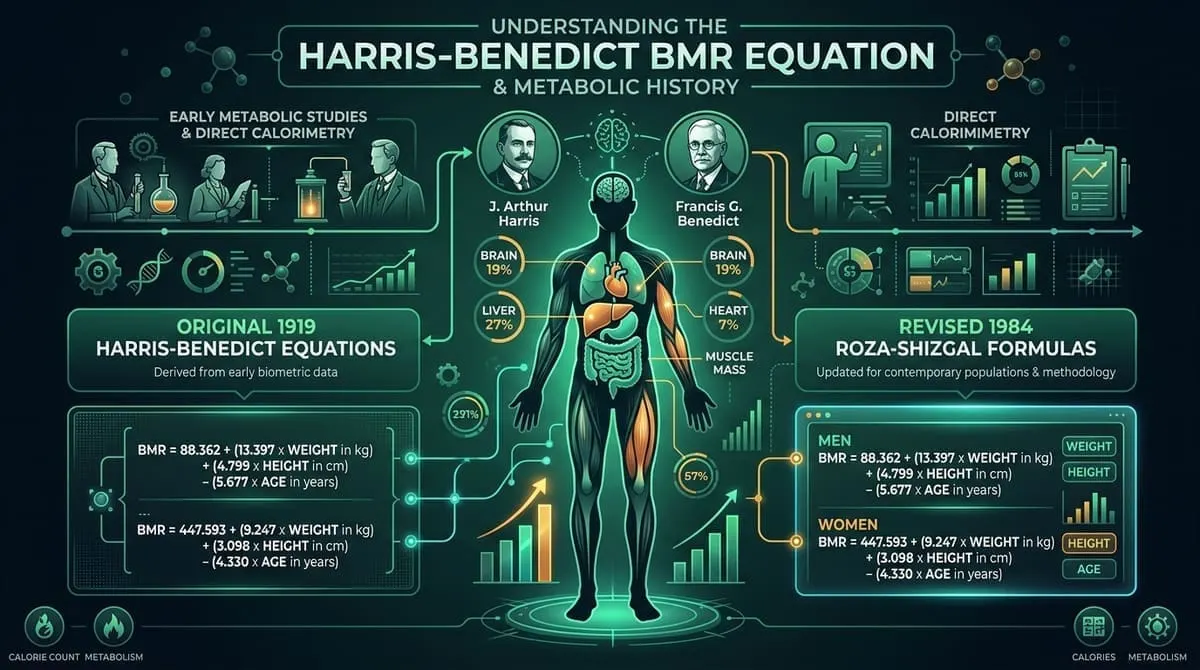
In 1919, biometrician J. Arthur Harris and physiologist Francis G. Benedict published a monumental scientific treatise through the Carnegie Institution of Washington, establishing the world's first empirical formula for predicting basal metabolism: the Harris-Benedict Equation.
Later revised by Roza and Shizgal in 1984 to reflect modernized datasets, the Harris-Benedict equation remains one of the most widely recognized, historically significant, and clinically influential formulas in exercise physiology and metabolic medicine.
The Harris-Benedict BMR Calculator computes your resting metabolic rate using both the classic and revised formulas, providing an essential baseline for calorie target planning. In this comprehensive guide, you will learn the history of direct and indirect calorimetry, the exact mathematical formulations, how Harris-Benedict compares with modern equations like Mifflin-St Jeor, and how to apply these numbers to your fitness regimen.
2. Core Definitions & Analogy
To understand basal metabolism and the Harris-Benedict method, let us examine the core concepts:
- Simple Definition: The Harris-Benedict formula estimates the total number of calories your body burns in 24 hours just to stay alive at complete rest, without moving or digesting food.
- Technical Definition: The Harris-Benedict equation is an empirical multi-variable regression model that predicts Basal Energy Expenditure (BEE) as a function of total body mass in kilograms, height in centimeters, chronological age in years, and biological sex. It correlates physical stature and mass with total body surface area and metabolic protoplasmic tissue mass.
- The Baseline Furnace Analogy: Imagine your body is an ancient stone cathedral heated by a basement coal furnace. Even on a warm summer day when no guests are inside and no lights are on, the furnace must maintain a steady pilot flame and baseline heat to prevent dampness and keep the structural pipes from freezing (BMR). When the church fills with choir singers and parishioners (exercise and daily activity), extra coal must be shoveled into the furnace (Total Daily Energy Expenditure).
3. History of the Harris-Benedict Equation
In the early 1900s at the Nutrition Laboratory of the Carnegie Institution in Boston, Massachusetts, Dr. Francis G. Benedict constructed state-of-the-art respiration calorimeters—sealed chambers measuring heat production and oxygen uptake ().
flowchart TD
    A["Direct & Indirect Calorimetry Experiments (Boston, 1910-1918)"] --> B["1919: Harris & Benedict Publication (239 Healthy Subjects)"]
    B --> C["1984: Roza & Shizgal Revision (Modern Re-evaluation on Contemporary Datasets)"]
    C --> D["Foundational Benchmark for Clinical Nutrition & Energy Prescription"]
Together with statistician J. Arthur Harris, they analyzed 136 men, 89 women, and 84 infants, publishing "A Biometric Study of Basal Metabolism in Man" in 1919. In 1984, researchers A.M. Roza and H.M. Shizgal re-analyzed the historical data alongside modern cohorts, recalibrating the coefficients to improve precision for modern populations.
4. The Mathematical Formulas
Both the Original 1919 equation and the Revised 1984 Roza-Shizgal equations are detailed below:
The Revised 1984 Roza-Shizgal Formula (Recommended Standard)
- For Men:
BMR = 88.362 + (13.397 × Weight in kg) + (4.799 × Height in cm) - (5.677 × Age in years)
- For Women:
BMR = 447.593 + (9.247 × Weight in kg) + (3.098 × Height in cm) - (4.330 × Age in years)
The Original 1919 Harris-Benedict Formula (Historical)
- For Men:
BMR = 66.5 + (13.75 × Weight in kg) + (5.003 × Height in cm) - (6.755 × Age in years)
- For Women:
BMR = 655.1 + (9.563 × Weight in kg) + (1.850 × Height in cm) - (4.676 × Age in years)
Imperial Conversion (Weight in lbs, Height in inches)
- Men (Revised):
BMR = 88.362 + (6.076 × Weight in lbs) + (12.189 × Height in inches) - (5.677 × Age)
- Women (Revised):
BMR = 447.593 + (4.194 × Weight in lbs) + (7.869 × Height in inches) - (4.330 × Age)
5. Harris-Benedict vs. Mifflin-St Jeor: Key Differences
Understanding the differences between the two leading BMR equations:
| Feature / Metric | Harris-Benedict (1919 / 1984) | Mifflin-St Jeor (1990) |
|---|---|---|
| Dataset Cohort | Early 20th-century leaner, active subjects (239 subjects). | Modern subjects spanning lean to obese (498 subjects). |
| Accuracy in Obesity | Tends to overestimate BMR by 5% to 15% in overweight individuals. | Accurate within ±10% in >82% of individuals across all BMI categories. |
| Clinical Status | Historic gold standard, widely referenced in academic literature. | Current clinical gold standard recommended by the Academy of Nutrition. |
| Best Application | Athletic individuals with higher lean muscle mass. | General population, fat loss planning, clinical medical dietetics. |
6. Step-by-Step Practical Calculations
Example 1: Adult Male (Revised Roza-Shizgal)
- Profile: 30-year-old male, weight = 75 kg, height = 178 cm.
- Step 1 (Base Constant): 88.362
- Step 2 (Weight Component):
13.397 × 75 = 1004.775
- Step 3 (Height Component):
4.799 × 178 = 854.222
- Step 4 (Age Deduction):
5.677 × 30 = 170.31
- Step 5 (Combine):
88.362 + 1004.775 + 854.222 - 170.31 = 1777.049 ≈ 1777 kcal/day.
Example 2: Adult Female (Revised Roza-Shizgal)
- Profile: 28-year-old female, weight = 60 kg, height = 165 cm.
- Step 1 (Base Constant): 447.593
- Step 2 (Weight Component):
9.247 × 60 = 554.82
- Step 3 (Height Component):
3.098 × 165 = 511.17
- Step 4 (Age Deduction):
4.330 × 28 = 121.24
- Step 5 (Combine):
447.593 + 554.82 + 511.17 - 121.24 = 1392.343 ≈ 1392 kcal/day.
7. Applying Activity Multipliers to Calculate TDEE
Multiply your calculated Harris-Benedict BMR by your Physical Activity Level (PAL) to determine Total Daily Energy Expenditure:
flowchart LR
    BMR["Harris-Benedict BMR (e.g. 1777 kcal)"] --> PAL["Physical Activity Multiplier (1.2 to 1.9)"]
PAL --> TDEE["Total Daily Energy Expenditure (TDEE)"]- Sedentary (Little/no exercise):
BMR × 1.200
- Light Activity (1–3 days/week):
BMR × 1.375
- Moderate Activity (3–5 days/week):
BMR × 1.550
- Very Active (6–7 days/week):
BMR × 1.725
- Extra Active (Hard labor / athlete):
BMR × 1.900
8. Clinical Case Studies
Case Study 1: Metabolic Overestimation in Overweight Adults
- Background: Robert, a 45-year-old male (, , 34% body fat).
- Harris-Benedict Calculation:
BMR ≈ 2025 kcal/day(TDEE at sedentary =2430 kcal).
- Mifflin-St Jeor Calculation:
BMR ≈ 1880 kcal/day(TDEE at sedentary =2256 kcal).
- Discrepancy: The Harris-Benedict equation overestimated Robert's needs by nearly 175 kcal/day because adipose tissue consumes far less energy than lean mass.
- Adjustment: By adopting the more conservative baseline, Robert avoided a hidden caloric surplus and achieved consistent 0.5 kg weekly weight loss.
Case Study 2: High Muscle Mass Athlete Precision
- Background: Derek, a 25-year-old collegiate swimmer (, , 10% body fat).
- Harris-Benedict Result:
BMR ≈ 1996 kcal/day.
- Metabolic Cart Measured:
2040 kcal/day.
- Outcome: For young, lean individuals with high muscle mass, the Harris-Benedict formula matches measured metabolic cart data within 2% accuracy.
9. Common Mistakes When Using Harris-Benedict
- Using the Unrevised 1919 Formula: Always use the 1984 Roza-Shizgal revision, as it provides greater statistical accuracy for contemporary populations.
- Treating BMR as Total Calorie Allowance: Eating only your BMR while working an active job results in an extreme caloric deficit that can cause severe lethargy.
- Ignoring Age-Related Decline: The equation subtracts ~5.7 kcal/day per year of age for men and ~4.3 kcal/day for women to account for natural sarcopenic shifts.
10. Frequently Asked Questions (FAQ)
- Why does Harris-Benedict have a base constant (88.362 for men, 447.593 for women)?The base constant represents the y-intercept of the multi-variable linear regression, anchoring the calculation to baseline human biological dimensions.
- Which formula is better: Harris-Benedict or Mifflin-St Jeor?For general weight loss and individuals with average or elevated body fat, Mifflin-St Jeor is slightly more accurate. For lean, athletic individuals with high muscularity, Harris-Benedict performs exceptionally well.
- Can you increase your BMR?Yes! Resistance training that builds skeletal muscle increases your resting metabolic rate because muscle tissue burns roughly 13 kcal/kg per day at complete rest compared to 4.5 kcal/kg for adipose tissue.
- How often should I recalculate my Harris-Benedict BMR?Recalculate your BMR every 4 to 5 kg (8–10 lbs) of body weight change to keep your nutrition targets aligned with your current body mass.
11. Expert Recommendations & Summary
- Use as a Validated Baseline: Treat your calculated BMR as an intelligent starting estimate for daily energy expenditure.
- Factor in True Lifestyle Activity: Choose conservative activity multipliers unless your daily occupation involves continuous physical labor.
- Track Scale Trends Over 3 Weeks: Monitor 7-day rolling weight averages to confirm whether your calculated maintenance calories match your real-world energy balance.
Additional Technical Guidelines & Measurement Standards
When conducting calculations for Harris-Benedict BMR Calculator, maintaining quantitative precision and verifying input parameter boundaries is essential for reliable scenario evaluation. Always verify that raw numerical inputs are measured using standardized instrumentation, and double-check unit conversions prior to applying outputs in commercial, industrial, or academic projects.
For quantitative unit conversions and scientific calculations, always maintain at least four decimal places of precision during intermediate arithmetic stages before rounding final results. When preparing technical reports, laboratory documentation, or financial forecasts, cross-verify all output variables against established international measurement standards (such as SI, NIST, and ISO metric benchmarks) to guarantee consistent analytical rigor across all computational workflows.
MathsLover.com delivers this interactive solver 100% free of charge to foster global mathematical literacy, educational accessibility, and data-driven problem solving across scientific, technical, and academic communities worldwide.