💡 Direct Answer & Executive Summary (Total Blood Volume Nadler Formula Calculator)
Definition: Compute values for Total Blood Volume Nadler Formula Calculator in standard exercise science.
Governing Math Formula: Biometric calculation formula for Total Blood Volume Nadler Formula Calculator.
Target Applications: Provides real-time quantitative solutions in Health & Fitness for students, engineers, researchers, and finance professionals.
Total Blood Volume Nadler Formula Calculator - Clinical Hemodynamic Guide
1. Introduction
Blood is the fundamental fluid tissue of the human circulatory system. It transports oxygen and nutrients to tissues, removes metabolic wastes, delivers immune cells to sites of infection, and stabilizes core body temperature and acid-base homeostasis. In clinical medicine, knowing a patient's Total Blood Volume (TBV) is vital for calculating safe blood loss thresholds during surgery, determining transfusion volumes, and configuring cardiopulmonary bypass machines.
Administering intravenous fluids or blood products without considering a patient's precise baseline blood volume carries significant clinical risks: 1. Hypovolemia: Inadequate circulatory volume leading to cellular hypoxia, hypotension, and hemorrhagic shock. 2. Hypervolemia (Fluid Overload): Excessive intravascular volume precipitating acute pulmonary edema, congestive heart failure exacerbation, and dilutional coagulopathy.
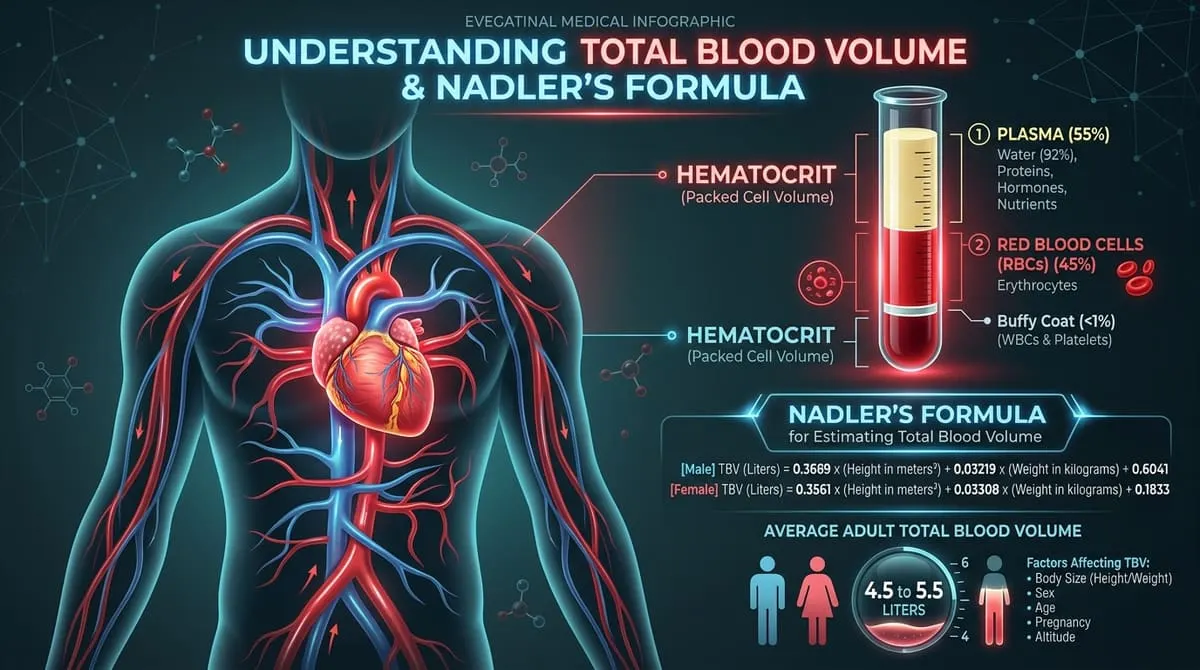
In 1962, Dr. S. B. Nadler, Dr. J. U. Hidalgo, and Dr. Ted Bloch published an anthropometric regression model in the journal Surgery based on isotope dilution techniques: the Nadler Formula.
The Total Blood Volume Nadler Formula Calculator computes total circulatory volume, plasma volume, and red blood cell mass based on height, weight, and biological sex. This comprehensive guide covers the physiological components of blood, mathematical derivations, clinical blood loss safety thresholds, and applications in intensive care and cardiovascular surgery.
2. Core Definitions & Analogy
To understand blood volume dynamics, let us examine the fundamental concepts:
- Simple Definition: Total Blood Volume (TBV) is the total quantity of blood circulating through your heart, arteries, veins, and capillaries, measured in liters or milliliters.
- Technical Definition: Total Blood Volume () is the sum of circulating Erythrocyte Volume () and Plasma Volume (): . The Nadler equation provides a multi-variable non-linear regression using stature cubed () and body mass () to account for sex-specific somatic density variations.
- The Hydraulic Cooling & Closed Circuit Analogy: Imagine an industrial liquid cooling system in an engine plant. The total capacity of the hydraulic pipes, reservoir tanks, and heat exchangers dictates the volume of cooling fluid required to maintain continuous system pressure (blood pressure). If the liquid drops below a critical threshold, the main pump cavitates and loses pressure (hypovolemic shock). If you overfill the system past pipe capacity, valves rupture and fluid leaks into surrounding machinery (pulmonary edema).
3. History of Blood Volume Measurement & The Nadler Equation
Before non-invasive mathematical modeling, measuring blood volume required radioactive isotope dilution (-labeled red blood cells and -labeled human serum albumin) or Evans Blue dye dilution:
flowchart TD
    A["Early 1900s: Evans Blue (T-1824) Dye Dilution - Complex & Slow"] --> B["1950s: Radioisotope Tracer Dilution (Cr-51 & I-131 Albumin)"]
    B --> C["1962: Dr. S. B. Nadler et al. Formulation (Surgery, Vol. 51)"]
    C --> D["Present Day: Universal Standard in Anesthesia, Perfusion & Dialysis Modeling"]
Dr. Nadler recognized that simple "rules of thumb" (such as assuming blood is strictly 70 mL/kg across all patients) caused severe overestimation in obese patients because adipose fat tissue is significantly less vascularized than skeletal muscle. By incorporating height cubed () alongside body weight, Nadler's formula provides superior accuracy across diverse body compositions.
4. The Mathematical Formulas
The Nadler Formula utilizes height (in meters) and body weight (in kilograms) with sex-specific polynomial coefficients:
Nadler Equations:
- For Men:
- For Women:
Rule-of-Thumb Comparison (Milliliters per Kilogram):
- Adult Males:
- Adult Females:
- Infants / Neonates:
Partitioning Plasma & Red Blood Cell Volumes:
Using the patient's Hematocrit ():
5. Blood Composition & Reference Ranges
Total blood volume is partitioned into fluid and cellular elements:
| Component | Percentage of TBV | Primary Sub-Components | Physiological Function |
|---|---|---|---|
| Plasma | ~55% | 92% Water, 7% Plasma Proteins (Albumin, Globulins, Fibrinogen), 1% Electrolytes | Oncotic pressure regulation, hormone transport, coagulation factors. |
| Erythrocytes (RBCs) | ~44% | Hemoglobin tetramers, Iron (), Carbonic Anhydrase | Transports oxygen () from lungs to tissues and carbon dioxide () to lungs. |
| Buffy Coat | < 1% | Leukocytes (Neutrophils, Lymphocytes, Monocytes) & Thrombocytes (Platelets) | Immune defense, inflammatory response, primary hemostatic plug formation. |
6. Step-by-Step Practical Calculations
Example 1: Adult Male
- Parameters: Male, Height = 1.80 m (180 cm), Weight = 75 kg, Hematocrit = 45% (0.45).
- Step 1 (Height Cubed):
- Step 2 (Height Term):
- Step 3 (Weight Term):
- Step 4 (Summation with Constant 0.6041):
- Step 5 (Partitioning):**
Example 2: Adult Female
- Parameters: Female, Height = 1.65 m (165 cm), Weight = 60 kg, Hematocrit = 40% (0.40).
- Step 1 (Height Cubed):
- Step 2 (Height Term):
- Step 3 (Weight Term):
- Step 4 (Summation with Constant 0.1833):
7. Major Clinical Applications
flowchart LR
    TBV["Total Blood Volume (Nadler Formula)"] --> ABL["Allowable Blood Loss (ABL) in Surgery"]
    TBV --> CPB["Cardiopulmonary Bypass: Circuit Priming & Hemodilution Target"]
    TBV --> DIAL["Nephrology: Hemodialysis Ultrafiltration Safety Limits"]
TBV --> TRANS["Massive Transfusion Protocols (MTP) & Resuscitation"]- Maximum Allowable Blood Loss (MABL) in Surgery: Anesthesiologists use TBV to calculate how much blood a patient can safely lose before triggering a red blood cell transfusion:
- Cardiopulmonary Bypass (CPB) Prime Volume: In open-heart surgery, the patient's blood is diverted into an extracorporeal heart-lung machine. Perfusionists use Nadler TBV to determine prime fluid volume, preventing severe dilutional anemia during surgery.
- Pregnancy Cardiovascular Adaptation: During a healthy pregnancy, maternal blood volume expands by 40% to 50% (an extra 1.2 to 1.5 Liters) above baseline Nadler values to supply the placenta and protect against postpartum hemorrhage.
8. Clinical Case Studies
Case Study 1: Calculating Safe Blood Loss in Orthopedic Surgery
- Patient: 55-year-old male undergoing total hip arthroplasty (Height = 1.75 m, Weight = 80 kg, Baseline Hematocrit = 42%, Minimum acceptable target Hct = 28%).
- TBV Calculation:
- Allowable Blood Loss:
- Outcome: The surgical team managed intraoperative bleeding to 850 mL, safely avoiding homologous blood transfusion and post-transfusion complications.
Case Study 2: Preventing Dialysis Disequilibrium in Renal Failure
- Patient: 62-year-old female receiving initial hemodialysis (Height = 1.60 m, Weight = 55 kg, TBV = 3.44 L).
- Clinical Need: Setting safe ultrafiltration rates without causing sudden intra-dialytic hypotension.
- Outcome: Fluid removal capped at strictly <10 mL/kg/hr relative to calculated vascular volume prevented circulatory collapse during dialysis sessions.
9. Limitations & Physiological Nuances
- Severe Obesity: While Nadler is superior to simple weight formulas, adipose tissue receives only ~2 to 3 mL of blood per 100 g of tissue (compared to 70–80 mL/100g in lean muscle and organs). In severe obesity (), consider using Lean Body Mass adjusted volume models.
- High Altitude Adaptation: Long-term residents of high-altitude regions develop chronic physiological polycythemia, elevating total red cell mass and expanding TBV above standard sea-level equations.
- Athletic Endurance Expansion: Elite endurance athletes experience exercise-induced hypervolemia (plasma volume expansion of 10%–20%), resulting in higher total circulatory capacity.
10. Frequently Asked Questions (FAQ)
- How much blood does the average adult human have?The average adult male has between 4.7 and 5.5 Liters (1.2 to 1.5 gallons) of blood, while the average adult female has between 3.5 and 4.2 Liters (0.9 to 1.1 gallons).
- Why do males have a higher blood volume than females of the same height?Males have higher circulating testosterone levels, which stimulates renal erythropoietin (EPO) production, resulting in a higher average hematocrit (40%–52% vs. 36%–48%) and greater baseline muscle mass.
- How much blood loss causes hemorrhagic shock?Loss of 15% to 30% of TBV (Class II Hemorrhage: ~750 to 1,500 mL) triggers tachycardia and narrowed pulse pressure; loss of >40% of TBV is life-threatening and requires emergency fluid and blood resuscitation.
- How quickly does the body replenish donated blood?After a standard 500 mL whole blood donation, plasma volume restores within 24 to 48 hours with proper hydration, while red blood cell count fully regenerates over 4 to 8 weeks.
11. Expert Recommendations & Summary
- Use Multi-Variable Equations: Prefer the Nadler formula over simplistic single-coefficient weight formulas for critical clinical estimations.
- Pair with Hematocrit Monitoring: Always incorporate measured hematocrit and hemoglobin to evaluate both oxygen-carrying capacity and total volume.
- Account for Physiological States: Adjust calculated baselines in pregnancy, endurance athletes, and surgical patients requiring fluid management.
Additional Technical Guidelines & Measurement Standards
When conducting calculations for Total Blood Volume Nadler Formula Calculator, maintaining quantitative precision and verifying input parameter boundaries is essential for reliable scenario evaluation. Always verify that raw numerical inputs are measured using standardized instrumentation, and double-check unit conversions prior to applying outputs in commercial, industrial, or academic projects.
For quantitative unit conversions and scientific calculations, always maintain at least four decimal places of precision during intermediate arithmetic stages before rounding final results. When preparing technical reports, laboratory documentation, or financial forecasts, cross-verify all output variables against established international measurement standards (such as SI, NIST, and ISO metric benchmarks) to guarantee consistent analytical rigor across all computational workflows.
MathsLover.com delivers this interactive solver 100% free of charge to foster global mathematical literacy, educational accessibility, and data-driven problem solving across scientific, technical, and academic communities worldwide.