💡 Direct Answer & Executive Summary (Baker Percentage Flour Hydration Solver)
Definition: Calculate bread dough ingredient masses based on flour mass (100% benchmark), target hydration, salt, and yeast inoculation.
Governing Math Formula: Ingredient Mass (g) = Flour Mass (g) * (Baker's % / 100).
Target Applications: Provides real-time quantitative solutions in Food for students, engineers, researchers, and finance professionals.
Baker Percentage Flour Hydration Solver: Professional Bread Formulas
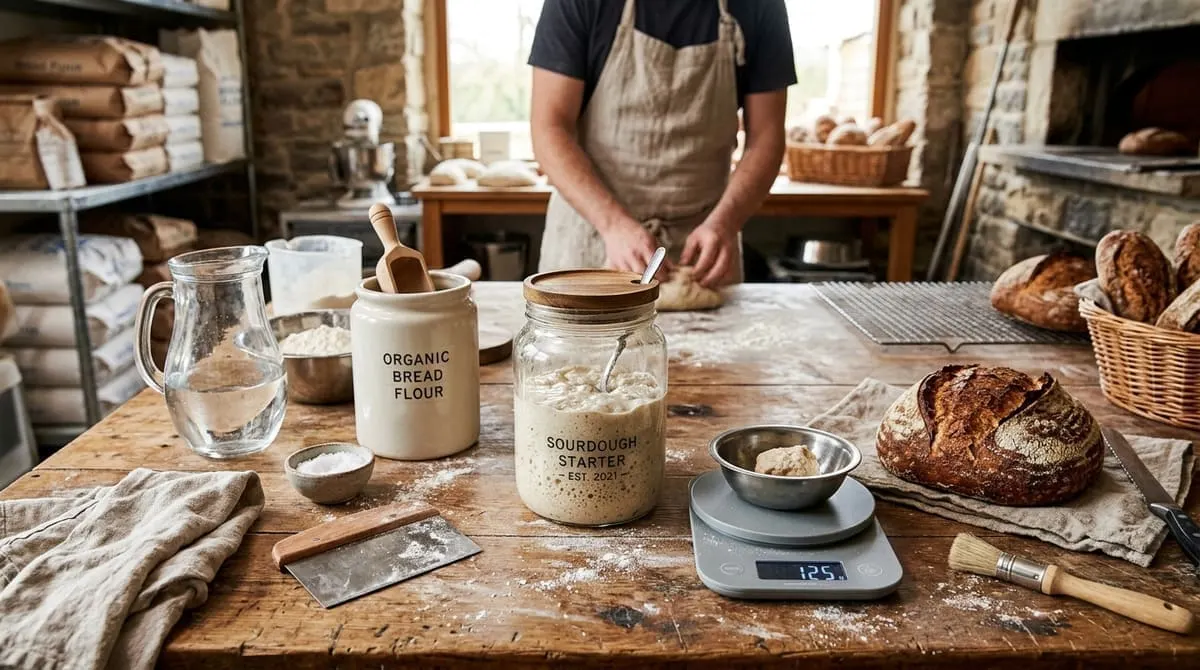
1. Introduction
In professional baking and artisan bread formulation, standard culinary percentage systems can be misleading. Instead of calculating ingredients as a percentage of total dough weight, professional bakers use Baker's Percentages (also known as Baker's Math), where the total weight of flour is always defined as the 100% benchmark.
The Baker Percentage Flour Hydration Solver calculates exact water, salt, yeast, sourdough starter, and enrichment weights relative to flour mass. Master baker math allows you to effortlessly scale recipes from a single sourdough boule to a commercial bakery run while precisely controlling crumb openness, crust blistering, and gluten network development.
flowchart TD
    FLOUR["🌾 Determine Total Flour Weight = 100% Reference Base"] --> HYDRATION["💧 Calculate Water Mass = Flour Mass × Target Hydration %"]
    FLOUR --> SALT["🧂 Calculate Salt Mass = Flour Mass × 2.0%"]
    FLOUR --> YEAST["🍞 Calculate Yeast / Starter Inoculation Mass"]
    HYDRATION & SALT & YEAST --> TOTAL["⚖️ Sum All Component Masses for Total Batch Mass"]
2. Core Definitions & Analogy
Simple Definition
Baker's Percentage expresses every ingredient in a recipe as a percentage of the total flour weight. If a bread formula calls for of flour and of water, the hydration is 75%.
Technical Definition
Technically, Baker's Percentage is an anchor-ratio system where total flour mass . The Baker's percentage of any ingredient with mass is defined as:
Because ingredients are added relative to flour, the sum of all Baker's percentages in a standard dough formula exceeds 100% (e.g., 100% flour + 75% water + 2% salt + 20% starter = 197% total dough yield).
The Anchor Weight Analogy
Imagine flour as the solid foundation anchor of a building weighing . Water, salt, and yeast are added relative to the anchor's mass. Adding of water (75%) creates a wet, open structure, while (60%) creates a dense sandwich loaf. The anchor (100%) never changes, making additions easy to adjust.
3. History & Milestones
timeline
    title Evolution of Baker Percentages and Flour Hydration
    1910s : Industrial bakeries introduce percentage formulas to standardize commercial dough batches.
    1970s : French bread master Raymond Calvel formalizes the autolyse method and hydration scaling.
    1990s : Artisan sourdough revival popularizes high-hydration open crumb doughs above 75 percent.
    2020s : Home micro-bakers use digital precision scales and online Baker percent calculators.
4. Core Concepts & Bread Style Matrix
Flour hydration (the ratio of water to flour) dictates dough handling, fermentation velocity, and final crumb morphology:
| Bread Style | Hydration Range | Salt % | Yeast / Starter Inoculation | Crumb & Texture Characteristics | Recommended Flour |
|---|---|---|---|---|---|
| Sandwich Loaf | 60% - 65% | 2.0% | 1.5% Commercial Instant | Tight, fine crumb, easy slicing, soft tender crust | Bread Flour (12.5% Protein) |
| Baguette (Traditional) | 65% - 70% | 1.8% | 1.0% Fresh Yeast | Crisp thin crust, cream-colored open crumb | French T65 or All-Purpose |
| Artisan Sourdough | 72% - 78% | 2.0% | 20% Active Starter (100% Hyd) | Open, airy crumb, glossy alveoli, dark blistered crust | Unbleached Bread + 10% Rye |
| Ciabatta | 80% - 85% | 2.2% | 1.2% Instant Yeast | Highly irregular wild open holes, flat slipper shape | High-Gluten Flour () |
| Focaccia | 80% - 90% | 2.5% | 1.5% Instant + Olive Oil | Tender, dimpled oil-soaked crumb, crisp bottom | Bread Flour |
| Neapolitan Pizza | 62% - 65% | 2.8% | 0.2% Fresh Yeast | Soft pliable rim, leopard charred spots, quick wood fire bake | Italian Tipo 00 Flour |
5. The Mathematical Model & Formulas
1. Hydration Percentage Equation:
2. Ingredient Mass from Baker's Percentage:
3. Total Target Dough Mass Scaling:
Given a desired final dough batch weight and known Baker's percentages:
6. Step-by-Step Computational Procedure
Consider formulating dough for two sourdough boules (Total target dough weight ) at 75% hydration, 2.0% salt, and 20% sourdough starter (100% hydration starter containing equal parts flour and water):
- Calculate Total Formula Percentage:* Flour = 100%* Water = 75%* Salt = 2.0%* Starter = 20% (10% flour + 10% water contribution)* Total Formula Sum = (or factor $1.97$)
- Compute Required Base Flour Mass:
- Calculate Individual Component Weights:* Water (75%):* Sourdough Starter (20%):* Salt (2.0%):
- Verification:
7. Visual Explanations
Component Mass Ratio in an Artisan Sourdough Batch
pie title Component Mass Ratio for a 75 Percent Hydration Artisan Boule (1000g Flour Base)
    "Flour Base (1000 g / 100%)" : 1000
    "Water (750 g / 75%)" : 750
    "Sourdough Starter (200 g / 20%)" : 200
    "Sea Salt (20 g / 2%)" : 20
8. Parameter Comparison Matrix
| Flour Weight () | Hydration % | Water Mass () | Salt Mass (2.0%) | Starter Mass (20%) | Total Dough Yield |
|---|---|---|---|---|---|
| 65% (Sandwich) | |||||
| 75% (Artisan) | |||||
| 70% (Baguette) | |||||
| 80% (Ciabatta) | |||||
| 75% (Commercial) |
9. Real-World Applications & Case Studies
- Flour Absorption Adjustments: When switching from standard all-purpose flour (11% protein) to whole grain stone-ground wheat (14% protein), whole grains absorb up to 10% - 15% more water due to bran fiber. Bakers use the solver to increase hydration from 70% to 78% without altering salt or fermentation inoculation percentages.
- Case Study: A bakery scaling up sourdough production noted that summer room temperatures caused dough to over-proof. By reducing sourdough starter inoculation from 20% down to 12% using Baker's math, they slowed fermentation rate while holding total hydration constant at 76%, restoring crust color and loaf volume.
10. Advantages & Limitations
Advantages
- Scales any recipe linearly up to industrial ton yields without changing flavor balance.
- Simplifies recipe modification: adjusting hydration or salt takes seconds without recalculating the whole recipe.
- Enables precise comparisons between different baker formulas around the world.
Limitations
- Requires measuring all ingredients by weight (grams), not volumetric cups or spoons.
11. Common Pitfalls
Pitfall 1: Forgetting Water Contribution in Sourdough Starter
A 100% hydration sourdough starter contains equal parts flour and water ( flour + water per starter). Forgetting to account for starter water when baking high-hydration doughs causes actual total hydration to be higher than calculated!
12. Frequently Asked Questions (FAQ)
Q: Why is flour always 100% in Baker's percentage?
A: Flour forms the structural gluten matrix of bread. Defining flour as 100% creates an invariant reference baseline so all liquids, fats, and seasonings can be adjusted independently.
Q: What is the best hydration percentage for beginner sourdough bakers?
A: Start at 68% - 72%. This provides sufficient moisture for a light crumb while remaining manageable to shape without sticking.
Q: Does salt percentage affect fermentation rate?
A: Yes! Salt acts as a natural yeast inhibitor. Standard salt is 1.8% - 2.2%. Dropping below 1.5% leads to fast, uncontrollable fermentation and pale crusts.
13. Expert Tips & Summary
- Use a Digital Gram Scale: Always weigh flour, water, and salt down to precision.
- Account for Preferments: Include flour and water from poolish, levain, or starter when calculating true total hydration.
- Summary: Baker's percentage () establishes flour as the 100% foundation, allowing instant recipe scaling, perfect hydration control, and consistent bread quality.
Additional Technical Guidelines & Measurement Standards
When conducting calculations for Baker Percentage Flour Hydration Solver, maintaining quantitative precision and verifying input parameter boundaries is essential for reliable scenario evaluation. Always verify that raw numerical inputs are measured using standardized instrumentation, and double-check unit conversions prior to applying outputs in commercial, industrial, or academic projects.
For quantitative unit conversions and scientific calculations, always maintain at least four decimal places of precision during intermediate arithmetic stages before rounding final results. When preparing technical reports, laboratory documentation, or financial forecasts, cross-verify all output variables against established international measurement standards (such as SI, NIST, and ISO metric benchmarks) to guarantee consistent analytical rigor across all computational workflows.
MathsLover.com delivers this interactive solver 100% free of charge to foster global mathematical literacy, educational accessibility, and data-driven problem solving across scientific, technical, and academic communities worldwide.