💡 Direct Answer & Executive Summary (Wine Yeast Alcohol ABV Potential Solver)
Definition: Predict potential Alcohol by Volume (ABV) from initial specific gravity (OG) or Brix readings and calculate final realized ABV.
Governing Math Formula: ABV (%) = (Original Gravity - Final Gravity) * 131.25.
Target Applications: Provides real-time quantitative solutions in Food for students, engineers, researchers, and finance professionals.
Wine Yeast Alcohol ABV Potential Solver: Enological Fermentation Yield Guide
1. Introduction
In commercial winemaking, mead production, and home enology, predicting final Alcohol by Volume (ABV) is essential for tax compliance, sensory balance, yeast strain selection, and fermentation stability.
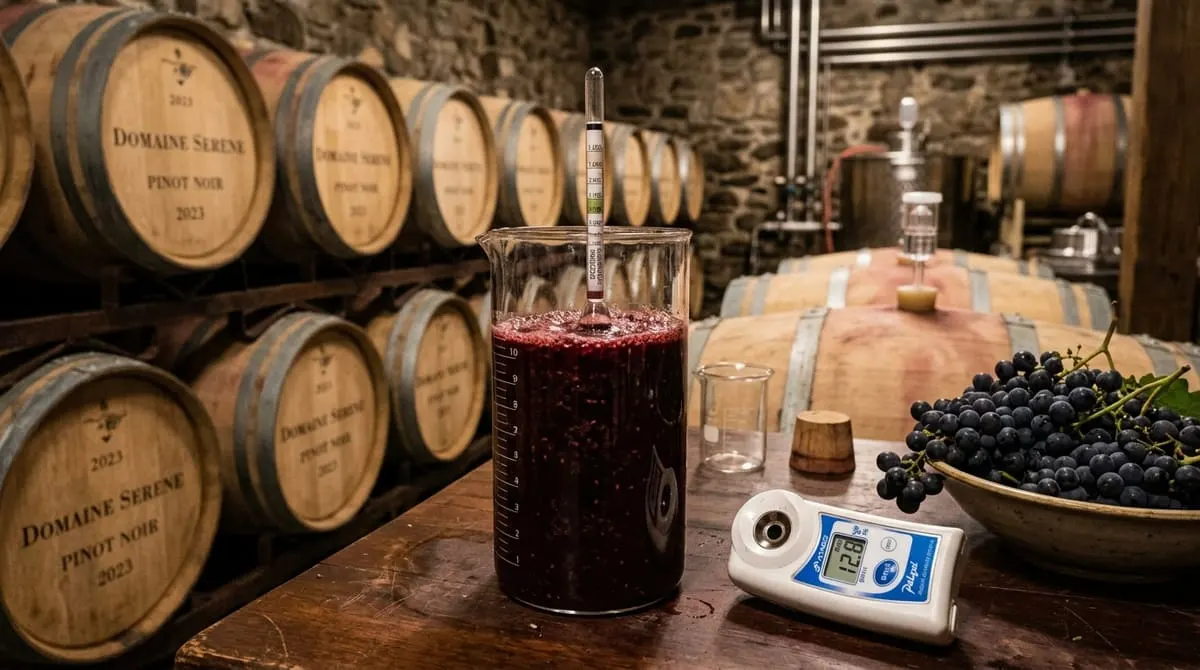
The Wine Yeast Alcohol ABV Potential Solver determines the potential alcohol yield based on initial fermentable sugar concentration (measured in Specific Gravity , degrees , or ), tracks real-time sugar depletion, and calculates final ABV upon completion of alcoholic fermentation.
flowchart TD
    MUST["🍇 Measure Grape Must Initial Specific Gravity OG or Brix"] --> YEAST["🔬 Select Commercial Wine Yeast Strain & Inoculate"]
    YEAST --> FERM["🫧 Glycolytic Fermentation Converts 1g Glucose to ~0.51g Ethanol + CO2"]
    FERM --> FG["🧪 Measure Final Specific Gravity FG at Fermentation Completion"]
    FG --> ABV["🍷 Calculate Final Alcohol By Volume ABV = OG minus FG times 131.25"]
2. Core Definitions & Analogy
Simple Definition
Alcohol by Volume (ABV) is the percentage of a wine's total volume that consists of pure ethanol. The solver calculates ABV by comparing the heavy sugar water density before fermentation (Original Gravity, ) to the lighter alcohol density after fermentation (Final Gravity, ).
Technical Definition
Technically, yeast (Saccharomyces cerevisiae) ferments hexose sugars (glucose and fructose, ) into ethanol () and carbon dioxide () via the Embden-Meyerhof-Parnas glycolytic pathway:
The theoretical Gay-Lussac yield factor converts of hexose sugar into ethanol. In practical winemaking, metabolic biomass synthesis and glycerol formation reduce actual yield factor to ethanol per gram of sugar.
The Fuel Tank Analogy
Think of fermentable grape sugar as gasoline in a car's fuel tank, and yeast as the engine. The initial hydrometer reading () measures how full the sugar tank is. The potential ABV tells you how far the car will travel (how much alcohol will be produced) when the yeast engine burns all the sugar fuel down to empty ().
3. History & Milestones
timeline
    title Milestones in Fermentation Science and Enology
    1857 : Louis Pasteur proves yeast micro-organisms drive sugar-to-alcohol fermentation.
    1900 : Balling, Brix, and Plato hydrometer density scales standardized for winemaking.
    1970s : Isolated cultured wine yeast strains (Lalvin EC-1118, K1-V1116) introduced.
    2010s : Optical digital refractometers with automatic temperature compensation become standard.
4. Core Concepts & Yeast Strain Matrix
Yeast strain selection dictates maximum alcohol tolerance, fermentation kinetics, and residual sweetness:
| Wine Yeast Strain | Alcohol Tolerance (% ABV) | Ideal Temp Range | Fermentation Speed | Recommended Wine Styles | Characteristics |
|---|---|---|---|---|---|
| Lalvin EC-1118 (Champagne) | 18.0% | Fast & Aggressive | Sparkling, High-ABV Fruit Wines, Stuck Ferment Restarts | Extremely neutral, killer factor positive | |
| Lalvin 71B (Narbonne) | 14.0% | Moderate | Pinot Noir, Syrah, Rosé, High-Malic Fruit Wines | Metabolizes up to 30% malic acid, enhances fruitiness | |
| Lalvin RC 212 (Bourgovin) | 16.0% | Moderate | Pinot Noir, Cabernet, Full-Bodied Reds | Enhances polyphenol structure and color extraction | |
| Red Star Cote des Blancs | 14.0% | Slow & Steady | Riesling, Chardonnay, Fruit Meads | Slow fermenter, preserves delicate fruit aromas | |
| Lalvin K1-V1116 | 18.0% | Fast | Sauvignon Blanc, Cider, Difficult Must Conditions | Vigorous, competitive, tolerates nutrient stress |
5. The Mathematical Model & Formulas
1. Standard Linear ABV Formula:
Where:
- = Original Gravity (e.g., $1.090$)
- = Final Gravity (e.g., $0.996$)
2. High-Gravity Advanced Catterall-Hall ABV Equation (For ):
3. Brix to Potential ABV Approximation:
6. Step-by-Step Computational Procedure
Consider fermenting a batch of Cabernet Sauvignon grape must with an initial reading of (Original Gravity ):
- Calculate Potential ABV from :
- Fermentation Execution & Monitoring:* Inoculate with Lalvin RC 212 yeast.* Ferment at until specific gravity stabilizes at .
- Compute Final Realized ABV (Standard Formula):
- Compute High-Gravity Catterall Equation for High Precision:
7. Visual Explanations
Sugar-to-Product Mass Conversion Distribution
pie title Fermentation Mass Conversion Yield of 100g Fermentable Grape Sugars
    "Ethanol Alcohol Mass (48.4 g)" : 48.4
    "Carbon Dioxide Gas Off-gassing (46.6 g)" : 46.6
    "Yeast Biomass Growth & Glycerol (5.0 g)" : 5.0
8. Parameter Comparison Matrix
| Initial Brix () | Original Gravity () | Final Gravity () | Standard ABV % | High-Gravity ABV % | Wine Profile Category |
|---|---|---|---|---|---|
| $1.074$ | $0.996$ | 10.24% | 10.45% | Light-bodied white / Pinot Grigio | |
| $1.087$ | $0.995$ | 12.08% | 12.42% | Medium-bodied red / Sauvignon Blanc | |
| $1.101$ | $0.994$ | 14.04% | 14.60% | Full-bodied Zinfandel / Syrah | |
| $1.115$ | $0.998$ | 15.36% | 16.15% | High-alcohol Port base / Fortified | |
| $1.129$ | $1.010$ (Sweet) | 15.62% | 16.85% | Dessert Wine / Icewine / Heavy Mead |
9. Real-World Applications & Case Studies
- Chaptalization Tuning: If late harvest grapes reach only () due to cool weather, potential ABV is capped at 11.4%. A winemaker seeking a target 13.5% ABV uses the solver to calculate the exact mass of cane sugar required to raise the must to prior to yeast pitch.
- Case Study (Stuck Fermentation Analysis): A home winemaker's blackberry wine stopped bubbling at with (13.1% realized ABV). The solver verified that the yeast strain used (Lalvin 71B, max tolerance 14%) had reached its osmotic alcohol threshold. Re-inoculating with killer-tolerant EC-1118 successfully fermented the remaining sugar down to $0.996$ (16.3% final ABV).
10. Advantages & Limitations
Advantages
- Prevents yeast alcohol toxicity failure by matching sugar gravity to yeast strain tolerance.
- Allows precise sugar additions (chaptalization) or water dilutions prior to fermentation start.
- Ensures accurate alcohol labeling for commercial beverage regulations.
Limitations
- Refractometer Alcohol Distortion: Once alcohol is present in fermented wine, light refractometer readings () are distorted by ethanol's refractive index. A hydrometer or correction equation must be used post-fermentation.
11. Common Pitfalls
Pitfall 1: Reading Refractometer Post-Fermentation Without Correction
Taking a Brix reading with an optical refractometer after fermentation begins produces an incorrectly high reading because alcohol alters the refraction of light. Always use a hydrometer or apply a refractometer alcohol correction calculation!
12. Frequently Asked Questions (FAQ)
Q: What is the difference between Specific Gravity and Brix?
A: Specific Gravity () measures liquid density relative to pure water ($1.000$). Brix () measures grams of sucrose per of liquid ().
Q: Why does Final Gravity drop below 1.000 in dry wine?
A: Pure ethanol has a specific gravity of $0.789$ (lighter than water). When all sugar is consumed, the alcohol-water mixture drops to .
Q: How much sugar adds 1% ABV to a 5-gallon batch?
A: Adding of cane sugar to a batch increases potential ABV by approximately 1.0%.
13. Expert Tips & Summary
- De-gas Hydrometer Samples: Carbon dioxide bubbles clinging to a hydrometer stem cause false high readings. Spin the hydrometer to dislodge bubbles.
- Temperature Compensation: Hydrometers are calibrated at (). Adjust readings if measuring warm must.
- Summary: Measuring and using the ABV formula () ensures precise alcohol tracking and flawless wine fermentation.
Additional Technical Guidelines & Measurement Standards
When conducting calculations for Wine Yeast Alcohol ABV Potential Solver, maintaining quantitative precision and verifying input parameter boundaries is essential for reliable scenario evaluation. Always verify that raw numerical inputs are measured using standardized instrumentation, and double-check unit conversions prior to applying outputs in commercial, industrial, or academic projects.
For quantitative unit conversions and scientific calculations, always maintain at least four decimal places of precision during intermediate arithmetic stages before rounding final results. When preparing technical reports, laboratory documentation, or financial forecasts, cross-verify all output variables against established international measurement standards (such as SI, NIST, and ISO metric benchmarks) to guarantee consistent analytical rigor across all computational workflows.
MathsLover.com delivers this interactive solver 100% free of charge to foster global mathematical literacy, educational accessibility, and data-driven problem solving across scientific, technical, and academic communities worldwide.