💡 Direct Answer & Executive Summary (Meat Cooking Safe Internal Temperature Guide)
Definition: Look up target internal doneness temperatures, pull temperatures from heat, and USDA pasteurization safety guidelines.
Governing Math Formula: Target Core Temp = Base Doneness Threshold; Pull Temp = Target - Carryover Rise (3°F-5°F).
Target Applications: Provides real-time quantitative solutions in Food for students, engineers, researchers, and finance professionals.
Meat Cooking Safe Internal Temperature Guide: Culinary Doneness & Pasteurization
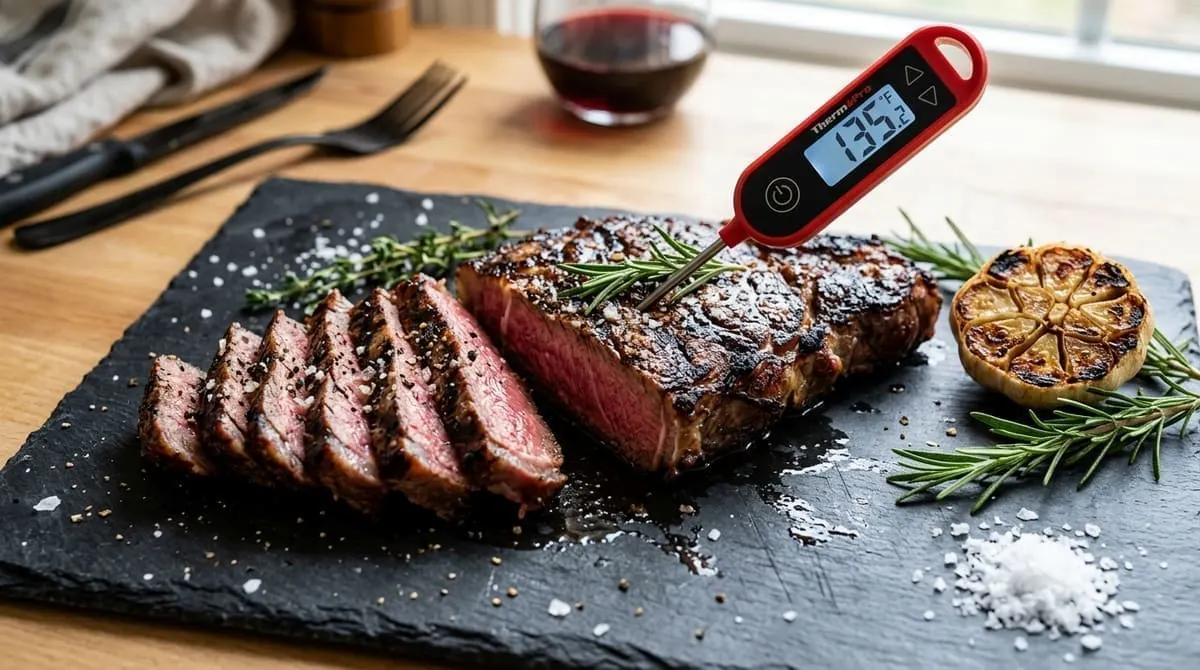
1. Introduction
Cooking meat to perfection requires balancing two critical priorities: culinary texture (juiciness, tenderness, flavor) and microbiological safety (pasteurization of harmful pathogens like E. coli, Salmonella, and Trichinella). Relying on visual color cues, knife pricking, or cooking time alone leads to dry, overcooked steaks or hazardous undercooked poultry.
The Meat Cooking Safe Internal Temperature Guide details recommended target temperatures, pull temperatures (accounting for carryover cooking rise during resting), pasteurization time-temperature curves, and USDA safety thresholds across beef, pork, poultry, lamb, game, and seafood.
flowchart TD
    CUT["🥩 Identify Meat Cut Type: Whole Muscle Steak vs Ground Meat vs Poultry"] --> TARGET["🎯 Select Target Doneness: Rare (52°C), Medium-Rare (57°C), Medium (63°C), Well-Done (71°C)"]
    TARGET --> COOK["🔥 Apply Heat Method: Sear, Roast, Sous-Vide, or Smoker"]
    COOK --> PROBE["🌡️ Measure Core Temp at Deepest Thickest Point with Digital Thermometer"]
    PROBE --> PULL["⏱️ Pull 3°C–5°C Below Target to Allow Carryover Thermal Rise During Rest"]
2. Core Definitions & Analogy
Simple Definition
The Internal Meat Temperature is the exact temperature at the center of the thickest part of the meat. A digital instant-read thermometer tells you when the meat is safely cooked and at your preferred level of doneness (rare, medium-rare, medium, well-done).
Technical Definition
Technically, meat safety is dictated by thermal death time (-value and -value kinetics). Pathogen destruction is a function of both temperature and time. For example, instant pasteurization ( reduction of Salmonella) occurs at (), but identical pasteurization occurs at () if held continuously for (such as in precision sous-vide cooking).
The Thermal Door Lock Analogy
Think of foodborne bacteria like intruders standing outside a locked door. Low heat () leaves the door wide open. Raising the core temperature to turns the thermal lock: the bacteria cannot survive the heat, locking out infection and making the meat safe to consume.
3. History & Milestones
timeline
    title Milestones in Food Safety and Meat Thermal Pasteurization
    1906 : Upton Sinclair publishes The Jungle leading to the US Pure Food and Drug Act.
    1993 : Jack in the Box E. coli outbreak prompts mandatory ground beef internal temp standards.
    2011 : USDA lowers safe pork cooking recommendation from 71C (160F) to 63C (145F) with 3-min rest.
    2020s : Bluetooth probe telemetry tracking continuous D-value thermal lethality curves.
4. Core Concepts & Meat Doneness Level Matrix
Different meat cuts and doneness levels correspond to precise internal temperature targets:
| Meat Cut Category | Doneness Degree | Pull Temp (From Heat) | Target Final Temp (After Rest) | Center Color & Texture Profile | USDA Safety Minimum |
|---|---|---|---|---|---|
| Beef / Lamb Steak | Rare | () | () | Deep cool red center, soft & juicy | () |
| Beef / Lamb Steak | Medium-Rare | () | () | Warm red center, tender perfection | () |
| Beef / Lamb Steak | Medium | () | () | Warm pink center, firm texture | () |
| Pork Chops & Roasts | Medium Juicy | () | () | Slightly pink center, juicy tender | |
| Ground Meats | Safe Well-Done | () | () | No pink remaining, surface brown | () |
| Whole Poultry | Fully Safe | () | () | Opaque white, clear running juices | () |
| Fish & Seafood | Flaky Tender | () | () | Flakes easily with fork, opaque | () |
5. The Mathematical Model & Formulas
1. Thermal Carryover Rise Equation ():
During resting, residual heat in the hot outer layers conducts inward to the cooler center:
Where:
- () for thin steaks ()
- () for thick roasts ()
2. Fahrenheit to Celsius Conversion:
6. Step-by-Step Computational Procedure
Consider grilling a thick Ribeye Steak to Medium-Rare ( final target):
- Establish Target Final Temperature:
- Estimate Carryover Thermal Rise:For a steak over high heat, expect .
- Calculate Pull Temperature:
- Execution Protocol:* Sear steak over high heat ().* Insert digital probe into geometric center.* Remove from heat immediately when probe reads .* Rest on warm cutting board for 5–8 minutes; temperature will coast up to .
7. Visual Explanations
USDA Minimum Safe Internal Temperature Thresholds
pie title USDA Minimum Safe Internal Temperature Thresholds across Meat Categories
    "Poultry Breast & Thigh (165F / 74C)" : 165
    "Ground Meats Beef & Pork (160F / 71C)" : 160
    "Whole Beef Steak & Pork Chops (145F / 63C)" : 145
    "Fresh Fish & Seafood (145F / 63C)" : 145
8. Parameter Comparison Matrix
| Meat Type | Visual Color Indicator | Touch Resistance Test | Core Pull Temp | Rest Time | Final Safety Level |
|---|---|---|---|---|---|
| Ribeye / New York Strip | Warm red center | Soft yield (thumb to middle finger) | Safe & Juicy | ||
| Ground Beef Burger | Brown throughout | Firm springback | USDA Safe () | ||
| Pork Tenderloin | Hint of pale pink | Pliable | USDA Safe () | ||
| Chicken Breast | Opaque white | Firm | USDA Safe () | ||
| Atlantic Salmon Fillet | Translucent pink center | Flakes easily | Chef Preferred () |
9. Real-World Applications & Case Studies
- Why Ground Meat Requires Higher Temperature Than Whole Steaks: On whole muscle steaks (like a New York Strip), surface bacteria like E. coli exist only on the exterior and are instantly killed by high searing heat (), leaving the interior sterile. When meat is ground, surface bacteria are mixed throughout the interior, requiring the entire core to reach () for complete safety.
- Case Study (Modern Pork Safety Standard): Historically, pork was cooked to to kill Trichinella spiralis, producing dry meat. In 2011, updated commercial pork production biosecurity led the USDA to lower safe pork internal temperature to () with a 3-minute rest, allowing juicy medium-cooked pork chops.
10. Advantages & Limitations
Advantages
- Eliminates food poisoning risks from undercooked poultry and ground meat.
- Guarantees consistent restaurant-quality steak doneness every single cook.
- Prevents overcooking expensive cuts of beef, lamb, and seafood.
Limitations
- Visual color is unreliable: dark myoglobin or nitrites can leave cooked poultry pink even when safely pasteurized at . Always trust digital thermometer readings over color.
11. Common Pitfalls
Pitfall 1: Touching Bone with Thermometer Probe
Bone conducts heat faster than meat tissue. Touching bone with your thermometer probe gives a false high reading, causing you to pull meat off heat while the core muscle is still undercooked!
12. Frequently Asked Questions (FAQ)
Q: What is the single safest internal temperature for all poultry?
A: () for chicken, turkey, duck, and goose (breast, thigh, and wings).
Q: Why does meat continue cooking after being removed from the heat?
A: This is carryover cooking. The hot exterior crust transfers residual heat inward toward the cooler center while resting.
Q: Is pink pork safe to eat?
A: Yes! The USDA updated guidelines allow pork chops and roasts to be cooked to () followed by a 3-minute rest, leaving a juicy blush-pink interior.
13. Expert Tips & Summary
- Use an Instant-Read Digital Thermometer: Thermocouple probes give accurate temperature readouts in under 2 seconds.
- Always Account for Carryover Cooking: Pull large roasts below target and steaks below target before resting.
- Summary: Measuring internal core temperature with a digital probe—pulling early to account for carryover rise—ensures safe, tender, restaurant-quality meat every time.
Additional Technical Guidelines & Measurement Standards
When conducting calculations for Meat Cooking Safe Internal Temperature Guide, maintaining quantitative precision and verifying input parameter boundaries is essential for reliable scenario evaluation. Always verify that raw numerical inputs are measured using standardized instrumentation, and double-check unit conversions prior to applying outputs in commercial, industrial, or academic projects.
For quantitative unit conversions and scientific calculations, always maintain at least four decimal places of precision during intermediate arithmetic stages before rounding final results. When preparing technical reports, laboratory documentation, or financial forecasts, cross-verify all output variables against established international measurement standards (such as SI, NIST, and ISO metric benchmarks) to guarantee consistent analytical rigor across all computational workflows.
MathsLover.com delivers this interactive solver 100% free of charge to foster global mathematical literacy, educational accessibility, and data-driven problem solving across scientific, technical, and academic communities worldwide.