💡 Direct Answer & Executive Summary (Cake Pan Size Recipe Rescaler)
Definition: Scale baking recipes between round, square, and rectangular pan dimensions with automatic surface area and volume scaling.
Governing Math Formula: Scaling Factor = Area of Target Pan / Area of Source Pan.
Target Applications: Provides real-time quantitative solutions in Food for students, engineers, researchers, and finance professionals.
Cake Pan Size Recipe Rescaler: The Complete Guide to Baking Area & Volume Conversions
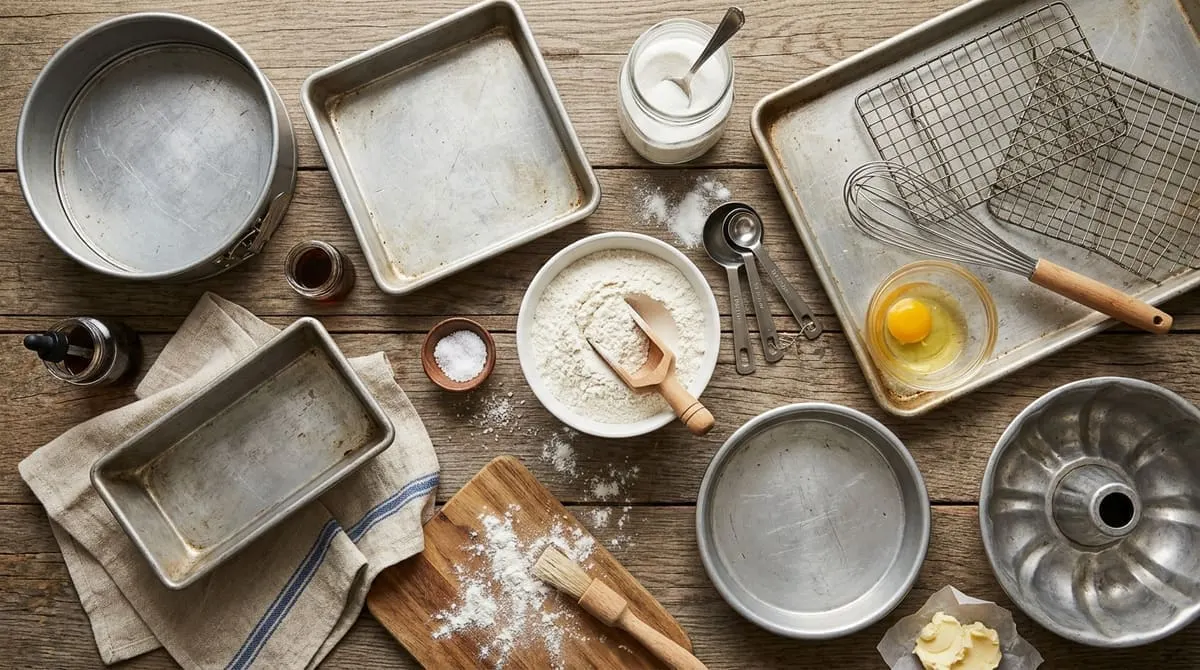
1. Introduction
Baking is an exact science where chemical leavening agents, batter hydration, structural gluten matrices, and thermal distribution must remain in precise equilibrium. When a recipe calls for an 8-inch round cake pan but you only own a 9x13-inch rectangular baking dish or a 9-inch square pan, simply doubling or halving ingredients by intuition often leads to over-baked dry edges, sunken undercooked centers, or overflow batter spills.
The Cake Pan Size Recipe Rescaler solves this culinary challenge by calculating the exact geometric surface area and volumetric ratio between your source recipe pan and your target baking pan. By applying accurate two-dimensional surface area scaling factors () or three-dimensional volume scaling (), you can seamlessly scale batter quantities, adjust oven baking times, and achieve perfect crumb structure regardless of pan geometry.
flowchart TD
    REC["Original Recipe Specification"] --> ORIG["Calculate Original Pan Area or Volume"]
    TGT["Desired Target Pan Size"] --> AREA["Calculate Target Pan Area or Volume"]
    ORIG & AREA --> SCALE["Compute Scaling Factor = Target Area / Original Area"]
    SCALE --> ADJ["Multiply All Ingredient Weights by Scaling Factor"]
    ADJ --> TEMP["Adjust Baking Time & Oven Temperature as Needed"]
2. Core Definitions & Analogy
Simple Definition
The Cake Pan Scaling Factor is the number you multiply every ingredient in a recipe by when moving from one pan size or shape to another, ensuring the batter layer remains at the ideal depth.
Technical Definition
Technically, pan scaling calculates the dimensional ratio of surface area and volumetric capacity between two Euclidean geometric shapes (cylinders for round pans, rectangular prisms for square/rectangular pans, or frustums for bundt/springform pans). When pan depth is constant (typically to ), batter scaling is governed purely by the two-dimensional surface area ratio.
The Water Bucket Analogy
Imagine spreading a bucket of paint over a small square floor versus a large rectangular floor. If you use the same bucket of paint on the larger floor, the layer becomes razor-thin. To achieve the exact same paint thickness on the larger floor, you must increase the volume of paint in exact proportion to the floor's surface area.
3. History & Milestones
timeline
    title Evolution of Standard Baking Pan Dimensions
    1880s : Cast iron skillets and earthenware crocks used as universal baking vessels.
    1920s : Stamped tinplate and aluminum standard 8-inch and 9-inch round cake pans introduced.
    1950s : Pyrex glass and standard 9x13-inch rectangular casserole pans become household defaults.
    1990s : Non-stick coatings and flexible silicone mold geometry popularized worldwide.
4. Core Concepts & Common Pan Dimensions
Baking pans vary greatly in shape, surface area, and total volume:
| Pan Name & Geometry | Standard Dimensions | Surface Area (sq in) | Volume (Cups) | Relative Capacity Factor |
|---|---|---|---|---|
| 8-Inch Round Pan | (Baseline) | |||
| 9-Inch Round Pan | ||||
| 8-Inch Square Pan | ||||
| 9-Inch Square Pan | ||||
| 9x13 Rectangular Pan | ||||
| 10-Inch Springform Pan | ||||
| Standard Loaf Pan |
5. The Mathematical Model & Formulas
1. Circular (Round) Pan Area:
Where is the interior diameter in inches.
2. Rectangular / Square Pan Area:
Where is width and is length in inches.
3. Scaling Factor Equation:
4. Volumetric Scaling (Variable Depth):
6. Step-by-Step Computational Procedure
Consider converting a recipe written for an 8-inch round pan () into a 9-inch square pan ():
- Calculate Source Pan Area:
- Calculate Target Pan Area:
- Compute Scaling Multiplier:
- Rescale Ingredients:* Flour ():* Sugar ():* Butter ():
7. Visual Explanations
Surface Area Proportions Across Standard Pans
pie title Standard Household Baking Pan Surface Area Distribution (sq in)
    "9x13 Rectangular Pan (117 sq in)" : 117
    "9x9 Square Pan (81 sq in)" : 81
    "9-Inch Round Pan (63.6 sq in)" : 64
    "8-Inch Round Pan (50.3 sq in)" : 50
8. Parameter Comparison Matrix
| Source Pan | Target Pan | Area Change (%) | Scaling Multiplier | Baking Time Adjustment Guide |
|---|---|---|---|---|
| 8'' Round | 9'' Round | Keep temperature same; add if filled thicker. | ||
| 8'' Round | 8'' Square | Check doneness earlier; corners brown faster. | ||
| 8'' Round | 9'' Square | Scale ingredients by ; maintain recipe bake time. | ||
| 9'' Round | 9x13'' Rect | Double recipe () or scale by . | ||
| 9x13'' Rect | 8'' Square | Halve original recipe (); reduce bake time by . |
9. Real-World Applications & Case Studies
- Commercial Bakery Recipe Scaling: Scaling single-tier home recipes up to commercial sheet pans () requires a multiplier over standard $8''$ round pans.
- Case Study: A wedding cake artisan needed to convert a three-tier recipe originally calibrated for $8''$ round layers into a modern square tier cake ($10''$ square). By computing the exact area ratio (), the baker doubled the batter quantity, preventing flat, dense cake layers and achieving uniform tier heights.
10. Advantages & Limitations
Advantages
- Eliminates flat, dense cakes caused by underfilled pans.
- Prevents batter overflow disasters inside hot ovens.
- Maintains perfect ingredient ratios for consistent crumb texture.
Limitations
- Egg Rounding: Scaling factors like may require $2.7$ eggs. Bakers must weigh whisked eggs in grams for 100% precision.
- Baking Time Non-Linearity: Baking time does not scale linearly with surface area; it is primarily governed by batter depth.
11. Common Pitfalls
Pitfall 1: Assuming 8-Inch Square and 8-Inch Round Pans are Equal
An 8-inch square pan () has 27.3% more surface area than an 8-inch round pan (). Using an unadjusted round pan recipe in a square pan will produce a thin, dry cake.
12. Frequently Asked Questions (FAQ)
Q: Can I substitute an 8-inch square pan for an 8-inch round pan?
A: Yes, but the square pan has 27% more area. Increase ingredients by or expect a slightly thinner cake layer.
Q: How do I handle partial eggs when scaling recipes?
A: Whisk a whole egg, weigh it on a digital kitchen scale (a large egg is without shell), and measure out the exact fraction needed.
Q: Does baking temperature change when pan size changes?
A: If the batter depth remains identical, keep the baking temperature the same. If batter is deeper, lower oven temperature by () and bake longer to avoid burning edges.
Q: What is the area of a standard 9x13 pan?
A: A standard 9x13-inch pan has a surface area of .
Q: How many cups of batter fit in an 8-inch round pan?
A: An 8-inch round pan () holds approximately of liquid capacity and should be filled with of batter (half full).
13. Expert Tips & Summary
- Measure Inside Rim to Rim: Always measure pan dimensions across the top inside edges, not the outer rim or bottom.
- Maintain 50% Fill Level: Cake pans should generally be filled no more than half to two-thirds full to allow for leavening expansion.
- Summary: Rescaling cake recipes using surface area geometry () guarantees consistent batter depth, crumb tender structure, and predictable oven baking times.
Additional Technical Guidelines & Measurement Standards
When conducting calculations for Cake Pan Size Recipe Rescaler, maintaining quantitative precision and verifying input parameter boundaries is essential for reliable scenario evaluation. Always verify that raw numerical inputs are measured using standardized instrumentation, and double-check unit conversions prior to applying outputs in commercial, industrial, or academic projects.
For quantitative unit conversions and scientific calculations, always maintain at least four decimal places of precision during intermediate arithmetic stages before rounding final results. When preparing technical reports, laboratory documentation, or financial forecasts, cross-verify all output variables against established international measurement standards (such as SI, NIST, and ISO metric benchmarks) to guarantee consistent analytical rigor across all computational workflows.
MathsLover.com delivers this interactive solver 100% free of charge to foster global mathematical literacy, educational accessibility, and data-driven problem solving across scientific, technical, and academic communities worldwide.