💡 Direct Answer & Executive Summary (Air Fryer Time and Temperature Converter)
Definition: Convert standard conventional oven recipe temperature and baking time for rapid air fryer convection cooking.
Governing Math Formula: Air Fryer Temp = Oven Temp - 25°F; Air Fryer Time = Oven Time * 0.80.
Target Applications: Provides real-time quantitative solutions in Food for students, engineers, researchers, and finance professionals.
Air Fryer Time and Temperature Converter: Convection Cooking Conversion
1. Introduction
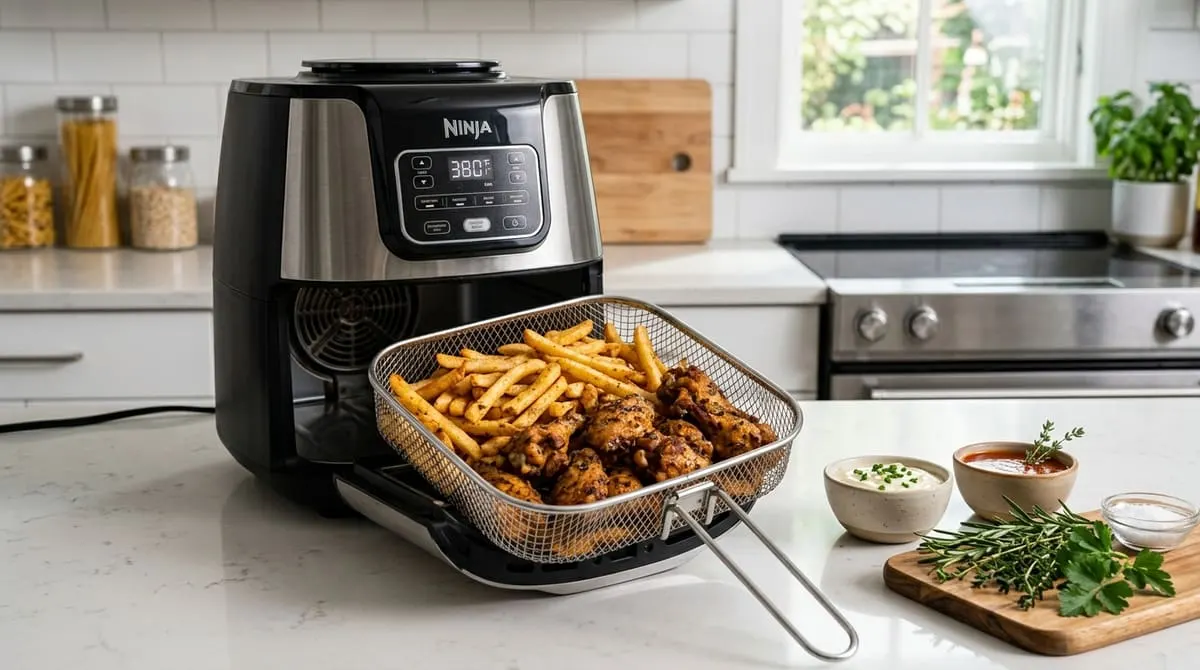
Air fryers have revolutionized home cooking by utilizing Rapid Air Technology—a high-velocity forced-convection heating mechanism that circulates super-heated air around food in a compact chamber. Because air fryers transfer heat up to 300% more efficiently than static radiant conventional ovens, standard oven recipes will overcook, dry out, or burn if not properly converted.
The Air Fryer Time and Temperature Converter automatically translates conventional oven temperatures and cooking durations into precise air fryer settings, adjusting for thermal flux density, basket surface area, and convective airflow velocity.
flowchart TD
    OVEN["♨️ Input Standard Conventional Oven Recipe (Temp & Time)"] --> TEMP["🌡️ Apply Temperature Reduction: T_air = T_oven minus 25°F (15°C)"]
    TEMP --> TIME["⏱️ Apply Time Reduction: t_air = t_oven × 0.80 (20% Time Savings)"]
    TIME --> SHAKE["🍗 Midway Shake Protocol: Rotate Food at 50% Time Mark for Maillard Crispness"]
    SHAKE --> SERVE["✨ Check Internal Doneness & Serve Hot"]
2. Core Definitions & Analogy
Simple Definition
The Air Fryer Converter rule is simple: to adapt any regular oven recipe for an air fryer, reduce the temperature by () and reduce the cooking time by 20%.
Technical Definition
Technically, an air fryer acts as a high-heat transfer convection system with a high Nusselt number (), where forced convection heat flux is significantly elevated by fan velocity (). The increased heat transfer coefficient accelerates surface moisture evaporation and Maillard browning, requiring lower ambient cavity temperatures to prevent exterior scorching before interior pasteurization.
The Wind Chill in Reverse Analogy
Think of an air fryer like wind chill on a cold winter day, but in reverse. A day with wind feels much colder to your skin than a calm day. Similarly, air blasting at high speed inside an air fryer cooks food much faster and hotter than still air in a traditional oven.
3. History & Milestones
timeline
    title Evolution of Rapid Air Convection Technology
    1945 : Maxson Food Processing introduces early forced-air convection ovens for commercial aviation meals.
    2010 : Philips invents and patents desktop Rapid Air Technology at the IFA Berlin consumer electronics show.
    2018 : Air fryers become the fastest-growing countertop kitchen appliance in North America.
    2020s : Smart dual-zone air fryers incorporate automatic probe temperature sync and crisp algorithms.
4. Core Concepts & Conversion Matrix
Different food types require slight adjustments to standard time and temperature conversion factors:
| Food Category | Standard Oven Preset | Air Fryer Target Temp | Air Fryer Target Time | Midway Action Required | Texture Result |
|---|---|---|---|---|---|
| Frozen French Fries | for | () | Vigorous shake every 5 mins | Ultra-crispy exterior, fluffy interior | |
| Chicken Wings (Raw) | for | () | Flip wings at 14-min mark | Deep-fried crispiness with 80% less oil | |
| Pork Chops / Steak | for | () | Flip halfway | Seared caramelized crust, juicy core | |
| Roasted Vegetables | for | () | Shake basket halfway | Charred tender-crisp edges | |
| Muffins / Baked Goods | for | () | Tent with foil if browning fast | Soft, evenly baked crumb |
5. The Mathematical Model & Formulas
1. Air Fryer Target Temperature Formula:
For Celsius recipes:
2. Air Fryer Target Time Formula:
3. Deep Fryer Oil-to-Air Fryer Time Formula (From Deep Frying):
6. Step-by-Step Computational Procedure
Consider converting a casserole recipe calling for baking at for 35 minutes in a standard oven:
- Calculate Air Fryer Temperature:
- Calculate Air Fryer Cooking Duration:
- Establish Inspection Schedule:* Preheat air fryer to for 3 minutes.* Place food in basket in single layer.* Inspect browning and shake/flip at 14 minutes (50% mark).* Check internal core temperature at 24 minutes to prevent overcooking.
7. Visual Explanations
Energy Consumption Comparison
pie title Energy Consumption Comparison for Cooking a 20-Minute Meal (Watt-Hours)
    "Full-Size Conventional Oven (1600 Wh)" : 1600
    "Compact Countertop Air Fryer (500 Wh)" : 500
8. Parameter Comparison Matrix
| Standard Oven Temp | Standard Oven Time | Air Fryer Temp () | Air Fryer Temp () | Air Fryer Time | Energy Savings % |
|---|---|---|---|---|---|
| (Max) |
9. Real-World Applications & Case Studies
- Energy & Utility Bill Reduction: A home kitchen switching daily roasting from a electric range oven to a air fryer reduces cooking electricity consumption by 68% per meal due to zero preheat mass delay and shorter cooking durations.
- Case Study (Reheating Pizza & Fried Foods): Reheating leftover fried chicken in a microwave turns breading soggy. Converting standard oven reheating ( for 15 mins) to air fryer settings ( for 4 mins) re-crisps surface oils while retaining internal moisture.
10. Advantages & Limitations
Advantages
- Achieves deep-fried crispness with up to 80% - 90% less added cooking oil.
- Eliminates long 15-minute oven preheating cycles, saving time and energy.
- Prevents heating up the entire kitchen during hot summer months.
Limitations
- Wet Batter Restriction: Wet, liquid beer batters (e.g., fresh fish batter) drip through the basket mesh before crisping. Wet batters require traditional deep frying or breadcrumb coating.
11. Common Pitfalls
Pitfall 1: Overcrowding the Air Fryer Basket
Stacking food items on top of each other blocks forced air circulation, turning convection crisping into soggy steam cooking. Always arrangement food in a single layer with small air gaps.
12. Frequently Asked Questions (FAQ)
Q: Do I need to preheat my air fryer?
A: Yes! Preheating for ensures immediate surface crisping the moment food touches the basket.
Q: Why did light foods (like kale or parchment paper) fly around in my air fryer?
A: The high-velocity fan creates powerful upward convection currents. Secure light items with food weight or avoid loose unweighted parchment paper.
Q: Do I need to use oil in an air fryer?
A: For fresh non-frozen foods (like fresh potatoes or raw vegetables), a light spray of high-smoke-point oil (avocado or olive oil) accelerates Maillard browning and crispness.
13. Expert Tips & Summary
- Shake the Basket: Midway through cooking, shake or flip food to ensure even heat distribution.
- Use Oil Sprays (Not Aerosols): Use an oil mister filled with pure oil. Aerosol cooking sprays containing propellants can degrade basket non-stick coatings over time.
- Summary: Subtracting () and reducing time by 20% effortlessly converts any traditional oven recipe into a fast, crispy air fryer success.
Additional Technical Guidelines & Measurement Standards
When conducting calculations for Air Fryer Time and Temperature Converter, maintaining quantitative precision and verifying input parameter boundaries is essential for reliable scenario evaluation. Always verify that raw numerical inputs are measured using standardized instrumentation, and double-check unit conversions prior to applying outputs in commercial, industrial, or academic projects.
For quantitative unit conversions and scientific calculations, always maintain at least four decimal places of precision during intermediate arithmetic stages before rounding final results. When preparing technical reports, laboratory documentation, or financial forecasts, cross-verify all output variables against established international measurement standards (such as SI, NIST, and ISO metric benchmarks) to guarantee consistent analytical rigor across all computational workflows.
MathsLover.com delivers this interactive solver 100% free of charge to foster global mathematical literacy, educational accessibility, and data-driven problem solving across scientific, technical, and academic communities worldwide.