💡 Direct Answer & Executive Summary (Price-to-Book (P/B) Valuation Calculator)
Definition: Compute values for Price-to-Book (P/B) Valuation Calculator inside the financial analytics domain.
Governing Math Formula: Standard industry financial equation for Price-to-Book (P/B) Valuation Calculator.
Target Applications: Provides real-time quantitative solutions in Finance for students, engineers, researchers, and finance professionals.
Price-to-Book (P/B) Valuation Calculator
1. Introduction
When investing in the stock market, evaluating a company's worth requires looking beyond its daily stock price. While some growth companies are valued based on their future earnings potential, asset-heavy companies (like banks, insurance firms, and capital-intensive manufacturers) are best valued by comparing their stock price against their actual tangible assets.
The standard metric used to measure this asset valuation is the Price-to-Book (P/B) ratio. This ratio compares a company's market price per share against its book value per share, showing if a stock is trading at a discount or premium to its net asset value.
The Price-to-Book (P/B) Valuation Calculator is an educational tool designed to calculate this metric. By entering your stock price per share and book value per share, you can instantly estimate your P/B ratio multiple.
This guide provides a comprehensive overview of P/B ratio mathematics, market vs. book valuations, manual calculation guidelines, and value investing strategies.
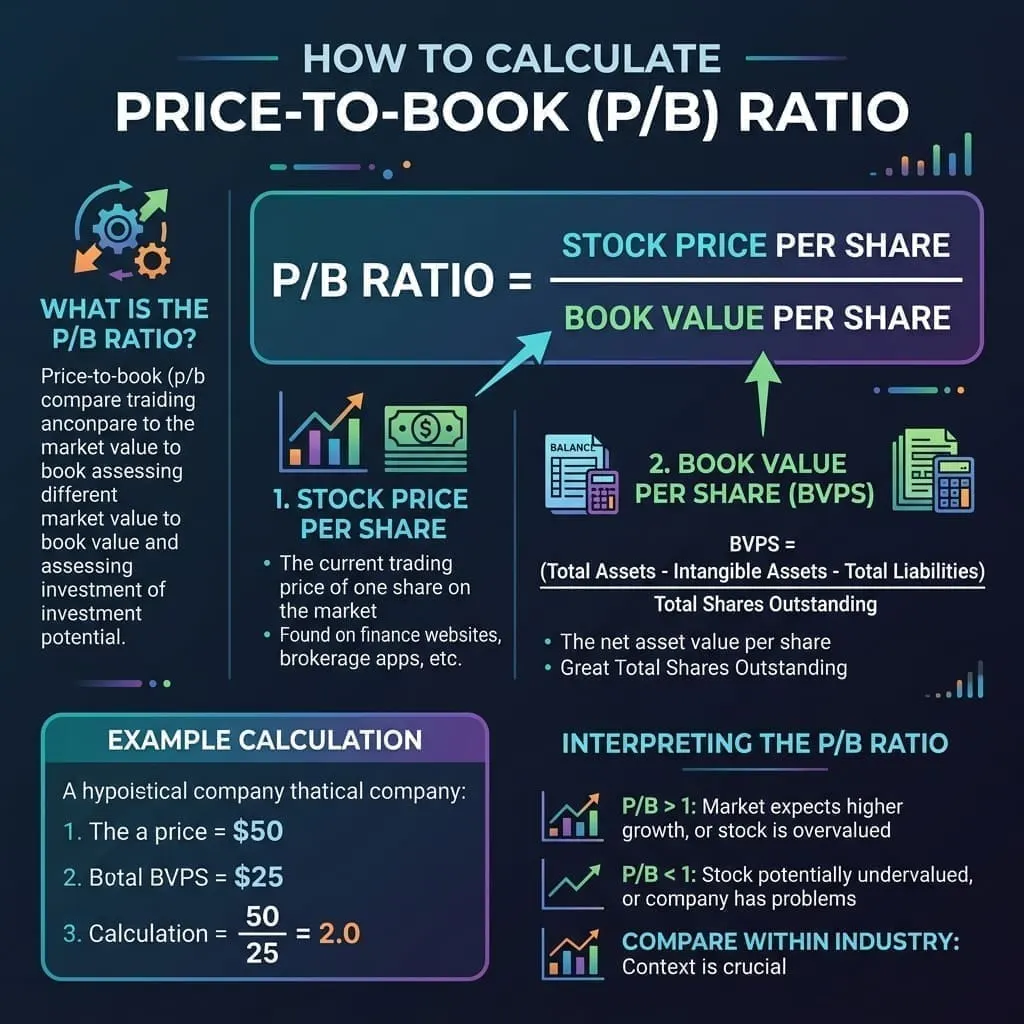
graph TD
    A["Stock Price Per Share"] --> C["Divide:
Price / Book Value"]
    B["Book Value Per Share"] --> C
    C --> D["Result:
Price-to-Book (P/B) Ratio Multiple"]
2. Core Definitions & Analogy
To build a solid financial valuation foundation, let us define the P/B ratio in both simple and technical terms:
- Simple Definition: The P/B ratio compares a company's stock market price against the value of its net assets if the company were closed down and liquidated today.
- Technical Definition: The P/B ratio is a market value ratio that divides the current market price per share (P) by the company's book value per share (BV), where book value represents total assets minus total liabilities, expressed as P/B Ratio = Stock Price / Book Value Per Share.
- Conceptual Analogy: Think of buying a physical toolbox. The stock price is the price you pay to buy the toolbox in a store. The book value is the actual replacement cost of all the hammers, screwdrivers, and wrenches inside the box. The P/B ratio measures if you are paying a premium for the brand name (P/B over 1.0) or buying the tools at a bargain discount (P/B below 1.0).
3. History & Milestones
The formalization of the P/B ratio helped establish modern value investing:
- Benjamin Graham & Value Investing (1930s): Graham advocated for buying stocks trading below their liquidation value (known as "net-net" stocks), using book value as a margin of safety.
- The DuPont Valuation Standard: Analysts historically used book value as the core valuation anchor, especially for industrial and financial firms before the rise of digital technology companies.
- Warren Buffett: Billionaire investor Warren Buffett famously targeted financial firms (like banks and insurance companies) trading at low P/B multiples relative to their earnings potential.
4. Core Concepts & Parameters
To evaluate a P/B ratio, you must understand two key parameters:
- Stock Price Per Share: The current market price to buy one share of the company on the stock exchange.
- Book Value Per Share: The company's net asset value (total assets minus intangible assets and liabilities) divided by the total number of outstanding shares.
5. The Mathematical Model & Formula
The Price-to-Book ratio is calculated using a straightforward division equation:
P/B Ratio Formula
P/B Ratio = Stock Price Per Share / Book Value Per Share
Variable Breakdown:
- Stock Price: Market price of one share (USD)
- Book Value: Net asset value per share (USD)
Valuation Rulings:
- P/B Ratio < 1.0: The stock is trading at a discount. In theory, you are buying the assets for less than they are worth, which can indicate an undervalued bargain or a struggling company.
- P/B Ratio > 1.0: The stock is trading at a premium. Investors are paying more than the net asset value, which is common for highly profitable companies with strong brand equity.
6. Step-by-Step Manual Procedure
Let us walk through a manual calculation using our default calculator values:
- Identify the variables:
Stock Price Per Share = $50Book Value Per Share = $25 - Divide the stock price by the book value per share:
P/B Ratio = 50 / 25 = 2.00Your Price-to-Book (P/B) ratio multiple is 2.00, indicating a premium valuation status.
7. Visual Diagram
The flowchart below displays the computation path for P/B ratios:
graph TD
    Start["Enter Stock Price & Book Value Share"] --> DividePriceByBook["Divide:
Stock Price / Book Value"]
    DividePriceByBook --> Display["Output: Price-to-Book (P/B) Ratio Multiple"]
8. Parameter Comparison Matrix
The table below shows how the book value per share affects the P/B ratio for a stock trading at a constant $50 per share:
| Stock Price Per Share | Book Value Per Share | P/B Ratio Multiple | Valuation Status |
|---|---|---|---|
| $50 | $10 | 5.00 | High Premium Valuation |
| $50 | $20 | 2.50 | Moderate Premium Valuation |
| $50 (Default) | $25 (Default) | 2.00 | Standard Premium Valuation |
| $50 | $35 | 1.43 | Value Valuation Status (Under 1.5) |
| $50 | $60 | 0.83 | Discount Valuation (Under 1.0) |
9. Real-World Applications
P/B ratio calculations are essential for stock analysis and portfolio management:
- Financial Sector Analysis: Investors use P/B ratios to evaluate banks and insurance companies, whose balance sheets consist of highly liquid financial assets.
- Spotting Value Stocks: Analysts search for companies with P/B ratios below 1.5 to identify potentially undervalued stocks.
- Distress Evaluations: A company with a very low P/B ratio (e.g. 0.5) is reviewed to check if its assets are overstated or if the business is facing bankruptcy.
10. Case Studies
Case Study 1: Spotting a Bank Bargain
An investor compares two commercial banks:
- Bank A: Stock price is $50, book value per share is $25.
P/B Ratio = 50 / 25 = 2.0
- Bank B: Stock price is $30, book value per share is $25.
P/B Ratio = 30 / 25 = 1.2
- Outcome: Bank B has a lower P/B ratio (1.2), indicating a value valuation status. Assuming Bank B has a clean balance sheet, it represents a better value buy than Bank A.
Case Study 2: Technology Company Valuation Limits
An investor evaluates a software giant trading at $150 per share with a book value per share of $15 (P/B ratio of 10).
- Analysis: The high P/B ratio indicates a massive premium. However, software companies own intellectual property (patents, code) rather than physical machinery, making book value less relevant for this sector.
- Outcome: The investor focuses on P/E ratio or free cash flow metrics instead of P/B to evaluate the software stock.
11. Advantages of Using the Tool
- Supports Value Investing: Instantly flags undervalued stocks.
- Financial Auditing Support: Helps evaluate asset-heavy businesses easily.
- Simple Comparisons: Quickly compares valuations of companies in the same sector.
12. Limitations & Boundary Conditions
The P/B ratio is less relevant for technology, service, and pharmaceutical companies whose main assets are intangible (patents, brand equity, software), which are not fully reflected in book value calculations.
13. Common Mistakes
- Comparing Across Different Sectors: Comparing a bank's P/B ratio (typically low) with a software company's P/B ratio (typically high).
- Ignoring Asset Quality: Assuming a stock with a P/B under 1.0 is a bargain without checking if its assets (like bad loans or outdated inventory) are overstated on the balance sheet.
12. Frequently Asked Questions
Q1: What is the Price-to-Book (P/B) ratio?
A valuation metric that compares a company's stock price against its book value per share.
Q2: What is the formula for the P/B ratio?
The formula is P/B Ratio = Stock Price / Book Value Per Share.
Q3: What is book value?
A company's net asset value (total assets minus liabilities), representing the liquidation value of the business.
Q4: What is a good P/B ratio?
A P/B ratio below 1.5 is generally considered a value valuation, while ratios below 1.0 indicate the stock is trading at a discount to its net assets.
Q5: Can a company have a negative P/B ratio?
Yes, if a company's liabilities exceed its assets, resulting in negative book value. This is a sign of severe financial distress.
Q6: Why do banks use P/B ratio analysis?
Because banks own mostly liquid financial assets (loans, cash, bonds) that can be easily valued on the balance sheet.
Q7: Does book value include patents?
Under standard accounting rules, internally developed intangible assets like patents and brand name values are excluded from book value.
Q8: Does a stock price drop lower the P/B ratio?
Yes, assuming the book value remains constant.
Q9: Why is a P/B ratio below 1.0 risky?
It can indicate that the market expects the company's assets to lose value, or that the company is facing bankruptcy (a value trap).
Q10: How often do public companies update their book value?
Quarterly and annually in their financial reports.
15. Expert Tips
- Compare peer groups: Only compare P/B ratios of companies in the same sector (e.g. comparing banks with banks) to ensure a fair evaluation.
- Check the return on equity (ROE): A company with a low P/B ratio but high ROE is often an excellent investment target, indicating highly efficient assets.
16. Summary
- The P/B ratio compares market price per share against net asset value per share.
- The P/B formula is
Price / Book Value.
- Ratios below 1.5 indicate value; ratios below 1.0 indicate a discount.
- The metric is standard for banks, insurance, and asset-heavy firms.
Additional Technical Guidelines & Measurement Standards
When conducting calculations for Price-to-Book (P/B) Valuation Calculator, maintaining quantitative precision and verifying input parameter boundaries is essential for reliable scenario evaluation. Always verify that raw numerical inputs are measured using standardized instrumentation, and double-check unit conversions prior to applying outputs in commercial, industrial, or academic projects.
For quantitative unit conversions and scientific calculations, always maintain at least four decimal places of precision during intermediate arithmetic stages before rounding final results. When preparing technical reports, laboratory documentation, or financial forecasts, cross-verify all output variables against established international measurement standards (such as SI, NIST, and ISO metric benchmarks) to guarantee consistent analytical rigor across all computational workflows.
MathsLover.com delivers this interactive solver 100% free of charge to foster global mathematical literacy, educational accessibility, and data-driven problem solving across scientific, technical, and academic communities worldwide.