💡 Direct Answer & Executive Summary (Present Value of Future Money Solver)
Definition: Compute values for Present Value of Future Money Solver inside the financial analytics domain.
Governing Math Formula: Standard industry financial equation for Present Value of Future Money Solver.
Target Applications: Provides real-time quantitative solutions in Finance for students, engineers, researchers, and finance professionals.
Present Value of Future Money Solver
1. Introduction
When evaluating business deals, inheritance options, or long-term investments, you are often faced with decisions involving cash flows distributed over time. For example, is it better to receive a cash payment today, or wait several years to receive a larger sum?
To make an informed decision, you must understand a fundamental rule of finance: a dollar today is worth more than a dollar tomorrow. This is known as the time value of money. To compare future payments with cash today, you must discount the future sum back to its present value.
The Present Value of Future Money Solver is an educational tool designed to calculate this discount. By entering your future cash sum and annual discount rate, you can instantly estimate the present value of that future money based on a standard 5-year discount period.
This guide provides a comprehensive overview of present value mathematics, discount rates, manual calculation guidelines, and investment scenarios.
graph TD
    A["Future Cash Sum"] --> C["Apply Discount Rate (r) over 5 Years"]
    B["Annual Discount Rate"] --> C
    C --> D["Compute Present Value: Future Sum / (1 + r)^5"]
    D --> E["Result:
Present Value of Future Money ($)"]
2. Core Definitions & Analogy
To build a solid financial foundation, let us define present value in both simple and technical terms:
- Simple Definition: Present value is the current worth of a future sum of money, calculated by discounting it based on a specific annual interest rate.
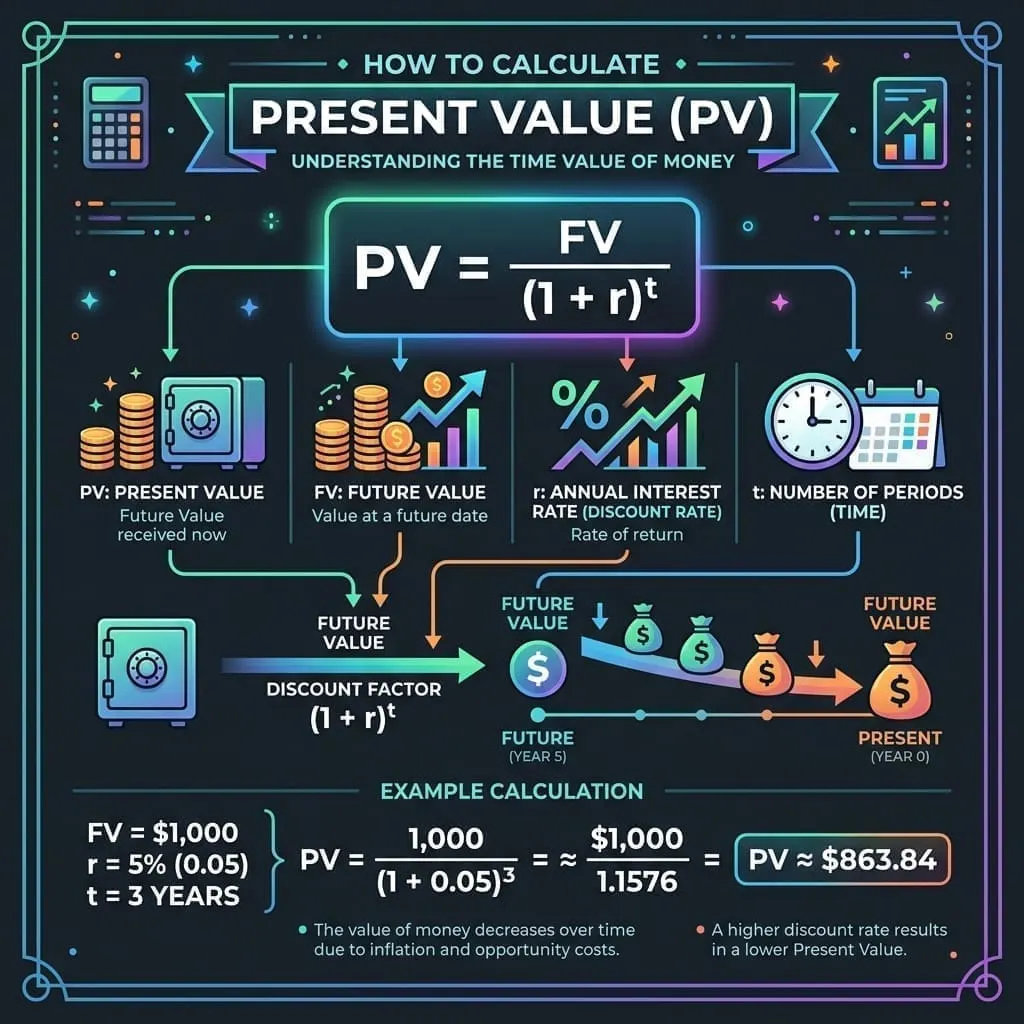
- Technical Definition: Present value (PV) is the current value of a future cash flow (FV) discounted by the periodic discount rate (r) over a specified number of compounding periods (t), expressed as PV = FV / (1 + r/100)^t.
- Conceptual Analogy: Think of present value like looking at a distant building through a pair of binoculars. The future cash sum is the actual size of the building. The discount rate and term act as the distance separating you from it, making the building look smaller from where you stand (its present value). Bringing the building closer (reducing the discount rate or term) increases its apparent size.
3. History & Milestones
The formalization of the time value of money transformed ancient commerce into modern valuation theory:
- Ancient Interest Tables: Early Mesopotamian and Greek merchants calculated the present value of debts to settle trade accounts before they came due.
- Fibonacci (1202): The Italian mathematician Leonardo Fibonacci published calculations on present value and interest compounding in his book "Liber Abaci," introducing structured discounting to Europe.
- Irving Fisher (1930): The American economist Irving Fisher published "The Theory of Interest," establishing the modern framework of interest rates and present value calculations used by modern banks.
4. Core Concepts & Parameters
To evaluate present value, you must understand three key parameters:
- Future Cash Sum: The total amount of money you are scheduled to receive at the end of the term.
- Annual Discount Rate: The interest rate used to discount the future sum, representing the rate of return you could earn if you invested your cash today (opportunity cost).
- Discount Period (t): The number of years you must wait to receive the future cash sum (standardized at a default of 5 years in our system).
5. The Mathematical Model & Formula
The present value of a future cash flow is calculated using the standard discounting equation:
Present Value Formula
Present Value = Future Cash Sum / (1 + Discount Rate)^Term
Variable Breakdown:
- Future Cash Sum: The future capital value (USD)
- Discount Rate: The annual discount percentage (written as a decimal, e.g. 5% is 0.05)
- Term: The timeline in years (Years, default t = 5)
Why the Formula Works:
Discounting is the reverse of compounding. While compounding projects how much a dollar today will grow in the future, discounting calculates how much money you would need to invest today at the discount rate to reach that future sum.
6. Step-by-Step Manual Procedure
Let us walk through a manual calculation using our default calculator values:
- Identify the variables:
Future Cash Sum = $15,000Annual Discount Rate = 5% = 0.05Term (t) = 5 Years - Calculate the Discount Factor (1 + r):
1 + 0.05 = 1.05 - Raise the discount factor to the power of 5 years:
1.05^5 = 1.27628 - Divide the future cash sum by the discount factor:
Present Value = 15,000 / 1.27628 = 11,752.89The present value of your future $15,000 payment is $11,752.89.This means that receiving $11,752.89 today is mathematically equivalent to receiving $15,000 in 5 years, assuming a constant 5% interest rate.
7. Visual Diagram
The flowchart below displays the computation path for present values:
graph TD
    Start["Enter Future Cash & Discount Rate"] --> CalcFactor["Compute Discount Factor: 1 + Rate / 100"]
    CalcFactor --> PowerOf["Raise to the Power of 5 Years"]
    PowerOf --> DivideCash["Divide:
Future Cash / Discount Factor"]
    DivideCash --> Display["Output: Present Value of Future Money ($)"]
8. Parameter Comparison Matrix
The table below shows how the discount rate affects the present value of a $15,000 future cash flow over a 5-year term:
| Future Cash Sum | Annual Discount Rate | 5-Year Discount Factor | Present Value | Discount Reduction |
|---|---|---|---|---|
| $15,000 | 2.0% | 1.1041 | $13,585.98 | $1,414.02 |
| $15,000 | 4.0% | 1.2167 | $12,328.91 | $2,671.09 |
| $15,000 (Default) | 5.0% (Default) | 1.2763 | $11,752.89 | $3,247.11 |
| $15,000 | 8.0% | 1.4693 | $10,208.74 | $4,791.26 |
| $15,000 | 12.0% | 1.7623 | $8,511.40 | $6,488.60 |
9. Real-World Applications
Present value calculations are fundamental in personal and corporate finance:
- Investment Deal Evaluations: Investors calculate the present value of projected future cash flows to determine the maximum price they should pay to buy a business or asset today.
- Bond Pricing: Financial institutions discount a bond's future interest payouts to calculate its current market price.
- Structured Settlement Analysis: Insurance companies and legal firms determine the current cash value of multi-year structured payouts.
10. Case Studies
Case Study 1: Settlement Option Selection
A beneficiary is offered two settlement options:
- Option A: Receive a lump sum of $11,000 cash today.
- Option B: Receive $15,000 in 5 years.
- Analysis: The beneficiary can earn 5% interest on their investments.
Present Value of Option B = 15,000 / (1.05)^5 = $11,752.89
- Outcome: Since the present value of Option B ($11,752.89) is higher than the cash payout of Option A ($11,000), the beneficiary chooses to wait for Option B.
Case Study 2: Evaluating a Business Buyout
An entrepreneur wants to purchase a small business. The business is projected to generate a single cash flow of $15,000 in 5 years. The entrepreneur targets an 8% annual return.
- Present Value calculation: 15,000 / (1.08)^5 = $10,208.74.
- Outcome: The maximum price the entrepreneur should pay to buy the business today is $10,208.74. Paying more would reduce their return below the 8% target.
11. Advantages of Using the Tool
- Financial Safety: Prevents overpaying for future assets.
- Supports Decisions: Compares cash today vs. future payments easily.
- Simplifies Valuation: Automatically handles multi-year compound discounting.
12. Limitations & Boundary Conditions
Present value calculations rely on a constant discount rate. In the real world, interest rates and market opportunities fluctuate, which can alter the actual present value over time.
13. Common Mistakes
- Using the Wrong Discount Rate: Setting a low discount rate that does not reflect inflation or the risk level of the investment.
- Confusing Discounting with Compounding: Multiplying the future cash sum by the interest rate instead of dividing it.
12. Frequently Asked Questions
Q1: What is present value?
The current worth of a future sum of money, calculated by discounting it based on a specific annual interest rate.
Q2: What is the formula for present value?
The formula is Present Value = Future Cash / (1 + Discount Rate)^t.
Q3: What is a discount rate?
The interest rate used to calculate the present value of future cash flows, representing your opportunity cost.
Q4: Why is a dollar today worth more than a dollar tomorrow?
Because you can invest a dollar today to earn interest, and inflation will erode the purchasing power of a dollar in the future.
Q5: How does a higher discount rate affect present value?
A higher discount rate increases the discount factor, which decreases the present value of the future cash flow.
Q6: Can present value exceed the future cash sum?
No. Assuming a positive discount rate, discounting will always make the present value smaller than the future cash sum.
Q7: What does opportunity cost mean in finance?
The return you give up by choosing one investment option over another.
Q8: Does this calculator include tax deductions?
No. Calculations are based on gross cash flows before tax adjustments.
Q9: What is the discount period?
The number of years you must wait to receive the future cash sum (default t = 5).
Q10: How often do financial analysts calculate present value?
Daily, when valuing stocks, corporate bonds, and investment projects.
15. Expert Tips
- Use your target return as the discount rate: When evaluating investments, set the discount rate to the annual return you expect to ensure you don't overpay.
- Adjust for risk: Use a higher discount rate for risky investments to build in a margin of safety.
16. Summary
- Present value discounts future cash flows back to current worth.
- The present value formula is
Future Cash / (1 + Discount Rate)^t.
- Higher discount rates lower the present value.
- Present value helps compare current cash with future payouts fairly.
Additional Technical Guidelines & Measurement Standards
When conducting calculations for Present Value of Future Money Solver, maintaining quantitative precision and verifying input parameter boundaries is essential for reliable scenario evaluation. Always verify that raw numerical inputs are measured using standardized instrumentation, and double-check unit conversions prior to applying outputs in commercial, industrial, or academic projects.
For quantitative unit conversions and scientific calculations, always maintain at least four decimal places of precision during intermediate arithmetic stages before rounding final results. When preparing technical reports, laboratory documentation, or financial forecasts, cross-verify all output variables against established international measurement standards (such as SI, NIST, and ISO metric benchmarks) to guarantee consistent analytical rigor across all computational workflows.
MathsLover.com delivers this interactive solver 100% free of charge to foster global mathematical literacy, educational accessibility, and data-driven problem solving across scientific, technical, and academic communities worldwide.