💡 Direct Answer & Executive Summary (Personal Loan Repayments Calculator)
Definition: Calculate payments and interest rates for unsecured personal bank loans.
Governing Math Formula: M = P [ i(1 + i)^n ] / [ (1 + i)^n – 1 ].
Target Applications: Provides real-time quantitative solutions in Finance for students, engineers, researchers, and finance professionals.
Personal Loan Repayments Calculator
1. Introduction
From consolidating debt to funding home improvements or covering medical expenses, life sometimes presents scenarios that require immediate funding. For many, a personal loan is the most versatile solution. Unlike auto or home loans, personal loans are typically unsecured, meaning they do not require collateral like a house or a car.
Because they are unsecured, lenders assess your creditworthiness and income stability to determine your interest rates. Understanding how requested loan amounts, fixed interest rates, and repayment terms affect your monthly obligations is essential to avoid taking on high-interest debt that strains your monthly budget.
The Personal Loan Repayments Calculator is an educational tool designed to clear up personal loan costs. By entering your desired loan amount, fixed interest rate, and term, you can instantly estimate your monthly payments and see the total interest cost over the life of the loan.
This guide provides a comprehensive breakdown of personal loan mathematics, unsecured credit parameters, step-by-step calculation guidelines, and budgeting tips.
graph TD
    A["Requested Loan Amount (P)"] --> B["Apply Fixed Annual Rate (r)"]
    B --> C["Establish Repayment Term (t)"]
    C --> D["Evaluate Monthly Payment (M)"]
    D --> E["Calculate Total Interest Cost"]
2. Core Definitions & Analogy
To build a solid financial foundation, let us define personal loans in both simple and technical terms:
- Simple Definition: A personal loan is money you borrow from a bank or credit union that you pay back in fixed monthly installments over a set number of years, typically with no collateral required.
- Technical Definition: A personal loan is an amortizing, unsecured installment loan. The monthly payment (M) is computed using the standard loan constant equation based on the principal (P), periodic rate (i), and total months (n), expressed as M = P [ i (1 + i)^n ] / [ (1 + i)^n - 1 ].
- Conceptual Analogy: Think of borrowing a personal loan like buying a subscription to a premium gym. The gym gives you access to all its facilities immediately (the loan proceeds), and you agree to pay a fixed monthly membership fee (monthly installments) for a set term. Once the term ends, your contract is complete and your balance is zero.
3. History & Milestones
The personal lending system has evolved from ancient community trusts to modern digital fintech platforms:
- Ancient Credit Guilds: Early societies relied on informal merchant guilds and family circles to borrow money, with loan terms enforced by social reputation rather than legal credit scores.
- The Rise of Credit Unions (1900s): The credit union movement emerged to offer affordable personal loans to working-class families who were excluded by traditional commercial banks.
- The FICO Score (1989): The introduction of the FICO credit score standardized credit evaluation, allowing lenders to approve unsecured personal loans in minutes based on mathematical risk metrics.
- Fintech Disruption (2010s): Peer-to-peer lending and digital lending apps simplified the process, enabling borrowers to secure competitive personal loans online with no physical paperwork.
4. Core Concepts & Parameters
To evaluate a personal loan, you must understand three key input parameters:
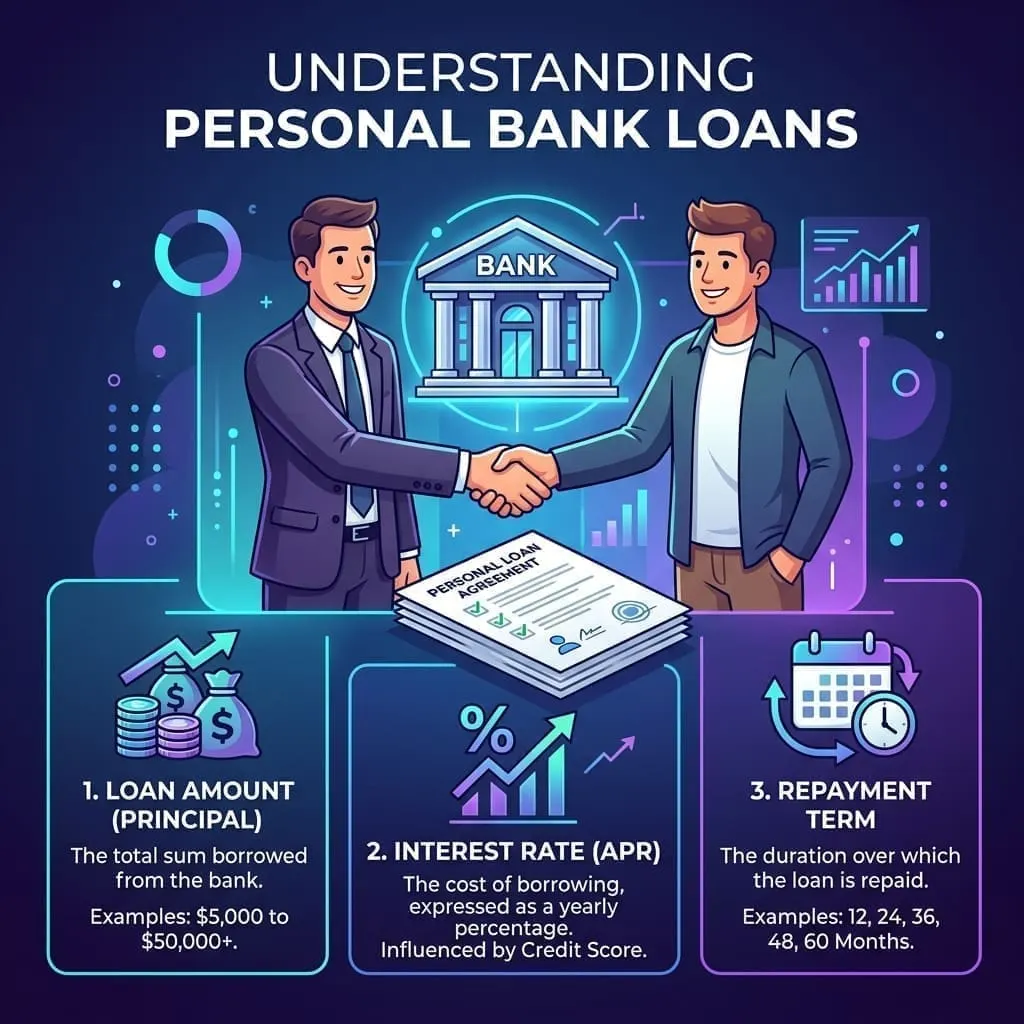
- Requested Loan Amount (P): The total sum of money you borrow from the lender.
- Fixed Interest Rate (r): The annual percentage rate (APR) charged by the lender, which remains constant throughout the loan term.
- Repayment Period (t): The number of years you have to pay back the loan (typically 2 to 7 years).
5. The Mathematical Model & Formula
The monthly payment for a fixed-rate personal loan is solved using the standard amortization formula:
Monthly Payment Formula
Monthly Payment (M) = P * [ i * (1 + i)^n ] / [ (1 + i)^n - 1 ]
Variable Breakdown:
- M: The monthly installment payment (USD)
- P: The requested loan principal amount (USD)
- i: The monthly interest rate (Fixed Annual Rate divided by 12, then divided by 100)
- n: The total number of monthly payments (Term in Years multiplied by 12)
6. Step-by-Step Manual Procedure
Let us walk through a manual calculation using our default calculator values:
- Identify the variables:
Requested Loan Amount (P) = $15,000Fixed Interest Rate (r) = 9% = 0.09Repayment Period (t) = 3 Years - Calculate the Monthly Interest Rate (i):
Monthly Rate (i) = (9 / 100) / 12 = 0.0075 - Calculate the Total Number of Payments (n):
Total Months (n) = 3 * 12 = 36 months - Apply the Amortization Formula:
M = 15,000 * [ 0.0075 * (1 + 0.0075)^36 ] / [ (1 + 0.0075)^36 - 1 ]M = 15,000 * [ 0.0075 * 1.308645 ] / [ 1.308645 - 1 ]M = 15,000 * [ 0.0098148 ] / [ 0.308645 ]M = 15,000 * 0.0317996 = 476.99Your monthly payment is approximately $476.99.The total interest cost over the term is $2,171.64 (476.99 * 36 minus 15,000).
7. Visual Diagram
The flowchart below displays the computation path for personal loan payments:
graph TD
    Start["Enter Amount P, Rate r, Years t"] --> ConvertRate["Convert Annual Rate to Monthly: r / 12"]
    ConvertRate --> ConvertMonths["Convert Term to Months: t * 12"]
    ConvertMonths --> SolveFormula["Calculate Monthly Installment: M"]
    SolveFormula --> DisplayResults["Output: Monthly Payment, Total Interest Cost"]
8. Parameter Comparison Matrix
The table below shows how varying the interest rate affects a $15,000 loan over a 3-year term:
| Principal (P) | Fixed Annual Rate | Term (t) | Monthly Payment | Total Repayment | Total Interest Cost |
|---|---|---|---|---|---|
| $15,000 | 6.0% | 3 Years | $456.33 | $16,427.88 | $1,427.88 |
| $15,000 (Default) | 9.0% | 3 Years | $476.99 | $17,171.64 | $2,171.64 |
| $15,000 | 12.0% | 3 Years | $498.21 | $17,935.56 | $2,935.56 |
| $15,000 | 9.0% | 5 Years | $311.38 | $18,682.80 | $3,682.80 |
| $15,000 | 12.0% | 5 Years | $333.67 | $20,020.20 | $5,020.20 |
9. Real-World Applications
Personal loans are highly flexible and commonly used in several financial scenarios:
- Debt Consolidation: Borrowers combine multiple high-interest credit card balances into a single personal loan with a lower interest rate, simplifying payments and saving on interest.
- Home Renovations: Homeowners use personal loans to fund remodels without putting a lien on their property (as required by home equity loans).
- Emergency Funding: Unsecured personal loans offer quick cash for unexpected medical bills, vehicle repairs, or urgent travel needs.
10. Case Studies
Case Study 1: Debt Consolidation Savings
A borrower has $15,000 in credit card debt with an average interest rate of 20%, costing them $500 per month. They secure a 3-year personal loan at 9% to pay off the credit cards.
- Credit Card Interest: Keeping the balance on credit cards would cost thousands in interest over many years.
- Personal Loan Payment: The monthly installment is $476.99, and the debt is fully paid off in 3 years with a total interest cost of $2,171.64.
- Outcome: The borrower saves on interest, lowers their monthly bill, and establishes a clear path to becoming debt-free.
Case Study 2: Emergency Repair Costs
A homeowner needs $10,000 for urgent roof repairs. They compare a 3-year personal loan at 9% with a 5-year loan at the same rate.
- 3-Year Term: Payment is $318.00/month, and total interest paid is $1,448.00.
- 5-Year Term: Payment is $207.58/month, and total interest paid is $2,454.80.
- Outcome: The 5-year term reduces the monthly bill by $110.42 but increases interest costs by $1,006.80. The homeowner chooses the 3-year option to minimize borrowing costs.
11. Advantages of Using the Tool
- Financial Security: Instantly estimates monthly costs to help you avoid overborrowing.
- Compare Offers: Helps you evaluate different interest rates and terms side-by-side.
- Simplifies Planning: Quickly displays how terms affect your total interest costs.
12. Limitations & Boundary Conditions
This calculator estimates the principal and interest (P&I) payments. It does not include upfront loan origination fees (typically 1% to 8% of the loan amount), which lenders deduct from the loan proceeds before payout.
13. Common Mistakes
- Ignoring the Origination Fee: Lenders often subtract fees from the loan payout (e.g. on a $15,000 loan with a 5% fee, you receive only $14,250, but still owe $15,000 plus interest).
- Focusing Only on Monthly Payments: Extending the loan term reduces the monthly bill but increases the total interest paid. Always check the total borrowing cost.
12. Frequently Asked Questions
Q1: What is a personal loan?
A personal loan is an installment loan that you pay back in fixed monthly installments over a set number of years, usually with no collateral required.
Q2: What does "unsecured" mean?
It means the loan is not backed by collateral (like a home or car). If you default, the lender cannot seize your property directly, though it will damage your credit score.
Q3: What is the typical interest rate on a personal loan?
Rates typically range from 6% to 36% based on your credit score, income, and debt-to-income ratio.
Q4: How does a longer term affect my loan?
A longer term reduces your monthly payment but increases the total interest paid over the life of the loan.
Q5: Can I pay off a personal loan early?
Yes, most lenders do not charge prepayment penalties, allowing you to pay off the principal early and save on interest.
Q6: What is debt consolidation?
Using a single personal loan with a lower interest rate to pay off multiple high-interest debts (like credit cards).
Q7: What does APR stand for?
Annual Percentage Rate, representing the yearly cost of borrowing funds, including the interest rate and standard fees.
Q8: What is a loan origination fee?
An upfront fee charged by lenders to process the loan, which is typically deducted from your initial payout.
Q9: Can I get a personal loan with bad credit?
Yes, but you will pay higher interest rates, or you may need a co-signer to qualify.
Q10: What is the monthly payment formula?
The formula is M = P * [ i(1 + i)^n ] / [ (1 + i)^n - 1 ], where P is principal, i is monthly rate, and n is total months.
15. Expert Tips
- Check for pre-qualification: Many lenders allow you to check your interest rate with a soft credit pull, which does not impact your credit score.
- Compare the total cost: Always compare the total repayment amount (principal plus interest and fees) when choosing between lenders.
16. Summary
- Personal loans are flexible installment loans, typically unsecured.
- Monthly payments are determined by the loan amount, fixed rate, and term.
- The personal loan payment formula is
M = P * [ i(1 + i)^n ] / [ (1 + i)^n - 1 ].
- Shorter terms and lower interest rates minimize your borrowing costs.
Additional Technical Guidelines & Measurement Standards
When conducting calculations for Personal Loan Repayments Calculator, maintaining quantitative precision and verifying input parameter boundaries is essential for reliable scenario evaluation. Always verify that raw numerical inputs are measured using standardized instrumentation, and double-check unit conversions prior to applying outputs in commercial, industrial, or academic projects.
For quantitative unit conversions and scientific calculations, always maintain at least four decimal places of precision during intermediate arithmetic stages before rounding final results. When preparing technical reports, laboratory documentation, or financial forecasts, cross-verify all output variables against established international measurement standards (such as SI, NIST, and ISO metric benchmarks) to guarantee consistent analytical rigor across all computational workflows.
MathsLover.com delivers this interactive solver 100% free of charge to foster global mathematical literacy, educational accessibility, and data-driven problem solving across scientific, technical, and academic communities worldwide.