💡 Direct Answer & Executive Summary (Loan-to-Value (LTV) Ratio Calculator)
Definition: Compute values for Loan-to-Value (LTV) Ratio Calculator inside the financial analytics domain.
Governing Math Formula: Standard industry financial equation for Loan-to-Value (LTV) Ratio Calculator.
Target Applications: Provides real-time quantitative solutions in Finance for students, engineers, researchers, and finance professionals.
Loan-to-Value (LTV) Ratio Calculator
1. Introduction
When purchasing real estate or applying for a mortgage, lenders look closely at the relationship between the loan amount you request and the actual value of the property you want to buy. This relationship measures the equity buffer protecting the lender's capital.
The standard underwriting metric used to evaluate this risk is the Loan-to-Value (LTV) ratio. Expressed as a percentage, the LTV ratio compares your loan amount against the property's appraised value, helping lenders determine if you need to pay for Private Mortgage Insurance (PMI).
The Loan-to-Value (LTV) Ratio Calculator is an educational tool designed to calculate this metric. By entering your loan amount and the asset's appraised value, you can instantly estimate your LTV percentage.
This guide provides a comprehensive overview of LTV mathematics, mortgage underwriting standards, manual calculation guidelines, and down payment strategies.
graph TD
    A["Loan Amount"] --> C["Divide:
Loan / Appraised Value"]
    B["Asset Appraised Value"] --> C
    C --> D["Multiply by 100"]
    D --> E["Result:
Loan-to-Value (LTV) Ratio (%)"]
2. Core Definitions & Analogy
To build a solid real estate finance foundation, let us define LTV in both simple and technical terms:
- Simple Definition: The LTV ratio is the percentage of a property's value that is funded by a mortgage loan, showing the size of your equity stake.
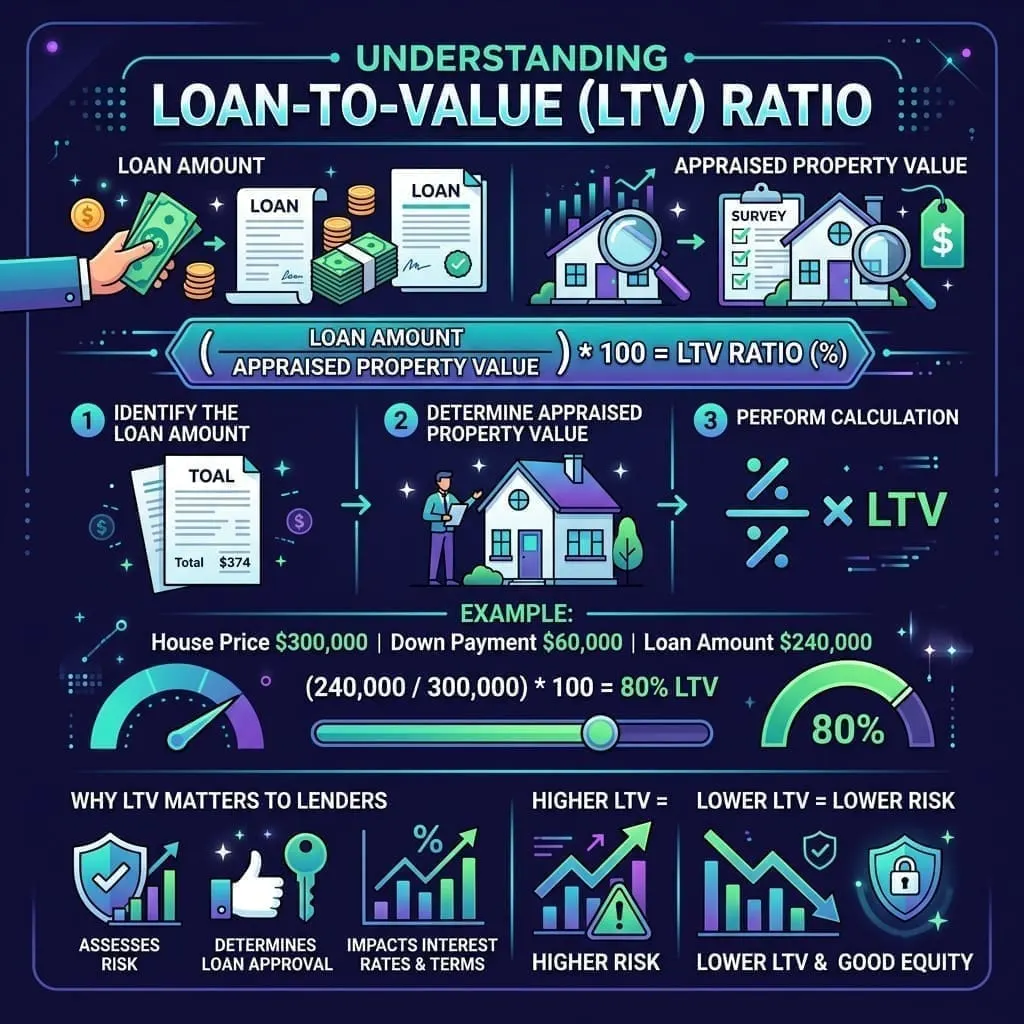
- Technical Definition: The LTV ratio is a lending risk assessment ratio calculated by dividing the total mortgage loan principal (L) by the appraised market value of the collateral property (V), expressed as LTV = (L / V) * 100.
- Conceptual Analogy: Think of buying a house like buying a custom cake with a friend. The cake costs $300,000 (appraised value). You pay $60,000 in cash (down payment) and borrow $240,000 from your friend (loan amount). The LTV ratio measures what percentage of the cake belongs to your friend's loan until you pay them back.
3. History & Milestones
The formalization of LTV limits stabilized modern home financing systems:
- Pre-FHA Era (1920s): Home buyers historically paid down payments of 50% or more (LTV below 50%), with short-term balloon loans that were difficult to qualify for.
- FHA Standardization (1934): The Federal Housing Administration introduced high-LTV loans (up to 80% or 90%), allowing buyers to purchase homes with smaller down payments.
- The 80% Threshold: Over time, the 80% LTV standard became the industry benchmark, dividing loans that require Private Mortgage Insurance from those that do not.
4. Core Concepts & Parameters
To evaluate an LTV ratio, you must understand two key parameters:
- Loan Amount: The total principal borrowed from the lender.
- Asset Appraised Value: The professional appraisal value of the property, which can differ from the negotiated purchase price.
5. The Mathematical Model & Formula
The LTV ratio is calculated using a straightforward division equation:
LTV Ratio Formula
LTV Ratio Percentage = ( Loan Amount / Asset Appraised Value ) * 100
Variable Breakdown:
- Loan Amount: Mortgage loan principal (USD)
- Appraised Value: Professional property valuation (USD)
The 80% PMI Rule:
If your LTV ratio exceeds 80.00% (meaning your down payment is less than 20%), lenders typically require you to purchase Private Mortgage Insurance (PMI). This insurance protects the lender if you default on the loan, adding a monthly fee to your mortgage bill.
6. Step-by-Step Manual Procedure
Let us walk through a manual calculation using our default calculator values:
- Identify the variables:
Loan Amount = $240,000Asset Appraised Value = $300,000 - Divide the loan amount by the appraised value:
240,000 / 300,000 = 0.80 - Multiply by 100 to get the percentage:
0.80 * 100 = 80.00%Your Loan-to-Value (LTV) ratio is 80.00%, meeting the standard conventional limit to avoid PMI.
7. Visual Diagram
The flowchart below displays the computation path for LTV ratios:
graph TD
    Start["Enter Loan Amount & Appraised Value"] --> DivideVals["Divide:
Loan / Appraised Value"]
    DivideVals --> MultPercent["Multiply by 100 for LTV (%)"]
    MultPercent --> Display["Output: LTV Ratio (%) & PMI Alert"]
8. Parameter Comparison Matrix
The table below shows how varying the loan amount affects the LTV ratio for a property appraised at $300,000:
| Loan Amount | Appraised Value | Down Payment | LTV Ratio Percentage | PMI Status |
|---|---|---|---|---|
| $285,000 | $300,000 | $15,000 (5%) | 95.00% | Required (High PMI fee) |
| $270,000 | $300,000 | $30,000 (10%) | 90.00% | Required |
| $240,000 (Default) | $300,000 (Default) | $60,000 (20%) | 80.00% | Standard limit met (No PMI) |
| $210,000 | $300,000 | $90,000 (30%) | 70.00% | Exempt |
| $150,000 | $300,000 | $150,000 (50%) | 50.00% | Exempt (Excellent equity) |
9. Real-World Applications
LTV ratio metrics are utilized daily by home buyers, lenders, and appraisers:
- Mortgage Pre-Approval: Buyers calculate LTV scenarios to check how their savings size affects their loan interest rates.
- Refinance Appraisals: Homeowners track LTV ratios to check if property appreciation allows them to refinance and cancel existing PMI.
- Home Equity Lines of Credit (HELOC): Banks calculate LTV limits to determine the maximum credit line a homeowner can secure based on their home equity.
10. Case Studies
Case Study 1: Canceling PMI Through Appreciation
A buyer purchases a home for $300,000 with a $15,000 down payment (95% LTV), paying monthly PMI. Over 5 years, the buyer pays down the loan balance to $240,000. Meanwhile, property values rise, and a new appraisal values the home at $300,000.
- New LTV calculation: 240,000 / 300,000 = 80%.
- Outcome: The LTV ratio drops to 80.00%, allowing the homeowner to cancel their PMI payments, saving hundreds monthly.
Case Study 2: HELOC Equity Limits
A homeowner owns a house appraised at $300,000 with an outstanding mortgage of $200,000. They want to secure a HELOC. The bank allows a maximum combined LTV (CLTV) of 85%.
- Maximum Loan Allowed: 300,000 * 0.85 = $255,000.
- Available HELOC Credit: 255,000 - 200,000 = $55,000.
- Outcome: The homeowner can borrow up to $55,000 on a HELOC based on their LTV equity limit.
11. Advantages of Using the Tool
- Underwriting Pre-Check: Instantly evaluates LTV metrics before loan applications.
- PMI Alert Support: Flags if your down payment is large enough to avoid PMI.
- Supports Negotiations: Easily shows how changing purchase prices alters LTV.
12. Limitations & Boundary Conditions
LTV ratios are based on the appraised market value of the property, not the purchase price. If the appraisal comes in lower than the negotiated purchase price (an appraisal shortfall), the LTV ratio will rise, forcing the buyer to pay more cash to close.
13. Common Mistakes
- Using Purchase Price Instead of Appraised Value: Lenders base LTV ratios on the lower of the purchase price or the professional appraisal value. If the appraisal is low, using the purchase price will underestimate your LTV.
- Ignoring Combined LTV (CLTV): Forgetting to add secondary mortgages or HELOC balances to your primary loan when calculating your total debt ratio.
12. Frequently Asked Questions
Q1: What is the Loan-to-Value (LTV) ratio?
A lending risk metric that compares the mortgage loan amount against the property's appraised value.
Q2: What is the formula for the LTV ratio?
The formula is LTV = (Loan Amount / Appraised Value) * 100.
Q3: Why does 80% LTV matter?
At 80% LTV or lower (20% down payment), conventional mortgage lenders do not require you to pay for Private Mortgage Insurance (PMI).
Q4: What is Private Mortgage Insurance (PMI)?
A monthly insurance fee paid by the borrower that protects the lender if the loan defaults.
Q5: How can I lower my LTV ratio?
By making a larger down payment, paying down your mortgage principal, or refinancing after your home's appraised value increases.
Q6: What does CLTV stand for?
Combined Loan-to-Value, which adds all outstanding mortgage balances (primary and secondary loans) to evaluate total housing debt.
Q7: What happens if the home appraisal is lower than the purchase price?
The LTV ratio increases, which can require the buyer to bring more cash to closing to qualify for the loan.
Q8: Does FHA require PMI?
FHA loans require a Mortgage Insurance Premium (MIP) regardless of the LTV ratio, which remains for the life of the loan in most cases.
Q9: Does a co-signer help lower the LTV ratio?
No. Adding a co-signer adds income to help qualify for the payment, but it does not change the loan-to-value ratio.
Q10: How often do lenders calculate LTV?
At the initial home purchase, during a refinance, or when you apply to cancel PMI.
15. Expert Tips
- Aim for 20% down: A 20% down payment (80% LTV) saves you from paying PMI and qualifies you for the best interest rates.
- Request a new appraisal: If property values in your neighborhood are rising, request a new appraisal to check if your LTV has dropped below 80% to cancel your PMI.
16. Summary
- LTV compares mortgage loan amounts against appraised property values.
- The LTV formula is
(Loan Amount / Appraised Value) * 100.
- Conventional loans with LTVs over 80% require monthly PMI.
- Lower LTV ratios represent lower risk for lenders and better rates for buyers.
Additional Technical Guidelines & Measurement Standards
When conducting calculations for Loan-to-Value (LTV) Ratio Calculator, maintaining quantitative precision and verifying input parameter boundaries is essential for reliable scenario evaluation. Always verify that raw numerical inputs are measured using standardized instrumentation, and double-check unit conversions prior to applying outputs in commercial, industrial, or academic projects.
For quantitative unit conversions and scientific calculations, always maintain at least four decimal places of precision during intermediate arithmetic stages before rounding final results. When preparing technical reports, laboratory documentation, or financial forecasts, cross-verify all output variables against established international measurement standards (such as SI, NIST, and ISO metric benchmarks) to guarantee consistent analytical rigor across all computational workflows.
MathsLover.com delivers this interactive solver 100% free of charge to foster global mathematical literacy, educational accessibility, and data-driven problem solving across scientific, technical, and academic communities worldwide.