💡 Direct Answer & Executive Summary (Future Value of Present Investment Solver)
Definition: Compute values for Future Value of Present Investment Solver inside the financial analytics domain.
Governing Math Formula: Standard industry financial equation for Future Value of Present Investment Solver.
Target Applications: Provides real-time quantitative solutions in Finance for students, engineers, researchers, and finance professionals.
Future Value of Present Investment Solver
1. Introduction
When building an investment portfolio, planning for retirement, or saving for major life events, you start with a specific amount of capital today. To make smart choices, you must project how much your initial savings will grow over time under different compound interest rates.
This projection is known as the Future Value. Future value calculates how much a current investment will be worth in the future, assuming a constant rate of return and annual interest compounding. It is the core mathematical model for wealth accumulation planning.
The Future Value of Present Investment Solver is an educational tool designed to calculate this growth. By entering your initial capital and expected annual yield, you can instantly estimate the future value of your investment based on a standard 5-year growth period.
This guide provides a comprehensive breakdown of future value mathematics, simple vs. compound interest growth, manual calculation guidelines, and investment scenarios.
graph TD
    A["Initial Capital (P)"] --> C["Apply Yield Rate (r) over 5 Years"]
    B["Expected Annual Yield"] --> C
    C --> D["Compute Future Value: Capital * (1 + r)^5"]
    D --> E["Result:
Future Value of Investment ($)"]
2. Core Definitions & Analogy
To build a solid investment planning foundation, let us define future value in both simple and technical terms:
- Simple Definition: Future value is the total amount of money your savings will grow to in the future if you invest them at a specific interest rate.
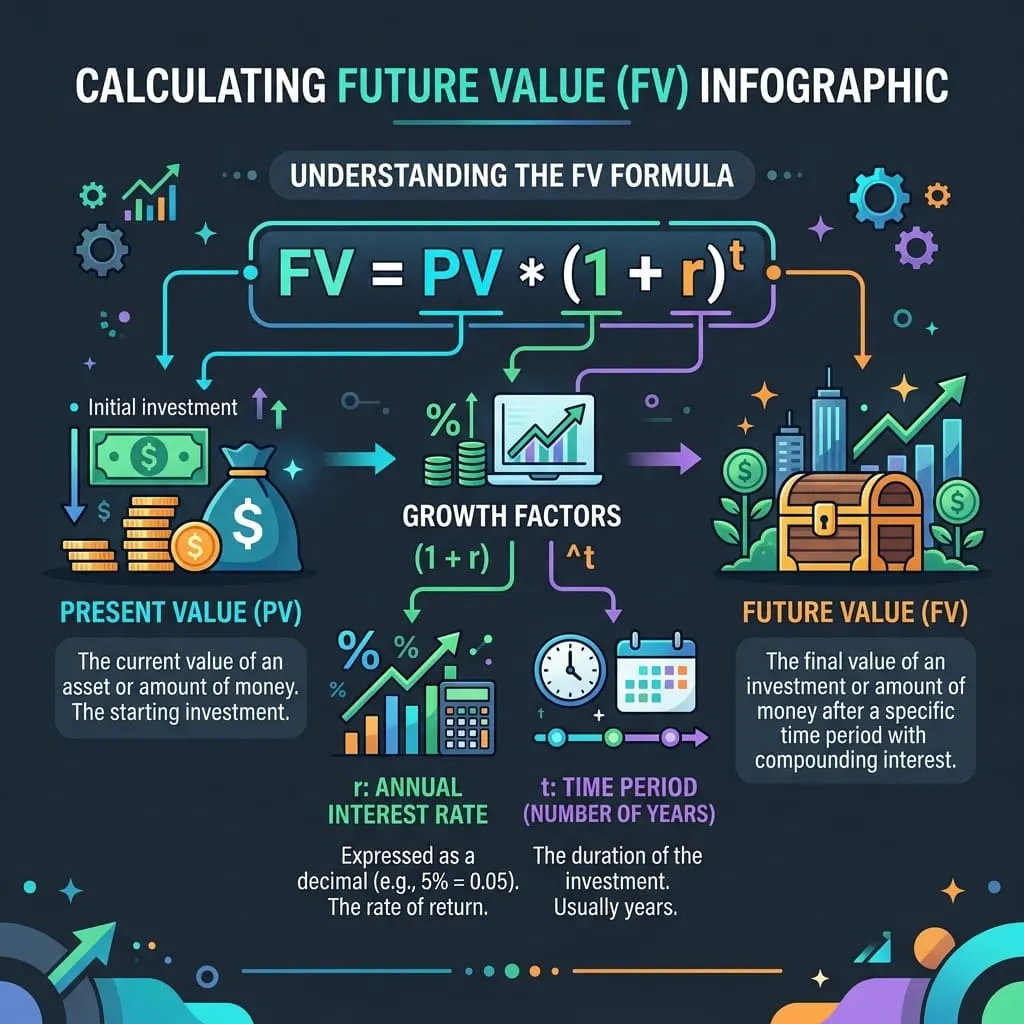
- Technical Definition: Future value (FV) is the asset value at a specified future date calculated by compounding the present value principal (PV) by the expected annual yield rate (r) over a term of years (t), expressed as FV = PV * (1 + r/100)^t.
- Conceptual Analogy: Think of your initial capital like a small tree sapling you plant in your garden today. The expected annual yield is the quality of the soil and watering schedule. The term is the number of years you let the tree grow. The future value is the physical size of the grown tree at the end of the term.
3. History & Milestones
The formalization of the time value of money transformed ancient lending into modern compounding investment models:
- Ancient Babylonia (c. 2000 BC): Archeologists found clay tablets displaying compound interest tables, which were used to calculate the future value of grain and silver debts.
- Jacob Bernoulli (1683): The Swiss mathematician Jakob Bernoulli discovered the mathematical constant "e" while studying compound interest rates, proving the limit of continuous compounding.
- Modern Brokerage Services: The expansion of mutual funds and retirement accounts popularized future value modeling, helping individuals plan for long-term wealth growth.
4. Core Concepts & Parameters
To evaluate future value, you must understand three key parameters:
- Initial Capital: The principal sum of money you deposit or invest at the beginning of the term.
- Expected Annual Yield: The annual percentage rate of return (interest or yield) promised by the asset or fund.
- Growth Period (t): The number of years you leave the capital to grow (standardized at a default of 5 years in our system).
5. The Mathematical Model & Formula
The future value of a present investment is calculated using the standard compounding equation:
Future Value Formula
Future Value = Initial Capital * (1 + Expected Annual Yield)^Term
Variable Breakdown:
- Initial Capital: The present principal value (USD)
- Expected Annual Yield: The annual interest or return rate (written as a decimal, e.g. 8% is 0.08)
- Term: The growth timeline in years (Years, default t = 5)
Why the Formula Works:
Unlike simple interest, which pays returns only on the initial principal, future value uses compounding interest. Every year's return is added to the principal balance, and next year's return is calculated on this new, larger balance, creating an upward exponential curve.
6. Step-by-Step Manual Procedure
Let us walk through a manual calculation using our default calculator values:
- Identify the variables:
Initial Capital = $10,000Expected Annual Yield = 8% = 0.08Term (t) = 5 Years - Calculate the Growth Factor (1 + r):
1 + 0.08 = 1.08 - Raise the growth factor to the power of 5 years:
1.08^5 = 1.469328This means your capital will grow by a factor of 1.4693 over the term. - Multiply by the initial capital:
Future Value = 10,000 * 1.469328 = 14,693.28The future value of your $10,000 investment in 5 years will be approximately $14,693.28.The total interest earned is $4,693.28 (14,693.28 minus 10,000).
7. Visual Diagram
The flowchart below displays the computation path for future values:
graph TD
    Start["Enter Initial Capital & Expected Yield"] --> CalcFactor["Compute Growth Factor: 1 + Yield / 100"]
    CalcFactor --> PowerOf["Raise to the Power of 5 Years"]
    PowerOf --> MultiplyCapital["Multiply:
Capital * Growth Factor"]
    MultiplyCapital --> Display["Output: Future Value of Investment ($)"]
8. Parameter Comparison Matrix
The table below shows how the annual yield affects the future value of a $10,000 investment over a 5-year term:
| Initial Capital | Expected Annual Yield | 5-Year Growth Factor | Future Value | Total Interest Earned |
|---|---|---|---|---|
| $10,000 | 2.0% | 1.1041 | $11,040.81 | $1,040.81 |
| $10,000 | 5.0% | 1.2763 | $12,762.82 | $2,762.82 |
| $10,000 (Default) | 8.0% (Default) | 1.4693 | $14,693.28 | $4,693.28 |
| $10,000 | 10.0% | 1.6105 | $16,105.10 | $6,105.10 |
| $10,000 | 12.0% | 1.7623 | $17,623.42 | $7,623.42 |
9. Real-World Applications
Future value metrics are used daily by investors and corporate planners:
- Retirement Planning: Individuals project how their current retirement account balance will grow over 10 to 30 years to check if they will meet their wealth goals.
- Education Savings: Parents project high-yield savings growth to ensure they can afford college tuition costs.
- Corporate Finance: Businesses estimate the future value of corporate cash reserves placed in interest-bearing assets.
10. Case Studies
Case Study 1: The Impact of Yield Ratios
An investor has $10,000 to invest for 5 years and compares a bank CD with a stock index fund.
- Bank CD Offer (2% Yield):
Future Value = 10,000 * (1.02)^5 = $11,040.81
- Stock Index Fund (8% Expected Yield):
Future Value = 10,000 * (1.08)^5 = $14,693.28
- Outcome: The stock index fund yields $3,652.47 more than the bank CD, helping the investor decide if the higher return offsets the stock market risk.
Case Study 2: Long-Term Growth Goals
A parent wants to check if a $10,000 investment will grow to cover a $14,000 tuition cost in 5 years, targeting an expected annual yield of 8%.
- Calculation: 10,000 * (1.08)^5 = $14,693.28.
- Outcome: The projected future value is $14,693.28, which exceeds the tuition goal, confirming the viability of the savings plan.
11. Advantages of Using the Tool
- Saves Time: Instantly projects compound investment growth.
- Financial Safety: Helps set realistic future wealth expectations.
- Scenario Comparison: Easily shows how interest rate changes alter your final balance.
12. Limitations & Boundary Conditions
This calculator assumes a constant interest rate and term, with no additional monthly contributions. Real-world savings accounts may feature fluctuating rates (variable rates) and regular monthly deposits, which require an annuity formula.
13. Common Mistakes
- Using Simple Interest Calculations: Forgetting to compound your interest, which underestimates your future balance.
- Overestimating Annual Yields: Assuming high, unrealistic return rates (like 20% annually) that carry extreme risk of loss.
12. Frequently Asked Questions
Q1: What is future value?
The total value of a current investment at a specified future date, assuming a constant rate of return and compounding interest.
Q2: What is the formula for future value?
The formula is Future Value = Initial Capital * (1 + Expected Yield)^t.
Q3: How is simple interest different from compound interest?
Simple interest is calculated only on the initial principal. Compound interest earns interest on the principal plus all interest already paid.
Q4: What is expected annual yield?
The annual percentage rate of return (interest or yield) promised by the asset or fund.
Q5: How does a longer term affect future value?
A longer term increases the compounding periods, which exponentially increases the future value of your investment.
Q6: Can future value be negative?
No. Assuming a positive yield, the future value will always be higher than the initial capital.
Q7: What does "compounding" mean?
The process where the returns earned in one period are added to the principal balance, earning additional returns in the next period.
Q8: Does this calculator include tax deductions?
No. Calculations are based on gross yields before tax adjustments.
Q9: What is the growth period?
The number of years the capital is left to compound (default t = 5).
Q10: How do analysts use future value?
To evaluate retirement plans, education savings accounts, and corporate investment projects.
15. Expert Tips
- Reinvest your interest: Always reinvest your earnings back into the asset to maximize the compounding effect.
- Review rates regularly: Update your yield expectations based on changing market conditions to keep your projections realistic.
16. Summary
- Future value calculates the compound growth of savings.
- The future value formula is
Initial Capital * (1 + Expected Yield)^5.
- Compounding interest earns returns on accumulated interest, leading to exponential growth.
- Higher yield rates exponentially increase your final balance.
Additional Technical Guidelines & Measurement Standards
When conducting calculations for Future Value of Present Investment Solver, maintaining quantitative precision and verifying input parameter boundaries is essential for reliable scenario evaluation. Always verify that raw numerical inputs are measured using standardized instrumentation, and double-check unit conversions prior to applying outputs in commercial, industrial, or academic projects.
For quantitative unit conversions and scientific calculations, always maintain at least four decimal places of precision during intermediate arithmetic stages before rounding final results. When preparing technical reports, laboratory documentation, or financial forecasts, cross-verify all output variables against established international measurement standards (such as SI, NIST, and ISO metric benchmarks) to guarantee consistent analytical rigor across all computational workflows.
MathsLover.com delivers this interactive solver 100% free of charge to foster global mathematical literacy, educational accessibility, and data-driven problem solving across scientific, technical, and academic communities worldwide.