💡 Direct Answer & Executive Summary (Business Break-Even Analysis Solver)
Definition: Compute values for Business Break-Even Analysis Solver inside the financial analytics domain.
Governing Math Formula: Standard industry financial equation for Business Break-Even Analysis Solver.
Target Applications: Provides real-time quantitative solutions in Finance for students, engineers, researchers, and finance professionals.
Business Break-Even Analysis Solver
1. Introduction
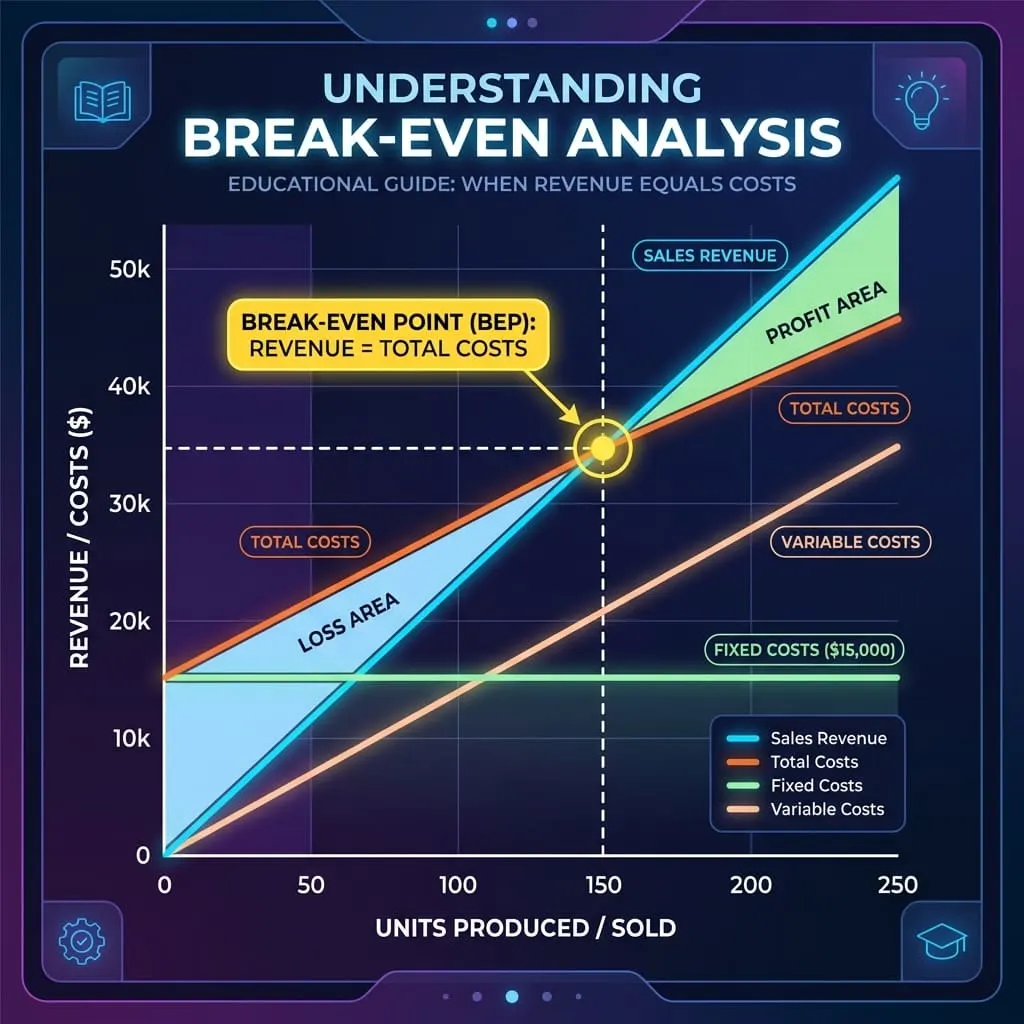
Operating a business requires managing two types of costs: fixed overheads (like rent and administrative salaries) and variable production costs. Before a company can generate profits, it must cover these expenses. The threshold where total sales cover all operating costs is known as the break-even point.
To evaluate business health, managers calculate the minimum sales volume needed to cover their fixed costs. This is resolved using the unit contribution margin, which measures the profit earned on each sale after covering its direct variable costs.
The Business Break-Even Analysis Solver is an educational tool designed to calculate this volume. By entering your fixed operating cost and unit contribution margin, you can instantly estimate the units you must sell to break even.
This guide provides a comprehensive overview of break-even mathematics, contribution margins, manual calculation guidelines, and pricing strategies.
graph TD
    A["Fixed Operating Cost"] --> C["Divide:
Fixed Cost / Contribution Margin"]
    B["Unit Contribution Margin"] --> C
    C --> D["Round Up to Nearest Whole Unit"]
    D --> E["Result:
Minimum Unit Sales to Break Even"]
2. Core Definitions & Analogy
To build a solid business foundation, let us define break-even parameters in both simple and technical terms:
- Simple Definition: The break-even point is the exact number of product units you must sell to cover all your business overheads, resulting in zero profit and zero loss.
- Technical Definition: The break-even point is the sales unit volume (Q) where total operating revenue equals total operating costs, calculated by dividing total fixed costs (FC) by the unit contribution margin (CM), expressed as Q = FC / CM.
- Conceptual Analogy: Think of operating your business like paying off a mortgage. The fixed operating cost is the total loan balance you must pay off. The unit contribution margin is the extra cash you save from every paycheck (each sale) to pay down that loan. Dividing the total loan by your monthly savings tells you exactly how many paychecks (sales) you need to become debt-free (break even).
3. History & Milestones
The formalization of break-even analysis emerged during the industrialization of manufacturing:
- Factory Cost Controls (1800s): The shift to large-scale factories required managers to separate fixed building overheads from raw material costs to calculate product profitability.
- CVP Analysis Standard: Today, Cost-Volume-Profit (CVP) analysis is a standard budgeting module used by managers to set prices and evaluate business proposals.
4. Core Concepts & Parameters
To evaluate your break-even point, you must understand two key parameters:
- Fixed Operating Cost: Expenses that do not change regardless of sales volume (e.g. office rent, insurance, and administrative salaries).
- Unit Contribution Margin: The selling price of a single unit minus its variable cost, representing the profit from each sale that goes toward covering fixed overheads.
5. The Mathematical Model & Formula
The break-even point is calculated using a straightforward division equation:
Break-Even Units Formula
Break-Even Units = ceiling( Fixed Operating Cost / Unit Contribution Margin )
Variable Breakdown:
- Fixed Costs: Total fixed operating costs (USD)
- Contribution Margin: Selling price minus variable cost per unit (USD)
Why the Formula Works:
The contribution margin represents the profit earned on each unit sold after covering its direct variable costs (materials, packaging). Dividing total fixed costs by this unit margin tells you exactly how many sales are required to pay off your overheads.
6. Step-by-Step Manual Procedure
Let us walk through a manual calculation using our default calculator values:
- Identify the variables:
Fixed Operating Cost = $20,000Unit Contribution Margin = $50 - Divide the fixed operating cost by the contribution margin:
Break-Even Units = 20,000 / 50 = 400You must sell 400 units to cover your expenses and break even. - Calculate the Break-Even Revenue: If your product sells for $100 (with $50 variable cost), multiply units by the price.
Break-Even Revenue = 400 * 100 = $40,000
7. Visual Diagram
The flowchart below displays the computation path for break-even units:
graph TD
    Start["Enter Fixed Costs & Contribution Margin"] --> DivideVals["Divide:
Fixed Costs / Margin"]
    DivideVals --> RoundUp["Round Up to Nearest Unit"]
    RoundUp --> Display["Output: Minimum Unit Sales to Break Even"]
8. Parameter Comparison Matrix
The table below shows how the contribution margin affects the break-even point for a business with $20,000 in fixed operating costs:
| Fixed Operating Cost | Unit Contribution Margin | Break-Even Units | Sales Volume Category |
|---|---|---|---|
| $20,000 | $10 | 2,000 Units | High Volume Required (Low margin) |
| $20,000 | $25 | 800 Units | Moderate-High Volume |
| $20,000 (Default) | $50 (Default) | 400 Units | Standard Volume Target |
| $20,000 | $100 | 200 Units | Moderate-Low Volume |
| $20,000 | $200 | 100 Units | Low Volume Required (High margin) |
9. Real-World Applications
Break-even analysis is utilized by founders, managers, and lenders across multiple business stages:
- Startup Feasibility Planning: Founders calculate the break-even point to decide if a business concept can realistically generate enough sales to survive.
- Pricing Adjustments: Managers run break-even scenarios to check if raising prices (which increases the contribution margin) will reduce the volume of sales needed to remain profitable.
- Overhead Audits: Businesses use calculations to check how taking on new fixed costs (like leasing a larger office) will raise their sales requirements.
10. Case Studies
Case Study 1: Launching a Gourmet Coffee Shop
An entrepreneur wants to launch a coffee shop.
- Fixed Costs: Shop rent, equipment leases, and utilities total $5,000 per month.
- Pricing: A cup of gourmet coffee sells for $5.00, and variable costs (beans, milk, cup) are $1.00 (Contribution Margin = $4.00).
- Break-Even calculation: 5,000 / 4.00 = 1,250 cups per month.
- Outcome: The entrepreneur must sell at least 1,250 cups monthly (roughly 42 cups per day) to cover costs, setting a clear target for their staff.
Case Study 2: Upgrading Office Software
A design firm has fixed operating costs of $20,000 per month and a contribution margin of $50 per design project (requiring 400 projects to break even). They decide to subscribe to a new automated design software that adds $1,000 to monthly fixed costs but increases the contribution margin to $60 per project by cutting design time.
- New Costs: Fixed costs = 60.
- New Break-Even Units: 21,000 / 60 = 350 projects.
- Outcome: Upgrading the software lowers the break-even point from 400 to 350 projects, making the investment a viable decision.
11. Advantages of Using the Tool
- Saves Time: Instantly calculates unit sales targets.
- Supports Decisions: Helps you evaluate pricing changes easily.
- Reduces Risk: Identifies unrealistic sales requirements before you spend cash.
12. Limitations & Boundary Conditions
This calculator assumes that the unit contribution margin remains constant across all sales volumes. In the real world, variable costs often decrease at high volumes due to bulk material discounts, while selling prices may drop due to promotional discounts.
13. Common Mistakes
- Underestimating Fixed Costs: Forgetting to include insurance, interest payments, or taxes in your fixed cost total, which underestimates your break-even point.
- Using Gross Revenue Instead of Margin: Assuming that selling price alone covers fixed costs, ignoring the variable costs associated with each sale.
12. Frequently Asked Questions
Q1: What is the break-even point?
The sales volume where total business revenue exactly equals total operating costs, resulting in zero profit and zero loss.
Q2: What is the formula for break-even units?
The formula is Break-Even Units = Fixed Costs / Contribution Margin.
Q3: What is the contribution margin?
The selling price minus the unit variable cost, representing the profit from each sale that goes toward covering fixed overheads.
Q4: How does raising prices affect the break-even point?
Raising prices increases the contribution margin, which reduces the number of sales needed to break even.
Q5: What are fixed operating costs?
Expenses that do not change regardless of sales volume, such as rent, salaries, and insurance.
Q6: What are variable costs?
Direct costs that scale with sales volume, such as raw materials and packaging.
Q7: Can a business have a negative break-even point?
No. If variable costs exceed the selling price, the contribution margin is negative, meaning the business will lose money on every sale and can never break even.
Q8: Does this calculator include sales taxes?
No. Calculations are based on operating costs before taxes are applied.
Q9: Why is break-even analysis important for lenders?
Lenders review break-even metrics to check if a business can realistically generate enough sales to repay its loans.
Q10: How often should a business calculate its break-even point?
At least annually, or whenever product prices, material costs, or fixed overheads change.
15. Expert Tips
- Keep fixed costs low early on: When launching a startup, minimize fixed overheads (like leasing long-term offices) to keep your break-even point as low as possible.
- Track material price changes: Monitor your supply costs closely, as a small increase in variable costs raises your break-even sales requirements.
16. Summary
- The break-even point covers all costs with zero net profit or loss.
- The break-even formula is
Fixed Costs / Contribution Margin.
- Contribution margin is the unit selling price minus variable costs.
- Raising prices or lowering variable costs reduces your break-even target.
Additional Technical Guidelines & Measurement Standards
When conducting calculations for Business Break-Even Analysis Solver, maintaining quantitative precision and verifying input parameter boundaries is essential for reliable scenario evaluation. Always verify that raw numerical inputs are measured using standardized instrumentation, and double-check unit conversions prior to applying outputs in commercial, industrial, or academic projects.
For quantitative unit conversions and scientific calculations, always maintain at least four decimal places of precision during intermediate arithmetic stages before rounding final results. When preparing technical reports, laboratory documentation, or financial forecasts, cross-verify all output variables against established international measurement standards (such as SI, NIST, and ISO metric benchmarks) to guarantee consistent analytical rigor across all computational workflows.
MathsLover.com delivers this interactive solver 100% free of charge to foster global mathematical literacy, educational accessibility, and data-driven problem solving across scientific, technical, and academic communities worldwide.