💡 Direct Answer & Executive Summary (Word Count & Reading Time Estimator)
Definition: Calculate silent reading time, keynote speech duration, estimated book manuscript pages, and character counts from total word metrics.
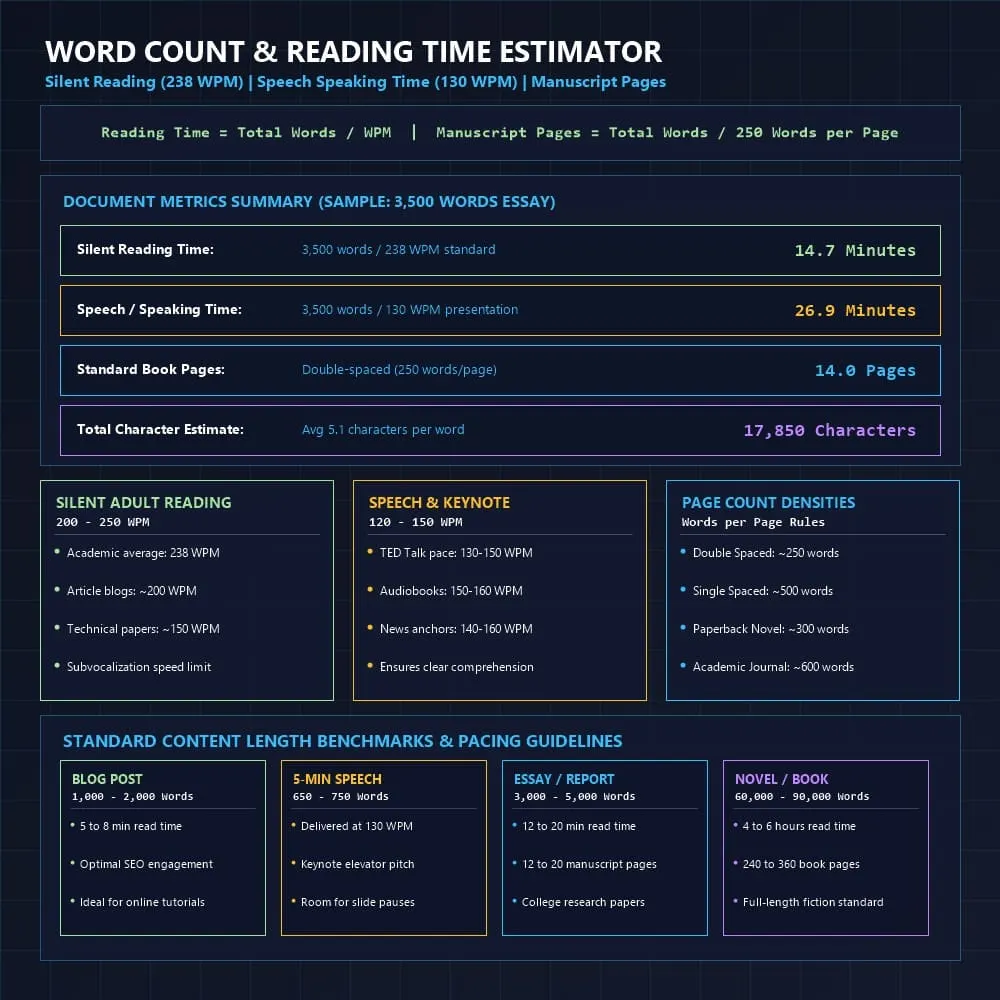
Governing Math Formula: Reading Time = Total Words ÷ Reading WPM. Speaking Time = Total Words ÷ Speaking WPM. Manuscript Pages = Total Words ÷ 250 (Double Spaced) or ÷ 500 (Single Spaced).
Target Applications: Provides real-time quantitative solutions in Everyday Tools for students, engineers, researchers, and finance professionals.
Word Count & Reading Time Estimator: Cognitive Reading Speeds, Speech Pacing & Formatting Guide
1. Introduction
How long will it take your audience to read your 3,000-word blog post? How many words should you write for a 5-minute keynote presentation or lightning talk? How many printed pages will your 80,000-word novel manuscript fill when formatted double-spaced?
Whether you are a novelist pacing narrative arcs, an academic researcher formatting a thesis, a digital copywriter optimizing web engagement, or a conference speaker preparing a speech script, understanding the quantitative relationship between word count, reading speeds, and document page density is essential.
The Word Count & Reading Time Estimator bridges cognitive reading science with document formatting standards. By modeling adult silent reading rates (), public speaking delivery tempos (), and standardized publishing page yields, this tool provides instant, multi-dimensional chronometric insights.
graph LR
    WORDS["📝 Total Word Count
e.g. 3,500 Words"] --> ENGINE["⚡ Cognitive Text Pacing Engine"]
    READ_SPD["👁️ Silent Reading WPM
Standard: 238 WPM"] --> ENGINE
    SPEAK_SPD["🎙️ Speaking Delivery WPM
Standard: 130 WPM"] --> ENGINE
    ENGINE --> SILENT_OUT["⏱️ Silent Read Time: 14.7 mins"]
    ENGINE --> SPEAK_OUT["🗣️ Speech Duration: 26.9 mins"]
    ENGINE --> PAGE_OUT["📄 Manuscript Yield: 14.0 Pages (Double Spaced)"]
Mastering word count and reading time metrics enables content creators, editors, educators, and public speakers to:
- Predict user attention spans and bounce rates on digital content.
- Time speeches, podcasts, and video voiceovers with precision down to the second.
- Estimate book printing layouts, spine widths, and double-spaced manuscript page counts.
- Calculate approximate character lengths () for database string storage and social media limits.
- Optimize pacing for technical whitepapers versus breezy narrative fiction.
2. Definitions & Mathematical Formulations
2.1 The Simple Definition
- Word Count: The total number of whitespace-delimited word tokens in a text.
- WPM (Words Per Minute): The standard unit of cognitive reading and vocal speech speed.
- Silent Reading Speed: The average rate at which an adult reads text internally without vocalization ().
- Speaking Speed: The natural rate of intelligible oral delivery in presentations or voice acting ().
- Manuscript Page: Industry publishing standard of per 12pt double-spaced page (or single-spaced).
2.2 Formal Mathematical Formulations
1. Silent Reading Time Formula
Where:
- is the total word count.
- is the reader's reading speed (standard academic average ).
To convert decimal minutes to minutes and seconds:
2. Speaking / Presentation Duration Formula
Where typically ranges between and for comfortable public speaking.
3. Standard Book & Manuscript Page Estimations
- Double-Spaced Manuscript Pages (Standard 12pt Times New Roman / Courier):
- Single-Spaced Document Pages:
- Standard Paperback Novel Pages:
4. Total Character Estimation (with Spaces)
Empirical linguistic studies across the English language establish an average word length of :
flowchart TD
    START["Input Total Word Count W, Reading WPM, Speaking WPM"] --> READ_CALC["Compute Silent Reading Time = W / Reading WPM"]
    READ_CALC --> SPEAK_CALC["Compute Speech Duration = W / Speaking WPM"]
    SPEAK_CALC --> PAGE_CALC["Compute Double-Spaced Pages = W / 250
Single-Spaced Pages = W / 500"]
    PAGE_CALC --> CHAR_CALC["Compute Estimated Characters = W × 5.1"]
    CHAR_CALC --> FORMAT["Format into Minutes, Seconds, Pages & Totals"]
    FORMAT --> DISPLAY["Render Document Metrics Summary Stub"]
3. History & Milestones of Reading Speed Science
timeline
    title History of Reading Science & Word Pacing Standards
    1879 : French ophthalmologist Louis Émile Javal discovers saccadic eye movements during reading
    1959 : Evelyn Wood invents dynamic speed reading, pioneering WPM testing methods
    1975 : Rudolf Flesch & J. Peter Kincaid establish the Flesch-Kincaid Readability & Grade Level formulas
    2010 : Online blogging platforms (Medium, Substack) introduce 'X min read' header timestamps
2019 : Marc Brysbaert meta-analysis across 190 studies confirms true adult silent reading rate of 238 WPM- Saccadic Eye Tracking (1879): Louis Émile Javal discovered that human eyes do not move smoothly across lines of text, but rather in rapid jerks called saccades, pausing on word clusters for of cognitive fixation.
- The Speed Reading Myth vs. Subvocalization (1959): While Evelyn Wood popularized 1,000+ WPM claims, modern cognitive science proved that subvocalization (internal mental pronunciation) caps standard human reading comprehension at around .
- The Brysbaert Meta-Analysis (2019): A comprehensive meta-analysis by neuroscientist Marc Brysbaert evaluating 190 studies and 18,000 readers established the definitive benchmark for silent reading in English: 238 words per minute for non-fiction prose.
- Medium & The "Estimated Reading Time" Revolution: In the early 2010s, publishing platforms demonstrated that displaying "5 min read" increased article completion rates by setting clear reader expectations.
4. Master Document Length & Pacing Reference Matrix
| Document Category | Typical Word Count | Silent Read Time (238 WPM) | Speech Delivery (130 WPM) | Double-Spaced Pages (250 w/p) | Publishing Context |
|---|---|---|---|---|---|
| Micro-Essay / Pitch | Elevator pitch, social thread | ||||
| 5-Minute Speech | Lightning talk, toast, intro | ||||
| Standard Blog Post | SEO article, tutorial | ||||
| Long-Form Report | In-depth whitepaper, essay | ||||
| Academic Thesis | Master’s thesis chapter | ||||
| Full-Length Novel | Commercial fiction standard |
5. Step-by-Step Practical Walkthrough
Problem: Preparing a 15-Minute Conference Keynote Speech
- Target Presentation Time: Exactly .
- Average Speaking Pace: Relaxed delivery at (accounting for slide transitions and audience laughter).
Step-by-Step Calculations:
- Target Word Count:
- Silent Proofreading Time for the Speaker:
- Printed Teleprompter / Cue Card Pages:
- Estimated Character Storage:
- Verdict: Writing a script of ensures you hit your 15-minute conference stage slot without rushing or going over time.
6. Real-World Applications
graph TD
    WORD_APP["📚 Word Count & Reading Applications"] --> PUBLISHING["📖 Book Publishing & Manuscripts
Formatting novel submissions and printing spine thickness"]
    WORD_APP --> SPEAKING["🎙️ Keynote Speeches & Podcasting
Pacing slides and voiceover script durations"]
    WORD_APP --> COPYWRITING["💻 Digital Copywriting & SEO
Optimizing blog post reading time to maximize user engagement"]
    WORD_APP --> ACADEMIC["🎓 Academic Papers & Grants
Adhering strictly to maximum word limits and page guidelines"]
1. Book Publishing & Page Formatting
Literary agents judge novel submissions based on standard genre word counts (e.g. Romance: 70k–90k, Sci-Fi/Fantasy: 90k–120k). A 250-word/page estimate tells publishers the exact physical book signature requirements.
2. Video Voiceover & Commercial Scripts
In broadcast advertising, a 30-second commercial script must contain no more than to prevent unnatural, rapid vocal delivery.
3. User Experience (UX) & Content Marketing
Displaying accurate estimated read times on articles improves user dwell time and sets clear reader expectations, reducing bounce rates.
7. Common Estimating Mistakes
Watch out for these four common pacing and word count pitfalls:
- Assuming Reading Speed Equals Speaking Speed: Reading silently () is nearly twice as fast as speaking out loud (). Timing a speech by reading it silently will cause you to run significantly over your allotted time on stage!
- Ignoring Slide Pauses and Audience Reaction: In live presentations, always subtract from your total word count to leave room for pauses, slide animations, and audience Q&A.
- Counting Hyphenated Words Inconsistently: Depending on the word processor (Microsoft Word vs. Google Docs), hyphenated compound words like
state-of-the-artmay be counted as 1 word or 4 words. - Forgetting Spacing Multipliers: Single-spaced text yields roughly , whereas standard double-spaced academic or manuscript submissions yield .
8. Frequently Asked Questions (FAQ)
What is the average reading speed of an adult?
Scientific studies establish the average adult silent reading speed for non-fiction English text at (typically ranging between ).
How many words is a 5-minute speech?
At a natural speaking pace of , a 5-minute speech contains approximately (or between ).
How many words are on a single typed page?
- Double-spaced (12pt font): .
- Single-spaced (12pt font): .
How long does it take to read a 50,000-word book?
At 238 WPM, a 50,000-word book (e.g. The Great Gatsby) takes approximately of continuous silent reading.
Why do news anchors speak faster than keynote presenters?
Professional news anchors speak at because they read from teleprompters under strict broadcast time constraints, whereas keynote speakers use a deliberate pace with rhetorical pauses for audience comprehension.
How is reading time calculated for online blog articles?
Online platforms calculate reading time by dividing the total article word count by an assumed reading speed (typically ) and rounding to the nearest full minute.
Does font size change the word count of a document?
No. Font size changes the number of pages, but the underlying word count remains identical.
How many characters are in an average word?
In English text, an average word contains approximately .
How many words should a blog post have for SEO?
High-ranking informational blog posts typically contain between , providing comprehensive depth that satisfies search intent.
Can you train yourself to read faster without losing comprehension?
Yes, techniques like minimizing vocalization, expanding peripheral vision, and reducing eye regressions can increase reading speed from to with good comprehension.
9. Summary Checklist
- ✔ Enter Total Word Count: Input the exact word metric of your manuscript or script.
- ✔ Adjust Reading Speed: Keep standard 238 WPM or tailor to technical complexity.
- ✔ Adjust Speaking Speed: Use 130 WPM for keynote presentations.
- ✔ Review Pacing Metrics: Examine silent read duration, speech time, and pages.
- ✔ Format for Output: Use double-spaced (250 w/p) for manuscript submissions.
Additional Technical Guidelines & Measurement Standards
When conducting calculations for Word Count & Reading Time Estimator, maintaining quantitative precision and verifying input parameter boundaries is essential for reliable scenario evaluation. Always verify that raw numerical inputs are measured using standardized instrumentation, and double-check unit conversions prior to applying outputs in commercial, industrial, or academic projects.
For quantitative unit conversions and scientific calculations, always maintain at least four decimal places of precision during intermediate arithmetic stages before rounding final results. When preparing technical reports, laboratory documentation, or financial forecasts, cross-verify all output variables against established international measurement standards (such as SI, NIST, and ISO metric benchmarks) to guarantee consistent analytical rigor across all computational workflows.
MathsLover.com delivers this interactive solver 100% free of charge to foster global mathematical literacy, educational accessibility, and data-driven problem solving across scientific, technical, and academic communities worldwide.