💡 Direct Answer & Executive Summary (Wallpaper Roll Calculator)
Definition: Determine total wallpaper rolls, vertical drop strips, and waste allowances needed for accent walls or whole room wallpapering projects.
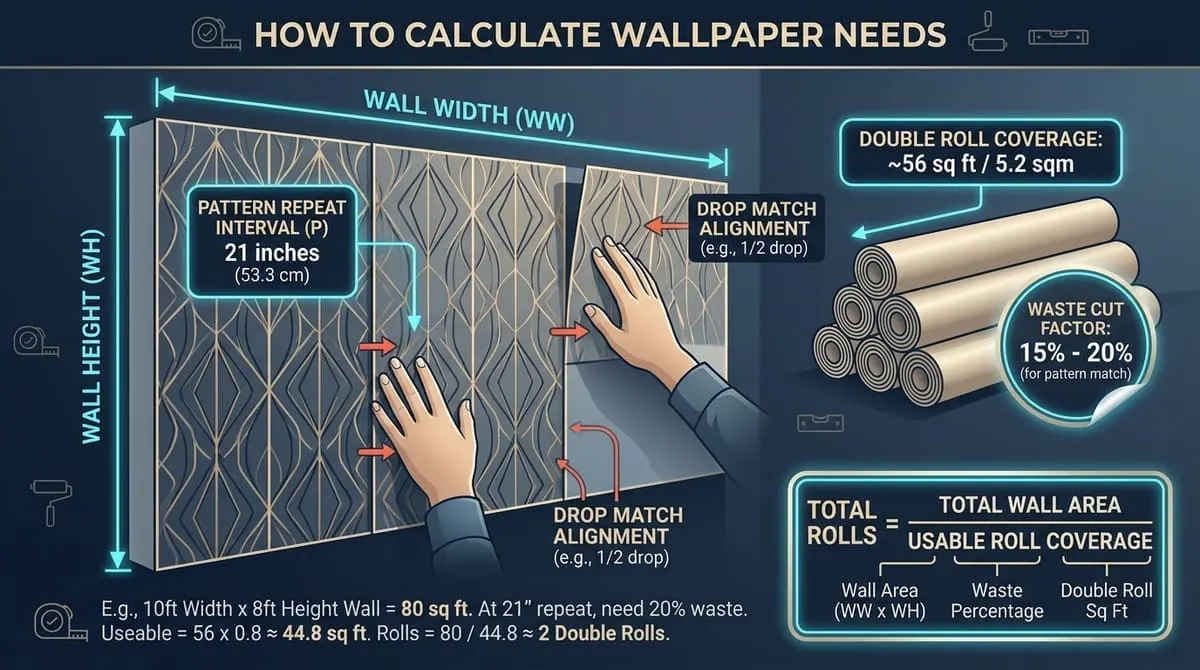
Governing Math Formula: Gross Area = (Wall Width × Wall Height) × (1 + Pattern Match Waste / 100). Total Rolls = Gross Area / Roll Usable Coverage.
Target Applications: Provides real-time quantitative solutions in Everyday Tools for students, engineers, researchers, and finance professionals.
Wallpaper Roll Calculator: Comprehensive Wall Measuring, Pattern Repeat & Roll Estimating Guide
1. Introduction
Wallpaper is experiencing a tremendous resurgence in contemporary interior design. From bold botanical murals and textured grasscloth coverings to mid-century geometric prints and metallic Art Deco motifs, wallpaper instantly infuses living spaces with luxury, visual depth, and distinct personality.
However, calculating how many wallpaper rolls to buy is notoriously challenging for DIYers and interior designers alike. Unlike paint, wallpaper cannot simply be brushed into corners. It is installed as continuous vertical sheets ("drops") that must align seamlessly across horizontal pattern cycles (pattern repeats). If a wallpaper features a half-drop repeat, several inches of paper from every consecutive strip will be trimmed off and discarded to ensure the design elements match across adjacent seams.
graph LR
    WALL["📐 Wall Dimensions
Total Width (ft) × Wall Height (ft)"] --> NET["🟦 Net Wall Area
Net Area = Width × Height (sq ft)"]
    PATTERN["🔲 Pattern Repeat Style
Random (5%), Straight (10%), Drop Match (15%-20%)"] --> WASTE["✂️ Pattern Waste Factor
Gross Area = Net Area × (1 + Waste %)"]
    NET --> WASTE
    ROLL_TYPE["📦 Roll Specification
US Double Roll (56 sq ft) / Euro Roll (57 sq ft)"] --> DIV["➗ Roll Division Engine
Rolls = Gross Area / Usable Roll Sq Ft"]
    WASTE --> DIV
    DIV --> ORDER["🛒 Final Purchase Count
Whole Rolls + Batch/Dye Lot Protection"]
Mastering wallpaper calculating mathematics enables homeowners, paperhangers, and contractors to:
- Accurately project total roll quantities for single feature accent walls or 4-wall full room installations.
- Navigate the critical industry distinction between Single Rolls, Double Rolls (Bolts), and European Metric Rolls.
- Calculate exact scrap trim waste generated by Straight Matches, Half-Drop Matches, and Random Matches.
- Order adequate material from a single printing run/dye lot to prevent glaring color mismatches.
- Budget for proper installation tools: universal wall primer/sizing, heavy-duty clear adhesive paste, seam rollers, and smoothing blades.
2. Definitions & Mathematical Formulations
2.1 The Simple Definition
- Net Wall Area: The raw rectangular surface area of the wall to be covered ().
- Pattern Repeat: The vertical distance (in inches or centimeters) before a decorative motif repeats identically along the roll length.
- Single Roll vs. Double Roll: In the US wallpaper industry, prices are often quoted per "single roll" (), but wallpaper is almost always packaged and shipped as a continuous "double roll" (bolt) containing approximately () to minimize cutting waste.
- Pattern Match Waste: An allowance () added to compensate for aligning decorative motifs across adjacent vertical drops.
2.2 Formal Mathematical Formulations
1. Net Wall Surface Area ()
For a feature wall with Width () and Height () in feet:
For whole-room installations across 4 walls:
For accent walls and high-end patterned paper, professional paperhangers standardly do not deduct doors and windows unless they exceed (such as large sliding glass doors), because vertical drops running above and below openings still consume full roll lengths to maintain pattern alignment.
2. Gross Area Factoring Pattern Match Allowance ()
Where:
- for Random / Solid Match (no repeat).
- for Small Straight Match ( repeat).
- for Standard Drop Match ( repeat).
- for Large / Complex Half-Drop Match ( repeat).
3. Total Double Rolls to Purchase ()
Dividing gross required area by the standard double roll coverage ( for standard US double rolls or for European rolls):
4. The Drop-Count Strip Method (Professional Precision Formula)
Professional paperhangers verify roll counts by calculating vertical strips:
- Calculate Number of Drops ():(Standard US roll width is ; Euro roll width is .)
- Calculate Cut Length per Drop ():
- Calculate Drops per Double Roll ():
- Calculate Total Rolls Needed ():
flowchart TD
    START["Measure Wall Width & Ceiling Height"] --> NET_CALC["Calculate Net Wall Area = Width × Height"]
    NET_CALC --> CHECK_REPEAT["Inspect Wallpaper Label for Pattern Repeat & Match Type"]
    CHECK_REPEAT --> MATCH_TYPE{"Match Type?"}
    MATCH_TYPE -->|Random / Texture| W5["Add 5% Waste Allowance"]
    MATCH_TYPE -->|Straight Match <12in| W10["Add 10% Waste Allowance"]
    MATCH_TYPE -->|Drop Match 12-24in| W15["Add 15% Waste Allowance"]
    MATCH_TYPE -->|Large Drop >24in| W20["Add 20% Waste Allowance"]
    W5 --> GROSS_CALC["Compute Gross Area = Net Area × (1 + Waste %)"]
    W10 --> GROSS_CALC
    W15 --> GROSS_CALC
    W20 --> GROSS_CALC
    GROSS_CALC --> DIV_ROLL["Divide by Double Roll Coverage (56 sq ft)"]
    DIV_ROLL --> CEIL_ROUND["Round UP to Whole Double Rolls"]
    CEIL_ROUND --> PURCHASE["Order All Rolls in Single Batch with Identical Run/Lot Number"]
3. Historical Timeline of Wallpaper Art & Mass Production
timeline
    title Milestones in Wallpaper Manufacturing & Decorative Arts
    c. 200 BCE : Chinese artisans glue painted rice paper onto interior screens
    1481 : King Louis XI of France commissions portable painted parchment wallpapers
    1789 : Jean-Baptiste Réveillon prints luxury neoclassical panoramic scenic murals
    1839 : Harold Potter invents steam-powered 4-color cylinder printing press in England
    1950s : Pre-pasted vinyl-coated waterproof wallpapers dominate suburban homes
Modern : Digital UV-cure printing & 'Peel-and-Stick' removable non-woven textiles- Ancient Chinese Rice Paper Screens (200 BCE): The earliest precursors to wallpaper originated during the Qin and Han dynasties, where decorative calligraphic and landscape paper panels were mounted onto imperial partitions.
- The Parisian Manufacture Royale (1789): French master Jean-Baptiste Réveillon perfected hand-carved woodblock printing, creating world-renowned neoclassical landscapes featuring over distinct hand-mixed mineral pigments per pattern.
- The Potter Steam Printing Machine (1839): English calico printer Harold Potter adapted textile roller-printing machinery to continuous paper, reducing production costs by 95% and bringing wallpaper into middle-class Victorian homes.
- The Non-Woven & Removable Revolution (2000s–Present): Modern synthetic non-woven backing fibers do not expand when wet, eliminating paper soaking and allowing breathable "paste-the-wall" application as well as damage-free "peel-and-stick" removal for renters.
4. Pattern Match Types & Repeat Geometry
Understanding the three foundational pattern match types is essential to avoid ordering shortages:
| Match Type Style | Diagrammatic Visual | Description & Alignment Behavior | Typical Trim Scrap Waste |
|---|---|---|---|
| Random Match (Free Match) | Continuous texture / solid stripes | No vertical alignment required between adjacent drops. Strips can be cut sequentially without waste. | 0% - 5% |
| Straight Match | Horizon-aligned elements | Patterns match horizontally directly straight across from strip to strip. Every strip starts at the same design point. | 10% - 12% |
| Half-Drop Match | Staggered diagonal motifs | The design repeats diagonally. Every second strip drops down by half the pattern repeat distance (). | 15% - 20% |
| Multiple Drop / Complex Match | Intricate panoramic murals | Design repeats across 3 or 4 sequential drops (e.g., ), requiring strict numbered sequence hanging. | 20% - 25% |
5. Step-by-Step Calculation Walkthrough
Let us calculate the exact wallpaper requirements for an Accent Feature Wall in a Living Room:
- Wall Dimensions: ( Net Area).
- Selected Wallpaper: High-end geometric design with a 21-inch half-drop repeat.
- Packaging: Standard US Double Roll ( gross).
graph TD
    subgraph "Feature Wall Wallpaper Project"
        W_IN["📐 Accent Wall: 16 ft Wide × 9 ft High = 144 sq ft"]
        P_IN["🔲 Pattern Repeat: 21-inch Half-Drop → 15% Match Waste"]
        W_IN --> G_CALC["📦 Gross Area = 144 × 1.15 = 165.6 sq ft"]
        P_IN --> G_CALC
        G_CALC --> R_CALC["🛒 Double Rolls: 165.6 / 56 = 2.95 → Order 3 Double Rolls (168 sq ft)"]
    end
Method 1: Square Footage with Waste Factor
- Net Wall Area:
- Apply 15% Half-Drop Waste Factor:
- Divide by Double Roll Usable Coverage (56 sq ft):
- Round UP to Whole Roll: Order 3 Double Rolls ().
Method 2: Precision Drop-Count Verification
- Determine Vertical Drops Required:
- Calculate Cut Length per Drop:
- Calculate Drops per 33-ft Double Roll:(Note: The remaining off-cut is too short for a full 9-ft drop, confirming why pattern repeat generates scrap).
- Calculate Total Rolls Needed:
Both calculation methods verify that 3 Double Rolls are mandatory.
6. Wallpaper Roll Size Comparison Matrix (US vs. European vs. Commercial)
| Roll Specification | Standard Width | Standard Roll Length | Total Surface Area | Common Regions / Markets |
|---|---|---|---|---|
| US Double Roll (Bolt) | United States & Canada standard | |||
| US Single Roll (Pricing unit only) | Price quotation metric (shipped as double) | |||
| European / Metric Roll (Euro Roll) | UK, European Union, Australia, Asia | |||
| Commercial Wide-Width Vinyl | Sold by linear yard () | Hotels, hospitals, commercial office corridors | ||
| Grasscloth / Natural Fiber Roll | Specialty handcrafted luxury residential |
7. Real-World Case Studies in Wallpaper Estimating
graph TD
    subgraph "Case 1: The Discontinued Batch Calamity"
        B1["Ordered Exactly 2 Rolls (0% Waste Allowance)"] --> B2["Ran Out 1 Strip Short on Final Corner"]
        B2 --> B3["Reordered 1 Roll 2 Weeks Later"]
        B3 --> B4["Batch #104 vs #102: Noticeable Greenish Tone Variance Across Seam"]
    end
    subgraph "Case 2: The Hallway Archway Savings"
        H1["Powder Room with 10ft Vaulted Ceiling"] --> H2["Used Drop-Count Formula to Catch 2-Drop Limit per Bolt"]
        H2 --> H3["Avoided Mid-Job Halt: Ordered 4 Bolts Instead of 3"]
    end
Case Study 1: The Disaster of Mismatched Batch / Dye Numbers
- Scenario: A homeowner calculated an accent wall to require exactly of paper and purchased two double rolls () without adding a pattern waste allowance.
- Disaster: Due to a drop match, the installer ran out of paper with one final vertical strip unhung.
- Outcome: The homeowner ordered one additional roll online. However, the new roll came from Printing Batch Run #104 (the original two were Batch #102). The metallic gold ink on the new roll had a visibly warmer bronze cast that stood out glaringly in direct sunlight, forcing the entire wall to be stripped and rehung.
8. Crucial Advantages of Accurate Wallpaper Estimating
graph LR
    PLAN["📋 Accurate Wallpaper Estimating"] --> LOT["🏷️ Guarantees Identical Run/Dye Lot Numbers"]
    PLAN --> MATCH["🎯 Ensures Seamless Pattern Repeat Continuity"]
    PLAN --> SPARE["📦 Preserves Spare Drop for Plumbing/Electrical Repairs"]
PLAN --> NO_HALT["⏱️ Prevents Costly Installer Downtime & Delays"]- Ensures 100% Run / Dye Lot Harmony: Wallpaper inks are mixed in custom batches. Ordering all required double rolls in a single transaction guarantees identical ink pigmentation, substrate weight, and surface embossing.
- Seamless Pattern Repeat Alignment: Prevents forced compromises such as mismatched mid-wall seams or inverted patterns.
- Emergency Repair Reserve: Keeping one leftover partial roll provides matching replacement strips in case of localized water damage, children's crayon marks, or electrical socket additions.
- Eliminates Installer Delay Surcharges: Professional paperhangers bill premium day-rates; stopping mid-installation incurs costly return trip fees.
9. Common Mistakes in Wallpaper Estimating & How to Avoid Them
Beware of these frequent paperhanging pitfalls:
- Confusing Single Roll Pricing with Double Roll Packaging: In the US, wallpaper websites often display prices "per single roll" to make prices look lower, but require customers to purchase in increments of 2 (a double roll). Always verify whether listed dimensions represent single or double rolls.
- Deducting Small Windows and Doors on Patterned Paper: While you subtract door square footage when painting, patterned wallpaper requires continuous vertical drops running above and below the door frame. Do not subtract standard doors on accent walls.
- Ignoring Top and Bottom Trimming Allowances: Walls and ceilings in older homes are rarely plumb or level. Always add of extra trim margin per vertical drop to accommodate uneven baseboards.
- Applying Wallpaper Over Unprimed Drywall: Never hang wallpaper directly onto raw drywall paper or flat builder-grade latex paint without applying a specialized acrylic wallpaper primer/sizing (such as Roman ShieldZ). Without primer, the paste will fuse to the drywall paper, destroying the wall if the paper is ever removed.
10. Frequently Asked Questions (FAQ)
What is the difference between a Single Roll and a Double Roll?
A Single Roll contains approximately () of paper, while a Double Roll (Bolt) contains approximately (). In the US, wallpaper is priced by the single roll but almost exclusively manufactured, packaged, and shipped as double rolls to minimize cutting waste.
How much extra wallpaper should I order for pattern matching?
- Random Match (solid/stripes): Add 5% extra.
- Straight Match ( repeat): Add 10% extra.
- Drop Match ( repeat): Add 15% extra.
- Large Drop Match ( repeat): Add 20% extra.
How many square feet does a standard wallpaper roll cover?
A standard US double roll covers 56.4 square feet (). A standard European metric roll covers 57.3 square feet ().
What is a "Pattern Repeat" and why does it matter?
The pattern repeat is the vertical distance along the roll before the design repeats. When hanging adjacent strips, you must slide each strip up or down to align with the previous strip, which generates scrap trimming at the top and bottom.
What is a "Drop Match" vs. a "Straight Match"?
In a Straight Match, the pattern elements align horizontally straight across adjacent strips at the exact same height. In a Drop Match (Half-Drop), the pattern repeats diagonally, requiring every alternating strip to be shifted down by half the repeat distance.
Should I deduct windows and doors when measuring for wallpaper?
For whole rooms with large French doors or multiple large bay windows, you can subtract 80% of the window area. For single feature accent walls, do not deduct doors or windows, as vertical strips running above and below openings still consume full roll lengths.
What is a "Run Number" or "Dye Lot"?
The run or lot number indicates the specific factory printing batch. Always verify that every roll received has the exact same run number to ensure identical color tone and ink saturation.
What is "Paste the Wall" vs. "Paste the Paper" vs. "Peel and Stick"?
- Paste the Wall: Modern non-woven paper where adhesive is rolled directly onto the drywall; no paper soaking needed.
- Paste the Paper: Traditional paper where paste is brushed onto the back of each strip and allowed to "book" (relax) for 5–10 minutes.
- Peel and Stick: Self-adhesive vinyl with a peel-off backing paper; ideal for temporary installations and rental apartments.
How do I prepare my walls before wallpapering?
Patch all nail holes and cracks with spackle, sand smooth, clean with a damp cloth to remove dust, and apply a dedicated acrylic wallpaper primer/size 24 hours before installation.
Can I install new wallpaper over old existing wallpaper?
It is not recommended. The moisture from new adhesive can soften the old glue, leading to bubbling, peeling, or seam lifting. Always strip old wallpaper down to the bare wall, wash off residual paste, prime, and install fresh.
11. Summary Checklist
- ✔ Measure Wall Width & Ceiling Height: Calculate total net square footage.
- ✔ Check Pattern Repeat & Match Type: Determine whether the pattern is random (5%), straight (10%), or drop match (15%–20%).
- ✔ Compute Gross Area: Apply pattern match waste factor to net wall area.
- ✔ Divide by Double Roll Coverage: Divide by (US) or (Euro) and round UP to the next whole double roll.
- ✔ Verify Single Batch / Dye Lot: Ensure all rolls ship from the same printing run.
- ✔ Prime Walls with Wallpaper Sizing: Apply primer 24 hours prior to hanging paper.
Additional Technical Guidelines & Measurement Standards
When conducting calculations for Wallpaper Roll Calculator, maintaining quantitative precision and verifying input parameter boundaries is essential for reliable scenario evaluation. Always verify that raw numerical inputs are measured using standardized instrumentation, and double-check unit conversions prior to applying outputs in commercial, industrial, or academic projects.
For quantitative unit conversions and scientific calculations, always maintain at least four decimal places of precision during intermediate arithmetic stages before rounding final results. When preparing technical reports, laboratory documentation, or financial forecasts, cross-verify all output variables against established international measurement standards (such as SI, NIST, and ISO metric benchmarks) to guarantee consistent analytical rigor across all computational workflows.
MathsLover.com delivers this interactive solver 100% free of charge to foster global mathematical literacy, educational accessibility, and data-driven problem solving across scientific, technical, and academic communities worldwide.