💡 Direct Answer & Executive Summary (Tip & Bill Split Calculator)
Definition: Calculate gratuity tip amounts and split restaurant bills evenly among dinner guests.
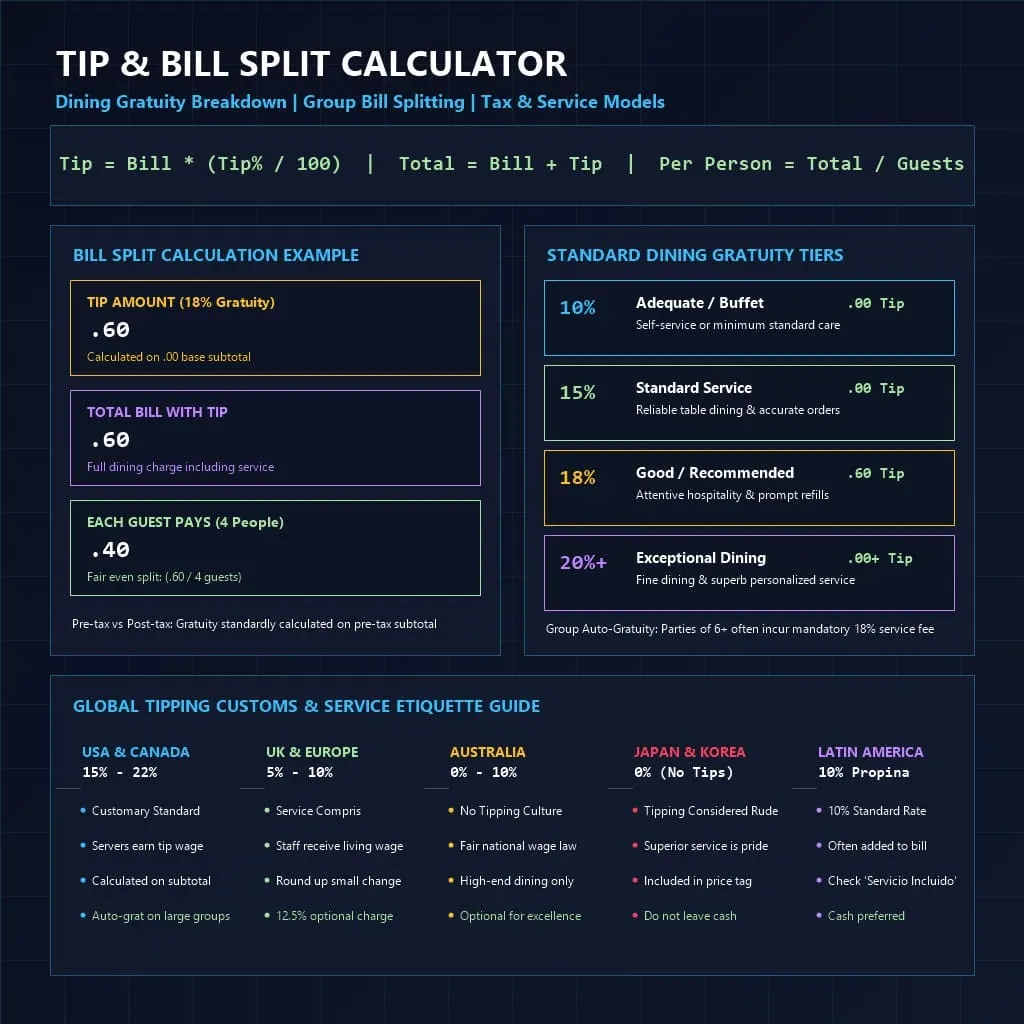
Governing Math Formula: Tip Amount = Bill Amount × (Tip Percentage / 100). Total Bill = Bill Amount + Tip Amount. Per Person = Total Bill / Guests.
Target Applications: Provides real-time quantitative solutions in Everyday Tools for students, engineers, researchers, and finance professionals.
Tip & Bill Split Calculator: Comprehensive Gratuity, Group Dining & Etiquette Guide
1. Introduction
Dining out with colleagues, celebrating birthdays with friends, or ordering food delivery requires answering two immediate questions when the receipt arrives: "How much should we tip?" and "How much does each person owe?" Gratuity and bill-splitting arithmetic may seem straightforward on paper, but in practice, diners encounter complicated edge cases: pre-tax vs. post-tax percentage calculation, mandatory auto-gratuity fees on large parties (), uneven item ordering (alcohol drinkers vs. non-drinkers), delivery platform service fees, and starkly contrasting international tipping customs.
Whether you are dividing a casual dinner bill evenly among four friends, navigating fine dining service charges in New York or London, or traveling abroad in Tokyo where tipping is considered culturally improper, calculating fair gratuities and exact per-person shares ensures smooth social dining, fair compensation for hospitality workers, and complete financial transparency.
graph LR
    BILL["💵 Base Bill Subtotal ($)
Itemized Food & Drink Total"] --> CALC["🧮 Gratuity & Splitting Engine
Tip % Selection + Equal/Itemized Division"]
    TIP_PCT["⭐ Tip Percentage (%)
10%, 15%, 18%, 20%, or 25%"] --> CALC
    GUESTS["👥 Number of Diners
Even Split Among N Guests"] --> CALC
    CALC --> OUT_TIP["💰 Tip Amount ($)
Fair Service Gratuity"]
    CALC --> OUT_TOT["🧾 Total Final Bill ($)
Subtotal + Tip (+ Tax)"]
    CALC --> OUT_SPLIT["💳 Per-Person Share ($)
Exact Amount Each Guest Pays"]
Mastering gratuity calculations and dining mathematics enables diners, event organizers, and travelers to:
- Quickly determine exact tip amounts () without awkward mental math at the table.
- Split dining, bar, or catering checks evenly among any number of guests down to the cent.
- Understand the financial and legal differences between voluntary tips, mandatory service charges, and government sales tax.
- Navigate global tipping etiquette across North America, Europe, Australia, Asia, and Latin America.
2. Definitions & Mathematical Formularies
2.1 The Simple Definition
- Tip (Gratuity): A voluntary sum of money given to service staff (waiters, bartenders, delivery drivers, valets) in recognition of their hospitality and service.
- Total Bill: The complete dining charge combining the original food/drink cost plus the gratuity tip.
- Bill Split (Per Person): The equal share of the total bill that each guest pays when dividing the check evenly.
2.2 The Formal Technical Formularies
1. Tip Amount Formula
The dollar value of the gratuity () is calculated by multiplying the base bill amount () by the selected tip percentage ():
- Where:- = Tip amount in currency units (USD $).- $B$ = Base bill subtotal (standardly pre-tax).- $P_{\text{tip}}18\%$).
2. Total Bill with Gratuity
The total financial amount payable to the restaurant or merchant () is:
3. Equal Per-Person Split Formula
When dividing the bill equally among dining guests:
- Where:- = Amount owed by each individual guest.- = Total number of guests ().
flowchart TD
    START["Input Base Bill ($B), Tip Rate (%P), Guests (N)"] --> COMP_TIP["Calculate Tip: T = B * (P / 100)"]
    COMP_TIP --> COMP_TOT["Calculate Total: Total = B + T"]
    COMP_TOT --> COMP_SPLIT["Calculate Share: Per Person = Total / N"]
    COMP_SPLIT --> ROUND["Round Values to Nearest Cent ($0.01)"]
    ROUND --> DISP["Display: Tip ($T), Total ($Total), Per Person ($S)"]
2.3 Pre-Tax vs. Post-Tax Tipping: The Golden Rule
A common debate at restaurant tables is whether gratuity should be calculated on the pre-tax subtotal or the post-tax grand total:
Hospitality Industry Standard: Tipping etiquette and consumer advocacy standards dictate that tips should be calculated on the pre-tax food & beverage subtotal. Government sales tax represents a mandatory state levy rather than hospitality service provided by your server. However, tipping post-tax simply provides a slightly larger tip (typically adding to the effective tip rate).
3. History & Cultural Evolution of Tipping
graph LR
    ORIGIN["☕ 16th-Century England
Tavern patrons give coins 'To Insure Promptitude' (T.I.P.)"] --> USA_POST["🚂 1860s Post-Civil War USA
Railroad & restaurant operators adopt tipping models"]
    USA_POST --> FLSA_1966["📜 1966 US Fair Labor Standards Act
Federal 'Tip Credit' system establishes tipped minimum wage"]
    FLSA_1966 --> DIGITAL["📱 2020s Digital POS Terminals
Touchscreen prompts & mobile bill-splitting apps"]- Tudor England & Coffeehouses (16th–17th Century): The tradition of giving small gratuities originated in British taverns and coffeehouses, where customers dropped coins into brass boxes inscribed with "To Insure Promptitude" (popularized as the acronym T.I.P.).
- Post-Civil War American Expansion (Late 19th Century): Wealthy Americans traveling in Europe brought the custom back to the United States. Following the abolition of slavery, hospitality employers (notably the Pullman Company on sleeper trains) utilized tips as a primary wage replacement for service workers.
- The US Tip Credit System (1966): The US Congress codified the Tipped Minimum Wage under the Fair Labor Standards Act (FLSA), allowing employers to pay direct cash wages below the standard minimum wage (as low as $2.13/hr federally in 2026), provided that employee tips cover the difference to meet the federal minimum wage.
- Digital Point-of-Sale Revolution (2010s–Present): Touchscreen POS tablets (Square, Toast, Clover) introduced preset tipping prompts () at counter-service cafes, bakeries, and food trucks—sparking widespread cultural discussions on "tip fatigue."
4. Standard Gratuity Rates & Industry Benchmarks
Gratuity norms vary substantially depending on the service category:
| Service Category | Standard Tip Range | Customary Benchmark | Notes & Guidelines |
|---|---|---|---|
| Sit-Down Table Restaurant | 15% - 22% | 18% - 20% | Standard for full-service dining with table waitstaff |
| Buffet / Self-Service Dining | 10% - 15% | 10% | For drink refills and clearing plates |
| Bartender / Cocktail Lounge | $1 - $2 per drink or 15% - 20% | $2/cocktail or 20% | Higher for complex craft cocktails |
| Food Delivery (DoorDash, UberEats) | $3 - $5 minimum or 15% - 20% | $5 or 20% | Factor in weather conditions and delivery distance |
| Rideshare & Taxi (Uber, Lyft, Cab) | 10% - 20% | 15% | Add extra if driver assists with heavy luggage |
| Coffee Shop / Barista | $0.50 - $1.00 per drink | Optional / Round Up | Common for specialty espresso beverages |
| Valet Parking Attendant | $2 - $5 | $3 - $5 | Paid upon vehicle return |
| Hotel Bellhop / Porter | $2 - $5 per bag | $3 per bag | Paid upon room delivery |
| Hair Salon, Barber, & Spa | 15% - 20% | 20% | Standard for personal grooming and styling services |
5. Global Tipping Customs & Etiquette Matrix
Tipping expectations vary dramatically across countries based on local labor laws and cultural standards:
| Country / Region | Customary Gratuity | Service Charge on Bill | Cultural Dining Context |
|---|---|---|---|
| United States & Canada | 15% - 22% | Rare (except parties $6+$) | Mandatory cultural norm; servers depend on tips for base livelihood |
| United Kingdom | 10% - 12.5% | Often added as "Optional 12.5%" | Staff earn statutory living wage; discretionary for good service |
| France & Western Europe | 5% - 10% (Round up) | Service Compris (15% built-in) | European law includes service and VAT in menu prices; leave small coins |
| Australia & New Zealand | 0% - 10% | Rare / None | Strong national minimum wage laws ($\ge \$24/\text{hr}$); tipping is strictly optional |
| Japan & South Korea | 0% (Zero Tip) | Never | Tipping is considered insulting or confusing; exceptional service is a matter of professional pride |
| China | 0% (Zero Tip) | High-end hotels only (10%) | Traditional restaurants do not accept tips |
| Latin America (Mexico, Brazil) | **10% (Propina)** | Often listed as Servicio | Check receipt before adding extra cash propina |
| Middle East (UAE, Egypt) | 10% - 15% | Often 10% municipality fee | Additional small cash gratuity (baksheesh) appreciated for waitstaff |
6. Step-by-Step Practical Calculation Examples
Example 1: Standard Table Dining Split (Pre-Tax)
- Dining Bill Subtotal: $120.00
- Selected Gratuity Rate: 18%
- Number of Guests:
- Step 1: Calculate Tip:
- Step 2: Calculate Total Bill:
- Step 3: Calculate Even Split Per Guest:
Example 2: Large Group Dinner with Auto-Gratuity & Sales Tax
- Itemized Food & Drink Subtotal: $380.00
- State Sales Tax (8.5%): $32.30
- Mandatory Large Group Auto-Gratuity (18% on subtotal):
- Total Final Bill:
- Split Among 8 Guests:
Example 3: Uneven Bill Splitting (Alcohol vs. Non-Alcohol Diners)
When two guests order expensive steak and wine while two guests order soup and water:
- Food Subtotal (Shared): $100.00 ($25.00/person)
- Alcohol Subtotal (Guests 1 & 2 only): $60.00 ($30.00/drinker)
- Gratuity Rate: 20%
- Share for Non-Drinkers (Guests 3 & 4):
- Share for Wine Drinkers (Guests 1 & 2):
- Verification:
7. Real-World Case Studies
Case Study 1: Large Party Auto-Gratuity Confusion
- Scenario: A group of 7 friends dined at an upscale bistro in Chicago. The receipt totaled $420.00, with an itemized line: "Service Charge 18%: $75.60".
- The Pitfall: The diner paying the bill did not examine the line items and wrote an additional 20% tip ($99.00) in the blank gratuity line—resulting in an unintentional 38% double tip ($174.60 total tip on a $420 bill).
- Key Takeaway: Always check receipts for terms like Auto-Gratuity, Service Charge, or Gratuity Included before adding an additional tip.
Case Study 2: Delivery App Fee Structure Breakdown
- Scenario: Ordering $30.00 of takeout on a food delivery app.
- Cost Structure:- Food Subtotal: $30.00- Delivery Fee: $3.99- Platform Service Fee (15%): $4.50- Small Order Fee: $2.00- Sales Tax: $2.70
- The Tipping Misconception: Many consumers assume the $3.99 delivery fee goes to the driver. In reality, delivery platforms retain the service fee and delivery fee, passing only a small base pay ($2 - $3) to the courier.
- Best Practice: Tip delivery couriers directly through the driver tip field (15% - 20% or a $5 minimum) to ensure the driver is fairly compensated for fuel, vehicle wear, and delivery time.
8. Common Mistakes & How to Avoid Them
Mistake 1: Double Tipping on Automatic Gratuity
Failing to review the itemized receipt for mandatory service charges on parties of 5 to 8 or more. If an 18% service charge is already included, no additional tip is required unless service was truly extraordinary.
Mistake 2: Tipping Abroad in Zero-Tip Cultures
Leaving cash tips on tables in Japan, South Korea, or mainland China. In Japan, waitstaff may chase you down the street to return "forgotten money." Respect local cultural customs when traveling internationally.
Mistake 3: Pen & Math Errors on Credit Card Slips
Writing a tip amount that does not match the written total line on paper slips. Legally, the merchant bank processes the Total line amount. Always double-check that .
9. Frequently Asked Questions (FAQ)
Q1: Is it customary to tip on take-out / carry-out food orders?
A: Tipping on take-out is generally optional. A tip of 10% or $1 - $3 is standard practice if the kitchen staff packed extensive condiments, customized orders, or brought food out curbside.
Q2: Should I tip when ordering at a fast-casual counter or self-service tablet?
A: Tipping at counter-service establishments (where you order standing up, pick up your own food, and bus your own tray) is entirely optional. While touchscreen terminals suggest 15% - 20%, 0% to $1.00 is completely acceptable.
Q3: What is the difference between a "Tip" and a "Service Charge"?
A: - Tip (Gratuity): Legally belongs 100% to the employee under US federal labor law (FLSA). Employers cannot retain any portion of employee tips.
- Service Charge: Legally belongs to the restaurant/employer. The business may choose to distribute it to staff or use it to cover general operating overhead and base kitchen wages.
Q4: How should a dining bill be split if someone didn't drink alcohol?
A: The fairest approach is proportional itemized splitting: have alcohol drinkers split the alcohol subtotal + gratuity among themselves, while sharing the food subtotal evenly across all diners.
Q5: What should I do if I received truly terrible service?
A: Tipping 0% is generally discouraged without speaking directly to management. If service was unacceptable, leave a reduced tip (10%) and politely explain the specific service failure to the floor manager so the issue can be corrected.
Q6: Can restaurant managers or supervisors participate in tip pools?
A: Under US federal labor regulations (FLSA 2021 Final Rule), managers and supervisors are strictly prohibited from receiving payouts from employee tip pools, even if they contribute to front-of-house service.
Q7: How does rounding work when splitting a bill evenly?
A: When dividing totals like $100.00 among 3 guests (33.333...), two guests pay $33.33 and one guest pays $33.34 to cover the exact 1-cent remainder.
Q8: Should I tip in cash or on a credit card?
A: Both are widely accepted. However, service staff often appreciate cash tips because cash is immediately accessible at the end of their shift rather than waiting for bi-weekly payroll processing.
10. Summary & Key Takeaways
- The Core Equation: , , and .
- Standard Benchmark: 18% - 20% for full-service dining in the US and Canada.
- Pre-Tax Precision: Gratuity is standardly computed on the pre-tax food and drink subtotal.
- Global Awareness: Understand regional etiquette—from 20% in New York to 10% in Paris and 0% in Tokyo.
Additional Technical Guidelines & Measurement Standards
When conducting calculations for Tip & Bill Split Calculator, maintaining quantitative precision and verifying input parameter boundaries is essential for reliable scenario evaluation. Always verify that raw numerical inputs are measured using standardized instrumentation, and double-check unit conversions prior to applying outputs in commercial, industrial, or academic projects.
For quantitative unit conversions and scientific calculations, always maintain at least four decimal places of precision during intermediate arithmetic stages before rounding final results. When preparing technical reports, laboratory documentation, or financial forecasts, cross-verify all output variables against established international measurement standards (such as SI, NIST, and ISO metric benchmarks) to guarantee consistent analytical rigor across all computational workflows.
MathsLover.com delivers this interactive solver 100% free of charge to foster global mathematical literacy, educational accessibility, and data-driven problem solving across scientific, technical, and academic communities worldwide.