💡 Direct Answer & Executive Summary (Time Duration Adder & Subtracter)
Definition: Add or subtract two time durations in hours, minutes, and seconds with automatic base-60 sexagesimal normalization, decimal hour conversions, and days breakdown.
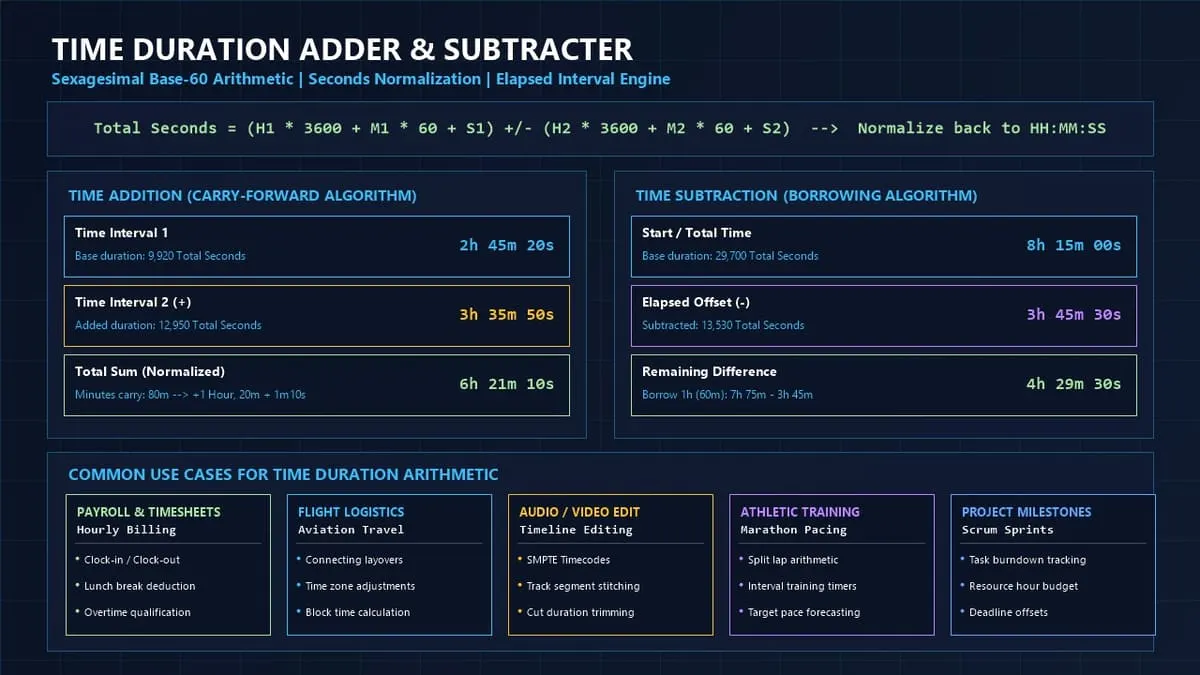
Governing Math Formula: Total Seconds = (H1 × 3600 + M1 × 60 + S1) ± (H2 × 3600 + M2 × 60 + S2). Normalized Time = Hours : Minutes : Seconds.
Target Applications: Provides real-time quantitative solutions in Everyday Tools for students, engineers, researchers, and finance professionals.
Time Duration Adder & Subtracter: Comprehensive Sexagesimal Time Arithmetic & Intervals Guide
1. Introduction
Time is the universal dimension governing modern society, global commerce, aviation logistics, software scheduling, media production, and athletic competition. Yet, performing arithmetic with time intervals—adding to , or computing elapsed billable employee timesheet hours across multiple shifts—is fundamentally counter-intuitive compared to standard base-10 decimal math.
Humanity measures time in a sexagesimal (base-60) positional numeral system inherited from ancient Mesopotamian astronomers. Unlike the metric system where roll over into the next decimal place, time units roll over at , , and . Calculating time durations manually requires continuous carrying (e.g., ) and borrowing (e.g., borrowing from an hour during subtraction).
graph LR
    T1["⏱️ Time Interval 1
Hours, Minutes, Seconds"] --> CONV_SEC["🔢 Normalization to Base Seconds
Total Seconds = (H × 3600) + (M × 60) + S"]
    T2["⏱️ Time Interval 2
Hours, Minutes, Seconds"] --> CONV_SEC
    OP["➗ Operation (+ or -)
Time Addition or Subtraction"] --> ARITH["🧮 Linear Integer Arithmetic
Result Sec = Sec₁ ± Sec₂"]
    CONV_SEC --> ARITH
    ARITH --> SEXA["🔄 Base-60 Sexagesimal Decomposer
Days = Sec / 86400 | Hours = Sec / 3600 | Mins | Secs"]
    SEXA --> OUT["🏆 Final Output: Formatted HH:MM:SS + Decimal Hours + Total Minutes"]
Mastering time duration arithmetic operations enables payroll managers, project coordinators, pilots, video editors, and athletes to:
- Seamlessly add or subtract complex time segments without manual carry/borrow mental strain.
- Convert sexagesimal hours and minutes into decimal billing hours (e.g., ) for accurate client invoicing.
- Calculate total video/audio track runtime from individual cut segments and frame timecodes.
- Plan multi-leg flight itineraries, international layover durations, and UTC time zone offsets.
- Accurately calculate cumulative training times, marathon split paces, and high-intensity interval training (HIIT) rest cycles.
2. Definitions & Mathematical Formulations
2.1 The Simple Definition
- Sexagesimal System: A base-60 numbering system used to measure time ().
- Time Normalization: The process of converting arbitrary sums of seconds and minutes into standard canonical form ().
- Decimal Hours: Time expressed as a single floating-point decimal number (e.g., ).
- Elapsed Interval: The net temporal duration between a start timestamp and an end timestamp.
2.2 Formal Mathematical Formulations
1. Total Seconds Conversion Function ($\Phi$)
Any discrete time tuple $(H, M, S)$ where is mapped to total scalar seconds ():
2. Time Addition Formula
Given two time intervals and :
3. Time Subtraction Formula
4. Sexagesimal De-Normalization Algorithm ()
To decompose total integer seconds () back into canonical Days (), Hours (), Minutes (), and Seconds ():
Where:
- $86,400$ is the number of seconds in one solar day ().
- $\lfloor \dots \rfloor$ is the floor function and is the remainder modulo operator.
5. Decimal Hour & Minute Conversions
flowchart TD
    START["Input Time 1 (H1, M1, S1) & Time 2 (H2, M2, S2)"] --> TO_SEC["Convert Both to Total Seconds:
Sec = H × 3600 + M × 60 + S"]
    TO_SEC --> OP_CHECK{"Operation Type?"}
    OP_CHECK -->|"Addition (+)"| SUM_SEC["Total Sec = Sec₁ + Sec₂"]
    OP_CHECK -->|"Subtraction (-)"| SUB_SEC["Total Sec = Sec₁ - Sec₂"]
    SUM_SEC --> NORM["Decompose into Canonical Units:
Days = Sec / 86400
Hours = (Sec % 86400) / 3600
Mins = (Sec % 3600) / 60
Secs = Sec % 60"]
    SUB_SEC --> NORM
    NORM --> OUT_DEC["Compute Decimal Hours & Total Minutes"]
    OUT_DEC --> DISPLAY["Display Formatted Output HH:MM:SS"]
3. Historical Origins of the 60-Minute Hour
timeline
    title Milestones in Time Measurement & Chronometry
    c. 3000 BCE : Sumerian & Babylonian astronomers develop base-60 sexagesimal math
    c. 1500 BCE : Ancient Egyptians divide day and night into 12 dual shadow hours (24-hour day)
    c. 150 BCE : Hipparchus divides equinoctial circles into 360 degrees of 60 minutes
    1656 : Christiaan Huygens invents the pendulum clock, adding second hands to dials
    1884 : International Meridian Conference establishes Greenwich Mean Time (GMT)
1967 : SI Unit 'Second' redefined via Cesium-133 atomic transition oscillations- Sumerian & Babylonian Base-60 Astronomy (3000 BCE): Ancient Mesopotamians utilized base-60 because is a superior highly composite number with 12 distinct integer divisors ($1, 2, 3, 4, 5, 6, 10, 12, 15, 20, 30, 60$), allowing easy fractional division of circles and astronomical calendars without repeating decimals.
- Egyptian 24-Hour Solar Division (1500 BCE): Egyptian sundial makers divided daytime into 10 daylight hours plus 2 twilight hours, and tracked 12 night star decans, establishing the universal 24-hour daily cycle.
- The Huygens Pendulum Clock (1656): Dutch polymath Christiaan Huygens achieved clock precision within , popularizing the minute hand and second hand on mechanical clock faces.
- Atomic Timekeeping (1967–Present): The International System of Units (SI) redefined the second as the duration of $9,192,631,770$ periods of radiation corresponding to the hyperfine transition of a Cesium-133 atom.
4. Master Operations Comparison Matrix
| Operation | Input Interval 1 | Input Interval 2 | Arithmetic Steps (Seconds Basis) | Canonical Sexagesimal Result | Decimal Equivalent |
|---|---|---|---|---|---|
| Addition ($+$) | |||||
| Addition ($+$) | |||||
| Subtraction ($-$) | |||||
| Subtraction ($-$) |
5. Step-by-Step Calculation Walkthroughs
Example 1: Time Addition with Carry-Forward
Add and .
graph TD
    subgraph "Column-by-Column Sexagesimal Addition"
        SEC["Seconds Column: 45s + 35s = 80s
80s = 1 Minute + 20 Seconds (Carry 1 min)"]
        MIN["Minutes Column: 48m + 26m + 1m (carry) = 75m
75m = 1 Hour + 15 Minutes (Carry 1 hr)"]
        HR["Hours Column: 4h + 3h + 1h (carry) = 8 Hours"]
        SEC --> MIN --> HR --> FIN["🏆 Final Normalized Result: 8 Hours 15 Minutes 20 Seconds"]
end- Add Seconds: (carry ).
- Add Minutes: (carry ).
- Add Hours: .
- Total Normalized Result: 8h 15m 20s ().
Example 2: Time Subtraction with Borrowing
Subtract from .
- Subtract Seconds (): Cannot subtract from . Borrow from (leaving ):
- Subtract Minutes (): Cannot subtract from . Borrow from (leaving ):
- Subtract Hours: .
- Final Difference: 4h 29m 40s ().
6. Real-World Applications of Time Duration Arithmetic
graph TD
    TIME_APP["⏰ Practical Time Arithmetic Applications"] --> PAYROLL["💼 Employee Timesheet & Billing
Summing daily shift hours for overtime calculation"]
    TIME_APP --> MEDIA["🎬 Video & Audio Timeline Editing
Stitching SMPTE cut durations (01:14:22 + 00:45:10)"]
    TIME_APP --> AVIATION["✈️ Flight & Transit Scheduling
Computing layovers, GMT offsets, and block times"]
    TIME_APP --> SPORTS["🏃 Athletics & Marathon Pacing
Multiplying 1-mile pace (7m 45s) × 26.2 miles"]
Case Study 1: Freelance Professional Decimal Billing
- Scenario: A software consultant logged three tasks: Task A (), Task B (), and Task C () at a billing rate of $\$120/\text{hour}$.
- Calculation:
Case Study 2: Marathon Finish Time Projection
- Scenario: A runner maintains an average pace of and wants to calculate their finishing time for a full marathon ().
- Calculation:
- Projected Finish Time: 3 hours 36 minutes 09 seconds.
7. Common Mistakes in Time Calculations
Watch out for these four frequent time arithmetic errors:
- Treating Minutes as Decimals: Assuming is . In reality, is half an hour (), so .
- Borrowing 10 Instead of 60: When subtracting minutes or seconds manually, mistakenly borrowing units rather than the sexagesimal base of units.
- Ignoring Midnight Boundary Shifts: Subtracting an evening start time () from an early morning finish time ($06:00$) without adding to account for the midnight rollover.
- Overlooking Time Zone Daylight Saving Shifts: Assuming all days have exactly 24 hours; annual "Spring Forward" days contain 23 hours, while "Fall Back" days contain 25 hours.
8. Frequently Asked Questions (FAQ)
How do I convert minutes to decimal hours for payroll?
Divide the number of minutes by 60. For example, .
Why is time based on 60 instead of 10?
The base-60 sexagesimal system was developed by ancient Sumerian and Babylonian astronomers because 60 is divisible by 12 different numbers ($1, 2, 3, 4, 5, 6, 10, 12, 15, 20, 30, 60$), making it exceptionally easy to divide into halves, thirds, quarters, and fifths.
How do you add hours and minutes together?
Add the minutes together. If the sum is 60 or more, divide by 60: add the quotient to the hours column and keep the remainder in the minutes column. Then add the hours together.
How do you subtract a larger time duration from a smaller one?
Convert both times into total seconds, subtract the second from the first to get a negative number of seconds, and format with a negative sign (e.g., ).
What is a "Leap Second"?
A leap second is a one-second adjustment occasionally added to Coordinated Universal Time (UTC) to compensate for slight irregularities and deceleration in the Earth's rotational speed.
How do I calculate elapsed time across midnight?
Add to the end time if it falls on the next calendar day, then subtract the start time (e.g., from $22:00$ to $06:00$: ).
What is military time vs. standard 12-hour time?
Standard time uses two 12-hour cycles designated by AM and PM. Military (24-hour) time counts continuously from $00:00$ (midnight) to $23:59$, eliminating AM/PM confusion in medical, aviation, and emergency services.
How many seconds are in one full day?
There are 86,400 seconds in one standard 24-hour day ().
How do I convert seconds to hours, minutes, and seconds?
- Divide total seconds by 3,600 to find Hours.
- Take the remainder, divide by 60 to find Minutes.
- The final remainder is the Seconds.
What is the difference between duration and timestamp?
A timestamp represents a specific fixed point in time (e.g., July 4, 2026 at 3:15 PM). A duration represents an elapsed quantity of time between two points (e.g., 2 hours and 45 minutes).
9. Summary Checklist
- ✔ Convert Time to Total Seconds: .
- ✔ Execute Integer Arithmetic: Add or subtract scalar seconds.
- ✔ Normalize to Base-60: Decompose seconds back into Days, Hours, Minutes, and Seconds.
- ✔ Compute Decimal Conversions: Divide total seconds by 3,600 for decimal hours and by 60 for decimal minutes.
- ✔ Format Output: Present results in clear canonical notation.
Additional Technical Guidelines & Measurement Standards
When conducting calculations for Time Duration Adder & Subtracter, maintaining quantitative precision and verifying input parameter boundaries is essential for reliable scenario evaluation. Always verify that raw numerical inputs are measured using standardized instrumentation, and double-check unit conversions prior to applying outputs in commercial, industrial, or academic projects.
For quantitative unit conversions and scientific calculations, always maintain at least four decimal places of precision during intermediate arithmetic stages before rounding final results. When preparing technical reports, laboratory documentation, or financial forecasts, cross-verify all output variables against established international measurement standards (such as SI, NIST, and ISO metric benchmarks) to guarantee consistent analytical rigor across all computational workflows.
MathsLover.com delivers this interactive solver 100% free of charge to foster global mathematical literacy, educational accessibility, and data-driven problem solving across scientific, technical, and academic communities worldwide.