💡 Direct Answer & Executive Summary (Random Number Generator)
Definition: Generate truly uniform pseudo-random integers, custom dice rolls, lottery numbers, and statistical sampling sets within any custom minimum and maximum bounds.
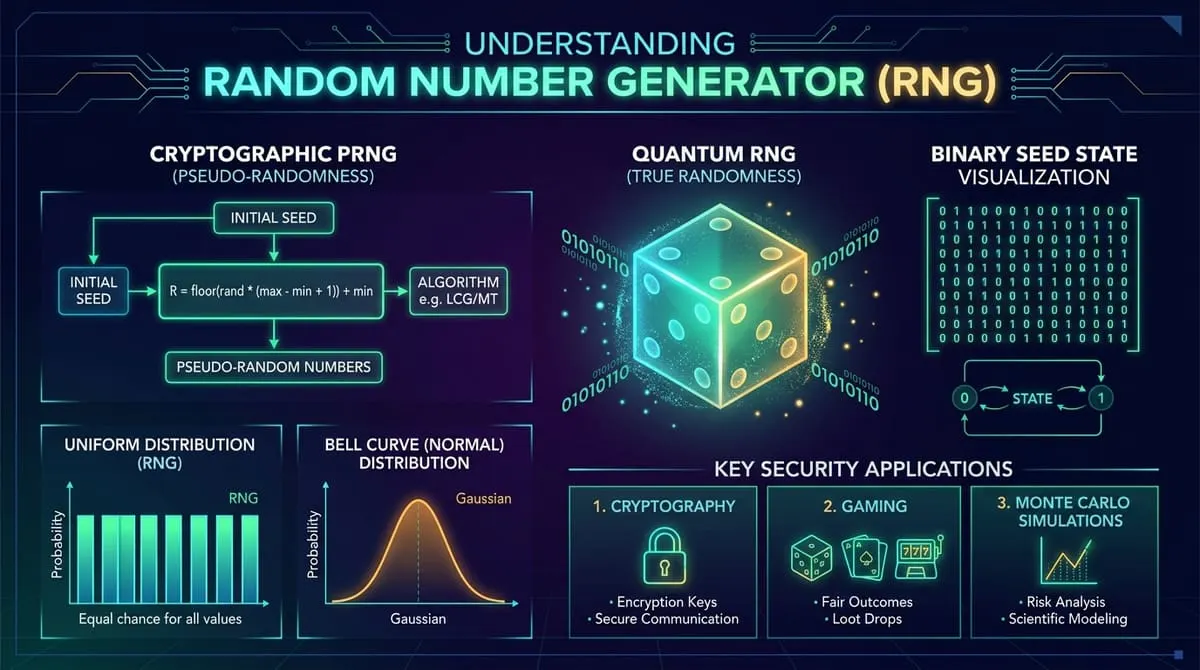
Governing Math Formula: Uniform Discrete RNG: R = Math.floor(Math.random() × (Max - Min + 1)) + Min. Probability per integer P(X = k) = 1 / (Max - Min + 1).
Target Applications: Provides real-time quantitative solutions in Everyday Tools for students, engineers, researchers, and finance professionals.
Random Number Generator (RNG): Comprehensive Guide to PRNG Algorithms, Entropy & Probability
1. Introduction
Randomness is one of the most vital concepts in modern computational science, cryptography, statistical modeling, gaming, and online security. Whether you are generating an uncrackable 256-bit AES cryptographic encryption key, simulating nuclear particle collisions via the Monte Carlo method, conducting randomized clinical drug trials, or rolling a virtual 20-sided die in tabletop gaming, Random Number Generators (RNGs) govern digital uncertainty.
Yet, creating true mathematical randomness inside a deterministic digital computer—a machine fundamentally designed to execute predictable logic gates () with absolute repeatability—presents an intriguing paradox. To bridge this gap, computer science relies on two foundational paradigms: Pseudo-Random Number Generators (PRNGs), which generate long mathematical sequences of uniformly distributed numbers from an initial seed state, and True Random Number Generators (TRNGs), which harvest physical entropy from quantum atmospheric thermal noise or radioactive decay.
graph LR
    SEED["🌱 Seed State (S₀)
Timestamp or Cryptographic Entropy"] --> PRNG["⚙️ Mathematical PRNG Algorithm
Linear Congruential / Mersenne Twister"]
    BOUNDS["🔢 Custom Range Bounds
Min (a) to Max (b)"] --> MAPPING["🧮 Discrete Mapping Engine
R = floor(rand × (b - a + 1)) + a"]
    PRNG --> MAPPING
    MAPPING --> UNI["📊 Uniform Random Sequence
Discrete Integers with Equal Probability P(X) = 1/N"]
    MAPPING --> SAMPLE["🎲 Sampling Modes
With Replacement (Duplicates) / Without Replacement (Unique)"]
Mastering random number generation mathematics enables software developers, data scientists, cryptographers, and game designers to:
- Understand the mathematical differences between Cryptographically Secure PRNGs (CSPRNG) and standard standard library generators (
Math.random()).
- Implement uniform discrete probability transformations to map floating-point random variables onto integer intervals $[a, b]$.
- Generate sampling sets without replacement (e.g., lottery picks, tournament brackets, and deck shuffling) using the Fisher-Yates Shuffle algorithm.
- Evaluate generator statistical quality using standardized randomness test batteries (Dieharder, NIST SP 800-22, TestU01).
- Prevent critical security vulnerabilities caused by predictable PRNG seeds in token generation and session identifiers.
2. Definitions & Mathematical Formulations
2.1 The Simple Definition
- Random Number Generator (RNG): An algorithm or physical device designed to generate a sequence of numbers lacking any predictable pattern.
- Pseudo-Random Number Generator (PRNG): A mathematical algorithm that generates numbers that appear random and satisfy statistical uniformity tests, but are completely determined by an initial Seed value.
- True Random Number Generator (TRNG): An RNG that samples non-deterministic physical phenomena (thermal Johnson-Nyquist noise, atmospheric radio static, or quantum photon beam splitters).
- Uniform Distribution: A probability distribution where every single number within a range has the exact same probability of being chosen.
2.2 Formal Mathematical Formulations
1. Continuous to Discrete Uniform Mapping
Standard programming languages provide a primitive uniform floating-point random generator returning a real value :
To map this continuous variable onto a discrete closed integer interval $[a, b]$ where and :
Where:
- $\lfloor \dots \rfloor$ denotes the mathematical floor function.
- is the total count of discrete possible integer outcomes.
2. Discrete Probability Density Function (PDF)
For a fair discrete uniform random variable :
3. Expected Value (Mean) and Variance
4. Linear Congruential Generator (LCG) Algorithm
The historic mathematical workhorse of computer PRNGs is the Linear Congruential Generator, defined by the recurrence relation:
Where:
- is the Initial Seed ().
- is the Modulus ().
- is the Multiplier ().
- is the Increment ().
flowchart TD
    START["Input Min Bound a, Max Bound b, Quantity Count, Duplicate Flag"] --> VALIDATE{"Is a ≤ b and Count Valid?"}
    VALIDATE -->|No| ERR["❌ Error: Invalid Range Configuration"]
    VALIDATE -->|Yes| MODE{"Allow Duplicates?"}
    MODE -->|With Replacement| LOOP_DUP["Loop Count Times:
R = floor(Math.random() × (b - a + 1)) + a"]
    MODE -->|Without Replacement| SET_POOL["Initialize Set Pool
While Set.size < Count:
Generate R and Add to Unique Set"]
    LOOP_DUP --> STATS["Compute Sample Mean, Variance & Sort Ascending"]
    SET_POOL --> STATS
    STATS --> DISPLAY["Display Random Set + Probability Metrics"]
3. Historical Evolution of Random Number Generation
timeline
    title Milestones in Random Number Generation & Cryptography
    c. 3000 BCE : Astragalus sheep knuckle-bones and 6-sided dice in Ancient Mesopotamia
    1927 : L.H.C. Tippett publishes table of 41,600 random digits from census logs
    1946 : John von Neumann invents Middle-Square Method for ENIAC nuclear simulations
    1951 : D.H. Lehmer formalizes Linear Congruential Generator (LCG)
    1997 : Makoto Matsumoto & Takuji Nishimura develop Mersenne Twister (MT19937)
Modern : Hardware Quantum TRNG chips integrated into consumer CPUs and cryptographic HSMs- Physical Dice & Knuckle-Bones (3000 BCE): The earliest physical randomizers were carved astragali (sheep talus bones) and cubic dice excavated in Ur and Ancient Egypt, used for divination and board games like the Royal Game of Ur.
- Tippett's Tables of Random Digits (1927): English statistician Leonard Tippett published the first formal random number tables () compiled by sampling middle digits from British parish census registers.
- Von Neumann's Middle-Square Method (1946): While working on the Manhattan Project's Monte Carlo simulations at Los Alamos, mathematician John von Neumann created the first algorithmic PRNG for digital computers by squaring an -digit number and extracting the middle digits.
- The Mersenne Twister (1997): Developed by Japanese mathematicians Matsumoto and Nishimura, the Mersenne Twister (MT19937) achieved a colossal period of iterations and 623-dimensional equidistribution, becoming the standard PRNG in Python, R, and Ruby.
4. Comparison Matrix: PRNG vs. CSPRNG vs. Quantum TRNG
| Feature / Metric | Standard PRNG (e.g., LCG, MT19937) | Cryptographically Secure PRNG (CSPRNG) | True Quantum Random Generator (TRNG) |
|---|---|---|---|
| Underlying Mechanism | Deterministic algebraic recurrence | Cryptographic hash / block cipher feedback | Quantum vacuum fluctuations / thermal noise |
| Predictability | Predictable (Once state is observed) | Unpredictable (Passes next-bit test) | Completely Non-Deterministic |
| Speed & Throughput | Extremely Fast () | Fast () | Moderate (, hardware bounded) |
| Period Length | Huge ( for Mersenne Twister) | Effectively infinite | Infinite (No repeating cycle) |
| Common Use Cases | Monte Carlo simulations, video games, graphics | SSL/TLS keys, password salts, session tokens | Hardware Security Modules (HSMs), government crypto |
| Examples in Code | Math.random(), C rand(), Python random | crypto.getRandomValues(), /dev/urandom | Cloudflare LavaRand, Quantis PCIe card |
5. Step-by-Step Practical Walkthrough: Unique Lottery Sampling
Let us generate 6 unique lottery numbers from a pool of 1 to 49 (standard 6/49 lottery matrix) using the Fisher-Yates Shuffle:
graph TD
    subgraph "6/49 Lottery Pick Generation"
        P_POOL["🎱 Array Pool: [1, 2, 3, ..., 49]"]
        PICK1["Pick 1: Random index in [0, 48] → e.g., 14"]
        PICK2["Pick 2: Random index in [0, 47] → e.g., 07"]
        PICK3["Pick 3: Random index in [0, 46] → e.g., 33"]
        PICK4["Pick 4: Random index in [0, 45] → e.g., 42"]
        PICK5["Pick 5: Random index in [0, 44] → e.g., 03"]
        PICK6["Pick 6: Random index in [0, 43] → e.g., 29"]
        P_POOL --> PICK1 --> PICK2 --> PICK3 --> PICK4 --> PICK5 --> PICK6
        PICK6 --> SORT["🏆 Sorted Ticket: [03, 07, 14, 29, 33, 42]"]
    end
Probability Analysis:
The total number of unique 6-number combinations from 49 candidates is given by the binomial coefficient :
The probability of matching all 6 numbers on a single ticket is:
6. Real-World Applications of Random Number Generation
graph TD
    RNG_APP["🎲 Real-World RNG Applications"] --> CRYPTO["🔐 Cybersecurity & Cryptography
SSH keys, AES-256 tokens, JWT secret salts"]
    RNG_APP --> SIM["🧪 Scientific Monte Carlo Modeling
Simulating financial stock portfolios & weather systems"]
    RNG_APP --> GAMING["🎮 Gaming & Entertainment
Loot drop tables, procedural terrain generation, D&D dice"]
    RNG_APP --> STATS["📊 A/B Testing & Medical Trials
Randomized double-blind clinical cohort assignment"]
1. Cryptography and Cyber Defense
Every HTTPS web connection initiates a TLS handshake relying on a 256-bit cryptographically secure pseudorandom number. If an attacker can predict the server's RNG seed, they can reconstruct session keys and decrypt user traffic.
2. Monte Carlo Financial Risk Analysis
Investment firms simulate millions of hypothetical economic futures by sampling random interest rate swings, equity valuations, and inflation trajectories to compute the Value at Risk (VaR) of complex portfolios.
3. Procedural Video Game Generation
Modern open-world games (like Minecraft and No Man's Sky) generate entire galaxies, terrain elevations, cave biomes, and enemy loot drops from a single integer world seed.
7. Common Mistakes in Random Number Generation
Beware of these four widespread PRNG pitfalls in software development:
- Using
Math.random()for Security or Passwords: StandardMath.random()in browsers uses xorshift128+ or similar algorithms that are not cryptographically secure. Never use them for reset tokens, password generation, or encryption keys (usecrypto.getRandomValues()instead). - Modulo Bias in Range Mapping: Writing
rand() % Nintroduces statistical skew when the generator's max integer is not evenly divisible by . Always use floating multiplication with floor or rejection sampling. - Re-Seeding with Millisecond Timestamps: Re-initializing an RNG with
Date.now()inside a fast loop causes dozens of iterations to produce identical numbers because they execute in the same millisecond. - The "Gambler's Fallacy" in Random Sequences: Believing that after rolling three 6's in a row, a 1 is "due" to appear. In true independent random trials, past outcomes have zero influence on future probability.
8. Frequently Asked Questions (FAQ)
What is the formula for generating a random integer between Min and Max?
What is the difference between "With Replacement" and "Without Replacement"?
- With Replacement (Duplicates Allowed): Numbers can repeat (like rolling a 6-sided die 10 times).
- Without Replacement (Unique Only): Once a number is picked, it is removed from the candidate pool (like dealing cards from a deck or picking lottery balls).
Are computer-generated random numbers truly random?
Standard computer numbers are pseudo-random (generated by mathematical formulas). However, True Random Number Generators (TRNGs) that measure physical quantum noise or atmospheric radio static achieve genuine physical non-determinism.
Why is 0.0 inclusive and 1.0 exclusive in Math.random()?
Because returning values in the half-open interval $[0, 1)$ guarantees that multiplying by integer and applying the floor function yields values strictly in the set without ever exceeding the array bounds.
What is a "Seed" in RNG?
A seed is the starting integer fed into a PRNG algorithm. If two computers use the same algorithm and the exact same seed, they will produce identical sequences of random numbers.
What is the Mersenne Twister?
The Mersenne Twister (MT19937) is one of the most widely used PRNG algorithms in scientific computing. It has a period of and passes comprehensive statistical uniformity tests.
How does Cloudflare use Lava Lamps for randomness?
Cloudflare operates a wall of 100 physical lava lamps in its San Francisco headquarters. A video camera records the turbulent fluid convection bubbles, converting the optical pixels into high-entropy cryptographic seeds for millions of web servers.
What is Modulo Bias?
Modulo bias occurs when mapping a large random integer onto a smaller range using the modulo operator () if the range does not divide the maximum integer evenly, causing lower numbers to have a slightly higher probability of appearing.
Can an RNG pick a decimal number?
Yes. To generate a real floating-point number between and :
What is the Fisher-Yates shuffle?
The Fisher-Yates (Knuth) algorithm is an optimal $O(n)$ algorithm for generating an unbiased random permutation of a finite set (such as shuffling a deck of 52 cards).
9. Summary Checklist
- ✔ Set Minimum & Maximum Bounds: Define inclusive integer endpoints $[a, b]$.
- ✔ Select Sampling Mode: Choose unique numbers (without replacement) or allow duplicates.
- ✔ Apply Discrete Uniform Transform: .
- ✔ Verify Single Pick Probability: .
- ✔ Use CSPRNG for Security: Ensure cryptographic libraries are employed for sensitive tokens.
Additional Technical Guidelines & Measurement Standards
When conducting calculations for Random Number Generator, maintaining quantitative precision and verifying input parameter boundaries is essential for reliable scenario evaluation. Always verify that raw numerical inputs are measured using standardized instrumentation, and double-check unit conversions prior to applying outputs in commercial, industrial, or academic projects.
For quantitative unit conversions and scientific calculations, always maintain at least four decimal places of precision during intermediate arithmetic stages before rounding final results. When preparing technical reports, laboratory documentation, or financial forecasts, cross-verify all output variables against established international measurement standards (such as SI, NIST, and ISO metric benchmarks) to guarantee consistent analytical rigor across all computational workflows.
MathsLover.com delivers this interactive solver 100% free of charge to foster global mathematical literacy, educational accessibility, and data-driven problem solving across scientific, technical, and academic communities worldwide.