💡 Direct Answer & Executive Summary (Secure Random Password Generator)
Definition: Generate cryptographically secure, high-entropy random passwords with customizable character sets, Shannon entropy metrics, and brute-force resistance analysis.
Governing Math Formula: Shannon Entropy (Bits): H = L × log₂(N). Total Combinations = Nᴸ (where L = length, N = character pool size).
Target Applications: Provides real-time quantitative solutions in Everyday Tools for students, engineers, researchers, and finance professionals.
Secure Random Password Generator: Cryptographic Entropy, NIST Standards & Brute-Force Guide
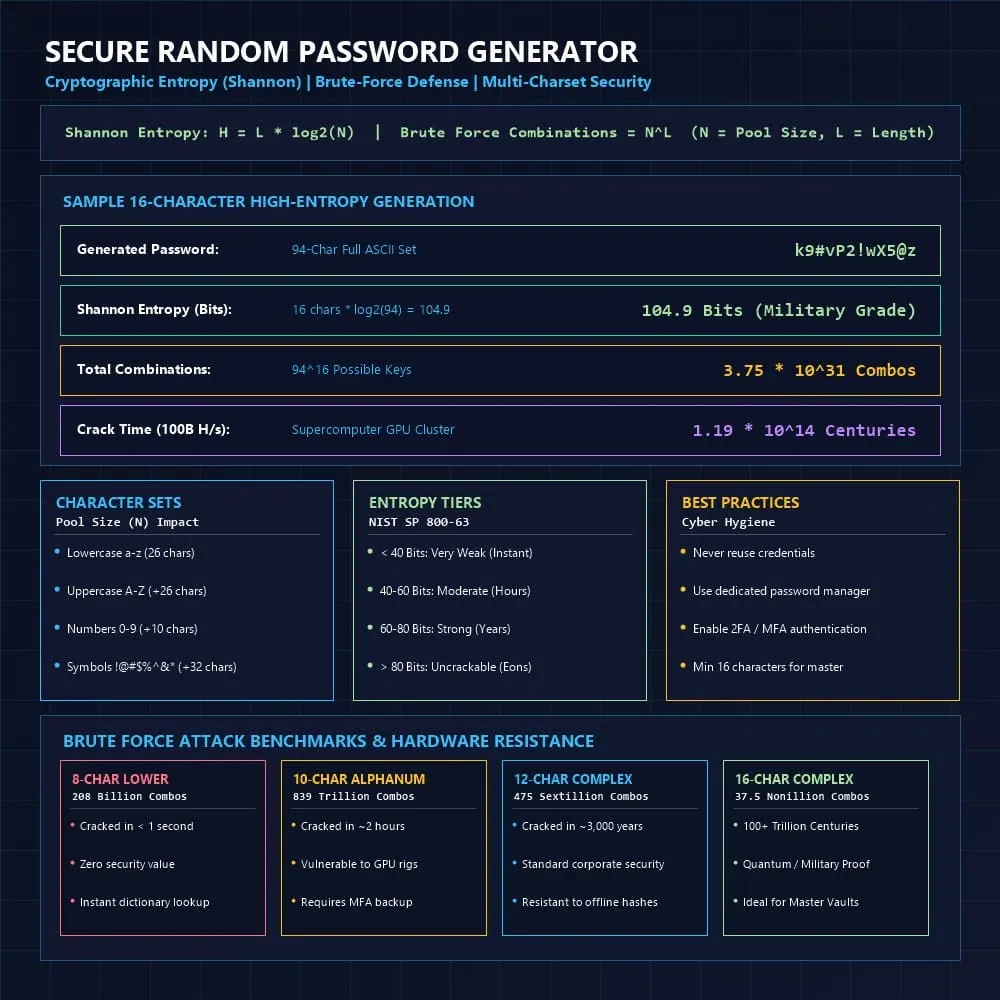
1. Introduction
In an era of automated credential stuffing botnets, distributed GPU password-cracking clusters, and massive cloud database breaches, passwords are the primary gatekeepers of our digital lives. From online banking and personal email accounts to enterprise cloud infrastructure and cryptographic cryptocurrency wallets, weak or predictable passwords are the single most exploited vulnerability in cybersecurity.
The Secure Random Password Generator creates high-entropy, mathematically unpredictable passwords by combining uppercase letters, lowercase letters, numbers, and special symbols across customizable character lengths. More than just a randomizer, this tool calculates the exact Shannon Entropy bit depth and estimates the realistic brute-force offline crack time across modern supercomputer clusters, following NIST Special Publication 800-63B digital identity guidelines.
graph LR
    LEN["📏 Desired Length (L)
e.g. 16, 20, 32 Chars"] --> ENTROPY_ENG["🔐 Cryptographic PRNG Engine
H = L × log₂(N) Bits Entropy
Combinations = Nᴸ"]
    CHARSET["🔠 Character Pool (N)
Lower (26) + Upper (26) + Digits (10) + Symbols (32)"] --> ENTROPY_ENG
    ENTROPY_ENG --> PASS["🔑 Generated High-Entropy Password"]
    ENTROPY_ENG --> BITS["📊 Shannon Entropy Bit Depth (e.g. 104.9 Bits)"]
    ENTROPY_ENG --> CRACK["⏱️ Brute-Force Offline Resistance Tier"]
Mastering password security and entropy mathematics enables cybersecurity specialists, sysadmins, software engineers, and every internet user to:
- Generate cryptographically strong, non-repeating passwords that resist dictionary attacks and rainbow table lookups.
- Calculate Shannon Entropy () to objectively assess password strength beyond simplistic visual rules.
- Understand how adding just 2 or 4 additional characters exponentially explodes brute-force attack costs from hours to trillions of centuries.
- Follow NIST recommendations for master vault passwords and multifactor authentication (MFA).
- Eliminate dangerous credential reuse across sensitive services.
2. Definitions & Mathematical Formulations
2.1 The Simple Definition
- Password Entropy: A mathematical measure of how unpredictable a password is, expressed in Bits.
- Character Pool (): The total count of unique possible characters allowed in the password.
- Brute-Force Attack: An automated trial-and-error method where an attacker tries every possible character combination until the correct password is found.
- Credential Stuffing: An automated cyber attack where lists of leaked username/password pairs are tested across hundreds of other websites.
2.2 Formal Mathematical Formulations
1. Total Permutations / Keyspace Formula
For a password of length selected uniformly from an alphabet of distinct characters:
Where:
- Numbers Only (0–9): .
- Lowercase Only (a–z): .
- Alphanumeric (a–z, A–Z, 0–9): .
- Full Printable ASCII (with symbols): .
2. Shannon Entropy Formula ()
Password entropy in bits represents the number of binary decisions required to guess the password:
For example, a 16-character password chosen from the full 94-character ASCII set:
3. Brute-Force Crack Time Estimation
Assuming an ultra-high-speed offline GPU cracking cluster capable of testing hashes per second (e.g., for MD5/NTLM):
flowchart TD
    START["Input Length L & Complexity Pool Mode"] --> POOL_SELECT{"Select Character Pool N"}
    POOL_SELECT -->|PIN Only| P10["N = 10 (Digits 0-9)"]
    POOL_SELECT -->|Letters Only| P52["N = 52 (Lower + Upper)"]
    POOL_SELECT -->|Alphanumeric| P62["N = 62 (Letters + Digits)"]
    POOL_SELECT -->|Full Complexity| P94["N = 94 (Letters + Digits + Symbols)"]
    P10 --> GEN["Loop L times: Select Random Character from Pool via Crypto PRNG"]
    P52 --> GEN
    P62 --> GEN
    P94 --> GEN
    GEN --> ENTROPY["Calculate Shannon Entropy: H = L × log2(N)"]
    ENTROPY --> TIER{"Evaluate Entropy H (Bits)"}
    TIER -->|< 40 Bits| T_WEAK["❌ Very Weak (< 1 Second Crack Time)"]
    TIER -->|40 - 60 Bits| T_MOD["⚠️ Moderate (Hours to Days)"]
    TIER -->|60 - 80 Bits| T_STR["✨ Strong (Thousands of Years)"]
    TIER -->|≥ 80 Bits| T_MIL["🛡️ Military / Quantum Resistant (Trillions of Centuries)"]
    T_WEAK --> DISPLAY["Display Password, Entropy Bits, Rating & Brute Force Metrics"]
    T_MOD --> DISPLAY
    T_STR --> DISPLAY
    T_MIL --> DISPLAY
3. History & Milestones of Password Security
timeline
    title Milestones in Password Security & Cryptography
    1961 : Fernando Corbató invents password login for MIT CTSS operating system
    1976 : Robert Morris & Ken Thompson introduce crypt() one-way password hashing in UNIX
    1999 : Bruce Schneier publishes Applied Cryptography, popularizing passphrase entropy
    2012 : LinkedIn breach leaks 6.5 million unsalted SHA-1 password hashes
    2017 : NIST SP 800-63B eliminates mandatory 90-day password resets in favor of length & passphrases
Modern : WebAuthn and FIDO2 Passkeys introduce passwordless public-key authentication- The First Computer Password (1961): Computer scientist Fernando Corbató implemented user login passwords on MIT’s Compatible Time-Sharing System (CTSS) to allow multiple researchers to share mainframe disk storage securely.
- UNIX One-Way Hashing (1976): Cryptographers Robert Morris and Ken Thompson realized passwords should never be stored in plaintext. They created
crypt(), running passwords through modified DES algorithms with salt.
- The Length vs. Complexity Revolution (2017): In NIST SP 800-63B, federal cybersecurity authorities overturned decades of obsolete advice, proving that length matters vastly more than frequent resets or arbitrary symbol substitutions (e.g.
P@ssw0rd1is easily cracked, while a 20-character random string is mathematically impregnable).
4. Master Entropy & Brute-Force Crack Time Matrix
Assuming an attacker with a high-end offline GPU array testing 100 Billion () guesses per second:
| Password Type | Length () | Pool Size () | Shannon Entropy | Total Combinations | Estimated Offline Crack Time |
|---|---|---|---|---|---|
| Numeric PIN | (Instant) | ||||
| Lowercase Only | |||||
| Alphanumeric | |||||
| Full Complex | |||||
| Enterprise Standard | |||||
| Master Vault Key |
5. Step-by-Step Practical Walkthrough
Problem: Calculating Entropy of a 14-Character Alphanumeric Password
- Password:
k9vP2mR8wX5zB7
- Length (): .
- Alphabet Composition: Lowercase () + Uppercase () + Digits () .
Step-by-Step Mathematical Evaluation:
- Calculate Bits per Character:
- Calculate Total Shannon Entropy:
- Calculate Total Keyspace:
- Compute Offline Crack Time at :
- Verdict: An 83.4-bit password provides enterprise-grade brute-force resistance, taking nearly 2 million years to crack offline.
6. Real-World Applications
graph TD
    PASS_APP["🔐 Password Security Applications"] --> VAULT["🗄️ Password Managers
Generating unique master vault and 2FA recovery keys"]
    PASS_APP --> DEV["💻 Developer API & SSH Keys
Securing AWS root credentials, JWT secrets, database tokens"]
    PASS_APP --> WI_FI["📡 WPA3 Wi-Fi Network Keys
Preventing offline 4-way handshake dictionary captures"]
    PASS_APP --> CRYPTO["🪙 Cryptocurrency Wallets
High-entropy BIP-39 seed phrase generation"]
1. Password Manager Vaults
Modern password managers (e.g. 1Password, Bitwarden) eliminate the need to memorize dozens of credentials. Users only memorize one strong master password (16+ characters), while the manager generates unique 20-character random passwords for every website.
2. Wi-Fi WPA2/WPA3 Pre-Shared Keys
Hackers capture Wi-Fi four-way authentication handshakes and crack them offline. A 16-character complex Wi-Fi password renders offline dictionary attacks futile.
3. API Keys & Webhook Secrets
Cloud platforms like Stripe and AWS generate 32-character random hex/base64 strings () to authenticate server-to-server payments.
7. Common Password Security Mistakes
Watch out for these four critical credential security errors:
- Password Reuse Across Accounts: If one minor website is breached, hackers use automated bots to test the same credentials across your email, Amazon, and banking accounts (Credential Stuffing).
- Predictable Substitutions ("L33tspeak"): Changing
passwordtoP@ssw0rd!adds almost zero real entropy because cracking dictionaries pre-compute all common symbol swaps. - Short Complex Passwords vs. Long Random Passwords: An 8-character complex password () is dramatically weaker than a 16-character alphanumeric password (). Length always wins.
- Writing Passwords in Plaintext Files: Storing passwords in unencrypted
.txtfiles or spreadsheet docs on your desktop leaves them vulnerable to malware scrapers.
8. Frequently Asked Questions (FAQ)
What makes a password "Strong"?
A strong password has high entropy (at least 80 bits), is at least 16 characters long, uses a random mix of characters, and is unique to that single service.
What is Shannon Entropy in passwords?
Shannon Entropy measures the mathematical unpredictability of a password in bits (). Each extra bit doubles the number of guesses required to crack it.
Why is length more important than complexity?
Because length () is an exponent in the keyspace equation (). Increasing length by 4 characters multiplies the keyspace by (), whereas adding special symbols only slightly increases the base .
Should I change my password every 90 days?
No. NIST guidelines explicitly recommend against mandatory routine password resets because users tend to make predictable minor modifications (e.g. Spring2024! Summer2024!). Change passwords only when a breach is suspected.
What is a "Passphrase"?
A passphrase consists of 4 to 6 random dictionary words strung together (e.g. correct-horse-battery-staple). They are easy for humans to remember while providing over of entropy.
What is the minimum recommended password length?
- Standard Accounts: At least 12 to 16 characters.
- Master Password / Banking: At least 16 to 20 characters.
Can quantum computers crack all passwords instantly?
Quantum computers running Grover's Algorithm theoretically halve the effective symmetric bit strength. A 128-bit key drops to 64 bits of quantum security. Using 16+ characters () preserves security even against quantum advances.
What is a Password Manager?
A password manager is an encrypted digital safe that generates, autofills, and stores complex passwords for all your online accounts behind a single master password.
What is 2FA / MFA?
Two-Factor Authentication (2FA) adds a second verification layer (such as an authenticator app TOTP code or hardware security key) so that even if an attacker guesses your password, they cannot access your account.
How do I check if my password has been leaked?
You can verify if your email or passwords have appeared in public data breaches using trusted security services like Have I Been Pwned (HIBP).
9. Summary Checklist
- ✔ Select Length: Minimum 16 characters for critical accounts.
- ✔ Choose Complexity: Include uppercase, lowercase, numbers, and symbols.
- ✔ Verify Entropy Depth: Aim for of Shannon entropy.
- ✔ Enforce Uniqueness: Never reuse passwords across multiple services.
- ✔ Enable 2FA: Activate multi-factor authentication on all accounts.
Additional Technical Guidelines & Measurement Standards
When conducting calculations for Secure Random Password Generator, maintaining quantitative precision and verifying input parameter boundaries is essential for reliable scenario evaluation. Always verify that raw numerical inputs are measured using standardized instrumentation, and double-check unit conversions prior to applying outputs in commercial, industrial, or academic projects.
For quantitative unit conversions and scientific calculations, always maintain at least four decimal places of precision during intermediate arithmetic stages before rounding final results. When preparing technical reports, laboratory documentation, or financial forecasts, cross-verify all output variables against established international measurement standards (such as SI, NIST, and ISO metric benchmarks) to guarantee consistent analytical rigor across all computational workflows.
MathsLover.com delivers this interactive solver 100% free of charge to foster global mathematical literacy, educational accessibility, and data-driven problem solving across scientific, technical, and academic communities worldwide.