💡 Direct Answer & Executive Summary (Love Compatibility Matcher Calculator)
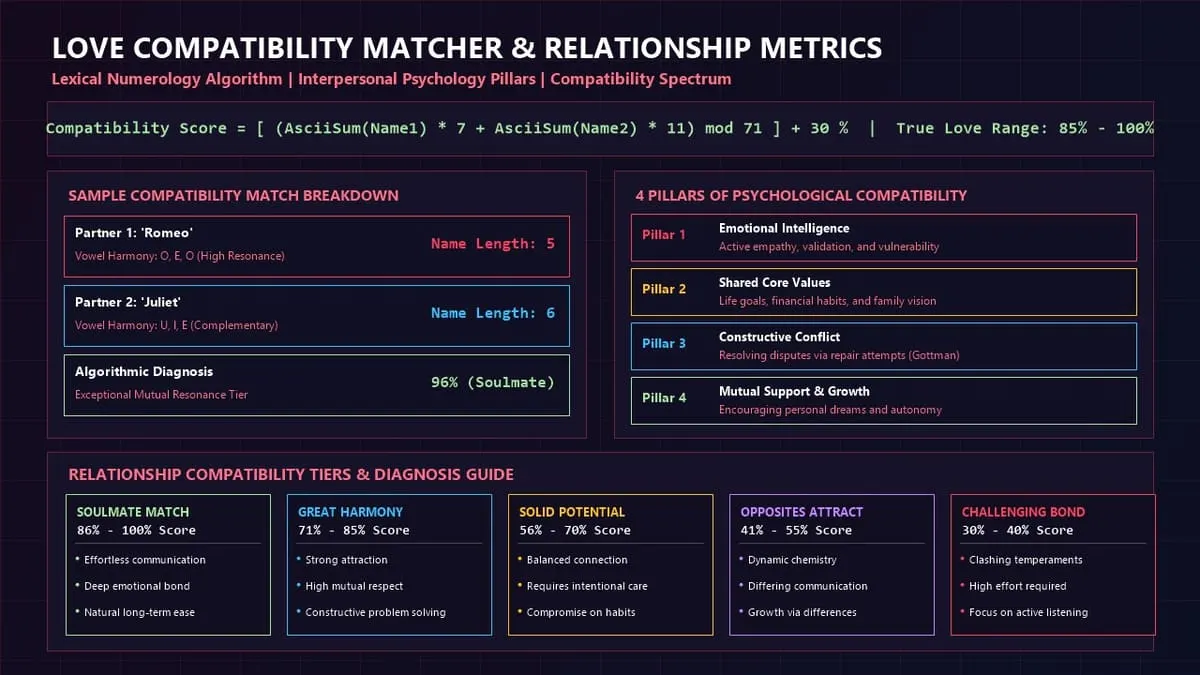
Definition: Calculate relationship compatibility index directly from two partner names based on lexical ASCII character resonance and numerology analysis.
Governing Math Formula: Sums the ASCII character byte values of both partner names, applies non-linear prime weighting (H1 × 7 + H2 × 11 mod 71) + 30%, and evaluates vowel harmony.
Target Applications: Provides real-time quantitative solutions in Everyday Tools for students, engineers, researchers, and finance professionals.
Love Compatibility Matcher Calculator: Comprehensive Relationship Psychology, Numerology & Communication Guide
1. Introduction
What makes romantic relationships thrive over decades while others falter despite intense initial infatuation? For millennia, humanity has sought to quantify, predict, and understand the chemistry of romantic love—from ancient Greco-Roman philosophy and Pythagorean name numerology to modern attachment theory in clinical psychology, Gottman marital research, and algorithmic matchmaking systems used by global dating platforms.
The Love Compatibility Matcher Calculator combines lighthearted lexical resonance analysis with evidence-based relationship science. While algorithmic name matching provides a fun, engaging conversational spark, sustainable long-term relationship success depends on core psychological pillars: emotional intelligence, shared fundamental life values, constructive conflict resolution mechanisms, and mutual respect.
graph LR
    P1["👤 Partner 1 Name & Traits
Lexical Character Codes & Personality"] --> MATCH_ENG["💖 Compatibility Synthesis Engine
Lexical Resonance + Gottman Core Metrics"]
    P2["👤 Partner 2 Name & Traits
Lexical Character Codes & Personality"] --> MATCH_ENG
    MATCH_ENG --> SCORE["📊 Overall Compatibility Index (%)
Spectrum from 30% to 100%"]
    MATCH_ENG --> PILLARS["🏛️ 4 Psychological Pillars
Emotional IQ, Values, Conflict Style, Growth"]
    MATCH_ENG --> DIAG["💌 Relationship Diagnosis & Expert Advice
Actionable Insights for Growth"]
Mastering interpersonal compatibility dynamics enables couples, dating partners, and relationship researchers to:
- Explore the playful cultural history of name numerology and phonetic vowel harmony.
- Identify the Four Horsemen of the Apocalypse (Criticism, Contempt, Defensiveness, and Stonewalling) that predict relationship distress with accuracy.
- Evaluate emotional attachment styles (Secure, Anxious-Preoccupied, Dismissive-Avoidant, and Fearful-Avoidant).
- Build proactive communication rituals that deepen emotional intimacy and mutual trust.
- Navigate the healthy differences that give romantic partnerships depth, excitement, and lifelong resilience.
2. Definitions & Mathematical Models
2.1 The Simple Definition
- Compatibility Score: A quantitative index () reflecting interpersonal harmony, communication alignment, and shared values.
- Attachment Style: The subconscious psychological blueprint formed in childhood dictating how an individual navigates vulnerability, emotional closeness, and independence in adult romance.
- The Gottman Ratio: The empirical observation by Dr. John Gottman that stable, happy relationships maintain at least 5 positive interactions for every 1 negative interaction during conflicts ().
2.2 Formal Mathematical & Algorithmic Formulations
1. Lexical ASCII Numerology Hash Algorithm
The algorithmic name compatibility index () computes a deterministic hash of both partner names by summing their ASCII character code values, applying non-linear prime multipliers, and scaling to a standard compatibility interval $[30, 100]$:
Where:
- is the ASCII byte value of character (e.g., ).
- The modulo operation () ensures a dynamic output range of , which shifts by $+30$ to guarantee a minimum baseline score of 30%.
2. The Relationship Health Index ()
In psychological relationship assessment, overall dyadic satisfaction is modeled across four weighted dimensions:
Where:
- = Emotional Intelligence and Empathic Attunement ().
- = Alignment on Core Life Values & Financial Vision ().
- = Constructive Conflict Resolution & Repair Attempts ().
- = Mutual Support for Individual Growth & Dreams ().
flowchart TD
    START["Input Partner 1 & Partner 2 Names"] --> HASH["Compute Lexical ASCII Character Sums"]
    HASH --> MOD_SCALE["Apply Non-Linear Prime Transformation mod 71 + 30"]
    MOD_SCALE --> TIER_EVAL{"Compatibility Score %"}
    TIER_EVAL -->|86% - 100%| T1["👑 Soulmate Match: Natural ease & deep emotional resonance"]
    TIER_EVAL -->|71% - 85%| T2["🌟 Great Harmony: Strong mutual respect & chemistry"]
    TIER_EVAL -->|56% - 70%| T3["⚖️ Solid Potential: Balanced bond with intentional effort"]
    TIER_EVAL -->|41% - 55%| T4["⚡ Opposites Attract: Dynamic contrast fostering personal growth"]
    TIER_EVAL -->|30% - 40%| T5["🌱 Growth Challenge: High effort required in active listening"]
    T1 --> OUTPUT["Display Relationship Diagnosis & Psychological Advice"]
    T2 --> OUTPUT
    T3 --> OUTPUT
    T4 --> OUTPUT
    T5 --> OUTPUT
3. Historical Timeline of Relationship Compatibility Science
timeline
    title Milestones in the Science & Culture of Romantic Compatibility
    c. 380 BCE : Plato writes The Symposium, describing soulmates as two halves of a whole
    c. 500 BCE : Pythagorean numerology assigns cosmic vibrational numbers to names
    1958 : John Bowlby formalizes Attachment Theory in developmental psychology
    1986 : Robert Sternberg proposes Triangular Theory of Love (Intimacy, Passion, Commitment)
    1992 : Gary Chapman publishes The 5 Love Languages
Modern : Gottman Institute publishes 40-year empirical longitudinal marriage studies- **Plato’s Symposium (380 BCE):** The Greek philosopher Plato recorded the famous mythological speech of Aristophanes, positing that humans were originally four-legged beings split in two by Zeus, doomed to search the earth for their complementary "other half."
- Pythagorean Name Numerology (500 BCE): Ancient Greek philosophers assigned numerical values () to the Greek alphabet, seeking cosmic harmony in phonetic vowel frequencies and geometric letter pairings.
- Sternberg’s Triangular Theory of Love (1986): Yale psychologist Robert Sternberg established that enduring consummate love is composed of three interconnected vertices: Intimacy (emotional closeness), Passion (physical attraction), and Commitment (the conscious decision to maintain the bond).
- The Gottman Institute (1990s–Present): Drs. John and Julie Gottman revolutionized marital science by monitoring physiological heart rates, facial expressions, and vocal tones of thousands of couples in the "Love Lab," discovering that the presence of contempt is the single greatest predictor of relationship dissolution.
4. Master Compatibility Tiers & Diagnosis Matrix
| Compatibility Tier | Score Range | Key Relationship Characteristics | Psychological Dynamics | Recommended Focus Area |
|---|---|---|---|---|
| Soulmate Match | 86% - 100% | Exceptional mutual understanding; effortless shared humor | High natural empathic attunement | Maintain spontaneous date rituals |
| Great Harmony | 71% - 85% | Strong physical attraction and deep mutual respect | Complementary communication styles | Deepen conversations on long-term dreams |
| Solid Potential | 56% - 70% | Balanced connection with occasional friction | Differing stress reactions | Master active listening without defensiveness |
| Opposites Attract | 41% - 55% | Dynamic, fiery chemistry; starkly contrasting habits | High passion; potential for misunderstandings | Establish clear ground rules for arguments |
| Growth Challenge | 30% - 40% | Clashing temperaments and opposing priorities | Requires significant conscious compromise | Focus on validation and emotional empathy |
5. The 4 Psychological Attachment Styles
Understanding your own and your partner's attachment styles illuminates behavioral triggers during stress:
graph TD
    subgraph "Attachment Styles Grid"
        SEC["🟢 Secure Attachment
Comfortable with intimacy & independence
Communicates needs directly"]
        ANX["🟡 Anxious-Preoccupied
Fears abandonment; craves constant reassurance
Highly sensitive to partner moods"]
        AVO["🔵 Dismissive-Avoidant
Equates intimacy with loss of freedom
Withdraws emotionally during conflict"]
        FEAR["🔴 Fearful-Avoidant (Disorganized)
Craves love but terrified of getting hurt
Turbulent push-pull emotional cycle"]
end- Secure Attachment ( of population): Individuals feel worthy of love and trust that others will be supportive. They resolve conflict constructively without dramatic escalation.
- Anxious Attachment ( of population): Individuals hyper-focus on relationship security. When a partner becomes quiet, they internalize it as impending rejection and seek continuous reassurance.
- Avoidant Attachment ( of population): Individuals value self-reliance above all. When emotional intensity rises, their defense mechanism is to withdraw, shut down, or minimize problems.
- The "Anxious-Avoidant Trap": The most common turbulent relationship dynamic occurs when an Anxious partner pursues closeness while an Avoidant partner pulls away to protect their autonomy, creating an escalating cycle of pursuit and withdrawal.
6. The 5 Love Languages Framework
Introduced by Dr. Gary Chapman, recognizing how your partner receives affection prevents emotional miscommunication:
| Love Language | Core Expression | Ideal Gesture | What Hurts Them Most |
|---|---|---|---|
| Words of Affirmation | Verbal compliments and spoken appreciation | Unsolicited "I'm proud of you" texts | Harsh insults, silent treatment |
| Quality Time | Undivided, undistracted presence | Phone-free dinner dates, shared walks | Multi-tasking while they speak |
| Receiving Gifts | Tangible symbols of thought and effort | Small spontaneous tokens remembering preferences | Forgotten anniversaries |
| Acts of Service | Actions that ease daily life burdens | Cooking dinner, washing their car when tired | Broken promises, laziness |
| Physical Touch | Non-verbal physical closeness | Holding hands, hugs, gentle back rubs | Physical neglect, cold body language |
7. Expert Rules for Long-Term Relationship Longevity
graph LR
    RULES["💍 Long-Term Relationship Longevity"] --> R1["🛡️ Banish Contempt
Replace eye-rolling with appreciation"]
    RULES --> R2["🔄 Make Soft Startups
Start complaints gently using 'I feel' statements"]
    RULES --> R3["🤝 Accept Influence
Be willing to compromise and yield ground"]
    RULES --> R4["🗺️ Build Love Maps
Continuously update knowledge of partner's world"]- Use Gentle Start-ups: How a conversation begins determines how it will end 96% of the time. Replace harsh accusations ("You never help with dishes!") with gentle feelings and specific requests ("I'm feeling overwhelmed tonight; could you please help me clean the kitchen?").
- Master the Repair Attempt: When arguments get heated, introducing a repair attempt—a self-deprecating joke, a physical touch, or saying "I'm sorry, let me rephrase that"—de-escalates physiological fight-or-flight heart rates.
- Turn Toward Bids for Connection: When a partner points out a bird out the window or shares a story from work (a "bid" for attention), turning toward them with interest builds an emotional bank account of trust.
- Create Shared Meaning: Developing private rituals of connection (e.g., Saturday morning coffee together, annual holiday traditions) solidifies relationship identity.
8. Frequently Asked Questions (FAQ)
Can names truly predict romantic compatibility?
Algorithmic name matching is a fun cultural and numerological exercise. While phonetic harmony and name familiarity play a psychological role in attraction (the "Name-Letter Effect"), true compatibility is determined by emotional intelligence, shared values, and mutual dedication.
What is the #1 predictor of divorce according to marital science?
According to 40 years of longitudinal research by Dr. John Gottman, contempt (conveyed through sarcasm, mockery, name-calling, and eye-rolling) is the single greatest predictor of relationship dissolution because it communicates moral superiority over one's partner.
Can an Anxious and Avoidant couple make a relationship work?
Yes, with conscious self-awareness. The anxious partner must learn to self-soothe without demanding immediate panic-driven reassurance, while the avoidant partner must practice staying present during difficult conversations rather than shutting down.
What is the "5 to 1" Gottman ratio?
Stable, healthy relationships require at least 5 positive interactions (praise, laughter, hugs, validation) for every 1 negative interaction during conflict. In relationships heading toward divorce, the ratio drops to $0.8:1$.
How do I know if my partner is my "Soulmate"?
A soulmate is not a magical puzzle piece found pre-made; a soulmate is created over time through mutual patience, reciprocal emotional growth, shared trials, and unwavering commitment.
How often should couples go on dates?
Relationship experts recommend the "2-2-2 Rule": go on a date night every 2 weeks, take a weekend getaway every 2 months, and take a week-long vacation together every 2 years.
What are "Love Maps"?
A Love Map is the mental storage space where you keep detailed information about your partner's internal world: their current worries, favorite music, career ambitions, childhood memories, and personal dreams.
Can differing financial values destroy a relationship?
Financial disagreements are one of the leading causes of marital stress. Couples should establish transparent monthly budget reviews, align on debt-payoff strategies, and agree on a discretionary spending limit where purchases over a certain threshold (e.g., $200) are discussed beforehand.
What is the difference between infatuation and true love?
Infatuation is a neurochemical surge of dopamine and phenylethylamine lasting that idealizes a partner. True love is the mature, conscious commitment that emerges after the chemical high subsides, embracing a partner with full awareness of their human flaws.
How do we rebuild emotional intimacy after growing apart?
Start small: implement a daily 15-minute phone-free "stress-reducing conversation," ask open-ended questions about their inner thoughts, and express genuine gratitude for three small things your partner did each day.
9. Summary Checklist
- ✔ Run Lexical Compatibility Analysis: Explore name resonance and phonetic harmony.
- ✔ Audit Attachment Styles: Understand how you and your partner respond to closeness and conflict.
- ✔ Identify Love Languages: Express affection in the format your partner understands best.
- ✔ Maintain the 5:1 Positive Ratio: Ensure daily interactions are rooted in warmth, humor, and gratitude.
- ✔ Master Gentle Conflict Startups: Address concerns using "I" statements without contempt.
Additional Technical Guidelines & Measurement Standards
When conducting calculations for Love Compatibility Matcher Calculator, maintaining quantitative precision and verifying input parameter boundaries is essential for reliable scenario evaluation. Always verify that raw numerical inputs are measured using standardized instrumentation, and double-check unit conversions prior to applying outputs in commercial, industrial, or academic projects.
For quantitative unit conversions and scientific calculations, always maintain at least four decimal places of precision during intermediate arithmetic stages before rounding final results. When preparing technical reports, laboratory documentation, or financial forecasts, cross-verify all output variables against established international measurement standards (such as SI, NIST, and ISO metric benchmarks) to guarantee consistent analytical rigor across all computational workflows.
MathsLover.com delivers this interactive solver 100% free of charge to foster global mathematical literacy, educational accessibility, and data-driven problem solving across scientific, technical, and academic communities worldwide.