💡 Direct Answer & Executive Summary (College GPA Grade Point Average Calculator)
Definition: Calculate semester and cumulative grade point average (GPA) on a standard 4.0 weighted credit scale with letter grade selections and Latin honors classifications.
Governing Math Formula: GPA = Total Quality Points / Total Credits = Sum(Grade Points × Course Credits) / Sum(Course Credits).
Target Applications: Provides real-time quantitative solutions in Everyday Tools for students, engineers, researchers, and finance professionals.
College GPA (Grade Point Average) Calculator: Comprehensive Academic & Honors Guide
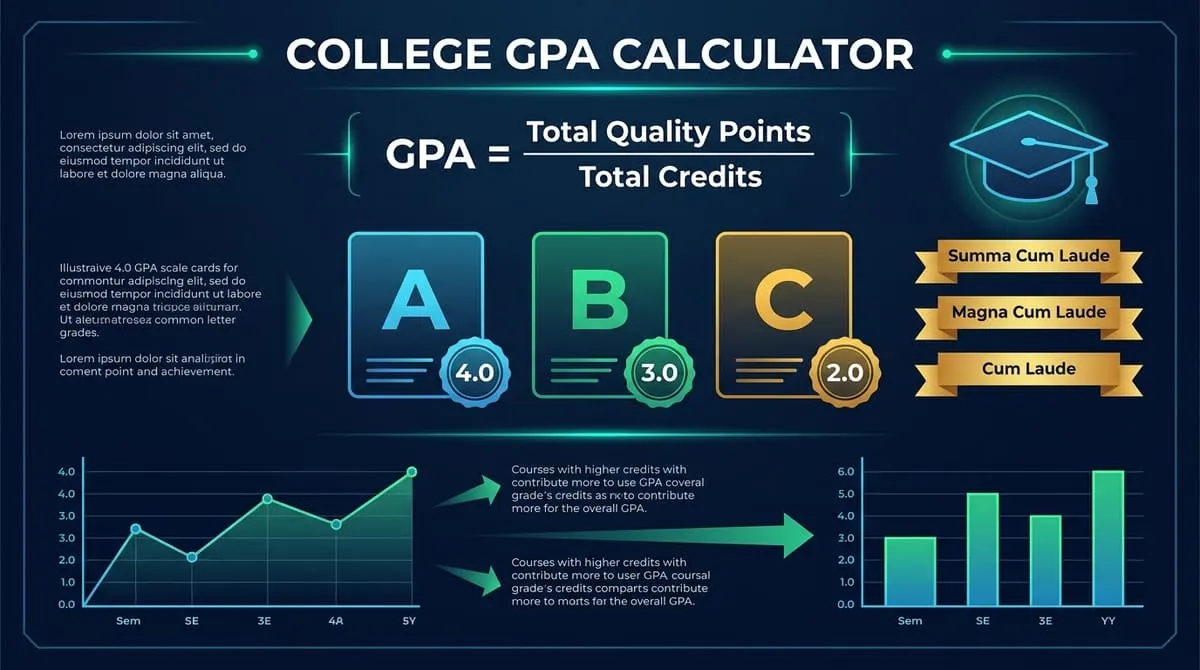
1. Introduction
What does a 3.85 GPA actually mean, and how does a single 4-credit laboratory course in organic chemistry or multivariable calculus alter your academic trajectory? In higher education, your Grade Point Average (GPA) is the universal quantitative metric of undergraduate and graduate academic performance. It determines eligibility for the Dean's Honor List, qualifies students for merit-based scholarships and research fellowships, dictates athletic NCAA eligibility, gates competitive major admissions (such as engineering, computer science, or nursing), and serves as a primary benchmark for medical school (AMCAS), law school (LSAC), and graduate school (GRE) admissions.
Yet, calculating college GPA is far more nuanced than simply averaging together percentages from high school quizzes. College transcripts utilize a credit-weighted mathematical model where courses with greater credit hours (lecture + lab courses carrying 4 or 5 semester credit hours) exert significantly greater gravitational pull on your cumulative average than 1-credit seminars.
graph LR
    GRADES["🎓 Course Letter Grades
A (4.0), A- (3.67), B+ (3.33), B (3.0)..."] --> CONVERT["🔢 Point Conversion Engine
Convert Letters to 4.0 Grade Points"]
    CREDITS["⏱️ Course Credit Hours
1, 2, 3, 4, or 5 Credit Weights"] --> WEIGHT["⚖️ Quality Point Multiplier
Quality Points = Grade Points × Credits"]
    CONVERT --> WEIGHT
    WEIGHT --> SUM_QP["∑ Total Quality Points Earned"]
    CREDITS --> SUM_CR["∑ Total Credit Hours Attempted"]
    SUM_QP --> DIV["➗ Weighted Division Engine
GPA = Total QP / Total Credits"]
    SUM_CR --> DIV
    DIV --> GPA_OUT["🏆 Semester & Cumulative GPA
Dean's List & Latin Honors Standing"]
Mastering collegiate GPA calculation and credit-weighting dynamics enables students, academic advisors, and educators to:
- Formulate strategic target-grade plans to achieve specific Latin Honors thresholds (Summa Cum Laude, Magna Cum Laude, Cum Laude).
- Accurately project how current semester coursework will shift overall Cumulative GPA after 30, 60, or 90 attempted credits.
- Understand the financial and institutional stakes of academic probation thresholds () and loss of Title IV financial aid.
- Calculate required future course grades under credit-recovery or grade-replacement policies.
- Navigate the critical differences between Weighted vs. Unweighted GPA, Quarter Hours vs. Semester Credit Hours, and Major GPA vs. Cumulative GPA.
2. Definitions & Analogies
2.1 The Simple Definition
In simple everyday terms:
- Grade Points: A numeric value assigned to each letter grade earned (e.g., an is worth , while a is worth ).
- Credit Hours: A measure of classroom and study time per week for a course (a standard lecture is , a science lecture with lab is ).
- Quality Points (QP): The mathematical weight of your achievement in a course, calculated as .
- GPA (Grade Point Average): Your average quality points earned per single credit hour attempted.
2.2 The Formal Technical Formulary
1. Semester Quality Points Formula
For any single course , the Quality Points () earned are the product of its assigned grade point value () and its attempted credit hour weight ():
2. Semester GPA Formula
For a semester comprising completed courses, the Semester Grade Point Average () is the quotient of total quality points divided by total credit hours attempted:
Where:
- = Numeric grade point value for course on the $4.00$ scale ().
- = Semester credit hours assigned to course ().
- = Total number of graded courses completed in the semester.
3. Cumulative Overall GPA Formula
When combining prior academic history ( over credit hours) with current semester performance:
flowchart TD
    START["Course Enrollment"] --> INPUT["Input Letter Grade & Course Credits"]
    INPUT --> GP_LOOKUP["Lookup Grade Points (e.g., A = 4.00, B+ = 3.33)"]
    GP_LOOKUP --> MULT["Calculate Quality Points: QP = Grade Points × Credits"]
    MULT --> ACCUM["Sum All Quality Points (∑QP) & Sum All Credits (∑Credits)"]
    ACCUM --> PRIOR_CHECK{"Include Prior Cumulative Transcript History?"}
    PRIOR_CHECK -->|Yes| MERGE["Add Prior QP (Prior GPA × Prior Credits) + Prior Credits"]
    PRIOR_CHECK -->|No| CALC_SEM["Calculate Semester GPA = ∑QP / ∑Credits"]
    MERGE --> CALC_CUM["Calculate Cumulative GPA = Total QP / Total Credits"]
    CALC_SEM --> HONORS["Determine Academic Standing & Dean's List / Latin Honors"]
    CALC_CUM --> HONORS
2.3 The Physical Analogy: Center of Mass
Think of your GPA as the Center of Mass (Centroid) of a physical balance beam:
- Each course grade represents a position along the ruler (from $0.00$ at the far left to $4.00$ at the far right).
- The course credit hours represent the heavy physical weights placed at those positions.
- A 4-credit course places a heavy weight at your grade position, while a 1-credit seminar places a tiny pebble. The balance point of the beam is your GPA.
- Furthermore, the more cumulative credits you accumulate over time (e.g., as a senior), the heavier the whole beam becomes. A single bad grade in your senior year barely moves the fulcrum, whereas in your first semester ( total), that same grade causes a dramatic swing.
3. Historical Origins & Evolution of Academic Grading
timeline
    title Historical Evolution of Academic Grading & GPA
    1785 : Ezra Stiles at Yale University categorizes students into 4 Latin ranks
    1830 : Harvard University introduces numerical scale based on 100 maximum points
    1897 : Mount Holyoke College adopts letter grade system (A, B, C, D, E/F)
    1930s : Standardization of 4.0 Quality Point Scale across North American Universities
    1980s : Proliferation of Weighted GPAs (5.0 scale for AP/IB/Honors courses)
Modern : Digital Student Information Systems & International ECTS Conversions- Ezra Stiles at Yale (1785): Yale President Ezra Stiles recorded the earliest structured academic assessment in the United States, dividing examinees into four Latin descriptors: Optimi (best), Secundi Aliquanto (second best), Inferiores (inferior), and Pejores (worst).
- Harvard's 100-Point Percentage Scale (1830): Harvard moved away from qualitative assessments toward strict numerical ranks out of 100, which were aggregated across classroom attendance, examinations, and deportment.
- Mount Holyoke's Letter Grading System (1897): Mount Holyoke College refined the modern letter grading hierarchy: (), (), (), (75%), and (Failing).
- The Modern 4.0 Grade Point Average: During the mid-20th century, registrar associations standardized the $4.00$ decimal conversion framework to facilitate credit transfers across state colleges and federal GI Bill education stipends.
4. Standard 4.0 Grading Scale & Quality Point Matrix
The standard North American college grading scale maps alphanumeric percentage scores to distinct letter grades and decimal grade point values:
| Letter Grade | Standard Percentage Range | Grade Points (4.0 Scale) | Academic Meaning & Performance Standard | Typical Honors Tier |
|---|---|---|---|---|
| A+ | 97.0% - 100% | 4.00 | Exceptional mastery of advanced subject matter | Summa Cum Laude Tier |
| A | 93.0% - 96.9% | 4.00 | Outstanding command of course material | Summa Cum Laude Tier |
| A- | 90.0% - 92.9% | 3.67 | Excellent comprehension and superior analytical skill | Magna Cum Laude Tier |
| B+ | 87.0% - 89.9% | 3.33 | Very good comprehension; above college average | Cum Laude Tier |
| B | 83.0% - 86.9% | 3.00 | Good, solid competency in standard curriculum | Good Academic Standing |
| B- | 80.0% - 82.9% | 2.67 | Average comprehension; meets baseline major standards | Good Academic Standing |
| C+ | 77.0% - 79.9% | 2.33 | Above-minimum passing competency | Satisfactory Progress |
| C | 73.0% - 76.9% | 2.00 | Satisfactory; universal minimum major prerequisite threshold | Institutional Minimum |
| C- | 70.0% - 72.9% | 1.67 | Below standard; may not fulfill major prerequisites | Academic Warning |
| D+ | 67.0% - 69.9% | 1.33 | Marginal passing; elective credit only | Probation Risk |
| D | 60.0% - 66.9% | 1.00 | Lowest passing grade; non-transferable | Probation Risk |
| F | 0.00 | Failure; zero credit hours earned, 0.00 quality points | Academic Suspension |
Some institutions do not award grade points above $4.00$, capping quality points strictly at $4.00$. Other universities (such as Columbia and Cornell) historically record grade points on internal transcripts.
5. Step-by-Step Calculation Walkthrough
Let us calculate both the Semester GPA and the New Cumulative GPA for a sophomore engineering student named Alex.
Step 1: Record Semester Courses, Grades, and Credits
Alex completed four courses in the fall semester:
graph TD
    subgraph "Fall Semester Transcript"
        C1["📐 Calculus I (MATH 101)
Grade: A (4.00 pts) × 4 Credits = 16.00 QP"]
        C2["⚛️ Physics w/ Lab (PHYS 201)
Grade: B+ (3.33 pts) × 4 Credits = 13.32 QP"]
        C3["💻 Computer Science I (CS 105)
Grade: A- (3.67 pts) × 3 Credits = 11.01 QP"]
        C4["✍️ Academic Writing (ENG 101)
Grade: B (3.00 pts) × 3 Credits = 9.00 QP"]
    end
Step 2: Compute Quality Points per Course
- Calculus I:
- Physics w/ Lab:
- Computer Science I:
- Academic Writing:
Step 3: Sum Total Semester Quality Points & Credits
- Total Semester Credits:
- Total Semester Quality Points:
Step 4: Calculate Semester GPA
Alex's fall semester GPA is 3.52, earning placement on the college Dean's Honor Roll ().
Step 5: Merge with Prior Cumulative History
Prior to this semester, Alex had completed with a cumulative GPA of $3.20$:
- Prior Quality Points:
- Total Career Credits:
- Total Career Quality Points:
The strong $3.52$ fall semester raised Alex's overall cumulative GPA from 3.20 to 3.30.
6. Academic Honors & Latin Honors Classifications
graph LR
    SUMMA["👑 Summa Cum Laude
3.90 - 4.00 GPA
Top 1% - 5%"] --- MAGNA["⭐ Magna Cum Laude
3.70 - 3.89 GPA
Top 10% - 15%"]
    MAGNA --- CUM["🎖️ Cum Laude
3.50 - 3.69 GPA
Top 20% - 25%"]
    CUM --- DEANS["📜 Dean's Honor List
Semester GPA ≥ 3.50
Min. 12 Graded Credits"]
Colleges and universities bestow prestigious Latin Honors (Honores Academici) at commencement based on final cumulative GPAs or graduating class rank percentiles:
1. Summa Cum Laude ("With Highest Praise")
- Typical GPA Requirement: (or top of the graduating class).
- Significance: The highest undergraduate distinction awarded. Honorees wear specialized gold stoles, receive engraved commencement medals, and enjoy competitive advantages in elite PhD, MD, and JD admissions.
2. Magna Cum Laude ("With Great Praise")
- Typical GPA Requirement: (or top of class).
- Significance: Represents sustained academic excellence across general education and rigorous upper-division major electives.
3. Cum Laude ("With Praise / Honors")
- Typical GPA Requirement: (or top of class).
- Significance: Conferred upon students demonstrating consistent honors-level proficiency.
4. Dean's Honor List & President's Honor Roll
- Semester Recognition: Conferred at the conclusion of each autumn/spring term for full-time students (usually ) achieving a semester GPA (Dean's List) or a perfect $4.00$ (President's List).
7. Comparative Matrix: Grading Systems Across the World
| Country / Educational System | Grading Scale Metric | Pass Threshold | Top Tier Descriptor | Conversion to US 4.0 Scale |
|---|---|---|---|---|
| United States & Canada | Scale | Summa Cum Laude () | ||
| United Kingdom & Commonwealth | Honours Degree Classifications | First Class Honours () | First Class | |
| European Union (ECTS) | A, B, C, D, E, F (Relative Curve) | Grade E | Grade A (Top 10% of Cohort) | |
| Germany | Scale | |||
| India & South Asia | Scale | |||
| Australia | HD, D, C, P, F (WAM Percentage) | High Distinction () |
8. Real-World Case Studies in College GPA Strategy
graph TD
    subgraph "Case 1: The Freshman Recovery"
        F1["Freshman Year: 2.40 GPA (30 Credits)
Quality Points = 72.0 QP"] --> REC["Sophomore to Senior: 3.80 GPA (90 Credits)
Quality Points = 342.0 QP"]
        REC --> F_FIN["Final Career Cumulative GPA:
(72 + 342) / 120 = 3.45 GPA"]
    end
    subgraph "Case 2: Senior Inertia Effect"
        S1["Junior Cumulative: 3.90 GPA (90 Credits)
Quality Points = 351.0 QP"] --> TOUGH["Challenging Final Semester: 3.00 GPA (15 Credits)
Quality Points = 45.0 QP"]
        TOUGH --> S_FIN["Final Career Cumulative GPA:
(351 + 45) / 105 = 3.77 GPA (Still Magna Cum Laude)"]
    end
Case Study 1: The "Freshman Slump" Turnaround
- Scenario: Maya struggled in her first collegiate year, finishing with a across ().
- Action: Maya revamped her study methodology, took advantage of campus tutoring, and maintained an average across her remaining ().
- Outcome: Total Quality Points across . Her graduating cumulative GPA reached 3.45, demonstrating a compelling upward trajectory that secured her admission into an accredited MBA program.
Case Study 2: Protecting Latin Honors via Credit Dilution (Senior Inertia)
- Scenario: Julian entered his senior spring semester with and a stellar (), targeting Magna Cum Laude ().
- Question: If Julian takes 15 credits of rigorous capstone coursework and earns a in his final term, will he lose his Latin Honors?
- Calculation:
- Conclusion: Because Julian had already accumulated 105 credits, his established GPA possessed immense mathematical inertia. His final GPA remained well above the $3.70$ threshold, successfully preserving his Magna Cum Laude honors.
9. Crucial Advantages of Maintaining a High College GPA
graph TD
    HIGH_GPA["🌟 High Cumulative College GPA (3.70 - 4.00)"] --> SCHOLAR["💰 Merit Scholarships & Tuition Waivers"]
    HIGH_GPA --> GRAD["🏛️ Competitive Graduate & Professional Admissions (MD, JD, PhD)"]
    HIGH_GPA --> INTERN["💼 Top-Tier Corporate Internship & Finance/Tech Recruiting"]
HIGH_GPA --> HONORS["👑 Prestigious Latin Honors & Academic Society Memberships"]- Graduate & Professional School Admissions: Medical schools (MCAT/AMCAS), law schools (LSAT/LSAC), and top-20 business schools screen thousands of applicants; a GPA places candidates in the top quartile of initial applicant scoring indices.
- First-Round Corporate Hiring Filters: Elite management consulting firms, investment banks, and Fortune 500 engineering rotational programs frequently implement automated applicant tracking system (ATS) filters requiring a minimum .
- Merit-Based Financial Aid & Institutional Fellowships: Maintaining departmental GPAs often unlocks annual private endowments, research stipends, and room-and-board fee waivers.
- Induction into Prestigious Honor Societies: Membership in foundational honor societies such as Phi Beta Kappa (liberal arts and sciences) and Tau Beta Pi (engineering) requires standing in the top 10% of junior or senior cohorts.
10. Common Mistakes in College GPA Calculations
Beware of these five widespread arithmetic and transcript errors when auditing your degree progress:
- Treating All Courses as Equal Weight: Averaging a 4-credit organic chemistry lecture with lab equally alongside a 1-credit physical education elective distorts your true GPA. Always multiply by credit hours first.
- Including Pass/Fail (P/NP) or Audited Courses in GPA Division: Courses completed on a Pass/Fail or Satisfactory/Unsatisfactory basis award credit hours toward degree requirements but contribute zero quality points and are excluded entirely from the GPA denominator.
- Misinterpreting Incomplete (I) and Withdrawal (W) Grades: A standard official withdrawal () does not negatively impact your GPA. However, an unresolved Incomplete () often converts automatically into a failing grade () after one academic semester if coursework remains unsubmitted.
- Overlooking Repeat/Grade Forgiveness Policies: Many universities allow students to retake a course where they earned a or . Depending on institutional rules, the new grade may completely replace the old grade in the GPA calculation (Grade Replacement), or both grades may be averaged together (Grade Averaging).
- Confusing Major GPA with Overall Cumulative GPA: Your Major GPA includes only courses satisfying major department core and elective requirements, while Cumulative GPA encompasses all undergraduate coursework attempted at the university.
11. Frequently Asked Questions (FAQ)
What is the difference between Weighted and Unweighted GPA?
In collegiate academics, GPA is almost universally calculated on an unweighted 4.00 scale, where the maximum grade point for an is $4.00$ regardless of course difficulty. In high school settings, "Weighted GPA" often uses a $5.00$ scale to award bonus points for Advanced Placement (AP), International Baccalaureate (IB), or Honors courses.
How does a 0-credit course or Pass/Fail course affect my GPA?
Pass/Fail () and 0-credit courses do not affect your GPA. If you pass (), you receive earned degree credits, but no quality points are entered into the numerator or denominator of the GPA formula. However, if you receive a "No Pass" or "Fail" in a course that treats failures as standard failing grades (F), it will count as .
What GPA is required for the Dean's List?
At most major colleges and universities, full-time undergraduate students enrolled in at least must achieve a minimum Semester GPA of 3.50 (or $3.75$ at select private colleges) to qualify for the Dean's List.
What happens if my college GPA falls below 2.00?
A cumulative GPA below $2.00$ places a student on Academic Warning or Academic Probation. Students on probation typically have one or two subsequent semesters to raise their cumulative GPA back to $2.00$ or face academic suspension. Additionally, federal Title IV financial aid requires Satisfactory Academic Progress (SAP), which mandates maintaining at least a .
Can a withdrawal (W) hurt my GPA?
A standard official withdrawal () does not affect your GPA because it carries zero quality points and zero attempted GPA hours. However, having excessive marks on a transcript can negatively impact your financial aid completion rate (67% rule) and raise concerns during medical or graduate school evaluations.
How does transferring colleges affect my GPA?
When transferring from a community college or another university, accepted transfer credits typically count toward total degree completion hours, but the letter grades do not transfer into your new institution's institutional cumulative GPA. You start with a clean at your new four-year university.
How is Quarter System GPA converted to Semester Credit Hours?
To convert quarter units to semester credits: Your numeric GPA on the $4.00$ scale remains identical between systems; only the total accumulated credit volume adjusts.
What is a good GPA for graduate school admissions?
- Master's Programs (STEM, Humanities, Business): A minimum is the standard baseline; competitive applicants typically hold .
- Medical School (MD): The median entering GPA for accredited US medical schools is approximately 3.75 to 3.80.
- Top Law Schools (T14): Median acceptance GPAs range from 3.80 to 3.94.
Does an A+ increase your GPA above 4.0?
At most universities, an is assigned the exact same as an . However, a select group of institutions (such as Columbia, Cornell, and Arizona State) and the Law School Admission Council (LSAC) assign , allowing students to graduate with GPAs above $4.00$.
What is Quality Point Deficit and how do I recover from it?
A Quality Point Deficit occurs when your cumulative GPA is below $2.00$. Every credit hour of adds zero deficit, while every credit of ( above $2.0$) or ( above $2.0$) directly cancels out past or point deficits.
12. Expert Academic Advice: Strategies to Elevate Your GPA
graph LR
    STRAT["🎯 Strategic GPA Elevation"] --> S1["⚖️ Balance Course Difficulty
Pair 2 Heavy STEM Courses with 2 Manageable Electives"]
    STRAT --> S2["🏢 Utilize Professor Office Hours
Clarify Exam Grading Rubrics Early in Weeks 3-5"]
    STRAT --> S3["📅 Leverage Drop/Add & Audit Deadlines
Withdraw Before Penalty Dates If Facing an F"]
    STRAT --> S4["🔄 Retake Low-Grade Core Courses
Activate Institutional Grade Forgiveness Policies"]- Master the Semester Credit Balance: Avoid pairing three heavy 4-credit laboratory science or advanced programming courses in the exact same semester. Balance rigorous core analytical requirements with lighter general education or writing seminars to protect your weekly study bandwidth.
- Audit Your Quality Points Before Finals Week: Calculate exactly what final examination percentage you need in each course to lock in key grade thresholds (e.g., scoring an 88% vs. an 83% to secure a rather than a ).
- Know Your University's Pass/Fail & Drop Deadlines: If you are experiencing personal emergencies or struggling severely in an elective outside your major, converting the course to Pass/Fail before the mid-semester deadline protects your cumulative GPA from catastrophic damage.
- Engage with Professors in Office Hours Early: Faculty often provide invaluable guidance on essay thesis formulation, exam preparation priorities, and potential extra-credit assignments well before midterm evaluations.
13. Summary Checklist
- ✔ Understand 4.0 Grade Point Conversions: , , , , , , .
- ✔ Calculate Quality Points: .
- ✔ Compute Weighted GPA: .
- ✔ Target Academic Honors Milestones: for Dean's List and Cum Laude, for Magna Cum Laude, for Summa Cum Laude.
- ✔ Monitor Minimum Academic Standing: Maintain a minimum cumulative to preserve financial aid eligibility and good degree standing.
Additional Technical Guidelines & Measurement Standards
When conducting calculations for College GPA Grade Point Average Calculator, maintaining quantitative precision and verifying input parameter boundaries is essential for reliable scenario evaluation. Always verify that raw numerical inputs are measured using standardized instrumentation, and double-check unit conversions prior to applying outputs in commercial, industrial, or academic projects.
For quantitative unit conversions and scientific calculations, always maintain at least four decimal places of precision during intermediate arithmetic stages before rounding final results. When preparing technical reports, laboratory documentation, or financial forecasts, cross-verify all output variables against established international measurement standards (such as SI, NIST, and ISO metric benchmarks) to guarantee consistent analytical rigor across all computational workflows.
MathsLover.com delivers this interactive solver 100% free of charge to foster global mathematical literacy, educational accessibility, and data-driven problem solving across scientific, technical, and academic communities worldwide.