💡 Direct Answer & Executive Summary (Road Trip Fuel Cost Calculator)
Definition: Estimate total gas station fuel expenses, fuel volume needed, and per-passenger cost splits for single-way or round-trip driving adventures.
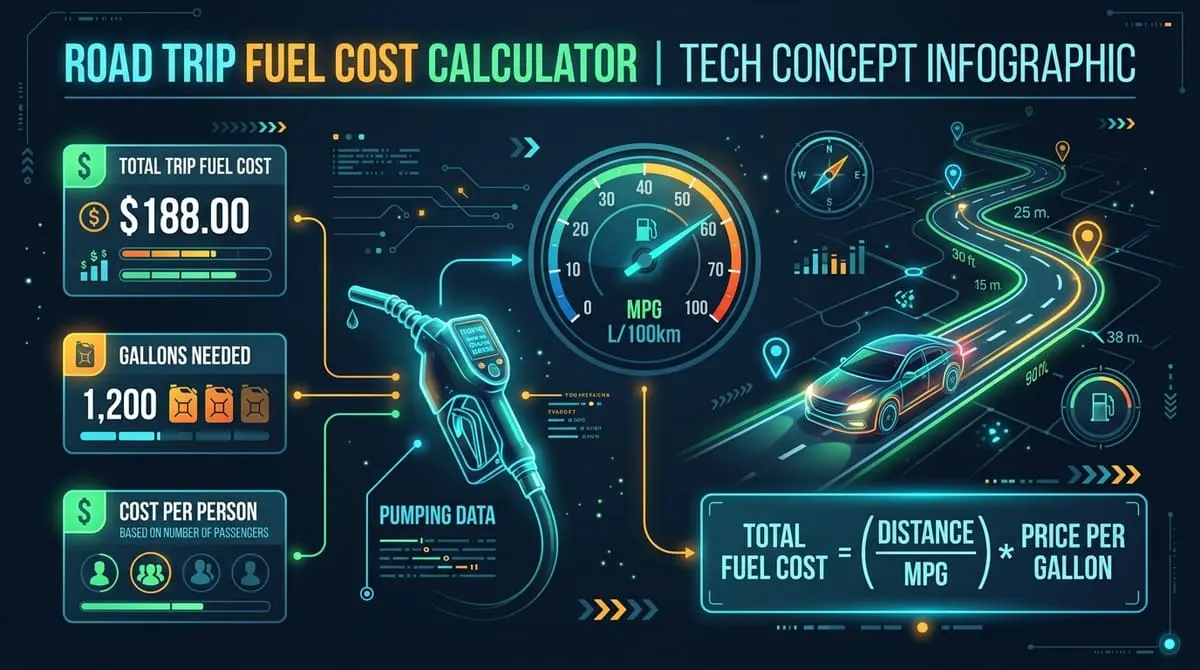
Governing Math Formula: Total Fuel Cost = (Total Trip Distance / Fuel Efficiency) × Fuel Price per Unit.
Target Applications: Provides real-time quantitative solutions in Everyday Tools for students, engineers, researchers, and finance professionals.
Road Trip Fuel Cost Calculator: Comprehensive Travel Budgeting & Fuel Economy Guide
1. Introduction
Few experiences compare to the freedom of the open road: cruising down scenic coastal highways, navigating mountain switchbacks, or embarking on a cross-country road trip with friends and family. However, among all travel logistics—hotel bookings, national park passes, packing lists, and roadside dining—fuel expenditure consistently represents one of the largest and most volatile variable expenses of any road trip.
Gasoline prices fluctuate significantly across state borders, highway toll stations, and remote rural junctions. Furthermore, real-world vehicle fuel efficiency varies dramatically depending on highway cruising speeds, mountain elevation changes, payload weight, roof rack aerodynamic drag, and aggressive acceleration.
graph LR
    DIST["🛣️ Trip Distance (Miles / km)
Single-Way or Round-Trip Route"] --> ENGINE["🧮 Fuel Calculation Engine
Volume = Distance / Fuel Efficiency"]
    MPG["⛽ Fuel Economy (MPG or L/100km)
City, Highway, or Combined Rating"] --> ENGINE
    PRICE["💵 Fuel Price ($/Gal or $/Liter)
Regional Pump Price"] --> ENGINE
    PASS["👥 Passenger Group Size
Even Split Among N Travelers"] --> ENGINE
    ENGINE --> COST["💰 Total Fuel Expenditure ($)"]
    ENGINE --> VOL["🛢️ Total Fuel Volume Needed (Gal/L)"]
    ENGINE --> SPLIT["💳 Per-Person Split ($ / person)"]
    ENGINE --> CPM["📊 Cost Per Driving Mile ($ / mi)"]
Mastering road trip fuel budgeting and fuel economy calculations enables travelers, fleet managers, rideshare drivers, and vacationers to:
- Accurately forecast total gasoline/diesel expenses before turning the ignition key.
- Divide vehicle operating and fueling costs fairly among travel companions down to the penny.
- Compare the true financial cost of driving vs. flying vs. train travel for family holidays.
- Identify actionable driving habits that enhance vehicle fuel economy by .
- Calculate the economic break-even point of taking alternate scenic routes vs. direct interstate highways.
2. Definitions & Mathematical Formulations
2.1 The Simple Definition
- Trip Distance: The total road mileage traveled from origin to destination (multiplied by 2 for round trips).
- Miles Per Gallon (MPG): The distance in miles your vehicle travels per single gallon of gasoline or diesel consumed.
- Fuel Price: The retail monetary price charged per gallon or liter at service stations.
- Fuel Cost per Passenger: The equal financial share each person contributes toward the group fuel fund.
2.2 Formal Mathematical Formulations
1. Total Fuel Volume Required ()
The total liquid fuel consumed during the journey is the total route distance () divided by the vehicle's effective fuel economy rating ():
Where:
- For a Round Trip: .
- For a One-Way Trip: .
2. Total Fuel Cost ()
The total monetary expenditure on gasoline or diesel is the fuel volume multiplied by the average pump price per gallon ():
3. Per-Passenger Cost Allocation ()
When sharing the road trip expenses among vehicle occupants:
4. Cost Per Mile ()
The direct fuel operating cost per single mile traveled:
flowchart TD
    START["Plan Road Trip Route"] --> DIST_IN["Determine Distance & Select Trip Type (One-Way or Round Trip)"]
    DIST_IN --> FUEL_IN["Input Vehicle MPG & Current Gas Station Price ($/Gal)"]
    FUEL_IN --> COMPUTE_VOL["Compute Fuel Volume: Gallons = Distance / MPG"]
    COMPUTE_VOL --> COMPUTE_COST["Compute Total Cost: Cost = Gallons × Price per Gallon"]
    COMPUTE_COST --> PASS_CHECK{"Splitting Cost With Passengers?"}
    PASS_CHECK -->|Yes| DIV_PASS["Per Person Share = Total Cost / Passenger Count"]
    PASS_CHECK -->|No| FINAL_OUT["Display Total Trip Budget & Gallons Required"]
    DIV_PASS --> FINAL_OUT
2.3 Metric System Formulations ()
In Canada, Europe, Australia, and most international territories, vehicle fuel consumption is expressed in Liters per 100 Kilometers () rather than MPG:
Unit Conversion Formulary:
To convert between US MPG and Metric :
3. Historical Timeline of Vehicle Fuel Economy & Gas Prices
timeline
    title Milestones in Automotive Fuel Economy & Road Travel
    1908 : Ford Model T achieves ~13-21 MPG on dirt roads
    1973 : OPEC Oil Embargo triggers global fuel conservation & 55 MPH speed limits
    1975 : US Congress enacts Corporate Average Fuel Economy (CAFE) standards
    1997 : Toyota releases Prius, popularizing hybrid regenerative braking (50+ MPG)
    2010s : Direct injection, turbocharging, and 10-speed transmissions improve ICE efficiency
2020s : Modern EV revolution introduces MPGe (Miles Per Gallon Equivalent)- The Ford Model T (1908): Henry Ford's legendary automobile achieved roughly from its 20-horsepower four-cylinder engine, operating on gasoline or ethanol.
- The 1973 OPEC Oil Shock: A quadrupling of crude oil prices prompted the United States to establish the National Maximum Speed Law () to conserve liquid fuel reserves.
- CAFE Standards (1975): The US enacted Corporate Average Fuel Economy standards, mandating automotive manufacturers to double fleet efficiency from in 1974 to over by 1985.
- Hybrid & Electric Innovation (1997–Present): The introduction of regenerative braking, lightweight aluminum unibody construction, and continuously variable transmissions (CVTs) pushed modern family sedans past .
4. Master Vehicle Fuel Economy Benchmark Matrix
Vehicle class, drivetrain architecture, and engine displacement heavily influence real-world highway fuel economy:
| Vehicle Classification | Example Models | Average Highway MPG | Fuel Needed for 600-Mile Trip | Fuel Cost at $3.50/gal | Cost Per Mile ($/mi) |
|---|---|---|---|---|---|
| Compact / Hybrid Sedan | Toyota Prius, Honda Civic, Hyundai Elantra | $38.18 - $46.67 | $\$0.064\text{ - }\$0.078$ | ||
| Midsize Sedan | Toyota Camry, Honda Accord, Subaru Legacy | $32 - 38\text{ MPG}$ | $15.8\text{ - }18.8\text{ gal}$ | $55.26 - $65.63 | $\$0.092\text{ - }\$0.109$ |
| Compact Crossover / SUV | Toyota RAV4, Honda CR-V, Subaru Forester | $28 - 34\text{ MPG}$ | $17.6\text{ - }21.4\text{ gal}$ | $61.76 - $75.00 | $\$0.103\text{ - }\$0.125$ |
| Midsize 3-Row SUV | Ford Explorer, Honda Pilot, Toyota Highlander | $22 - 27\text{ MPG}$ | $22.2\text{ - }27.3\text{ gal}$ | $77.78 - $95.45 | $\$0.130\text{ - }\$0.159$ |
| Full-Size Truck / Large SUV | Ford F-150, Chevy Tahoe, RAM 1500 | $16 - 21\text{ MPG}$ | $28.6\text{ - }37.5\text{ gal}$ | $100.00 - $131.25 | $\$0.167\text{ - }\$0.219$ |
| Heavy-Duty Truck / RV Camper | Ford F-350 Dually, Class C Motorhome | $8 - 12\text{ MPG}$ | $50.0\text{ - }75.0\text{ gal}$ | $175.00 - $262.50 | $\$0.292\text{ - }\$0.438$ |
5. Step-by-Step Calculation Walkthrough
Let us calculate the full road trip fuel budget for a group of 4 friends driving from Chicago, IL to Nashville, TN and back.
graph TD
    subgraph "Chicago to Nashville Round Trip"
        LEG1["📍 Chicago → Nashville: 470 Miles"]
        LEG2["📍 Nashville → Chicago: 470 Miles"]
        LEG1 --- LEG2
        LEG2 --> TOT_DIST["🛣️ Total Round-Trip Distance: 940 Miles"]
    end
Step 1: Determine Total Distance
- One-Way Distance:
- Trip Type: Round Trip
- Total Driving Distance ():
Step 2: Establish Vehicle Parameters & Gas Prices
- Vehicle: Compact SUV (e.g., Honda CR-V)
- Highway Fuel Economy ():
- Average Gas Station Price (): $\$3.60\text{ per gallon}$
- Travelers ():
Step 3: Compute Fuel Volume Required
Step 4: Calculate Total Fuel Cost
Step 5: Split Cost per Passenger & Calculate Cost per Mile
For less than $30 per person, the entire group completes a 940-mile journey!
6. Major Real-World Factors Affecting Fuel Consumption
graph TD
    AERO["💨 Aerodynamic Drag & Speed
Cruising at 75 MPH vs 60 MPH increases fuel burn by 20%"] --> MPG_DROP["📉 Decreased Fuel Efficiency"]
    WEIGHT["🏋️ Vehicle Payload & Roof Cargo
Every extra 100 lbs reduces economy by 1-2%"] --> MPG_DROP
    PRESSURE["🛞 Low Tire Pressure
Underinflated tires increase rolling resistance"] --> MPG_DROP
    IDLE["⏳ Traffic Idling & AC Usage
Stop-and-go congestion wastes 0.5 gal/hour"] --> MPG_DROP- Highway Cruising Speed & Aerodynamic Drag: Vehicle aerodynamic drag increases with the square of speed (). Driving at consumes roughly than cruising at .
- Cargo Weight & Roof Racks: Adding of luggage reduces fuel economy by roughly 1%. External roof-mounted cargo boxes or bicycle racks create substantial turbulence, reducing highway MPG by up to .
- Tire Inflation Pressure: Driving on tires underinflated by just increases rolling resistance, wasting of your fuel tank.
- Terrain & Elevation Changes: Climbing steep mountain grades demands continuous high-torque engine output, cutting fuel economy in half during ascents.
7. Comparative Travel Analysis: Driving vs. Flying vs. Train
| Mode of Transportation | Out-of-Pocket Cost (Group of 4) | Total Travel Time (940 Miles) | Flexibility & Baggage Freedom | Carbon Footprint |
|---|---|---|---|---|
| Personal Road Trip (Car) | $112.80 (Total Fuel) | $14\text{ hours}$ (Total driving) | Highest (Free luggage, spontaneous stops) | Low per capita ($28\text{ kg CO}_2$/person) |
| Commercial Airline Flights | $1,000 - $1,600 ($250-$400/ticket) | $6\text{ hours}$ (Including TSA & transit) | Lowest (Baggage fees, strict schedules) | High ($180\text{ kg CO}_2$/person) |
| Passenger Rail (Train) | $480 - $800 ($120-$200/ticket) | $16\text{ - }18\text{ hours}$ | Moderate (Generous luggage, fixed stops) | Lowest ($18\text{ kg CO}_2$/person) |
8. Real-World Case Studies in Road Trip Fuel Planning
Case Study 1: The Cross-Country Family Vacation (Route 66)
- Route: Chicago, IL to Los Angeles, CA ( one-way).
- Vehicle: Full-size Minivan ( loaded with 5 passengers and luggage).
- Fuel Price: Average $\$3.85/\text{gallon}$ across Midwest and Southwest corridors.
- Calculation:
- Result: Even on a massive 2,400-mile cross-country drive, total fuel costs remained under $80 per traveler.
Case Study 2: The Roof Box Drag Penalty
- Scenario: Mark drives a Subaru Outback ( baseline) on an ski trip. He attaches a hard-shell rooftop cargo carrier and drives at , causing fuel economy to drop to .
- Comparison:- Baseline at 30 MPG ($3.75/gal): $26.67\text{ gal} \times \$3.75 = \mathbf{\$100.00}$- With Roof Box at 23 MPG ($3.75/gal): $34.78\text{ gal} \times \$3.75 = \mathbf{\$130.43}$
- Takeaway: The increased aerodynamic drag added $30.43 ($30\% increase) in direct fuel expenses for the trip.
9. Top Expert Tips to Maximize Road Trip Fuel Economy
graph LR
    TIPS["💡 Fuel Saving Strategies"] --> T1["⚡ Maintain 60-65 MPH
Use cruise control on flat interstate highways"]
    TIPS --> T2["🛞 Calibrate Cold Tire PSI
Inflate to door-jamb spec for minimum rolling resistance"]
    TIPS --> T3["📱 Use Gas Price Mapping Apps
Find stations 2-3 miles off turnpikes for $0.40/gal savings"]
    TIPS --> T4["📦 Pack Inside Vehicle
Avoid roof-mounted carriers whenever possible"]- Leverage Highway Cruise Control: Maintaining steady throttle input on flat terrain eliminates micro-accelerations that waste fuel.
- Avoid Highway Oasis Gas Traps: Service stations situated directly on interstate tollways often charge $\$0.30\text{ to }\$0.60\text{ more per gallon}$ than stations located just 1 mile off the highway in nearby towns.
- Keep Windows Closed at Highway Speeds: At speeds above $50\text{ MPH}$, open windows create more aerodynamic drag than running the vehicle's air conditioner on low.
- Remove Unnecessary Trunk Cargo: Remove heavy tools, sports gear, and clutter before departure to minimize unnecessary mass.
10. Frequently Asked Questions (FAQ)
How do I calculate fuel cost for a road trip?
Divide your total trip distance (miles) by your vehicle's fuel economy (MPG) to determine total gallons needed, then multiply by the average price per gallon.
Is it cheaper to drive or fly for a road trip?
For solo travelers on trips exceeding 500 miles, flying is often comparable in price once meal and lodging stops are factored in. However, for groups of 2 to 5 people, driving is almost always significantly cheaper because vehicle fuel cost is split among all passengers.
How much does driving speed affect gas mileage?
Fuel efficiency typically peaks between . The EPA estimates that every you drive over is equivalent to paying an extra $0.25 to $0.35 per gallon for gas.
Should I use premium fuel for a road trip if my car takes regular?
No. Unless your vehicle owner's manual explicitly mandates premium fuel () for high-compression or turbocharged engines, filling with premium will not increase fuel economy or power.
How do gas price tracking apps help on road trips?
Apps like GasBuddy, Waze, and Google Maps display real-time fuel prices along your GPS route, enabling you to schedule fill-ups in lower-tax counties and save $\$10\text{–}\$25$ per tank.
What is the difference between city and highway MPG?
City driving involves constant braking, idling at traffic lights, and accelerating from stops, which consumes significantly more energy. Highway driving allows the engine to operate in higher overdrive gears at lower RPMs, resulting in .
How do electric vehicles (EVs) compare in road trip cost?
Electric vehicles achieve the equivalent of . Charging at DC Fast Chargers (e.g., Tesla Superchargers or Electrify America) typically costs $\$0.30\text{ to }\$0.45\text{ per kWh}$, making an EV road trip roughly $30\%\text{ to }50\%\text{ cheaper}$ than an equivalent gasoline vehicle.
How do I calculate fuel cost in metric units (liters & kilometers)?
Multiply your total distance in kilometers by your fuel consumption rate in , divide by 100 to get total liters, and multiply by the price per liter.
Does running the air conditioning waste gas on the highway?
At highway speeds (), running modern AC is more efficient than driving with windows down, because open windows create massive aerodynamic drag.
How do I budget for unexpected fuel expenses on a long road trip?
Always add a to your estimated fuel budget to account for local detour sightseeing, heavy traffic idling, and mountain driving.
11. Summary Checklist
- ✔ Calculate Total Distance: Account for both outbound and return mileage.
- ✔ Verify Vehicle MPG: Check your vehicle's realistic highway fuel economy rating.
- ✔ Check Regional Gas Prices: Identify average pump prices along your state route.
- ✔ Include Passenger Splits: Divide total expenses by the number of travelers.
- ✔ Optimize Driving Habits: Inflate tires, minimize roof cargo, and maintain moderate highway speeds.
Additional Technical Guidelines & Measurement Standards
When conducting calculations for Road Trip Fuel Cost Calculator, maintaining quantitative precision and verifying input parameter boundaries is essential for reliable scenario evaluation. Always verify that raw numerical inputs are measured using standardized instrumentation, and double-check unit conversions prior to applying outputs in commercial, industrial, or academic projects.
For quantitative unit conversions and scientific calculations, always maintain at least four decimal places of precision during intermediate arithmetic stages before rounding final results. When preparing technical reports, laboratory documentation, or financial forecasts, cross-verify all output variables against established international measurement standards (such as SI, NIST, and ISO metric benchmarks) to guarantee consistent analytical rigor across all computational workflows.
MathsLover.com delivers this interactive solver 100% free of charge to foster global mathematical literacy, educational accessibility, and data-driven problem solving across scientific, technical, and academic communities worldwide.