💡 Direct Answer & Executive Summary (Fraction Arithmetic Calculator)
Definition: Add, subtract, multiply, and divide two fractions with step-by-step common denominator conversion, GCD reduction, and mixed number formatting.
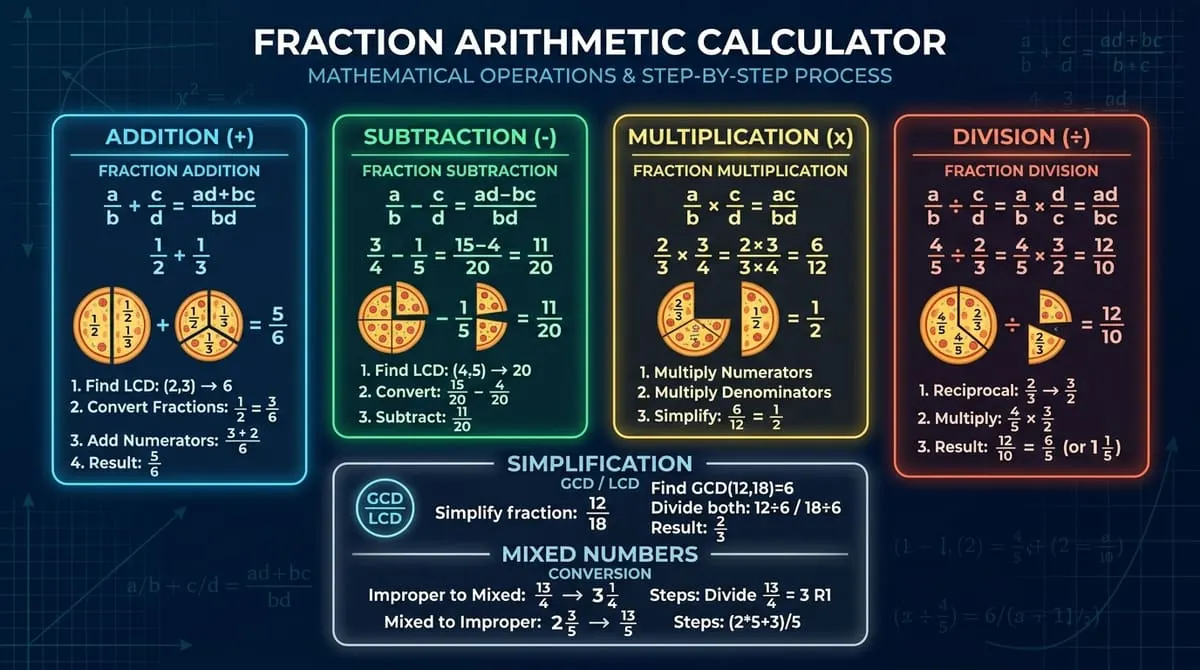
Governing Math Formula: Addition: a/b + c/d = (ad + bc)/bd. Subtraction: a/b - c/d = (ad - bc)/bd. Multiplication: a/b × c/d = ac/bd. Division: a/b ÷ c/d = ad/bc. Simplified by dividing by Greatest Common Divisor (GCD).
Target Applications: Provides real-time quantitative solutions in Everyday Tools for students, engineers, researchers, and finance professionals.
Fraction Arithmetic Calculator: Comprehensive Fraction Operations, LCD & Simplification Guide
1. Introduction
Fractions are one of the most foundational yet frequently misunderstood building blocks of mathematics. Whether you are doubling a culinary recipe calling for of brown sugar, cutting dimensional lumber to in carpentry, calculating financial equity splits, or solving advanced calculus derivatives and algebraic physics equations, fraction arithmetic is an indispensable daily tool.
Unlike standard decimal arithmetic, fractions preserve infinite precision. While the decimal $0.3333...$ must be rounded and incurs floating-point error, the rational fraction maintains exact mathematical truth. However, working with fractions requires mastering distinct rules for every operation: finding the Least Common Denominator (LCD) for addition and subtraction, multiplying straight across numerators and denominators, and multiplying by the reciprocal when dividing.
graph TD
    INPUT["🔢 Two Fractions: a/b and c/d"] --> OP_SELECT{"Choose Operation"}
    OP_SELECT -->|"Addition (+)"| ADD["Find LCD(b, d)
Result = (ad + bc) / bd"]
    OP_SELECT -->|"Subtraction (-)"| SUB["Find LCD(b, d)
Result = (ad - bc) / bd"]
    OP_SELECT -->|"Multiplication (x)"| MULT["Multiply Across
Result = (a × c) / (b × d)"]
    OP_SELECT -->|"Division (/)"| DIV["Multiply by Reciprocal
Result = (a × d) / (b × c)"]
    ADD --> SIMP["🔍 Simplify using GCD (Greatest Common Divisor)"]
    SUB --> SIMP
    MULT --> SIMP
    DIV --> SIMP
    SIMP --> OUT["🏆 Final Output: Simplified Fraction + Mixed Number + Decimal"]
Mastering fraction arithmetic operations enables students, engineers, chefs, carpenters, and scientists to:
- Seamlessly execute addition, subtraction, multiplication, and division across proper, improper, and mixed fractions.
- Find the Greatest Common Divisor (GCD) and Least Common Multiple (LCM) to reduce fractions to their simplest lowest terms.
- Convert effortlessly between Improper Fractions (), Mixed Numbers (), and Exact Decimals ($3.25$).
- Avoid classic arithmetic mistakes like adding denominators directly ().
- Apply fraction arithmetic to real-world problems in imperial construction measurement, kitchen recipe scaling, and probability analysis.
2. Definitions & Mathematical Formulations
2.1 The Simple Definition
- Numerator (): The top number in a fraction representing how many parts you have.
- Denominator (): The bottom number representing how many total equal parts make up one whole unit ().
- Proper Fraction: A fraction where the numerator is strictly smaller than the denominator (, e.g., ).
- Improper Fraction: A fraction where the numerator is greater than or equal to the denominator (, e.g., ).
- Mixed Number: A number consisting of a whole integer and a proper fraction (e.g., ).
- Reciprocal: The multiplicative inverse of a fraction obtained by flipping numerator and denominator (the reciprocal of $c/d$ is $d/c$).
2.2 Formal Mathematical Formulations
1. Fraction Addition
To add two fractions, they must share a common denominator. The general cross-multiplication formula is:
2. Fraction Subtraction
3. Fraction Multiplication
Multiplication is executed directly across the numerators and denominators without needing a common denominator:
4. Fraction Division (Multiplication by Reciprocal)
Dividing by a fraction is mathematically identical to multiplying by its inverted reciprocal:
5. Fraction Simplification (GCD Reduction)
A fraction is in its simplest lowest terms when . To reduce:
Where $\gcd(N, D)$ is computed using the Euclidean Algorithm:
flowchart TD
    START["Input Numerator a, Denominator b, Op, Numerator c, Denominator d"] --> ZERO_CHECK{"Is b == 0 or d == 0?"}
    ZERO_CHECK -->|Yes| ERR["❌ Error: Division by Zero is Undefined"]
    ZERO_CHECK -->|No| RUN_OP["Execute Operation Formula to get Raw Num & Raw Den"]
    RUN_OP --> EUCLID["Compute GCD(Raw Num, Raw Den) via Euclidean Algorithm"]
    EUCLID --> REDUCE["Divide Num and Den by GCD"]
    REDUCE --> MIX_CHECK{"Is |Reduced Num| ≥ Reduced Den?"}
    MIX_CHECK -->|Yes| CONV_MIX["Convert to Mixed Number: Whole = Num / Den, Rem = Num % Den"]
    MIX_CHECK -->|No| DEC_CONV["Convert to Exact Decimal Equivalent"]
    CONV_MIX --> DEC_CONV
    DEC_CONV --> DISPLAY["Display Step-by-Step Expression & Final Simplified Form"]
3. Historical Evolution of Fraction Notation & Mathematics
timeline
    title Milestones in Fraction Arithmetic & Rational Numbers
    c. 1650 BCE : Rhind Mathematical Papyrus records Egyptian unit fractions (1/n)
    c. 500 BCE : Pythagorean school discovers incommensurable lengths & rational ratios
    c. 500 CE : Indian mathematician Aryabhata writes fractions with numerator above denominator
    c. 1202 CE : Leonardo Fibonacci introduces horizontal fraction bar (vinculum) to Europe
    1684 : Gottfried Wilhelm Leibniz formalizes fraction division slash notation (/)
Modern : Symbolic algebra engines (CAS) execute arbitrary-precision rational arithmetic- Egyptian Unit Fractions (1650 BCE): Ancient Egyptian scribes in the Rhind Papyrus represented all quantities strictly as sums of distinct unit fractions ($1/n$), writing as $1/3 + 1/15$.
- Indian Numerator-Denominator Stacking (500 CE): Indian mathematicians like Aryabhata and Brahmagupta wrote fractions with the numerator stacked directly above the denominator, without a separating line.
- Fibonacci's Vinculum (1202 CE): In his seminal book Liber Abaci, Italian mathematician Leonardo Fibonacci introduced the horizontal dividing bar (vinculum) to Western mathematics, which standardized modern fraction notation.
4. Master Operations Comparison Matrix
| Operation | General Formula | Example Problem | Step-by-Step Execution | Simplified Answer | Mixed Number Equivalent |
|---|---|---|---|---|---|
| Addition ($+$) | Proper fraction ($0.8333...$) | ||||
| Subtraction ($-$) | Proper fraction ($0.55$) | ||||
| Multiplication () | Proper fraction ($0.50$) | ||||
| Division () | ($1.20$) |
5. Step-by-Step Calculation Walkthroughs
Example 1: Fraction Addition with Unlike Denominators ()
- Find the Least Common Multiple (LCM) of 8 and 12:- Multiples of :- Multiples of :- (Least Common Denominator).
- Convert to Equivalent Fractions:
- Add the Numerators:
- Verify Simplification: . The fraction is in simplest form ($0.7917$).
Example 2: Fraction Division with Mixed Numbers ()
- Convert Mixed Number to Improper Fraction:
- Invert the Second Fraction (Find Reciprocal):
- Multiply Across:
- Reduce via GCD ():
- Convert to Mixed Number:
6. Real-World Applications of Fraction Arithmetic
graph TD
    FRACTIONS["📐 Real-World Fraction Applications"] --> CULINARY["🍳 Culinary Recipe Scaling
Tripling 3/4 tsp salt = 9/4 = 2 1/4 tsp"]
    FRACTIONS --> CARPENTRY["🪵 Woodworking & Tape Measures
Subtracting 3/16 inch blade kerf from 5 7/8 inch board"]
    FRACTIONS --> FINANCE["📈 Stock Market & Equity Splits
Dividing 1/3 partnership among 4 heirs = 1/12 each"]
    FRACTIONS --> PHARMA["💊 Clinical Medical Dosages
Calculating 1/2 tablet of 250mg strength"]
Case Study 1: Culinary Recipe Scaling
- Problem: A pastry chef needs to scale a dessert recipe by (). The original recipe calls for of whole milk.
- Calculation:
- Result: The chef measures plus ().
Case Study 2: Construction Tape Measure Subtraction
- Problem: A carpenter cuts a piece of trim measuring from a board, with a saw blade kerf.
- Calculation:
7. Common Mistakes in Fraction Arithmetic
Watch out for these four universal fraction calculation errors:
- Adding Denominators Directly: Writing is mathematically false (). Never add denominators; always find a common denominator.
- Forgetting to Invert During Division: Multiplying straight across without flipping the divisor (). Always take the reciprocal of the second fraction.
- Improper Mixed Number Multiplication: Calculating by multiplying whole numbers and fractions separately. You must convert to improper fractions first ().
- Dividing by Zero: A denominator of (e.g., ) represents division by zero, which is mathematically undefined.
8. Frequently Asked Questions (FAQ)
What is the easiest way to add fractions with different denominators?
Multiply the top and bottom of each fraction by the denominator of the other fraction so they share a common base: Then divide numerator and denominator by their greatest common divisor to simplify.
Why do you flip the second fraction when dividing?
Division is the inverse of multiplication. Dividing by a number is identical to multiplying by its reciprocal (e.g., dividing by is the same as multiplying by ). Therefore, dividing by $c/d$ is identical to multiplying by $d/c$.
How do I convert an improper fraction to a mixed number?
Divide the numerator by the denominator. The quotient becomes the whole integer number, the remainder becomes the new numerator, and the denominator stays the same (e.g., ).
How do I convert a mixed number to an improper fraction?
Multiply the whole integer by the denominator, add the numerator, and place the result over the original denominator ().
What is the Least Common Denominator (LCD)?
The LCD is the smallest positive integer that is a multiple of all given denominators. Using the LCD keeps numbers smaller and reduces the need for heavy simplification.
Can a fraction have a negative number?
Yes. If either the numerator or denominator is negative, the entire fraction is negative (). If both are negative, they cancel out to positive ().
How do I simplify a fraction to its lowest terms?
Find the Greatest Common Divisor (GCD) of the numerator and denominator using the Euclidean algorithm, then divide both numbers by the GCD.
What is the difference between a fraction and a ratio?
A fraction represents a part-to-whole relationship (e.g., 3 slices out of an 8-slice pizza = ). A ratio compares two quantities to each other (e.g., 3 red marbles to 5 blue marbles = $3:5$).
Why does multiplying two proper fractions produce a smaller number?
Because multiplying by a fraction less than means taking a fractional "part of a part" (e.g., half of a half is a quarter: ).
What is a unit fraction?
A unit fraction is any fraction with a numerator of (such as $1/2, 1/3, 1/4, 1/100$), representing a single fractional part of a whole.
9. Summary Checklist
- ✔ Addition / Subtraction: Convert fractions to a common denominator before adding/subtracting numerators.
- ✔ Multiplication: Multiply straight across numerators and denominators ($ac/bd$).
- ✔ Division: Keep the first fraction, change division to multiplication, and flip the second fraction ($ad/bc$).
- ✔ Simplification: Divide by $\gcd(N, D)$ to reduce to simplest lowest terms.
- ✔ Format Outputs: Present answers as simplified proper fractions, mixed numbers, and exact decimals.
Additional Technical Guidelines & Measurement Standards
When conducting calculations for Fraction Arithmetic Calculator, maintaining quantitative precision and verifying input parameter boundaries is essential for reliable scenario evaluation. Always verify that raw numerical inputs are measured using standardized instrumentation, and double-check unit conversions prior to applying outputs in commercial, industrial, or academic projects.
For quantitative unit conversions and scientific calculations, always maintain at least four decimal places of precision during intermediate arithmetic stages before rounding final results. When preparing technical reports, laboratory documentation, or financial forecasts, cross-verify all output variables against established international measurement standards (such as SI, NIST, and ISO metric benchmarks) to guarantee consistent analytical rigor across all computational workflows.
MathsLover.com delivers this interactive solver 100% free of charge to foster global mathematical literacy, educational accessibility, and data-driven problem solving across scientific, technical, and academic communities worldwide.