💡 Direct Answer & Executive Summary (Single-Use Plastic Bottle Savings Calculator)
Definition: Environmental footprint computation: Single-Use Plastic Bottle Savings Calculator.
Governing Math Formula: N_bottles = (Liters_daily × 365.25) / 0.5; Plastic_lbs = N_bottles × 0.0218; Savings = (N_bottles × $1.50) - Filter_Cost
Target Applications: Provides real-time quantitative solutions in Ecology for students, engineers, researchers, and finance professionals.
Single-Use Plastic Bottle Savings Calculator: The Environmental & Financial Impact of Reusable Water Systems
1. Introduction
Globally, over 1 million single-use plastic water bottles are purchased every single minute. Made primarily from Polyethylene Terephthalate (PET), these disposable containers require heavy petroleum refining, high transport energy, and hundreds of millions of gallons of water during manufacturing. Tragically, over 80% of single-use bottles end up in landfills or pollute marine ecosystems, taking over 450 years to decompose into hazardous microplastics.
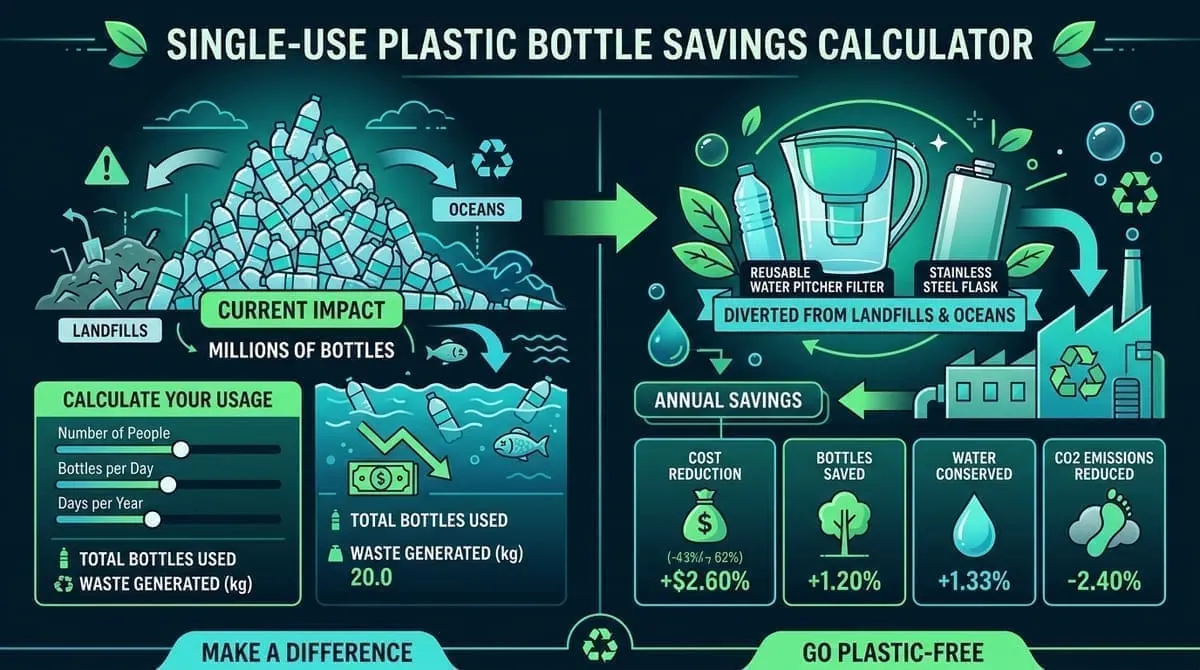
The Single-Use Plastic Bottle Savings Calculator measures the positive ecological and financial impact of switching from disposable bottled water to reusable bottles or tap pitcher filtration systems.
graph TD
    A[Daily Filtered Tap Water Usage] --> B[Single-Use Plastic Bottles Diverted]
    B --> C[Plastic Solid Waste Reduction kg/lbs]
    B --> D[Oil & Petroleum Fuel Conserved]
    B --> E[CO2 Emissions Avoided]
    B --> F[Direct Financial Cash Savings $]
2. Core Definitions & Analogy
Simple Definition
A Single-Use Plastic Bottle Savings Calculator computes how many plastic water bottles, pounds of trash, and dollars you save by using a reusable bottle or filter pitcher instead of buying bottled water.
Technical Definition
Technically, annual plastic waste reduction (, in kg) and avoided carbon emissions (, in kg ) are modeled as functions of daily fluid replacement volume (, L/day), baseline bottle unit size (, default 0.5 L), PET mass per bottle (), and lifecycle embodied energy factors ().
3. History & Milestones
timeline
    title History of Bottled Water & Environmental Policy
    1973 : Nathaniel Wyeth patents PET plastic bottles for carbonated beverages.
    1990s : Commercial bottled water consumption explodes globally.
    2010 : Concord, Massachusetts becomes first US town to ban single-use plastic water bottles.
    2026 : Global plastic treaties enforce recycled Content mandates and single-use bans.
4. Core Concepts & Environmental Benchmarks
| Metric / Parameter | Value per 500 mL PET Bottle | Impact per 1,000 Bottles Diverted |
|---|---|---|
| PET Plastic Mass | () solid plastic waste diverted | |
| Petroleum Oil Equivalent | () crude oil | () crude oil saved |
| Embodied Water Overhead | virtual water | freshwater conserved |
| Carbon Footprint | () greenhouse gas saved | |
| Average Retail Cost | $\$1.50\text{ per bottle}$ | $\$1,500\text{ retail cash saved}$ |
5. The Mathematical Model & Formulas
The total annual single-use bottles saved () is:
Where:
- = Daily drinking water consumption ()
- = Equivalent single-use bottle capacity ()
The annual plastic trash weight diverted (, in lbs) is:
The net financial cash savings (, in USD) is:
Where is retail cost per bottle ($1.50) and $C_{\text{filter}}$ is annual filter replacement cost ($\approx \$40/year$).
6. Step-by-Step Computational Procedure
Consider a person drinking 4 Liters of filtered water daily (equivalent to 8 single-use 500mL bottles per day):
- Calculate Annual Bottles Saved: .
- Calculate Plastic Mass Diverted: () of plastic landfill waste.
- Calculate Crude Oil Conserved: () of oil.
- Calculate Financial Cash Savings: $(2,922 \times \$1.50) - \$40 = \$4,383 - \$40 = \$4,343\text{ net savings/year}$.
7. Visual Explanations & Parameter Comparison Matrix
| Daily Usage (L/day) | Annual Bottles Saved | Plastic Waste Diverted (lbs) | Oil Saved (gallons) | Net Annual Cash Savings ($) |
|---|---|---|---|---|
| 2 L / day (4 bottles) | 1,461 bottles | 31.9 lbs | 24.1 gal | $2,151.50 / year |
| 4 L / day (8 bottles) | 2,922 bottles | 63.8 lbs | 48.2 gal | $4,343.00 / year |
| 8 L / day (Family 16 btl) | 5,844 bottles | 127.6 lbs | 96.5 gal | $8,726.00 / year |
9. Real-World Applications & Case Studies
- University Campus Green Initiatives: Installing hydration refill stations to eliminate campus plastic waste.
- Corporate Sustainability: Gifting employees stainless steel bottles to eliminate bottled water in offices.
- Case Study: A high school with 1,200 students installed 8 water bottle refill stations. In one academic year, students diverted 185,000 plastic bottles, saving parents $277,500 and diverting 4,000 lbs of plastic trash.
10. Advantages & Limitations
Advantages
- Massive direct financial savings (bottled water costs up to 1,000x more than tap water).
- Prevents microplastics leaching from warm plastic bottles into drinking water.
Limitations
- Requires washing reusable bottles and changing pitcher filters every 2-3 months.
11. Common Pitfalls
Pitfall 1: Assuming Bottled Water is Purer than Tap Water
Over 45% of commercial bottled water is simply municipal tap water filled into plastic bottles and marked up by .
12. Frequently Asked Questions (FAQ)
Q: How much money do I save by stopping bottled water purchases?
A: Switching to filtered tap water saves the average person $1,500 to $2,500 per year.
Q: How many plastic bottles are used worldwide each year?
A: Over 500 billion single-use plastic bottles are sold annually.
Q: How long does a plastic water bottle take to decompose?
A: Approximately 450 to 1,000 years in a landfill.
Q: What is microplastic pollution?
A: As plastic bottles breakdown under sunlight, they fragment into microscopic plastic particles that enter soil, water, and human bloodstream.
Q: How much oil is required to make plastic water bottles?
A: Manufacturing single-use bottles consumes over 17 million barrels of oil per year in the US alone.
Q: How often should filter pitcher cartridges be replaced?
A: Standard pitcher filters (like Brita or Pur) should be replaced every 40 gallons ( months).
Q: Are stainless steel or glass reusable bottles better?
A: Both stainless steel (18/8 grade) and glass are infinitely reusable, BPA-free, and do not leach microplastics.
Q: Does recycling solve the plastic bottle problem?
A: No. Less than 10% of all plastic ever produced has been recycled; reduction at the source is essential.
Q: Is tap water safe to drink in North America?
A: Yes, municipal tap water is strictly regulated under the Safe Drinking Water Act with frequent quality testing.
Q: How much embodied water is spent making 1 bottle of water?
A: Producing a 0.5L plastic bottle requires up to 3 Liters of water in processing overhead.
Q: Can I calculate office corporate bottle savings?
A: Yes! Multiply daily headcount by 2 bottles to calculate corporate ESG savings.
Q: Is this tool free to use?
A: Yes, 100% free and client-side private.
13. Expert Tips & Summary
- Tip: Keep an insulated stainless steel water bottle filled in your bag or car so you never need to purchase single-use plastic on the go.
Additional Technical Guidelines & Measurement Standards
When conducting calculations for Single-Use Plastic Bottle Savings Calculator, maintaining quantitative precision and verifying input parameter boundaries is essential for reliable scenario evaluation. Always verify that raw numerical inputs are measured using standardized instrumentation, and double-check unit conversions prior to applying outputs in commercial, industrial, or academic projects.
For quantitative unit conversions and scientific calculations, always maintain at least four decimal places of precision during intermediate arithmetic stages before rounding final results. When preparing technical reports, laboratory documentation, or financial forecasts, cross-verify all output variables against established international measurement standards (such as SI, NIST, and ISO metric benchmarks) to guarantee consistent analytical rigor across all computational workflows.
MathsLover.com delivers this interactive solver 100% free of charge to foster global mathematical literacy, educational accessibility, and data-driven problem solving across scientific, technical, and academic communities worldwide.