💡 Direct Answer & Executive Summary (Paper Saving Tree Conservation Solver)
Definition: Environmental footprint computation: Paper Saving Tree Conservation Solver.
Governing Math Formula: Annual_Sheets = Sheets_weekly × Headcount × 52.14; Trees_saved = Annual_Sheets / 8333
Target Applications: Provides real-time quantitative solutions in Ecology for students, engineers, researchers, and finance professionals.
Paper Saving Tree Conservation Solver: Calculating Forest Conservation & Resource Offsets
1. Introduction
Despite the rise of digital computers, smartphones, and cloud storage, global paper consumption remains staggering at over 400 million metric tons per year. The pulp and paper industry is the 3rd largest industrial consumer of energy and a major driver of timber harvesting, industrial water use, and greenhouse gas emissions.
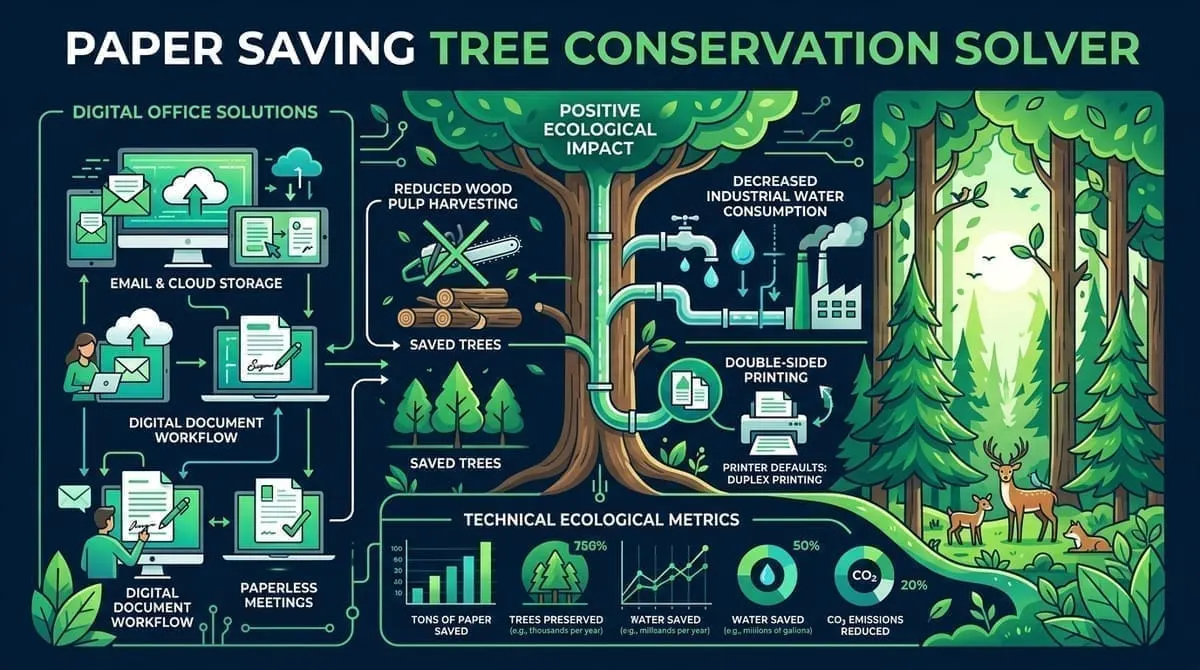
The Paper Saving Tree Conservation Solver evaluates the direct forest conservation impact of reducing office and personal paper printing, converting sheet reduction metrics into equivalent standing trees preserved, gallons of industrial water saved, kWh of energy conserved, and avoided CO2 emissions.
graph TD
    A[Paper Reduction & Duplex Printing] --> B[Avoided Wood Pulp Harvesting]
    B --> C[Standing Timber Trees Preserved]
    B --> D[Industrial Process Water Saved]
    B --> E[Paper Mill Electricity Conserved]
    B --> F[Avoided Landfill Methane Emissions]
2. Core Definitions & Analogy
Simple Definition
This calculator measures how many full-grown trees you save by printing less paper, adopting double-sided printing, or going paperless in your home or office.
Technical Definition
Technically, 1 metric ton of standard un-recycled copy paper ( bond / , equivalent to approximately $200,000$ sheets of Letter size paper) requires approximately 16 to 24 mature trees (mix of softwoods and hardwoods). Therefore, standard industry life-cycle models establish that 8,333 sheets of standard office paper equal 1 full-grown tree ( tall, trunk diameter).
3. History & Milestones
timeline
    title History of Paper Manufacturing & Digital Conservation
    105 CE : Cai Lun invents paper from plant fibers in China.
    1844 : Friedrich Gottlob Keller invents wood pulping process.
    1975 : BusinessWeek famous article predicts "The Paperless Office".
    2020s : Digital PDF signatures and cloud workflows make true paperless offices achievable.
4. Core Environmental Conversion Factors
| Resource / Impact Category | Per 100 Reams (50,000 Sheets) | Per 1 Tree Equivalent (8,333 Sheets) |
|---|---|---|
| Standing Trees Saved | 6.0 Trees | 1.0 Tree |
| Industrial Water Saved | 3,500 Gallons | 583 Gallons |
| Electricity Conserved | 1,375 kWh | 229 kWh |
| Landfill Solid Waste Avoided | 250 lbs | 41.6 lbs |
| Greenhouse Gas Avoided () | 560 lbs | 93.3 lbs |
5. The Mathematical Model & Formulas
The annual sheets saved () for an office of people printing sheets weekly is:
The annual trees preserved () is:
The associated industrial water conservation (, in gallons) is:
6. Step-by-Step Computational Procedure
Consider an office of 25 employees, where each employee reduces weekly printing from 100 sheets down to 20 sheets through duplex printing and PDF workflows ():
- Calculate Weekly Office Sheet Reduction: .
- Calculate Annual Sheet Reduction: .
- Compute Trees Saved: .
- Compute Water Saved: .
- Compute Electricity Conserved: .
7. Visual Explanations & Parameter Comparison Matrix
| Head Count | Sheets Saved / Person / Wk | Total Annual Sheets Saved | Trees Saved / Year | Industrial Water Saved |
|---|---|---|---|---|
| 1 Person (Home) | 50 sheets/wk | 2,607 sheets | 0.31 Trees | 182 Gallons |
| 10 Employees | 50 sheets/wk | 26,070 sheets | 3.13 Trees | 1,825 Gallons |
| 50 Employees | 80 sheets/wk | 208,560 sheets | 25.03 Trees | 14,595 Gallons |
9. Real-World Applications & Case Studies
- Digital PDF Workflows & e-Signatures: Replacing physical signing with DocuSign or Adobe Sign.
- Default Duplex Printing Policies: Setting corporate printers to automatically print double-sided.
- Case Study: A mid-sized accounting firm with 100 staff switched printer defaults to double-sided and implemented digital invoicing. In one year, they reduced paper consumption by 400,000 sheets, preserving 48 mature trees and saving $4,800 in paper purchases.
10. Advantages & Limitations
Advantages
- Direct cost savings on reams of paper, printer toner cartridges, and printer maintenance.
- Reduces clutter and speeds up document searchability via digital cloud archives.
Limitations
- Recycled paper requires less wood pulp, but still consumes industrial energy and water during repulping.
11. Common Pitfalls
Pitfall 1: Assuming Paper Recycling Eliminates Impact
While recycling is vital, manufacturing recycled paper still uses significant water and energy. Reducing paper use at the source is always far superior.
12. Frequently Asked Questions (FAQ)
Q: How many sheets of paper come from one tree?
A: Standard industry life-cycle models estimate that 1 mature tree yields approximately 8,333 sheets of copy paper.
Q: Does double-sided (duplex) printing cut paper use in half?
A: Yes! Defaulting to duplex printing instantly reduces office paper volume by up to 50%.
Q: How much water is required to make 1 sheet of paper?
A: Producing a single sheet of paper requires roughly 3 to 10 ounces of water.
Q: How much energy does paper making consume?
A: The paper industry is the 3rd largest industrial consumer of energy globally.
Q: Does paper in landfills produce methane gas?
A: Yes! Paper decomposing anaerobically in landfills releases methane (), a potent greenhouse gas 28x more powerful than .
Q: What is the benefit of 100% Post-Consumer Recycled (PCR) paper?
A: 100% PCR paper uses zero virgin tree timber, saves 55% water, and uses 33% less energy.
Q: Is digital cloud storage better for the environment than paper?
A: Yes, in over 90% of office document use-cases, cloud storage carbon emissions are a fraction of physical paper pulping and shipping.
Q: How many reams of paper are in 1 tree?
A: One mature tree produces approximately 16.6 reams of paper (500 sheets per ream).
Q: How can an office measure paper reduction?
A: Track monthly ream purchases or monitor network print server software counters.
Q: Does saving paper save office money?
A: Yes! Beyond paper costs ($\approx \$8-\$12/\text{ream}$), saving paper cuts toner expenses by up to $70\%$.
Q: Can schools use this calculator for environmental projects?
A: Absolutely! It is an excellent educational tool for eco-club audits.
Q: Is this tool free?
A: Yes, 100% free and client-side private.
13. Expert Tips & Summary
- Tip: Set your organization's printer server default to duplex (double-sided) and black-and-white.
Additional Technical Guidelines & Measurement Standards
When conducting calculations for Paper Saving Tree Conservation Solver, maintaining quantitative precision and verifying input parameter boundaries is essential for reliable scenario evaluation. Always verify that raw numerical inputs are measured using standardized instrumentation, and double-check unit conversions prior to applying outputs in commercial, industrial, or academic projects.
For quantitative unit conversions and scientific calculations, always maintain at least four decimal places of precision during intermediate arithmetic stages before rounding final results. When preparing technical reports, laboratory documentation, or financial forecasts, cross-verify all output variables against established international measurement standards (such as SI, NIST, and ISO metric benchmarks) to guarantee consistent analytical rigor across all computational workflows.
MathsLover.com delivers this interactive solver 100% free of charge to foster global mathematical literacy, educational accessibility, and data-driven problem solving across scientific, technical, and academic communities worldwide.